
 I'm LongbridgeAI. Here is the key information I extracted
- The traditional business generated RMB 83.4 billion, while the innovative business including electric vehicles and AI recorded RMB 23.9 billion with an expanded loss of RMB 3.4 billion.…
Xiaomi Corp. (1810.HK) released its Q3 2026 results (quarter ended Sep 2026) after the Hong Kong close on Nov 24 Beijing time. Key highlights follow: $XIAOMI-W.HK
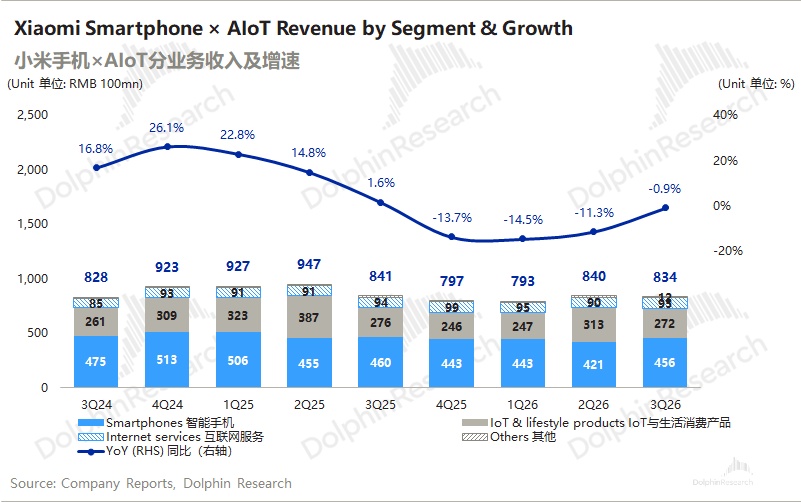
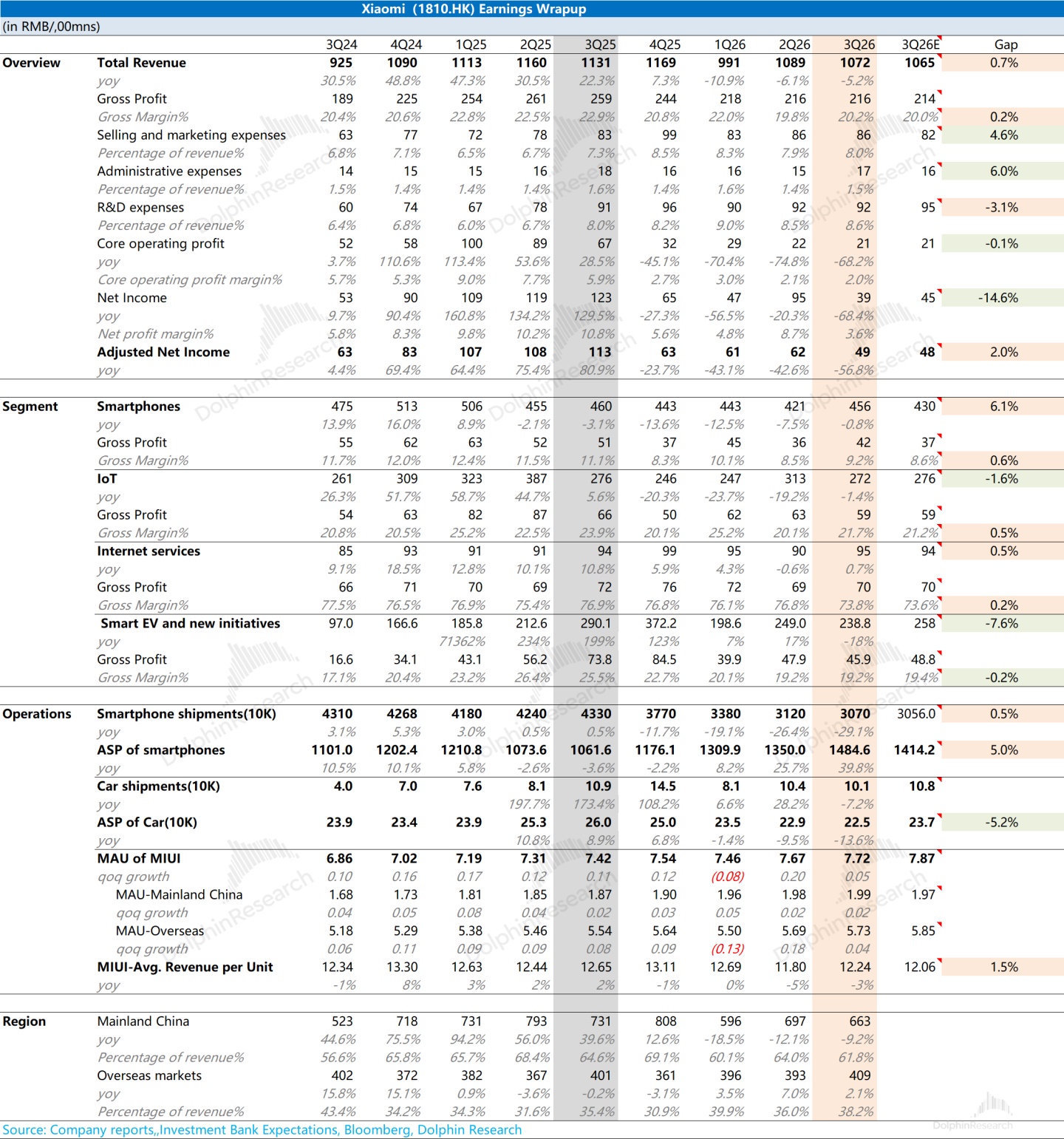
1. Overall results: revenue was RMB 107.2bn, down 5.2% YoY, in line with the street's RMB 106.5bn.
Legacy biz (Smartphones × AIoT) delivered RMB 83.4bn, down 0.9% YoY. NEV and AI-related innovation revenue was RMB 23.9bn, down 17.7% YoY, below the RMB 25.8bn consensus, mainly on lower auto volume and ASP.
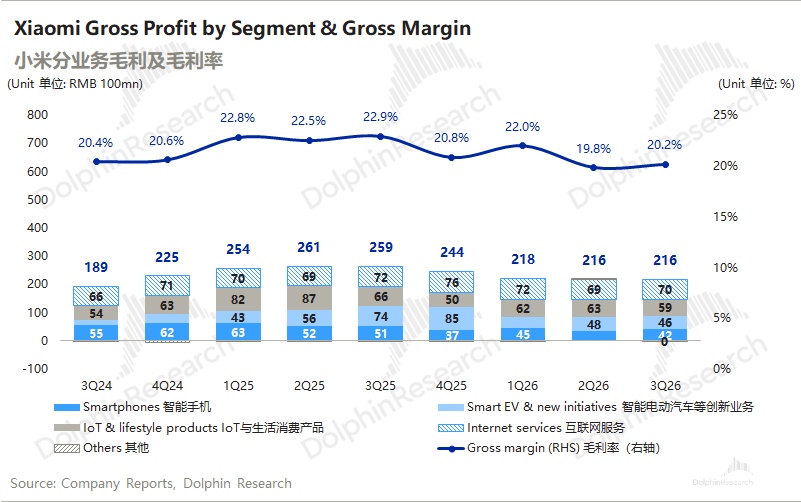
Group GPM was 20.2%, up 40bps QoQ, broadly in line with the 20.0% street est.
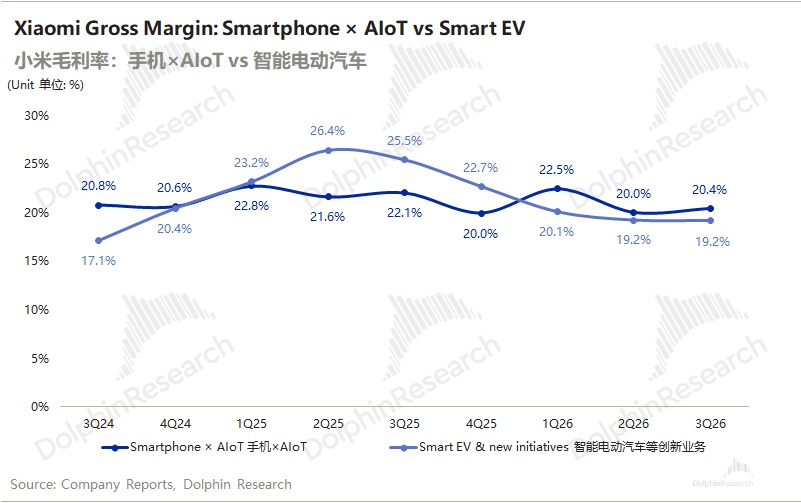
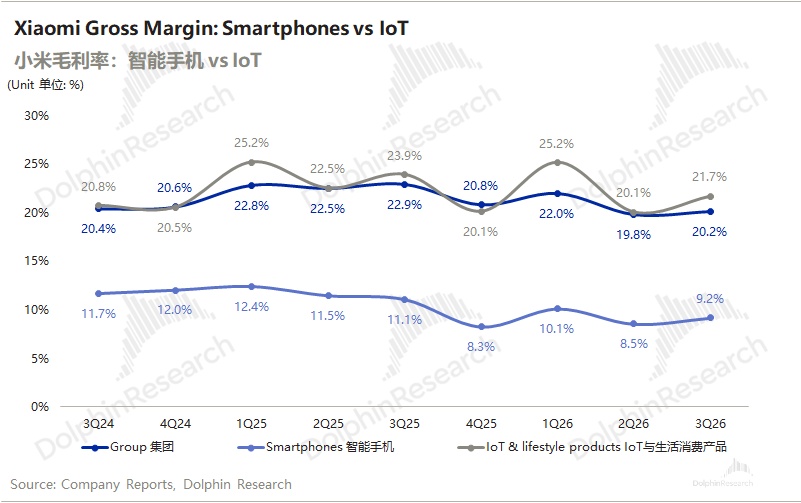
QoQ improvement was led by legacy biz: smartphone GPM improved from 8.5% to 9.2% and IoT GPM from 20.1% to 21.7%. NEV and AI innovation GPM was flat at 19.2%.
2. Autos: segment revenue was RMB 23.9bn (NEV revenue RMB 22.7bn), below the RMB 25.8bn consensus.
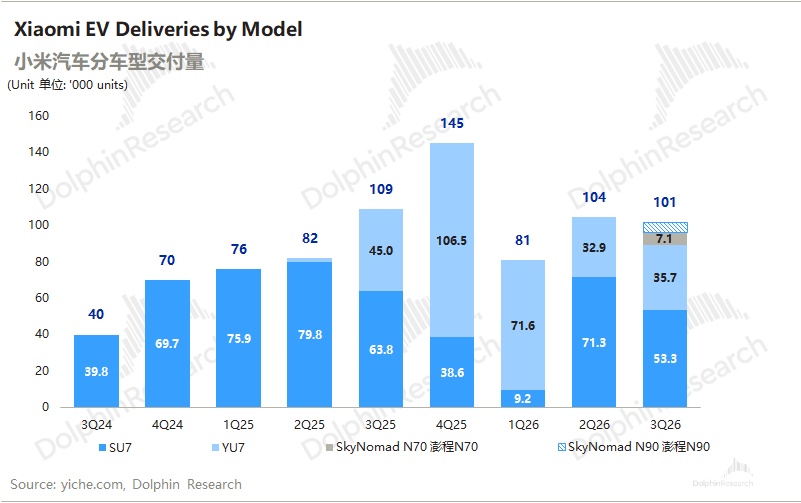
With the range-extended 'Pengcheng' added, the segment was renamed from 'Smart EV and AI Innovation' to 'NEV and AI Innovation' starting this quarter. Deliveries were 101k units, down 7.2% YoY, with the Pengcheng series (launched on Sep 7) contributing over 10k units.
ASP was ~RMB 225k, down about 2% QoQ, below the RMB 237k street est, and ASP pressure was the key driver of the revenue miss. Q3 deliveries were still dominated by the new-gen SU7 and YU7, while the higher-priced Pengcheng N90 only started deliveries in Sep, with ASP uplift to show in Q4.
Auto segment GPM (NEV and AI innovation) was 19.2%, flat QoQ, slightly below the 19.4% street est. The company cited a lower mix of SU7 Ultra deliveries, higher core component prices, and rising AI costs.
Management added that post-Pengcheng launch, Xiaomi Auto maintained a 'high and healthy' margin level and remains confident in sustaining auto GPM.
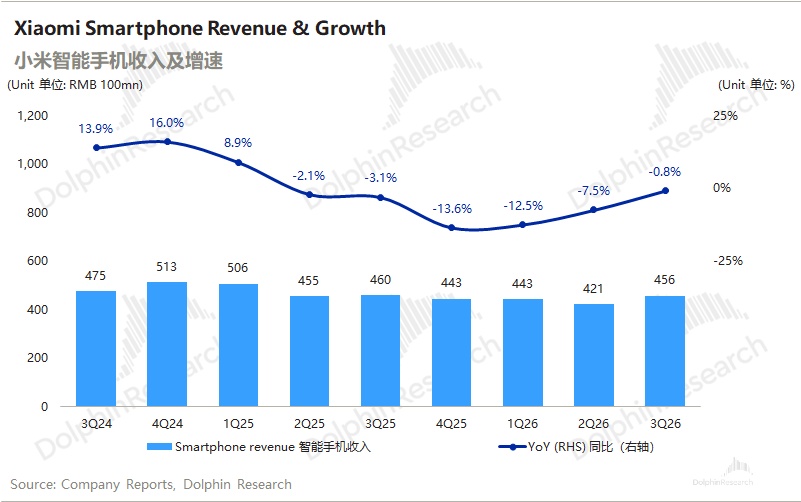
3. Smartphones: RMB 45.6bn, down 0.8% YoY, up 8.2% QoQ and ahead of the RMB 43.0bn street est.
Shipments were 30.7mn units, broadly in line. ASP was RMB 1,486, up 39.8% YoY, the key beat driver, reflecting the ongoing 'control volume, protect price' strategy.
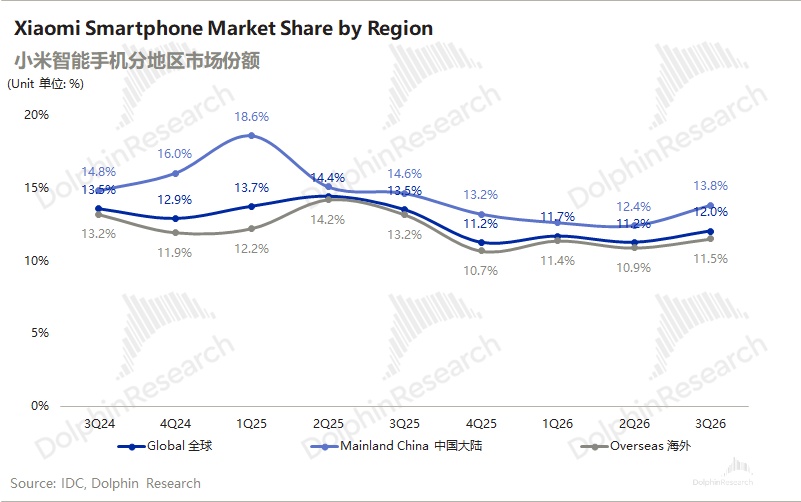
By market, China shipments were ~8mn units, down ~20% YoY, with a 13.8% share. Overseas shipments were ~22.7mn units, down ~32% YoY, with overseas share down to 11.5% YoY, as the deliberate pullback in low-end models overseas drove the shipment decline.
ASP kept rising, driven by two factors: 1) under memory tightness, the company prioritized allocation to higher-priced models. 2) cost pressure prompted price hikes across the portfolio.
Smartphone GPM was 9.2%, up 70bps QoQ, above the 8.6% street est. Management attributed the QoQ uplift to a better mix led by domestic premium launches, partially offset by core component price increases.
For 9M26, smartphone GPM averaged ~9.3%, aligning with the prior '9%+' full-year guidance. Management expects memory costs to remain relatively high in 2027, making further ASP uplift vs. 2026 a 'given', and is confident in sustaining healthy smartphone margins.
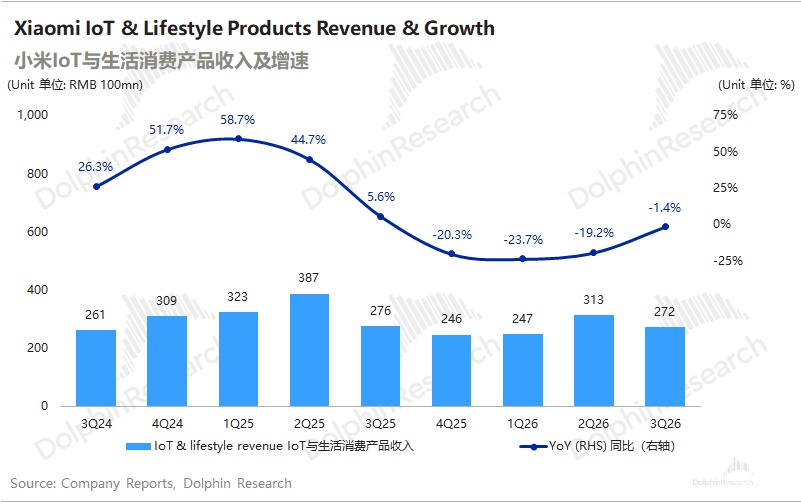
4. IoT: RMB 27.2bn, down 1.4% YoY, slightly below the RMB 27.6bn street est. As last year's high base from state subsidies was digested, YoY declines narrowed markedly vs. the prior three quarters (~20%).
IoT GPM was 21.7%, up 160bps QoQ and above the 21.2% street est. The QoQ uplift came from higher margins in ACs and laptops, as well as higher margins and mix for overseas wearables.
To meet the prior full-year guidance of -5% to -10%, Q4 YoY growth needs to be about 13%–38%. Management said IoT has 'exited the difficult phase and entered a steady growth phase'.
5. Internet services were RMB 9.5bn, up 0.7% YoY, in line with the RMB 9.4bn street est. Internet GPM was 73.8%, down 300bps QoQ, mainly due to a lower contribution from pre-installs, which dragged ad margins as smartphone shipments declined and flowed through to high-margin pre-install revenue.
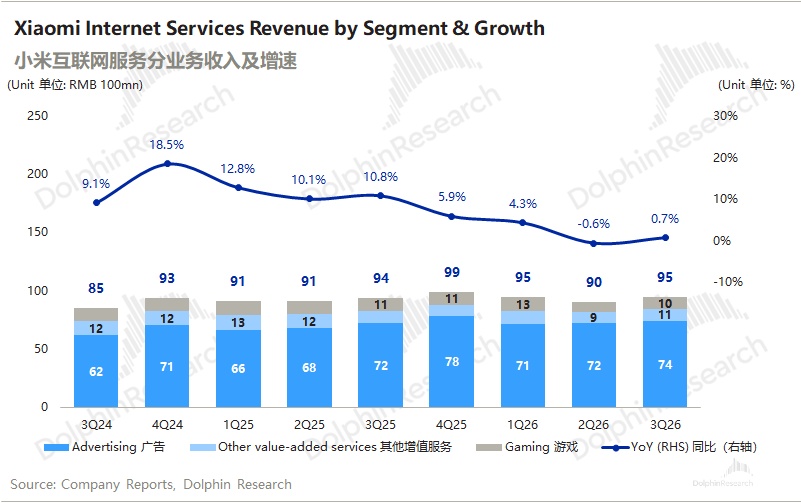
By region: overseas internet revenue was RMB 3.2bn, down ~1.5% YoY. Domestic internet revenue was ~RMB 6.2bn, up ~2% YoY.
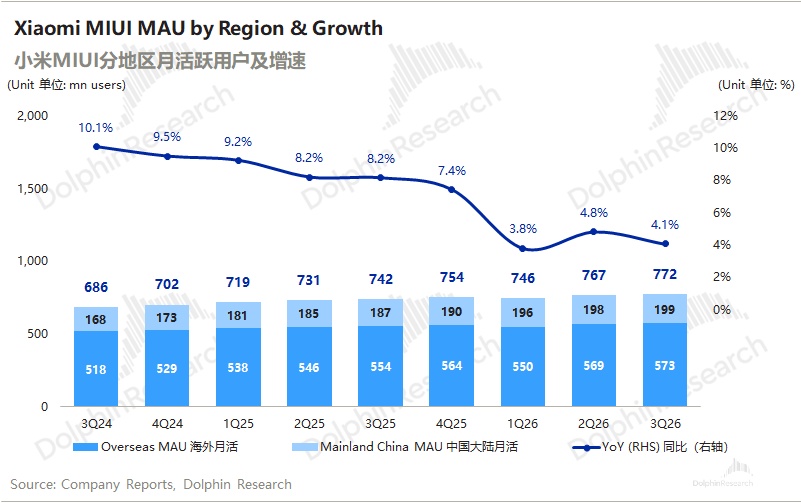
Domestic MAU reached 199mn, up 6.4% YoY. Overseas MAU was ~573mn, up 3.3% YoY.
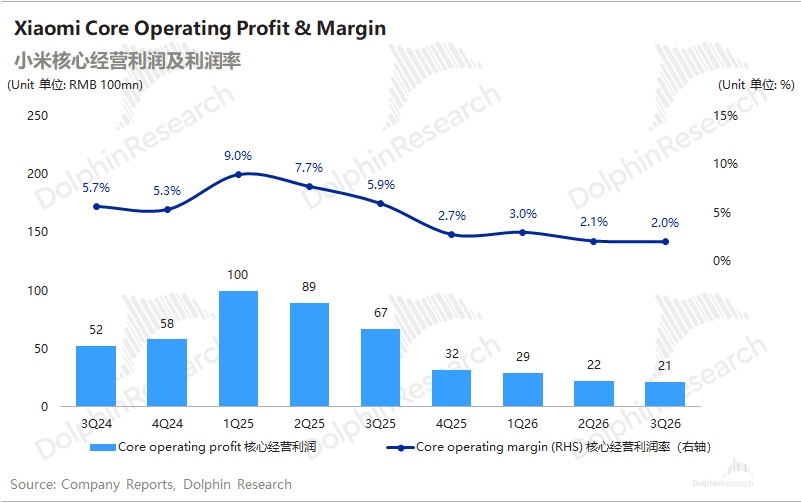
6. Profit: core profit RMB 2.1bn, adj. NP RMB 4.9bn. On Dolphin Research definition (GP minus S&M, G&A and R&D), core profit was RMB 2.14bn, down 68% YoY, with a 2.0% core margin.
By segment, legacy core profit was ~RMB 5.5bn, down ~8% YoY. NEV and AI innovation posted a RMB 3.4bn loss, widening by ~RMB 0.8bn QoQ.
Xiaomi earnings call transcript: 'Xiaomi Group (Trans): Memory downcycle not over; record-high ASP supports GPM'
Dolphin Research view: Smartphones stop the bleeding, plugging the auto hole
Overall, results were in line, but divergence was stark. Smartphones lifted margin back into guidance via pricing, while autos faced volume and price declines with widening losses.
On smartphones, QoQ growth came entirely from ASP, signaling a move from passive to proactive 'volume discipline and price protection'. With IoT declines narrowing and pricing gains outpacing memory inflation, group GPM ticked up QoQ and the legacy biz bottom looks firmer.
Autos are in a transition gap between model generations. Lower ASP dragged revenue below expectations and down QoQ, while the higher-end Pengcheng flagship only started deliveries late in the quarter, pushing losses wider. This push-pull keeps core profit hovering near RMB 2.0bn.
Beyond the print, the market focuses on the following:
a) Smartphones: margins recover first, shipments still contracting. Global smartphone shipments fell 20.9% YoY in Q3, as memory-led price hikes curbed demand in EMs, with Xiaomi shipments down 29.4% YoY vs. Samsung (-5.9%) and Apple (-2.2%) holding up better.
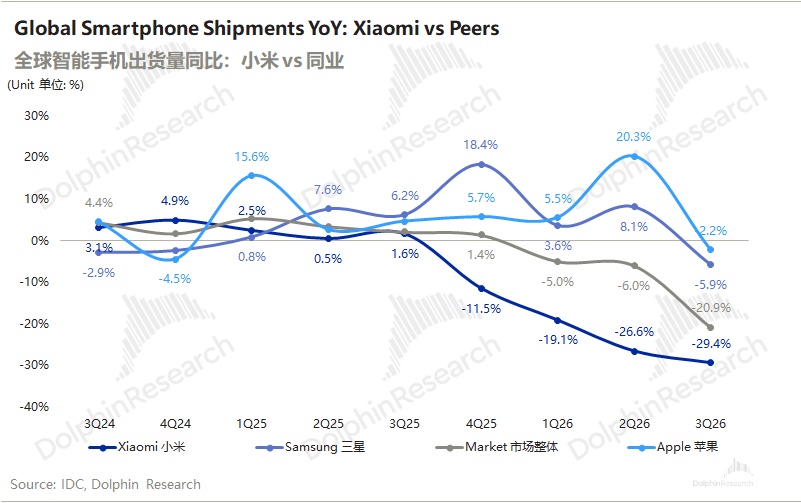
On pricing, under memory pressure, the company continued to raise prices in Q3, the main driver of margin recovery. In China, Redmi Note 17 rose 20%–30% vs. prior gen and K100 Pro Max was up 5%–13%. Price hikes were ~35% in India, ~34% in France and ~38%–40% in Spain.
The market is starting to price in an earlier-than-expected memory downcycle (H1 2027). Should memory prices ease, Xiaomi's smartphones and legacy biz would benefit, suggesting 8%–9% could be the trough GPM for smartphones.
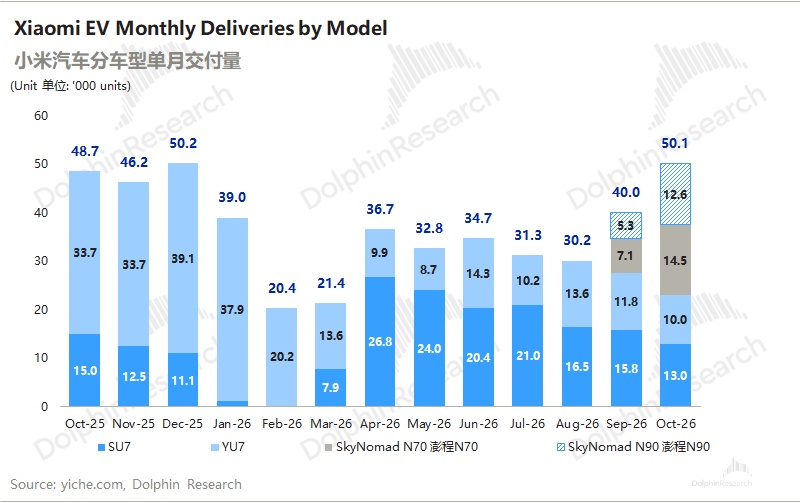
b) Autos: the full-year delivery target was cut from 550k to 450k earlier (no change this quarter, with management aiming to exceed the target and no 2027 target provided).
Deliveries totaled 286k for the first three quarters, with Oct above 50k. The first ten months summed to ~336k, implying Nov–Dec deliveries of ~114k, or ~57k per month, about 14% above Oct.
On international expansion, Xiaomi announced in Sep it will enter Europe in 2027 and signed MOUs with eight leading German dealership groups.
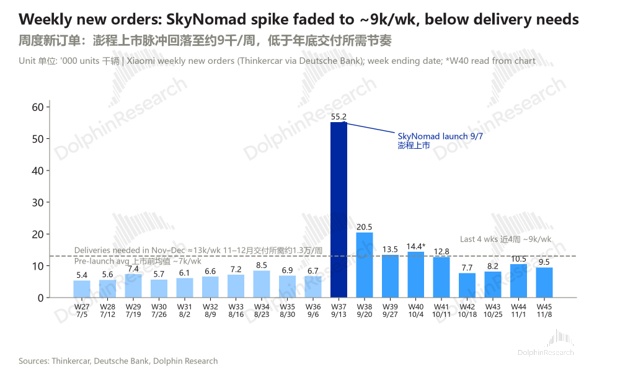
By weekly orders, Pengcheng booked 55.2k orders in launch week (Sep 7–13), then stabilized since mid-Oct at 8k–11k per week, only ~2.5k above the pre-launch ~7k/week.
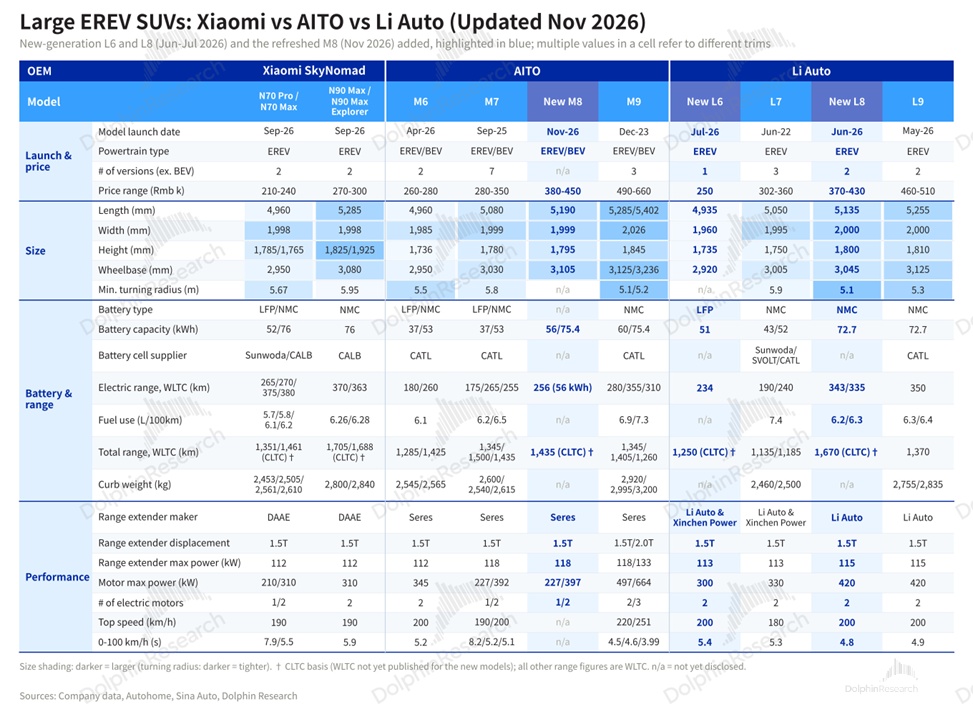
Versus peers, Pengcheng N70 is a large five-seat SUV comparable to Li Auto L7 and Aito M7, and N90 Max aligns with Li Auto L9 and Aito M9. Pricing is generally below comps, with batteries supplied by Sunwoda and CALB.
Xiaomi's results are driven by two legs: legacy and autos. Given their differing profiles, SOTP is more appropriate than a single PE.
1) Legacy: a more predictable floor
Assuming full-year smartphone shipments of ~125mn units, smartphone GPM rising to ~10.5%, and IoT returning to growth, 2027 legacy post-tax core OP could be ~RMB 23.0bn.
When memory prices previously corrected hard, the stock rallied meaningfully, showing a clear seesaw effect. If hardware margins stabilize and improve, assigning 20–25x PE implies HK$ 540–680bn for legacy (HKD/RMB=0.85), or about HK$ 21–26 per share.
2) Autos: with ~336k deliveries in the first ten months of 2026, hitting ~450k for 2026 and ~568k in 2027 with ASP ~RMB 228k, auto revenue in 2027 would be ~RMB 139.5bn.
Applying 0.5x–1.0x PS yields HK$ 82–164bn, or ~HK$ 3.1–6.4 per share.
Putting both together, legacy provides the floor if it no longer declines. While autos rebounded to 50k+ monthly deliveries post-Pengcheng launch, most OEMs now trade below 1x PS, limiting the valuation contribution from autos to roughly ~HK$ 100bn.
Overall, with legacy at HK$ 21–26/sh and autos at HK$ 3.1–6.5/sh, Xiaomi's fair value range is ~HK$ 24–33. With smartphone GPM back to 9.2% in Q3, the legacy 'bottoming' thesis has early validation, reinforcing the floor.
Before clear signs of a downtrend in memory prices (management expects elevated prices through Q2 2027), the stock could remain capped.
Xiaomi and the AI tech complex show a clear seesaw effect. If the stock retraces below HK$ 25, or even near HK$ 22, a bet on 'earlier memory price cuts and earnings recovery' could offer a better margin of safety.
<End here>
Historical coverage by Dolphin Research:
Product launches
Mar 20, 2026 SU7 launch: 'Xiaomi (Spring Launch): SU7 'low-key' refresh, MiMo free access races the charts'
Sep 26, 2025 smartphone launch: 'Xiaomi (with Trans): Full-on iPhone benchmarking! Spec bump at same price to the end'
Earnings season
Aug 18, 2026 call: 'Xiaomi Corp. (Trans): No guidance, no orders'
Aug 18, 2026 print take: 'Xiaomi: Still stuck on the floor, can range-extended models be the savior?'
May 26, 2026 call: 'Xiaomi (Trans): Paid tokens exceed 30%, confident in 550k delivery target'
May 26, 2026 print take: 'Xiaomi: Rock bottom doubts? The worst is over!'
Mar 24, 2026 call: 'Xiaomi (Trans): Memory upcycle longer than expected, AI monetization too early'
Mar 24, 2026 print take: 'Xiaomi: Heaven falls, hell rises, what holds the faith?'
Nov 18, 2025 call: 'Xiaomi (Trans): Rising memory costs hit low-ASP vendors harder'
Nov 18, 2025 print take: 'Xiaomi: With state subsidies gone, can autos carry the banner?'
Risk disclosure and disclaimer: Dolphin Research Disclaimer and General Disclosure