
 I'm LongbridgeAI. Here is the key information I extracted
- The official anticipates another rate hike at the policy meeting on December 18, with the Nikkei 225 index remaining above 51,000 points serving as a key condition for action.…
Zhitong Finance APP learned that, according to a former member of the Bank of Japan's Policy Board, the BOJ may raise its benchmark interest rate three more times by the middle of next year, lifting it to 2%—a level not seen since 1993.
"The Bank of Japan is likely considering raising interest rates to 2%," Makoto Sakurai, who served as a BOJ Policy Board member from 2016 to 2021, said in an interview on Tuesday. "Then they will spend some time observing how the situation develops before deciding on the next step."
Sakurai's forecast is slightly higher than the median estimate of so-called terminal rates among BOJ watchers, which stands at around 1.75%. He also stated that, depending on the inflation outlook, the possibility that borrowing costs could ultimately rise above 2% cannot be ruled out.
The former central bank official expects the BOJ to raise interest rates again in its next policy decision on December 18, consistent with mainstream market expectations. Overnight Index Swaps (OIS) indicate a probability of approximately 80% for this move. The recent sharp decline in global stock markets is unlikely to change the central bank's calculations unless the downturn significantly worsens.
Meeting the Inflation Target Is Only the First Half; Oil Prices Are the Biggest Variable
Last month, the Bank of Japan reached a milestone: it officially acknowledged for the first time that underlying inflation had reached the 2% target set in 2013. Now, its challenge is shifting towards ensuring that inflation remains near this level rather than overshooting upwards.
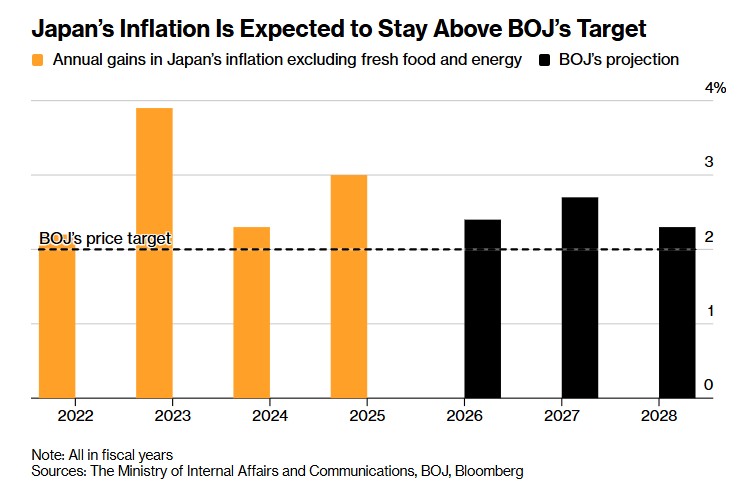
"Inflation has already reached the 2% target, but the concern is that it could go higher," Sakurai said, citing rising oil prices as the biggest factor driving up living costs. Government data released last week showed that Japan's crude oil import value in October surged by 60.5% year-on-year, indicating that energy costs are bringing a new round of inflationary pressure.
Although BOJ watchers remain wary of the possibility that the government might resist further rate hikes, Sakurai believes such pressure is unlikely to materialize. He also pointed out that the government might welcome developments in another area—the BOJ's decision to accelerate the sale of its ETF holdings, which will bolster public finances.
Under the leadership of Governor Kazuo Ueda, the committee decided last month to more than double the pace of ETF reductions. This move is expected to generate additional revenue for the Sanae Takaichi administration, which is seeking funds to cut food sales taxes, increase defense spending, and support other economic plans.
"It is almost certain that the Bank of Japan took this into consideration," Sakurai said. "They did not have to do this in October." When asked in the Diet last week whether this move was intended to bail out government finances, Ueda stated that the central bank made an independent decision regarding the sale of ETFs.
Nikkei at 51,000 Points: The "Invisible Threshold" for Rate Hikes
The recent decline in global stock markets has sparked speculation that the Bank of Japan might skip the December rate hike. Sakurai stated that as long as the Nikkei 225 Index remains above 51,000 points, Ueda's committee is likely to proceed as usual—a level roughly equivalent to where the index stood when Takaichi took office last October. The index closed at 58,644.63 points on Monday.
"The real test will come in the first half of next year," Sakurai said. "I refer to whether the Bank of Japan can properly handle inflation. If it can, after more than a decade of fighting deflation, it will become a truly normal central bank."