
 I'm LongbridgeAI. Here is the key information I extracted
- The company's AI server backlog reached a historic high of 132.3 billion U.S. dollars, with total AI orders over the past four quarters hitting 180 billion U.S. dollars.…
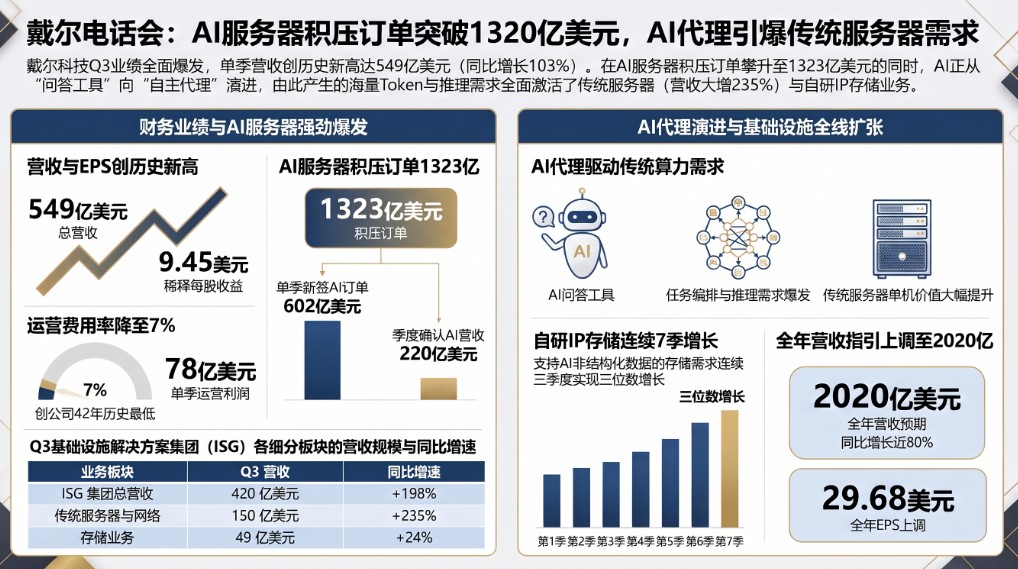
Driven by fervent demand for AI infrastructure and the modernization of traditional data centers, Dell Tech's revenue doubled in the third quarter of fiscal year 2027. The backlog for AI servers hit a record ATH (All-Time High) of $132.3 billion, with management explicitly stating that they "see no signs of slowing demand."
Wall Street Insights mentioned that after the U.S. market close on November 24, Dell Tech announced its financial results for the third quarter of fiscal year 2027, ending in October 2026. Both revenue and profits refreshed company historical records, with the AI server business serving as the core driver. The company simultaneously raised its guidance for the fourth quarter and announced a $25 billion share repurchase authorization, sending a strong signal of confidence to the market.
During the earnings conference call, Jeff Clarke, Vice Chairman and Chief Operating Officer of Dell, clearly stated that new AI server orders reached $60.2 billion this quarter, recognized revenue amounted to $22 billion, and the period-end backlog stood at $132.3 billion, all representing historical records. Furthermore, every order underwent strict qualification reviews.
Clarke pointed out that the current gap where demand exceeds supply is continuing to widen, and the degree of supply-demand imbalance in the 2027 calendar year is expected to surpass that of 2026.
In addition to the core AI server business, Dell's traditional server business also saw an explosion this quarter, with revenue reaching $15 billion, a staggering 235% year-over-year increase. Storage business revenue also grew by 24%, reaching $4.9 billion.
Clarke attributed this growth to the superposition of multiple demand drivers: modernization of data centers to release power and space, the renewal of aging installed infrastructure, heightened security and compliance requirements, and the additional demand for CPU computing power from inference and agent AI workloads.
Among these, CPU servers related to AI inference are the fastest-growing segment within the traditional server business, with an average selling price approximately twice that of traditional enterprise servers.
"No Slowdown in Demand," AI Server Backlog Reaches $132.3 Billion
The market is currently highly focused on the sustainability of AI spending, and Dell's management provided a very strong response during the conference call.
Jeff Clarke, Vice Chairman and Chief Operating Officer of Dell, clearly stated:
Demand is persistent. The broad demand for intelligence continues. We see no signs of any slowdown.
Data supports this view: Dell secured $60.2 billion in AI server orders in Q3 alone, achieving a record $22 billion in AI server revenue. Over the past four quarters, Dell has cumulatively received $180 billion in AI orders, with most new orders based on NVIDIA's Vera Rubin NVL 72 architecture.
Addressing market concerns about "duplicate ordering" or "false prosperity," Clarke emphasized that Dell's record $132.3 billion AI server backlog at the end of this quarter is highly certain:
Every AI order undergoes rigorous review regarding funding availability, end-customer quality, trade and export compliance, and land and power acquisition capabilities... We know our customers very well and are highly confident that our backlog will convert into revenue.
Clarke stated that the backlog spans nearly 100 data center sites globally, distributed across multiple U.S. states and numerous countries outside the United States, with typically two to three sovereign projects advancing simultaneously in each major economy.
The number of Dell AI Factory customers has exceeded 7,500, with 4,500 added in just the past three quarters. Enterprise customers are the fastest-growing group, indicating that demand for AI infrastructure is spreading from hyperscale cloud providers to a broader base of enterprise clients.
Regarding the future supply and demand landscape, Clarke offered a judgment that exceeded market expectations:
Demand continues to exceed supply. As we look ahead to next year, the gap between component supply and end-user demand continues to widen. In fact, we believe that in the 2027 calendar year, demand will lead supply even more than it did in 2026.
Clarke explicitly stated that the company predicts token demand will grow approximately 87-fold by 2030, training demand will grow 5-fold, and the supporting power capacity for global data centers under construction or planning exceeds 200 gigawatts.
He pointed out that AI applications are evolving from single-turn Q&A inference to "agent" and recursive learning models, a shift that will significantly increase infrastructure demand.
AI Evolving from "Advisor" to "Operator," Igniting Demand for Traditional Servers
In addition to the core AI servers, Dell's traditional server business also saw an explosion this quarter, with revenue reaching $15 billion, a staggering 235% year-over-year increase.
Clarke shared Dell's deep observations on AI evolution during the meeting, which is the core logic driving the comprehensive expansion of infrastructure:
AI models have evolved from initial single-turn Q&A to possessing reasoning and self-iteration capabilities, and now further evolve into systems capable of autonomously executing, managing, and orchestrating workloads. As the 'customer zero' for our own technology, we are shifting the positioning of AI from auxiliary tools and advisors to frontline 'executors'.
He pointed out that AI agents are generating massive token demand. In handling such tasks, inference and agent workloads are extending infrastructure demand into the realms of traditional servers and storage.
Clarke added:
The fastest-growing area driving this demand is the computing power required to run infrastructure in the AI and inference era. Inference tasks are shifting towards agent-based AI, and will further develop towards recursive learning in the future... The core supporting this workload is CPU tasks. The average selling price of these servers is approximately twice that of traditional servers running traditional enterprise workloads.
Clarke pointed out that although the number of units shipped decreased, the number of cores per server, DRAM capacity, and storage bytes all achieved quarter-over-quarter and year-over-year growth.
The company's latest generation of 18G servers can replace 12 to 14 older 14G servers, driving a significant increase in overall computing value despite a reduction in unit numbers.
Regarding the slight quarter-over-quarter decline in the revenue guidance for traditional servers in the fourth quarter, Kennedy explained that the strong North American business mix in the third quarter brought some supra-seasonal benefits, which will gradually normalize in the fourth quarter. The overall direction of demand has not changed, and a year-over-year growth of approximately 137% is still expected for the fourth quarter.
Storage Business: Dell IP Products Grow for Seven Consecutive Quarters
Storage business revenue reached $4.9 billion in the third quarter, a 24% year-over-year increase. Demand for Dell's proprietary IP storage products has grown for seven consecutive quarters, with the proportion of IP products reaching a historical high.
Clarke stated that the growth logic of the storage business is being reshaped by AI. In addition to traditional workload and data volume growth, key-value caching, context layers, multimodal workflows (images, video, audio, sensor data), and log and trace data generated by agent AI all constitute new increments in storage demand.
The company also launched a unified semantic layer and enterprise knowledge graph, aiming to reduce token consumption per query while ensuring sensitive data remains within the customer's own data center.
In terms of specific product performance, PowerStore demand hit a historical high for the fiscal year, achieving double-digit growth for 10 consecutive quarters; PowerFlex achieved double-digit growth for three consecutive quarters; and demand for unstructured storage achieved triple-digit growth for three consecutive quarters, mainly driven by AI workloads.
The expansion of the storage business scale and the increased proportion of the IP portfolio are viewed by management as important support for the continuous improvement of ISG's overall profitability.
Full Transcript of Dell's Q3 Fiscal Year Conference Call (AI-assisted translation):
Host:
Good afternoon, and welcome to Dell Technologies' fiscal year 2027 third-quarter financial results conference call. Please note that, at the request of Dell Technologies, this conference call is being recorded. This live broadcast is the copyrighted property of Dell Technologies, and rebroadcasting this information in whole or in part is prohibited without prior written permission from Dell Technologies. Following the prepared remarks, we will proceed to a Q&A session. I will now turn the call over to Paul Frantz, Head of Investor Relations. Mr. Frantz, please begin.
Paul Frantz, Head of Investor Relations:
Thank you for joining us. Joining me today are Jeff Clarke, David Kennedy, and Tyler Johnson. Our press release and presentation have been posted on our investor relations website, and the presentation contains supplementary information for today's discussion.
During this conference call, unless otherwise specified, we will refer to Non-GAAP financial measures. You can find reconciliations to the most comparable GAAP measures in our press release and presentation. Unless otherwise noted, growth rates are calculated on a year-over-year basis.
We will also make forward-looking statements based on current expectations. These statements represent views only as of today, and actual results may differ materially due to risks and uncertainties described in our presentation and SEC filings, including our latest Forms 10-K and 10-Q. We undertake no obligation to update these statements. I will now hand over to Jeff.
Jeffrey W. Clarke, Vice Chairman and Chief Operating Officer:
Thank you, Paul, and thank you all for participating. I am proud of our team's outstanding performance, which once again created quarterly records, achieving robust execution and growth across the business.
Key financial highlights for the quarter:
Revenue hit a historical high of $54.9 billion, up 103% year-over-year
Diluted earnings per share hit a historical high of $9.45, up 265% year-over-year
Cash flow from operations was $4.5 billion
Returned a record $4.9 billion to shareholders
Our validated operating model, competitive advantages, market responsiveness, and scalability are delivering compounding benefits. Our modernization efforts are driving significant operating leverage—operating expenses as a percentage of revenue dropped to 7%, the lowest level in the company's 42-year history.
Strategic Position of the ISG Business:
ISG is our most profitable business segment, having achieved significant growth in recent years and contributing the vast majority of our growth and profit. In fiscal year 2024 (the year we began selling AI servers), ISG contributed 38% of revenue. Over the past four quarters, this contribution ratio has increased to 68%.
This trend is even more pronounced in operating profit, where ISG's contribution ratio increased from 54% to 83%, a trend I expect to continue into the next fiscal year. Meanwhile, ISG's operating margin expanded by 2 percentage points during this period. Despite the substantial growth in AI servers, we achieved margin expansion, thanks to the strong growth of Dell's proprietary intellectual property (Dell IP) storage business, robust demand for computing resources, and efficiency gains from modernization efforts.
Outlook for AI Infrastructure Demand:
Technology is driving substantial business outcomes, and demand for AI infrastructure and data center monetization remains strong. As AI infrastructure becomes increasingly complex, our competitive advantages are strengthening, and momentum is accelerating.
Our engineering design capabilities are differentiated. We develop customized, exclusive solutions for each customer's specific needs, often requiring multiple rounds of design iteration—considering not just the infrastructure itself, but planning the data center from a holistic perspective, covering power, cooling, efficiency, and software.
Our technical teams are leveraging AI technology and the proprietary knowledge accumulated over the past 13 quarters to simplify and accelerate design work, enabling our engineers to complete complex designs in hours and rapidly perform numerous iterations.
Our procurement capabilities and world-class supply chain offer differentiated advantages, particularly prominent in the current supply-constrained environment. In manufacturing, we conduct comprehensive L11 and above testing on complete solutions, including full rack power-up tests, thermal compliance tests, and horizontal and vertical scaling network verification, ensuring all inspections are completed before shipment.
Our deployment services team can get racks online within six hours of delivery. Our on-site support services help customers achieve over 99% equipment utilization with fewer spare parts than competitors. Combining these capabilities, we can bring infrastructure online faster.
In large-scale deployment projects, compared to competitors, we can reduce the time-to-first-token by four to six weeks while providing industry-leading total cost of ownership. This enables customers to convert backlogs into revenue faster and more reliably.
Product Innovation:
Innovation has always been at the core of our advantage. In the third quarter, we became the first original equipment manufacturer (OEM) to ship fully liquid-cooled network racks, consolidating our market leadership. Currently, we are the only OEM using standard L11 rack designs to ship 100% scalable direct liquid cooling (DLC) units across compute, accelerators, and networking equipment, and we will soon begin shipping storage liquid-cooled L11 racks.
Order Momentum:
Total orders over the past four quarters reached $180 billion, with most new orders based on NVIDIA's Vera Rubin NVL 72 platform. We also pioneered the launch of AMD-based PowerEdge 9815 and R9825 platforms, with the R9825 alone setting 238 global records and industry benchmarks.
AI Technology Evolution:
Meanwhile, AI technology continues to evolve rapidly. Models have progressed from one-time responses to reasoning, then to recursive capabilities, and now to agent systems capable of executing operations, managing, and coordinating workloads. As "customer zero," we are transitioning from using AI as a tool and advisor to using it as an operational entity.
The first wave of AI, focused on Q&A and knowledge retrieval, brought 10% to 40% productivity improvements. However, in practical application cases, we observe that AI agents can achieve an order-of-magnitude productivity improvement, i.e., 10x or higher, by accelerating work processes and embedding intelligence directly into decision-making.
Enterprise AI Implementation Path:
To achieve these results, strong leadership is required first—companies must simplify, standardize, and automate processes before digitizing or introducing intelligent augmentation. At the same time, companies must modernize their data architecture, including building a semantic data layer that provides semantic context around data and intellectual property.
AI agents generate massive token demand, increasing the need for modernized decentralized infrastructure, covering AI servers and traditional servers, Dell IP storage, data management solutions, and networking equipment. Although traction in the enterprise market is accelerating, the vast majority of customers are still in the proof-of-concept and tool adoption phases, with broader adoption opportunities still ahead.
Overall, AI and the pursuit of intelligence are expanding the total addressable market (TAM) for our entire product portfolio. This is no longer just about IT budgets—data centers are becoming value centers, driving growth, productivity, speed, and intelligence across the enterprise.
Detailed ISG Business Performance:
AI Servers: Demand continues to accelerate. In the third quarter, we booked $60.2 billion in AI orders, AI server revenue reached a record $22 billion, and the quarter-end AI server backlog hit a record $132.3 billion.
Behind every customer interaction and every order lies a rigorous due diligence process, ensuring the quality of the backlog is thoroughly vetted. Every AI order is reviewed for funding availability, end-customer quality, trade and export compliance, and land and power acquisition conditions. Each design solution is custom-made, optimized through multiple rounds of iteration with the customer.
Through this close collaboration, we have a thorough understanding of our customers and are highly confident in converting the backlog into revenue. Our pipeline continued to grow quarter-over-quarter this quarter, remaining several times the size of the backlog—achieved on top of converting $180 billion over the past four quarters.
Furthermore, our customer base and opportunity pipeline continue to diversify. We currently have over 7,500 Dell AI Factory customers, covering Neo-clouds, Sovereigns, and enterprise clients. Within segments, we remain highly selective about partners and the end customers they serve.
As more data centers are built outside the United States, global opportunities are expanding. Almost every major country globally has two to three sovereign projects underway. Quarter-over-quarter, enterprise clients are the fastest-growing part of our opportunity pipeline, further confirming that enterprise AI adoption is accelerating.
Internally, we continue to invest in building our capabilities to maintain competitive advantages, create value for customers, and prepare for future huge opportunities.
Traditional Servers: Revenue grew 235% year-over-year, demand remains exceptionally strong, and multiple growth drivers are continuously expanding our total addressable market. Enterprise customers increasingly recognize the importance of computing power for their business growth and operations; they are purchasing more computing equipment to handle growing workloads, refreshing existing installed bases, and modernizing data centers to release power and space for the AI era. Quarter-over-quarter, we are seeing increased demand for CPU computing equipment to support AI and inference workloads.
Higher product content will continue to be a long-term structural tailwind. Servers possess more computing value, including higher core counts, larger memory, and storage capacities, thereby increasing the value per system. Underlying all this demand, network resilience and security are also driving refresh demand. A significant portion of the existing installed base requires new hardware to meet current security and performance requirements, which cannot always be addressed through software patches.
We executed exceptionally well in a supply-constrained environment and expect to further expand market share this quarter.
Storage Business: Revenue grew 24% year-over-year, with strong demand for the Dell IP product portfolio driving revenue growth and profitability improvements. Storage has always been key, and its importance is growing as enterprise workloads and data volumes increase. In the AI era, as data grows at an exponential rate, the strategic position of storage becomes even more critical.
As AI evolves, our storage business opportunities are also expanding. AI workloads are creating new demand drivers, such as key-value caching (KV caching), context layers, and AI agents that need to store data, memory, and state. For enterprises, data is their intellectual property, but isolated data without context is merely data. Therefore, AI agents need this context. This is why we expanded the Dell AI Data Platform—we added a unified semantic layer and an enterprise knowledge graph, enabling almost all applications and AI agents to access the same trusted, real-time panoramic view of the business without reconstructing context for each query. This reduces token consumption, cuts computing costs, accelerates time-to-production, and securely governs customers' most sensitive data within their own data centers.
Our storage products continue to enrich, and the Dell IP product portfolio is deeply recognized by customers, with expectations to further expand market share this quarter. Demand for Dell IP storage has grown for seven consecutive quarters, with the IP product portfolio proportion at a historical high, and demand in North America is particularly strong. We also continue to see strong demand for unstructured storage supporting AI workloads, with this category achieving triple-digit demand growth for three consecutive quarters. PowerStore set an annual demand record and has achieved double-digit or higher growth for ten consecutive quarters. PowerFlex has achieved double-digit growth for three consecutive quarters, and the data protection business also achieved double-digit growth.
Storage business growth, scale expansion, the structural shift towards Dell IP products, and significant quarter-over-quarter improvements in product-level profitability continue to be important drivers of ISG profitability.
CSG Business: Revenue grew 3% year-over-year against the backdrop of a soft PC market and industry adaptation to higher price points. Customers recently prioritized budgets towards servers and storage, delaying some PC-related refresh plans. The existing PC installed base continues to age, accumulating delayed replacement demand, which is expected to trigger a refresh cycle in the future.
Summary:
We continue to deliver record-breaking results: record annual revenue, earnings per share, cash generation, and shareholder returns. The demand environment we see today remains strong and unchanged. Capable customers are planning years in advance, providing us with better visibility into future demand.
AI server demand continues to accelerate, supported by an expanding customer base and global opportunities. Our record $132.3 billion AI server backlog has passed rigorous due diligence processes. Traditional server demand remains strong, benefiting from traditional workload growth, aging installed bases, higher security requirements, and growing AI inference demand. Dell IP storage continues to grow, driving marginal profitability improvements. As AI infrastructure becomes more complex, our competitive advantages become more prominent, the total addressable market expands, and demand for modernized decentralized architectures increases. Infrastructure demand continues to exceed supply.
Looking ahead to next year, the gap between component supply and end-user demand continues to widen. Our world-class supply chain is well-positioned to handle these constraints and deliver for customers. Our operating model, market responsiveness, growth capabilities, and scalability are delivering comprehensive compounding benefits—jointly driving substantial cash flow, shareholder returns, and long-term value.
I am proud of the team's outstanding performance and look forward to this momentum continuing into next year. I will now hand over to David to detail the financial data and business outlook.
David Kennedy, Chief Financial Officer:
Thank you, Jeff. The team executed excellently, driving revenue, earnings per share, and shareholder returns to historical highs. These results fully reflect the strength of our operating model—driving growth, enhancing profitability, and generating substantial cash flow.
Overall Performance:
Total revenue grew 103% year-over-year to $54.9 billion
Gross profit grew 105% year-over-year to $11.7 billion; gross margin was 21.2%, up 10 basis points year-over-year
Operating expenses grew 20% year-over-year to $3.8 billion, mainly due to variable compensation linked to exceeding targets; operating expenses as a percentage of revenue decreased by 480 basis points to 7%, showing significant operating leverage
Operating profit grew 213% year-over-year to $7.8 billion; operating margin improved by 490 basis points year-over-year to 14.2% of revenue, mainly driven by scale effects and pricing discipline
Net income grew 245% year-over-year to $6.1 billion, mainly benefiting from strong operating profit growth
Diluted earnings per share grew 265% year-over-year to a historical high of $9.45
ISG Business:
ISG revenue hit a historical high of $42 billion, up 198% year-over-year, achieving double-digit or higher revenue growth for 11 consecutive quarters.
AI server momentum continues to accelerate: orders reached $60.2 billion this quarter (the second consecutive quarter with orders exceeding $60 billion), revenue reached a record $22 billion, and period-end backlog reached $132.3 billion, with all orders strictly reviewed.
Supplementing Jeff's remarks, every customer must undergo a credit review and due diligence process supported by the Dell Financial Services (DFS) risk management team. We evaluate the company itself, its financial capabilities, and its underlying end-user contracts. The due diligence process occurs at two key nodes: first when the purchase order is confirmed, and second before production begins, helping us proactively manage risk. If DFS financing is used, it is selective and short-term, only used to bridge the funding gap for customers from placing purchase orders to cluster go-live.
Traditional server and networking equipment revenue hit a historical high of $15 billion, up 235% year-over-year. Storage revenue was $4.9 billion, up 24% year-over-year, with strong demand for the Dell IP product portfolio driving revenue growth and significant margin contributions. High-margin Dell IP storage demand has grown for seven consecutive quarters, and the Dell IP product portfolio proportion hit a historical high.
ISG's third-quarter operating profit surpassed the full-year performance of fiscal year 2026, reaching a record $7.1 billion, up 308% year-over-year, achieving double-digit or higher growth for 10 consecutive quarters. The operating margin was 17%, up 460 basis points year-over-year, mainly driven by scale effects.
Continuing last quarter's trend, the benefits of scale effects continue to improve profitability across the entire product portfolio—reflected in the decoupling of revenue growth from operating expenses. This decoupling is driven by two factors: first, strong demand supported record revenue, and second, our modernization efforts continue to drive operating expense efficiency.
We maintained strong operational and pricing discipline in a dynamic environment, reflecting the team's excellent execution and continuous focus on supporting customers. Most of these benefits are structural and reflected in our higher fourth-quarter margin expectations. However, margins will narrow quarter-over-quarter as the tailwind from the strong North American sales mix gradually normalizes.
CSG Business:
CSG revenue grew 3% year-over-year to $12.9 billion. CSG operating profit was $700 million, accounting for 5.5% of revenue, broadly in line with expectations. CSG provides important scale effects for our supply chain and drives substantial cash generation—given that CSG is our most capital-efficient business.
Cash Flow and Balance Sheet:
Cash performance was strong again this quarter, with cash flow from operations at $4.5 billion, mainly benefiting from quarter-over-quarter revenue growth and improved profitability.
The cash and investment balance at the end of the quarter was $16.3 billion, an increase of $2 billion quarter-over-quarter, with a core leverage ratio of 0.7x.
We returned a historical record $4.9 billion to shareholders this quarter, maintaining a high level of shareholder returns for the second consecutive quarter, with an average return of $4.6 billion, compared to a run rate of only $1.9 billion in the same period last year. We repurchased 9 million shares at an average price of $488 per share this quarter and paid a dividend of approximately $0.63 per share.
Additionally, the Board approved a $25 billion increase in the share repurchase authorization, demonstrating our confidence in continued strong free cash flow generation and our commitment to shareholder returns and long-term value creation. We remain committed to our long-term capital allocation framework, including the promise to return at least 80% of adjusted free cash flow to shareholders.
Business Outlook:
Given the current strong momentum of ISG, we raised our fourth-quarter revenue growth and Non-GAAP diluted earnings per share expectations:
Expected fourth-quarter revenue midpoint is $56.25 billion, up approximately 69% year-over-year, mainly driven by ISG growth of about 120%
AI server revenue increases quarter-over-quarter to approximately $23.5 billion
Traditional servers continue to achieve triple-digit growth, and storage business growth is in the low double digits
Operating expenses are expected to be broadly flat quarter-over-quarter, accounting for slightly less than 7% of revenue
Operating margin is expected to improve by approximately 175 basis points quarter-over-quarter, with ISG and CSG performing similarly year-over-year
Expected diluted share count is approximately 634 million, and interest and other expenses (I&O) are approximately $450 million
Non-GAAP diluted earnings per share midpoint is expected to be $8.40, up approximately 115% year-over-year
The fourth-quarter guidance implies another historical high for fiscal year 2027: full-year revenue will reach a record $202 billion, up nearly 80% year-over-year; full-year operating margin is expected to improve by approximately 350 basis points, far exceeding beginning-of-year expectations—particularly noteworthy is that this improvement was achieved under the structural pressure of AI server revenue reaching $78 billion (more than three times last year). Non-GAAP diluted earnings per share midpoint is expected to be $29.68, up nearly 190% year-over-year.
Regarding Fiscal Year 2028:
As Jeff stated, ISG demand remains strong, with growth driven by diverse demands: AI server demand continues to accelerate, and we are well-prepared to seize this growth opportunity; data center modernization will drive growth in traditional server and storage businesses; traditional workloads and data continue to grow, aging installed bases urgently need refreshing, and customers are strengthening cybersecurity capabilities; meanwhile, inference and agent workloads are also extending infrastructure demand into traditional server and storage fields.
In a supply-constrained environment, we continue to prioritize the ISG business. Although PC shipment environments are expected to remain soft next year, this impact is manageable given the strong performance of the infrastructure business.
Despite the significantly higher base, the earnings per share improvement path outlined at our Investor Day about a year ago—focusing on revenue growth, margin expansion, and operating leverage to drive substantial cash generation and shareholder returns—remains valid and strong.
Summary:
We delivered another excellent quarterly performance, with cumulative results for the first nine months hitting historical highs:
Revenue for the first nine months totaled $145.8 billion, up 82% year-over-year
Diluted earnings per share grew 231% year-over-year to $21.32
Cash flow from operations hit a historical high of $10.8 billion
Returned a historical record $11.2 billion to shareholders
Driven by modernization efforts we have been advancing for several years, operating expenses as a percentage of revenue dropped to 7%, the lowest level in the company's 42-year history, while continuously strengthening competitive advantages in innovation, marketing, services, and supply chain.
We continue to focus on capital efficiency and cash generation. We are excited about the fourth quarter and confident in closing the year with record-breaking results. Looking ahead to next year, we are equally capable of continuing to create long-term value for shareholders. Thank you to the team for their excellent execution, and thank you all for participating today. I will now hand back to Paul for the Q&A session.
Q&A Session
Paul Frantz, Head of Investor Relations:
Thank you, David. To ensure as many people as possible have the opportunity to ask questions, please keep each question concise. Let's start with the first question.
Host:
The first question comes from Mark Newman of Bernstein Research. Please proceed.
Mark Newman, Analyst:
Thank you for taking the question, and congratulations on your impressive results. In addition to strong revenue growth, the operating margin performance across ISG business segments was also quite outstanding. Looking ahead, how should we view the trend of operating margins?
I believe your company was able to benefit from rising memory costs because, in a supply-constrained environment, the price increases passed on to customers exceeded your own cost increases, which led not only to rising operating margins but also to rising gross margins for each product. Looking forward, how should we view the profitability of ISG's main segments—AI servers, traditional servers, and storage? What are the assumptions for profitability in the current guidance? Thank you.
David Kennedy, Chief Financial Officer:
Mark, let me answer first. First, the strong demand and final revenue growth of the ISG business are the starting point for everything, and this growth is comprehensive—from geographic, customer segment, and customer industry perspectives, it is the broadest demand in history. Obviously, the $22 billion in AI shipments is the core anchor of this growth, a historical high, 35% higher than the previous quarterly record, and the fourth quarter will set another new high.
The 235% growth rate of traditional servers obviously had a significant pulling effect on the income statement. The storage business achieved24%** growth in the third quarter—continuing the momentum of the second quarter, which is also reassuring.
From a margin perspective, all this growth brought excellent operating leverage. ISG's operating expenses as a percentage of revenue improved by 8 percentage points year-over-year and 2 percentage points quarter-over-quarter. This is true scale benefit, where the decoupling of revenue growth from operating expenses is fully reflected, validating the modernization path we are promoting within the company. This benefit is sticky and structural and will continue to be reflected in the income statement in the future.
It is this optimization of operating expenses that allowed us to absorb the margin dilution impact brought by AI servers growing nearly 3 times year-over-year—ISG operating margin improved by nearly 5 percentage points year-over-year, reaching 17% of revenue.
Looking to the fourth quarter, this trend will continue. We increased revenue, increased profit amounts, and improved margins. We comprehensively raised guidance, which is exactly what we strive for: continuously driving revenue growth while continuously excavating scale benefits in operating expenses—this is completely decoupled from revenue growth. We are committed to bringing significant scale benefits to the income statement, which also lays a good foundation for our continued growth.
Mark Newman: Thank you very much.
Host:
The next question comes from an analyst at Evercore. Please proceed.
Amit:
Thank you, good afternoon everyone. Jeff, in your prepared remarks, you mentioned that the supply-demand gap will continue to widen in the coming year. This contrasts sharply with the concerns of some investors in the market that AI spending may be peaking soon.
From your perspective, what is driving this supply-demand gap? Also, considering your company's fourth-quarter revenue run rate is approximately $56 billion, without asking for formal fiscal year 2028 guidance, could you introduce which business segments have visibility for continued growth from the current base? Thank you.
Jeffrey W. Clarke, Vice Chairman and Chief Operating Officer:
Certainly, Amit. Looking at the full-year trend, I think we have been continuously emphasizing the persistence of this demand. The thirst and demand for broad intelligence continue unabated, and we see no signs of any slowdown.
Our AI orders again recorded $60 billion, with total orders over the past four quarters reaching $180 billion, shipments approaching $66 billion, while the five-quarter outlook pipeline continues to expand. We added 4,500 Dell AI Factory customers in the past three quarters, compared to only 3,000 in the previous eight quarters, and the number of customers continues to grow. The number of potential customers in the five-quarter outlook pipeline already exceeds the total number of customers we have served to date.
All signs point to continued robust demand for intelligence—especially as the market transitions from the initial training phase that drove demand, to the inference phase, and continues to evolve towards the recursive learning phase. We see this pattern continuing.
In fact, from November 2022 to October 2025, the market was basically driven by "single-response" AI—you ask it a question, it gives an answer. Now we are seeing changes: AI is transforming from a "responder" to an "executor" and "operator." We are also feeling the huge benefits of this shift within our own company—the historically low operating expenses mentioned by David are a reflection of the modernization we are advancing and the organizational efficiency improvements brought by AI.
Fundamentally, work consists of three core components: defining goals, executing tasks, and verifying results. The core action of "execution" is increasingly being taken over by AI agents. We believe this will drive astonishing growth in tokens and token consumption, along with the accompanying infrastructure demand, and we see no signs of slowing down.
Looking at various growth categories, whether storage, traditional servers, or AI business, the drivers come from inference, key-value cache demand, recursive learning demand, and the supporting hardware demand required to run the entire technology stack.
Our judgment of the market has not changed. We still expect token demand to grow approximately 87-fold by the end of this decade, reaching about 3,600 quadrillion tokens; training demand will continue to grow about 5-fold; and we are still tracking over 200 gigawatts of data center shell and power construction plans to accommodate all this computing power demand.
Looking at our internal usage—our token consumption is now higher than at the beginning of this fiscal year. On any given workday, our developers and knowledge workers deploy approximately 100,000 AI agents internally, while enterprise-level agents also consume massive tokens across the company, driving the efficiency improvements we mentioned earlier. And we plan to double this number within the next 90 days.
I think, as "customer zero," we deeply feel this trend. Our partners in the Neo-cloud, Sovereign, and enterprise client sectors continue to confirm this judgment. We believe this demand is extremely persistent, which is reflected in our order rates and backlogs.
David Kennedy, Chief Financial Officer:
Supplementing Jeff's description of demand robustness, and your mention of the connection to next year. If we look at our long-term value creation framework and EPS toolkit, all tools are still available and strong: first, revenue growth that drives everything, second, profitable growth accompanied by operating expense leverage, and finally, generating substantial free cash flow to return to shareholders. These tools give us sufficient flexibility and responsiveness to continuously seize demand opportunities in the intelligent ecosystem.
Jeffrey W. Clarke, Vice Chairman and Chief Operating Officer:
To briefly conclude this topic, Amit. This demand leads supply. In fact, we believe that in the 2027 calendar year, demand will lead supply to a greater extent than in 2026.
Paul Frantz: Thank you very much, Amit.
Host:
The next question comes from Ben Reitzes of Melius Research. Please proceed.
Ben Reitzes, Analyst:
Thank you, the performance of traditional servers in the third quarter was very bright. However, the fourth-quarter guidance shows that this business will decline quarter-over-quarter by about 7% to 8%. I originally expected more CPU racks to enter this segment in the fourth quarter. How will this situation unfold in the 2027 calendar year? Is the attitude towards this fourth-quarter figure conservative? Thank you.
David Kennedy, Chief Financial Officer:
Thank you, Ben. The 235% growth in the third quarter was indeed exciting. And the fourth-quarter guidance also has a growth target of as high as137%**, which is still quite substantial. We see diversified demand drivers continuing to emerge, including traditional data center workload growth and aging installed bases, AI inference evolution, and continued attention to network and security resilience topics.
At the operational level, we mentioned earlier this year utilizing the flexibility of the ecosystem to transfer some PC wafer capacity to server supply. We planned to concentrate most of the conversion in November, but in reality, there was a certain degree of balanced distribution between October and November. Overall, the various demand drivers in the traditional server market have not changed in direction or intensity.
Jeffrey W. Clarke, Vice Chairman and Chief Operating Officer:
Adding some data, Ben: Traditional server revenue was $8.5 billion in the first quarter, $10.5 billion in the second quarter, and $15 billion in the third quarter, totaling $34 billion for the first nine months, compared to only $19.5 billion for the full year last year. The performance is extremely bright, and the momentum continues to strengthen.
We see that the vast majority of this demand comes from existing customer groups, from small and medium-sized enterprises to large corporations, and the demand is global. North America is particularly prominent, and we continue to see the data center modernization demand we mentioned earlier—to release power, space, and cooling capacity. The scale of installed base refresh demand mentioned by David is huge, and the degree of aging is unprecedented.
Our 17G products achieved an integration ratio of about 7:1, and 18G products reached an integration ratio of 12:1 to 14:1. Internal enterprise workloads are also growing, with increasing demand for computing resources. In addition, security and resilience requirements are also driving replacement demand.
The fastest-growing segment is the computing demand required in the AI inference era—supporting servers for running the entire technology stack. We see this trend widely among Neo-clouds and enterprise clients, especially in industries with very mature AI deployments such as financial services, EDA and semiconductor companies, high-frequency trading firms, and pharmaceutical companies.
This trend has lasted for four quarters and is the fastest-growing part of our traditional server business. Initially dominated by inference demand, it has now expanded to generative AI and will further evolve towards future recursive learning. This will bring more demand, continuously expanding the total addressable market for traditional servers.
In addition, here is a reference data point for your modeling: the average selling price of inference servers is about twice that of traditional servers. We are very optimistic about the continued growth prospects of the traditional server business.
Paul Frantz: Thank you, Ben.
Host:
The next question comes from Wamsi Mohan of Bank of America. Please proceed.
Wamsi Mohan, Analyst:
Thank you for taking the question. Your company has performed excellently in backlog conversion and expressed high confidence. What is the potential impact on your company if data center construction experiences delays (such as the recent situation in Texas)? If construction is delayed, who bears the risk of inventory and repricing? Jeff, please analyze from a macro perspective whether your company expects delays to have a substantial impact on 2027 and 2028?
Jeffrey W. Clarke, Vice Chairman and Chief Operating Officer:
Wamsi, we continuously track orders and backlogs. Both David and I mentioned in our prepared remarks that we have a review process covering financial aspects as well as "whether the building is ready, whether it is powered, and whether it has the required power and cooling capabilities." We have been tracking these metrics since entering this business.
This is an extremely complex business involving the precise coordination of many variables. Whether the site is ready, whether power is connected, whether cooling is installed, whether equipment can be received, and whether supply matches (whether CPU, memory, or seemingly insignificant optical transceivers)—all these are indispensable parts of the coordinated work delivered to customers.
Currently, no customers have rescheduled deliveries, and the backlog remains very solid. We are highly confident that these backlogs will be fulfilled into actual shipments as promised to our customers. These backlogs span multiple quarters, distributed across about 100 sites globally, with the number of sites outside the United States comparable to those within the U.S., distributed across multiple U.S. states. Therefore, from the perspective of where customers deploy equipment, we believe we are in a very favorable position. David, would you like to add?
David Kennedy, Chief Financial Officer:
Regarding credit and capital aspects, as Jeff said, this rigorous process is not newly established. We have maintained high consistency in this process over the past three to four quarters, including credit assessment, financing schemes, and whether the end user has an investment-grade contract—this point is crucial for us.
We conduct a complete review of these contracts, including all unredacted original contracts, to understand all terms and details in order to make correct decisions. Another element that may be overlooked is that this is an evergreen process, not a one-time review. When the backlog is ready to enter the production phase, we re-execute all review steps. For all major customers, whether Neo-clouds or not, we track their future cash recovery on a weekly basis, and this level of rigor applies equally to financing assessments for the AI business.
The financing we provide is highly selective and always short-term in nature. An intuitive data point: look at our third-quarter results—against the backdrop of shipping a record $22 billion in AI equipment, our financing receivables balance only increased by $500 million quarter-over-quarter. It is evident that our financing is not open to all customers and is only used when necessary. Overall, this is a core component of the company's execution system.
Host:
The next question comes from Katherine Murphy of Goldman Sachs. Please proceed.
Katherine Murphy, Analyst:
Thank you for the question. Regarding the traditional server business, please help us understand the respective driving contributions of shipment volume and pricing in the quarterly performance and outlook. In addition, your company expects to expand market share in both the traditional server and storage markets. Is the attach rate for storage better than historical levels? How does reallocating CSG wafer capacity to ISG help achieve market share expansion? Thank you.
Jeffrey W. Clarke, Vice Chairman and Chief Operating Officer:
Regarding the question of server shipments, to put it directly: server shipments decreased this quarter, which was within our expectations. Considering the current inflationary environment, we believe that measuring the true value of the server market solely by shipment volume is inaccurate.
Due to market inflation, the shipment-based total addressable market (TAM) has been substantially disrupted. Traditionally, low-priced tower servers and single-socket rack servers accounted for about 20% of shipments but contributed only about 2% of revenue—this sub-$3,000 market has basically disappeared. Therefore, from an industry-wide perspective, the number of units shipped is decreasing.
But what is truly worth paying attention to, and I think is very illustrative, is the significant change in product content per server this quarter:
We shipped and sold more CPU cores in the third quarter than in the previous quarter and the same period last year
We shipped more DRAM memory capacity per server than in the previous quarter and the same period last year
We shipped more storage bytes per server than in the previous quarter and the same period last year
Therefore, the content per server is increasing substantially—not a relative increase adjusted for inflation, but an absolute increase in content: more cores, more memory, more DRAM. These servers are more powerful and feature-rich, capable of handling more workloads, and although there are fewer units, they serve a larger scale of business demand. This trend has lasted for several quarters, and I believe it will continue.
Regarding the storage business, the trend is different, but the result is similar. We see an increasing attach rate for high-value storage products (i.e., the Dell IP product portfolio)—growing for seven consecutive quarters, with PowerStore achieving double-digit growth for ten consecutive quarters, strong demand for structured storage products, and triple-digit year-over-year growth in unstructured storage demand.
We see increasing storage attach sales in our AI business, especially for unstructured storage products like PowerScale and ObjectScale. Future storage demand drivers remain strong: AI, key-value caching, multimodal workflows, and recursive learning will all drive incremental storage demand.
Especially in recursive learning scenarios, the operation traces and logs of each AI agent, artifacts generated by agents, and retrievable enterprise corpora—all these are driving significant growth in storage demand. Multimodal workflows such as key-value caching, images, video, audio, and sensor data also require storing increasing bytes. Storage growth is not driven by the number of GPUs deployed, but by the amount of data bytes that need to be retained long-term, and this compound-like storage growth will continue to accumulate. This is the growth driver and business focus we see.
Paul Frantz: Thank you, Kat.
Host:
The next question comes from Erik Woodring of Morgan Stanley. Please proceed.
Erik Woodring, Analyst:
Thank you for taking the question. ISG operating margin reached 17% this quarter, improving both year-over-year and quarter-over-year, which is quite outstanding especially against the backdrop of a significant increase in the proportion of AI servers. Please help us understand how the triple-digit growth of traditional servers in the fourth fiscal quarter and the continued strong performance of AI servers will jointly lead to a quarter-over-quarter narrowing of ISG operating margins? Also, what does this preliminarily imply for fiscal year 2028? Thank you.
Jeffrey W. Clarke, Vice Chairman and Chief Operating Officer:
As I said before, looking at our fourth-quarter guidance, compared to 90 days ago and 180 days ago, we added more revenue, more profit amounts, and higher margins in the guidance. It is evident that our performance continues to improve as scale benefits materialize.
AI continues to raise targets—AI server revenue in the fourth-quarter guidance is $23.5 billion. For traditional servers, the 235% growth in the third quarter benefited from some tailwinds from the North American business mix, which we expect to normalize in the fourth quarter. But overall, the fourth-quarter ISG operating margin is still higher than the high end of our range, performing quite strongly.
David Kennedy, Chief Financial Officer:
Eric, perhaps it is clearer from an annual perspective. Compared to the beginning-of-year guidance, and combined with our latest guidance for the full year and the fourth quarter, we will add nearly $58 billion in ISG revenue, with $28 billion from AI servers and another $30 billion from core businesses (traditional servers, networking, and storage). While achieving this growth, our operating margin expanded by about 400 basis points.
The macro theme is: while the AI business grows substantially, the core business also continues to grow, and margins have improved synchronously. Looking ahead, considering the persistence of demand and the operating decision leverage generated through our modernization, we are confident in continuing to perform well within this range.
Erik Woodring: Thank you very much.
Host:
The next question comes from Joseph Cardoso of JPMorgan. Please proceed.
Joseph Cardoso, Analyst:
Good afternoon, thank you for taking the question. In the prepared remarks, you mentioned that most new orders are currently based on the Vera Rubin platform. Compared to the Blackwell platform, how should we view the impact of Vera Rubin on Dell in terms of rack pricing, service attach sales, and profit opportunities? In addition, your company also mentioned liquid-cooled networking and liquid-cooled storage. With the introduction of these products at the rack level, what is the strategic value for Dell? What is the impact on margins? Thank you.
Jeffrey W. Clarke, Vice Chairman and Chief Operating Officer:
From a macro perspective, we are still operating this business in the mid-single-digit margin range. We continue to see the growth trends we described—$60 billion in orders this quarter, $180 billion in cumulative orders over the past four quarters, and continuously growing backlogs and five-quarter outlook pipelines. When confirming the Vera Rubin platform with all customers, we have aligned on expected delivery dates and planned according to customers' building conditions, power conditions, and other factors.
Regarding networking and storage attach sales opportunities, we have consistently viewed them as opportunities to enhance margins in various business segments. We continue to focus on this and continue to see good attach rates, but there is still room for improvement.
If our ISG business head Arthur Lewis were here, he would talk about how to further expand the storage business in all these accounts—this is exactly the direction we continue to focus on. I just listed all the new storage opportunities spawned by AI, which is the focus of our storage solutions: from separate software-defined storage layers, to storage devices, to rack-level storage solutions for large-scale deployments.
A large number of AI deployments will occur in enterprise environments, where we already have a broad customer base and coverage capability today. Our team is focused on providing suitable products for enterprise-scale AI deployments, while providing rack-level solutions for the world's largest clusters and Neo-clouds.
Paul Frantz: Thank you, Joe.
Host:
The next question comes from David Vogt of UBS. Please proceed.
David Vogt, Analyst:
Thank you. Jeff, from a macro perspective, if DRAM and NAND prices begin to deflate or stabilize, what does this mean for customer demand and pricing in the server market?
Considering the rapid price increases in the CPU server market, are some customers holding back because of this? Please analyze the pricing trends, demand prospects, and how product configurations and specifications might evolve in an environment of slowing component price inflation. Thank you.
Jeffrey W. Clarke, Vice Chairman and Chief Operating Officer:
First, it must be pointed out that "slowing inflation" for our customers means that product prices are still rising. Given the substantial inflation that has occurred over the past year, even if the inflation rate slows down, the product prices faced by customers will still be higher.
From a macro supply and supply outlook perspective, there are no signs that prices for enterprise NAND and DRAM server memory will decline. Demand for these memory categories far exceeds supply, and as more DRAM wafer capacity is used for GPUs, especially for producing High Bandwidth Memory (HBM), this will come at the expense of capacity for all other types of memory. We believe this supply tightness will clearly extend into 2027.
Although the inflation rate will not be as high as in 2026, we still judge the market to be in an inflationary state. Customers are actively using their budgets, and I don't know of any customer holding back. They may not purchase as much as before, but I must also point out that the 17G or 18G servers they buy today are far more capable than the old products they replace.
For example: the 14G servers we sold five years ago were priced at about $75,000 to $100,000 (approximately RMB 550,000 to 750,000); today's 18G servers are priced higher, but they can replace 12 to 14 old servers, with a very considerable integration ratio, and customers benefit significantly.
This also answers another question—this may mean fewer units, but each server is more powerful, capable of meeting the needs of everyone from small businesses to the world's largest enterprises. Customers in the server market are not holding back.
The situation in the PC market is different. I think enterprises are delaying PC purchases to ensure they have sufficient infrastructure to cope with the era of technology-driven transformation and comprehensive corporate reshaping. This is what we observe in the market.
Will the rate of inflation increase slow down? Yes. But for customers, the pricing impact remains significant—because a smaller percentage on a large base is still a considerable amount. Our customers are actively using their budgets, they are active in the market, and we believe this will continue into 2027.
David Kennedy, Chief Financial Officer:
Adding one point: customers are also actively seeking flexible alternatives, and DFS financing products are one of them. Loan origination for investment-grade customers grew 55% in the third quarter (including PCs, storage, and servers), showing that even facing short-term budget pressures, customers have a strong demand for infrastructure construction. Our ability to convert Capital Expenditure (CapEx) into Operational Expenditure (OpEx) is a differentiated core competency in the market, highly recognized by customers, and utilized as an important tool for IT construction.
Host:
The last question comes from Tim Long of Barclays.
Tim Long:
Thank you for the last question opportunity. I want to delve deeper into traditional servers, especially the sale of more CPU-type servers to new cloud and sovereign customers that you mentioned. Can you quantify the scale or growth pace of this part of the business? What are the margins for these products? In addition, when you sell CPU servers and GPU servers to these customers simultaneously, is the storage attach rate different? Please help us understand the scale of this part of the business and its impact on various key indicators.
Jeffrey W. Clarke:
Let me try to answer. GPUs are used in the AI server business, but not in the traditional server business—we clearly distinguish these two parts of the business.
In the traditional server (non-GPU) business, the fastest-growing segment is precisely the part driven by inference and AI, but the largest volume part remains traditional enterprise clients and traditional applications—the business we have served for a long time.
Server demand for new workloads is widespread among the new clouds deploying them, as well as in industries relatively leading in AI deployment such as financial services, semiconductors, high-frequency trading, and pharmaceuticals. These industries are promoting AI applications throughout the enterprise, and we believe that as the next stage of evolution such as recursive learning advances, this market will continue to grow.
More computing demand, more agents, more computing—and the "orchestration layer" supporting all this is essentially CPU-intensive tasks: managing containers, sandboxes, I/O orchestration, workload scheduling, these are what we call CPU-driven tasks.
As mentioned earlier, the average selling price of these servers is about twice that of servers for traditional enterprise workloads, and the margin performance is fully in line with expectations under our measurement standards for the entire server product portfolio. We are very satisfied with this business and its prospects, and the growth potential is quite substantial.
Host:
Okay, Tim, thank you very much.
Jeffrey W. Clarke: Okay. Thank you Paul, and thank you all for attending our meeting today. Demand still exceeds supply, and our world-class supply chain enables us to seize this opportunity well. We look forward to the performance in the fourth quarter and to capping off a record-breaking year. Our full-year revenue guidance is $202 billion, and Non-GAAP diluted earnings per share (EPS) is $29.68, up nearly 190% year-over-year. We will enter fiscal year 2028 with strong momentum and are confident in our ability to continue creating long-term value for shareholders. Thank you again for taking the time today. Happy Thanksgiving.
Operator: Today's conference call has ended. Thank you for your participation. You may now hang up.