
 I'm LongbridgeAI. Here is the key information I extracted
- While Huang's return restores strategic continuity and leadership stability, the company continues to face policy risks, regulatory scrutiny, and upcoming congressional hearings.…
TradingKey - Market enthusiasm sparked by Jensen Huang's return appears to be cooling. On November 24, Eastern Time, shares of Nvidia (NVDA) fell 5.86% to close at $155.38, giving back part of the previous session's gains. On Monday, driven by news that the board had reappointed Huang as chief executive officer, the company's shares surged as much as 31.5%, recording their largest single-day gain in over two decades and adding approximately $952 billion in market capitalization.
Tuesday's pullback stemmed partly from short-term profit-taking, but it also reflected investors reassessing the unresolved issues that remain following Jensen Huang's reinstatement. While renewed leadership stability eased market concerns over the product roadmap, customer relationships, and internal execution, investigations surrounding corporate governance, chip export restrictions, and Huang's personal conduct have not ended.
Huang held an all-hands meeting on Tuesday at Nvidia's headquarters in Santa Clara, California, and apologized to employees for the conduct that led to his brief departure. According to reports, he acknowledged violating certain company codes of conduct and said he is undergoing daily therapy. Huang also thanked Chief Financial Officer Colette Kress for temporarily leading the company during his absence and stated that the board will strengthen oversight of his conduct going forward.
Huang also denied that he was rehired because of special status or being above the rules, stating that Nvidia's board determined his reinstatement would not pose a threat to national security after reassessing the relevant facts and receiving information from the government.
However, the market has not viewed this conclusion as a resolution to all problems. Investigations into Huang's ties with former Megaspeed executives remain ongoing, while the company's chip sales in Southeast Asian markets and whether they were used to circumvent export controls on China continue to face scrutiny from Washington.
William Blair analyst Sebastien Naji noted that Huang's return helps restore Nvidia's strategic continuity, and the Trump administration's support for his reinstatement could signal an improved short-term regulatory environment for the company. However, he also cautioned that the events of recent weeks have exposed deep-seated issues in board governance, management succession, and regulatory oversight, factors that could impact Nvidia's competitive standing over the long term.
Some investors similarly believe that Huang's return merely eliminates the leadership vacuum, but cannot directly resolve the policy risks facing Nvidia. As the U.S. continues to tighten export controls on advanced chips and offshore computing power services, whether Nvidia can sustain the scale of its Southeast Asian business, prevent its products from ultimately flowing into China, and maintain growth amid rising compliance costs remains a key focus for the market.
In addition, investors are reassessing the sustainability of AI infrastructure expansion. Data center buildouts by Big Tech firms, cloud service providers, and AI startups are increasingly reliant on bonds, private credit, and off-balance-sheet financing. With interest rates remaining elevated, whether these projects can secure sufficient funding and whether customers can honor their long-term computing power purchase commitments will directly impact future demand for Nvidia's GPUs. While Huang's return can stabilize customer confidence, it cannot resolve the capital returns and financing cost challenges facing the broader AI industry.
Political risks are also continuing to heat up. Huang is scheduled to be questioned by relevant House committees on December 1 and attend an open hearing held by the Senate Banking Committee on December 3 titled 'Protecting America's AI Edge: Oversight of U.S. Export Controls.' U.S. lawmakers are expected to focus their questioning on Nvidia's sales arrangements in Asia, its compliance with export rules, as well as corporate governance and national security concerns.
In an interview with The New York Post, U.S. President Donald Trump said that pardoning Huang is 'always an option' if necessary, though he believes it is not needed at this time, and urged Huang to answer questions truthfully when testifying before Congress. Trump previously acknowledged intervening in Huang's reinstatement, arguing that Nvidia choosing the wrong successor could harm America's competitiveness in artificial intelligence.
While the Trump administration's intervention reduced the near-term risk of Huang losing his post, it has sparked bipartisan scrutiny in Washington. Some lawmakers worry that direct executive branch influence over management decisions at publicly traded companies could undermine board independence and set an unfavorable precedent for corporate governance. Whether Nvidia's board can restore investor trust will also pose another challenge in the wake of Huang's reinstatement.
Nvidia Stock Price Technical Analysis
Source: TradingKey
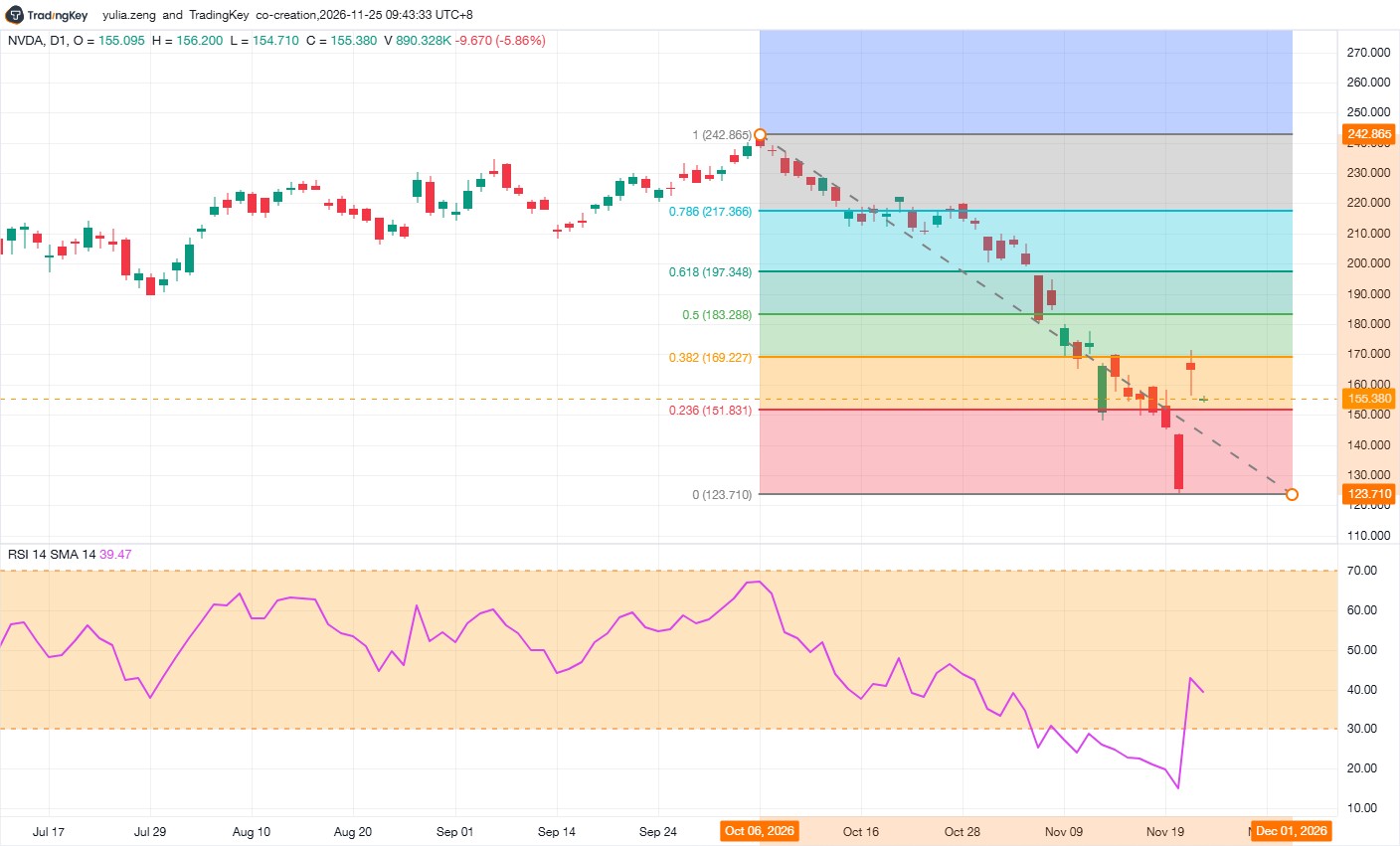
From a technical perspective, Nvidia's stock has continued to fall since touching $242.87 in early October, recording lower highs and lower lows and remaining in a clear bearish structure. The stock most recently closed at $155.38, down 5.86% on the day. Although it has rebounded from an interim low of $123.71, it has yet to break above the downward trendline, meaning this advance should still be seen as a technical rebound from oversold levels rather than a trend reversal.
Fibonacci retracements show that $151.83 corresponds to the 23.6% retracement level of this decline and represents the most critical short-term support. The stock temporarily holding above this level indicates that bulls still retain a chance for a rebound; if it can stabilize above $152 going forward, the initial rebound target will point to $169.23. This level is also close to the $170 round-number mark and is expected to face strong selling pressure.
The Relative Strength Index (RSI) currently sits around 39.47, having previously fallen into deeply oversold territory below 20. Although it has seen a rapid recovery recently, it remains below the 50 neutral threshold, indicating that while bearish momentum has eased, it has not yet shifted to bullish control.
If Nvidia breaks above $170 on heavy volume and clears the downward trendline, further rebound room could open up, with subsequent targets at $183.29 and $197.35, respectively. Among them, $183 is the 50% retracement level of this decline, while $197 to $200 represents the previous breakdown zone; only firmly reclaiming $200 would confirm a material repair of the medium-term downward trend.
Conversely, if the stock falls below $151.83 and gives up the $150 round-number mark, the short-term weak structure will worsen further, likely pulling back near $145 first before retesting the interim low of $123.71 to $125. A drop from $155.38 to $125 would represent a potential decline of nearly 20%.