
 I'm LongbridgeAI. Here is the key information I extracted
- The data serves as a crucial test for the Federal Reserve's December interest rate decision and the tail risk of a 50-basis-point hike, while also heavily impacting AI-related stocks and valuation pressures.…
Zhitong Finance APP learns that at 21:30 Beijing time tonight, the U.S. Department of Commerce will release the October Personal Consumption Expenditures (PCE) Price Index—the last major data point before the Thanksgiving holiday and the final complete inflation reading before the Federal Open Market Committee (FOMC) meeting on December 8-9. Headline inflation is expected to rise year-on-year from 3.6% in September to 3.8%, with core inflation rising to 3.2%, making a 25 basis point rate hike in December almost certain; the only real suspense remains—how much the market should price in the tail risk of what Waller called "a one-time 50 basis point hike," with AI trades, which have just experienced a round of sharp declines, bearing this tail risk.
What the Data Will Look Like: Energy "Stains" Core Inflation
The nowcast model shows that October headline PCE is expected to rise year-on-year to 3.8% (from 3.6% in September), with high energy prices pushing up food inflation and seeping into core inflation, details that "will make the Fed uncomfortable." This model replicates the Bureau of Economic Analysis (BEA)'s methodology each month, using CPI, PPI, and import price data to estimate the PCE deflator. Due to some underlying data and seasonal adjustment factors not being public, there is a small tracking error. Since its inception, the average absolute error for this metric has been only 3 basis points (for both headline and core), with errors almost entirely concentrated in the "core services excluding housing" category, which has the highest proportion of confidential data.
Analyst expectations surveyed by Trading Economics are for a 0.3% month-on-month and 3.8% year-on-year increase for headline, and 0.3% month-on-month and 3.2% year-on-year for core; the Cleveland Fed's Inflation Nowcasting model predicts a 0.31% month-on-month and 3.81% year-on-year increase for headline, and 0.27% month-on-month and 3.21% year-on-year for core.
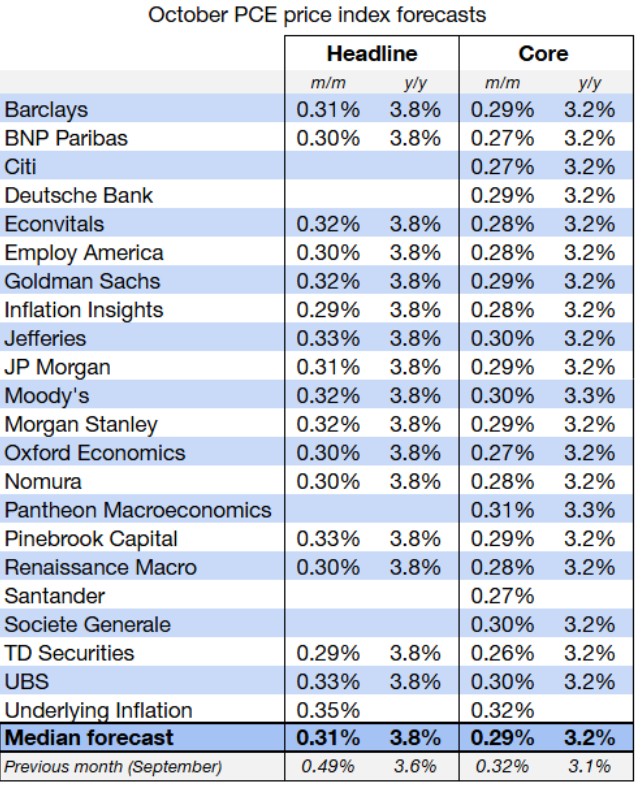
Regarding the base effect, it is worth noting that the 0.5% month-on-month increase in September headline PCE was the fastest in six months, and the 3.1% year-on-year core increase was the highest in five months; the October CPI (released on November 10) showed a 0.4% month-on-month increase for headline, down from 0.6% in September, but core has remained fixed at 0.3% for three consecutive months—this is precisely why Waller set "core month-on-month 0.3%" as the trigger line for a 50 basis point hike.
A Citi research report breaks down structural variables for the coming months, highlighting three directions:
Inflation readings in January-February are historically strong. This is especially true for 2026, partly attributed to AI-related computer software prices tending to rise in the first half of the year; if holiday discounts are canceled in 2027 and transportation costs further pass through to goods prices, upside risks remain.
Medical services may move in the opposite direction. Medical service prices rose 0.6% month-on-month in January 2026, contributing 11 basis points to the 40 basis point increase in core PCE that month; but for January 2027, Citi assumes only a 0.2% month-on-month increase, or even a slight decline—the one-year increase in Medicare physician payments under the OBBBA Act (passed in summer 2025) only covers the 2026 calendar year, and under current law, payments will fall in 2027, a point already incorporated in the final Medicare fee schedule released earlier this month. The variable is: if the appropriations bill to keep the government open after December 11 restores these payments, or if private payers are strong enough to offset, the downside risk will be discounted.
Used cars are sideways. Manheim wholesale prices were sideways in the first half of November, and Citi retains only a slight upside assumption for used car CPI for the year; new and used cars are among the consumer prices most sensitive to interest rates, and as automotive demand softens, they are expected to remain mild in 2027.
Impact on the Fed: 25 Basis Points Locked, 50 Basis Points a "Credibility Contest"
The current policy rate is 3.75%-4.00% (a 25 basis point hike in September, and a pause in the October meeting by a 10-2 vote). The market has long moved past "whether to hike in December": after the CPI release on November 10, CME FedWatch showed a 100% probability of a hike. Currently, the market expects about a 95.8% probability of a 25 basis point hike in December, and about a 55.5% probability of a cumulative 50 basis point hike by next January.
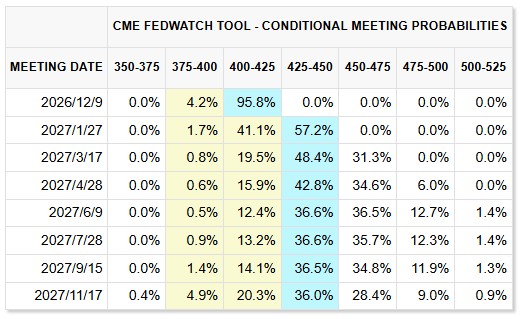
The divergence lies in magnitude and pace. Governor Waller stated at the Bank of England's London conference: if October core CPI remains at 0.3% month-on-month or higher, "the Fed should consider a 50 basis point hike in December; hiking only 25 would put the Fed's credibility at risk"; while Fed Chair Wash opposes using forward guidance to pre-commit to a path, Waller thus advocates "if unwilling to give signals, hike the full amount at once." The opposition camp is equally clear: New York Fed President Williams explicitly stated that "the current situation does not require dramatic action," Cleveland Fed's Hammack and Dallas Fed's Logan support tightening but favor a gradual approach, while St. Louis Fed's Musalem expects at most four hikes by spring 2027. Wall Street's divergence is consistent: Goldman Sachs expects a 25 basis point hike each in December and next March; Bank of America and Deutsche Bank expect three consecutive 25 basis point hikes in December, January, and March, raising the upper limit of the rate to 4.75%.
The weight of tonight's data in this debate is that it is the last complete piece of inflation evidence before the December meeting. Nowcast analysts stand with the "gradualists"—"the market is overpricing the probability of a 50 basis point hike," reasoning that the recent drop in oil prices "supports the forecast that headline inflation will peak in Q4," the transmission of energy to core will ease in 2027, and flat stock markets, declining home buying demand, and moderate wage growth should keep service inflation benign.
The Fed itself has already articulated this implication for the market. Governor Bowman estimated that October core PCE might be 3.3%—listing energy costs and "AI demand-driven" factors as drivers, but she also provided a dovish tail: as AI expands and pressure from Middle East conflicts eases, and the job market is not overheating, next year's core PCE will be closer to the 2% target (according to Commercial Times). Citi economist Veronica Clark's previous warning was more direct: if officials fail to deliver a December hike, the main risk will be further significant adjustments in the stock market or widening credit spreads.
Transmission Chain for US Stocks and AI Trades
US stocks after tonight's data release face not one transmission chain, but three intertwined ones:
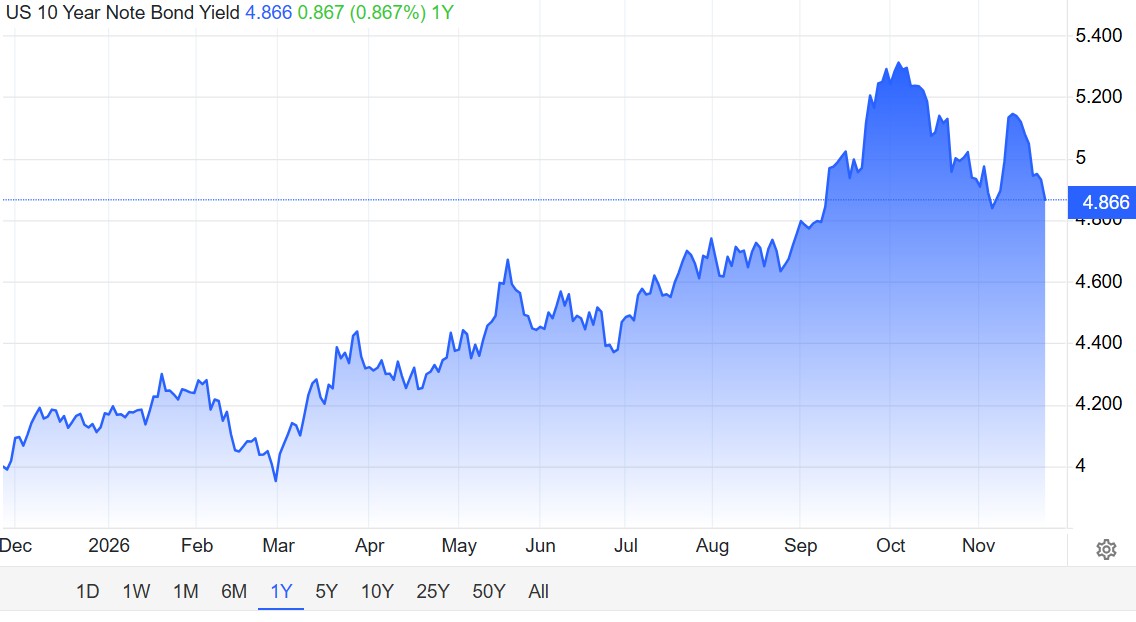
The first is the direct impact of the interest rate path on the valuation of AI growth stocks. The S&P 500 and Dow Jones confirmed entry into correction territory last Friday, with the 10-year US Treasury yield approaching its 29th closing above 5% for the year—tying the 2007 record. If tonight's core PCE month-on-month falls above 0.3%, lifting the probability of a 50 basis point tail risk, short-end yields and the US dollar will surge again, exposing the duration attribute of the AI sector first: Dell fell over 20% in the past two weeks, and SoftBank accumulated a nearly 40% drop in November, with the sensitivity of valuations to discount rates repeatedly verified by market movements.
The second is more subtle: AI is both a driver of inflation and an inflation-sensitive asset. Bowman listed AI demand as one of the inflation drivers; Goldman Sachs pointed out that AI infrastructure construction is driving up upstream hardware and electricity costs; Citi even listed "rising prices of AI-related computer software" as a structural factor for stronger inflation early next year. In other words, the boom in AI capital expenditure is itself adding fuel to inflation, while rate hikes aimed at suppressing inflation conversely draw away the valuation support for AI trades—this closed loop is the core feature distinguishing this rally from previous tech bull markets, and tonight's data will visualize the tension in this loop again.
Furthermore, the AI sell-off itself may be shielding the Fed from a 50 basis point hike. On Tuesday, SoftBank's five-year CDS spread surged to 501 basis points, with Oracle, Alphabet, SpaceX, and CoreWeave hitting overnight records, and CoreWeave's spread of 1,314 basis points entering distress territory; Guosheng Securities' judgment is that the US stock adjustment and widening credit spreads of AI companies mean financial conditions have already tightened, and a large rate hike "could cause unnecessary liquidity shocks"—this is the strongest argument for the gradualists within the Fed, and also the mirror image of the stock market rebound triggered by Huang Renhui's reinstatement failing to transmit to the credit market (after Huang Renhui's reinstatement, the divergence of rising stocks and stable bonds lasted only one day). If tonight's data only confirms a 25 basis point hike, while the credit market continues to widen, the combination of "hiking but slowing the pace" may instead provide a breathing window for oversold AI hardware.
After Thanksgiving, there is another verification: the year-end shopping season kicked off by Black Friday is empirical evidence of "whether households can digest energy and borrowing costs"—NRF expects holiday retail sales to increase 4.2% year-on-year, breaking $1 trillion for the first time, while the University of Michigan Consumer Confidence at 51.5 remains in historical low ranges, with 57% of respondents stating directly that high prices are eroding living standards. If consumer resilience is as expected by institutional surveys (personal consumption expenditures adjusted for inflation up 0.1% month-on-month), the Fed has more room for "gradual hiking"; if consumption stalls under high interest rates, AI trades will face not a valuation issue, but a profitability issue.