
 I'm LongbridgeAI. Here is the key information I extracted
- The company's Q3 performance benefited from optimized product mix, improved free cash flow of 2.0 billion RMB, and narrowed net losses, alongside ongoing investments in proprietary technologies like chips and batteries.…
Li Auto's third-quarter revenue and profitability metrics comprehensively exceeded market expectations, with a significant sequential recovery in Gross Profit Margin and a return to positive free cash flow. However, the fourth-quarter revenue guidance fell significantly short of analysts' estimates.
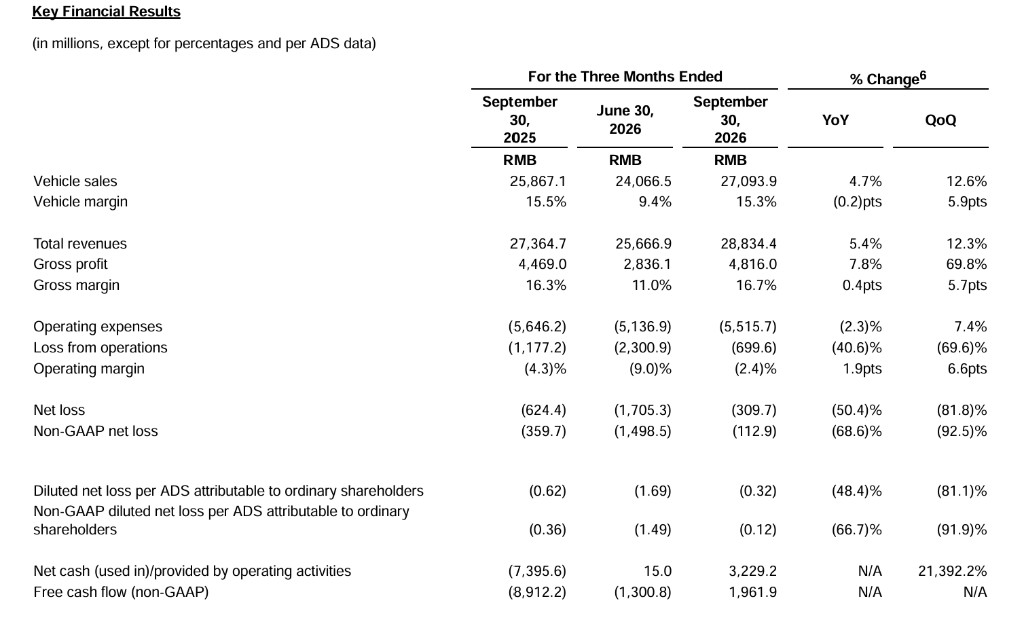
The company announced its unaudited third-quarter results on November 25. Revenue reached RMB 28.83 billion, a year-on-year increase of 5.4%, surpassing the Bloomberg consensus estimate of RMB 28.0 billion. The Gross Profit Margin was 16.7%, up 0.4 percentage points from 16.3% in the same period last year, far exceeding the estimated 13.6%. Third-quarter deliveries totaled 99,964 vehicles, a 7.2% year-on-year increase, but slightly below the estimated 102,489 units.
However, the company's guidance for the fourth quarter disappointed the market. Li Auto expects fourth-quarter revenue to be between RMB 31.7 billion and RMB 33.1 billion, while the Bloomberg consensus estimate is RMB 34.94 billion; expected deliveries are between 110,000 and 115,000 units, compared to an estimate of 130,281 units.
Gross Profit Margin Recovery Becomes the Highlight of Q3
The Gross Profit Margin increased by 5.7 percentage points sequentially to 16.7% in the third quarter, up from 11.0% in the second quarter. The vehicle gross profit margin was 15.3%, a substantial rebound from 9.4% in the second quarter, but a slight decrease of 0.2 percentage points from 15.5% in the same period last year.
The company stated that the slight year-on-year decline in vehicle gross profit margin was mainly due to differences in product mix, partially offset by estimated costs related to the Li MEGA recall in the third quarter of 2025; the sequential increase was primarily driven by changes in product mix.
The improvement in Gross Profit Margin drove gross profit to reach RMB 4.82 billion, a 7.8% year-on-year increase and a significant 69.8% sequential increase.
Losses Narrow Significantly, Free Cash Flow Turns Positive
Operating loss in the third quarter was RMB 699.6 million, a 40.6% narrowing from RMB 1.18 billion in the same period last year, and a 69.6% narrowing from RMB 2.30 billion in the second quarter. The operating margin was -2.4%, compared to -4.3% in the same period last year and -9.0% in the second quarter.
Net loss was RMB 309.7 million, a 50.4% narrowing year-on-year and an 81.8% narrowing sequentially. Net loss under non-GAAP measures was RMB 112.9 million, a 68.6% narrowing year-on-year and a 92.5% narrowing sequentially. Adjusted net loss attributable to shareholders was RMB 117.3 million, compared to an estimated loss of RMB 667 million.
Adjusted loss per ADS was RMB 0.12, compared to a loss of RMB 0.36 in the same period last year and an estimated loss of RMB 0.57. Loss per American Depositary Share (ADS) was RMB 0.32, compared to RMB 0.62 in the same period last year and an estimate of RMB 1.00.
In terms of cash flow, net cash generated from operating activities was RMB 3.22 billion, compared to a net outflow of RMB 7.40 billion in the same period last year. Free cash flow was RMB 2.0 billion, compared to negative RMB 891 million in the same period last year and negative RMB 130 million in the second quarter.
As of September 30, cash reserves stood at RMB 88.2 billion.
Divergence in Expenses, R&D Spending Continues to Increase
Operating expenses in the third quarter were RMB 5.52 billion, a 2.3% year-on-year decrease and a 7.4% sequential increase.
R&D expenses were RMB 3.12 billion, a 4.8% year-on-year increase and a 12.3% sequential increase. The company stated that the sequential increase was mainly due to increased costs supporting product matrix expansion and technological development.
Selling, general and administrative expenses were RMB 2.36 billion, a 14.7% year-on-year decrease, mainly due to reduced employee compensation and rent and other expenses related to sales and service networks; a 3.7% sequential increase, remaining largely flat.
Intensive Launch of New Products, Self-Developed Technology Forms Core Narrative
In September and October, the company sequentially launched the new Li MEGA, the flagship family SUV Li i9, and the 2026 Li i6, priced at RMB 509,800, RMB 369,800, and RMB 249,800 respectively. The three models feature the company's latest self-developed technologies, including the MACH M100 chip and Lianshan battery. Deliveries of the new Li MEGA and Li i9 began in September, and deliveries of the 2026 Li i6 began in October.
In October, the company held Power Day, releasing its self-developed Lianshan electric technology system covering batteries, electric drives, and charging infrastructure, and launching the Lianshan battery warranty program.
In the chip business, on October 16, the company announced that its subsidiary Shanghai Machixin Technology Co., Ltd., responsible for chip and domain controller business, completed equity financing. The company contributed RMB 1 billion through a wholly-owned subsidiary, and external investors contributed RMB 625 million.
Buyback Program Continues, Overseas Expansion Accelerates
Under the $1 billion buyback plan announced on March 24, 2026, the company repurchased 10.6382 million Class A ordinary shares for HKD 493.3 million on the Hong Kong Stock Exchange and 13.5623 million ADSs (corresponding to 27.1246 million Class A ordinary shares) for $169.7 million on Nasdaq in the third quarter. As of the date of the press release, the company had cumulatively repurchased approximately 102.3 million Class A ordinary shares (including approximately 23.7 million ADSs), at a total cost of approximately $694.4 million.
Internationally, the company launched the all-new Li L9 in the United Arab Emirates in September, made its European debut at the Paris Motor Show in October, and signed agreements with partners in Hong Kong, Thailand, Singapore, the Philippines, and Vietnam in November to advance expansion in the Asia-Pacific region. The company plans to debut the right-hand-drive version of the Li MEGA at the Thailand International Motor Show in December and list it in Hong Kong, followed by starting deliveries of the Li 6 (European-spec Li i6) in the Netherlands and Norway in the first quarter of 2027.
Management Commentary: Technological Moat Coexists with Cost Pressures
Li Xiang, Chairman and CEO, stated in the press release that self-developed technologies, from the MACH M100 chip to the Lianshan battery, are strengthening the company's competitive barriers. The integrated iteration of software and hardware brings tighter system integration, providing a differentiated user experience and enhancing supply chain resilience, a capability ultimately reflected in the stronger delivery performance in the third quarter.
CFO Li Tie stated that despite industry-wide cost pressures, the company's Gross Profit Margin improved sequentially to 16.7%, and free cash flow turned positive, reflecting product mix optimization, efficiency gains from self-developed technologies, and consistent operational discipline. He stated that with the update of the product matrix and the advancement of self-developed technologies, the company is capable of coping with market changes and further strengthening financial performance, and will continue to invest in deepening its technological moat and global expansion.
Q4 Guidance Below Expectations, Delivery Growth Nearly Stagnant
The company expects fourth-quarter deliveries of 110,000 to 115,000 units, a year-on-year increase of 0.7% to 5.3%; revenue of RMB 31.7 billion to RMB 33.1 billion, a year-on-year increase of 10.1% to 15.1%.
According to the Bloomberg consensus, the market originally expected fourth-quarter deliveries of 130,281 units and revenue of RMB 34.94 billion. The upper limit of the company's guidance is still significantly below expectations, implying that the year-on-year growth rate of fourth-quarter deliveries may approach zero.
For comparison, the company delivered 109,194 units in the fourth quarter of 2025. In October, the company delivered 29,025 units. As of October 31, the company had 481 retail stores in 160 cities in China, operated 527 service centers and authorized body repair and painting centers in 217 cities, and had put into operation 4,206 supercharging stations and 23,163 charging piles.
As of September 30, the company had 485 retail stores in 160 cities nationwide, operated 532 service centers and authorized body repair and painting centers in 217 cities, and had put into operation 4,188 supercharging stations and 23,077 charging piles.
For investors, the improvement in profit margins and cash flow in the third quarter has been verified. The key variables lie in whether new models can effectively translate into delivery volumes from the fourth quarter to early 2027, and whether investments in self-developed technologies can continue to support Gross Profit Margin amid industry price and cost pressures.
More updates to follow...