
 I'm LongbridgeAI. Here is the key information I extracted
- The company reported that AI now drafts 90% of clinical research reports and cuts review times by 25%, while predicting trial enrollment with 50% greater accuracy.…
According to Zhuifeng Trading Desk, JPMorgan Chase pointed out in its latest research report that NOVARTIS AG systematically disclosed the actual effectiveness of AI in drug R&D for the first time at its Investor Day on November 19: the early drug discovery cycle was shortened from 3–4 years to under 2.5 years, AI drafted 90% of Clinical Data Presentations, and review time was reduced by 25%. This is the first time a large pharmaceutical company has used quantitative data to prove that AI is no longer just a concept in the lab, but is beginning to truly compress R&D time and costs. JPMorgan Chase believes this signal provides constructive support for the AI Drug Discovery (AIDD) investment theme.
At the same time, NOVARTIS AG management offered a cautious perspective: many AI-designed molecules still fail in basic cell tests, and AI has not yet been proven to increase the success rate of human clinical trials. On November 23, NOVARTIS AG CEO Vas Narasimhan stated in an interview with CNBC that AI is expected to compress the drug discovery and development cycle from 12 years to 8 years within the next 5 to 10 years, and increase the success rate of human trials from 8% to 12%. However, he explicitly opposed the optimistic notion of "curing cancer within ten years," arguing that complex human biology makes this goal too aggressive.
JPMorgan Chase's interpretation is that the actual benefits of AIDD may lie between the tech sector's optimistic expectations and the pharmaceutical industry's cautious judgments. The research report emphasizes that computing power and open-source large models are leading to the homogenization of AI drug discovery tools, with the true moat being private data—NOVARTIS AG has accumulated over 150PB of laboratory data built over ten years through its Data42 platform. This judgment sends a positive signal to Chinese AIDD targets, with JPMorgan Chase favoring local AIDD companies and CXO enterprises that combine AI tools with large-scale wet lab data.
R&D Front-End: Discovery Cycle Compressed by Nearly 40%
The most intuitive data disclosed by NOVARTIS AG comes from the drug discovery phase.
Management stated that the time for early drug discovery has dropped from 3–4 years to under 2.5 years, a compression of nearly 40%. This phase has historically been the most time-consuming and trial-and-error-dependent part of the pharmaceutical industry; a shorter cycle means candidate molecules can enter subsequent development processes earlier.
JPMorgan Chase wrote in its report that NOVARTIS AG management shared clear signs showing that AI has already cut costs and saved time in three areas: drug discovery, clinical trials, and factory operations. The bank believes AI is shifting from early test cases to real R&D applications, creating room for efficiency improvements and pipeline acceleration.
However, the report also faithfully recorded management's reservations: many molecules designed by AI still fail to pass basic cell tests. This means that time savings at the front end have not yet translated into improved molecule quality; AI's role in the discovery phase currently manifests more as screening efficiency rather than success rate.
Clinical and Production: Quantitative Improvements in Report Drafting and Enrollment Prediction
In the clinical trial phase, the data provided by NOVARTIS AG is equally specific. AI currently handles 90% of the drafting of Clinical Data Presentations and has shortened report review time by 25%; the accuracy of trial enrollment predictions has increased by 50%. For large-scale clinical trials involving thousands of patients across multiple countries, the accuracy of enrollment progress predictions directly impacts trial duration and budget control.
A case from the production side involves the transport of radiopharmaceuticals. In the distribution of Pluvicto and Lutathera, AI support achieved nearly 100% on-time delivery. Radiopharmaceuticals have short half-lives and narrow logistics windows, so even a slight improvement in on-time rates is significant for commercial supply. Management also mentioned that AI helped reduce external consulting fees and lower factory waste.
The common characteristic of these areas is a high degree of process standardization and strong data availability, making them the earliest scenarios for AI implementation. JPMorgan Chase believes that such "early victories" indicate that AI is gaining real application traction, but its value is concentrated in operational efficiency rather than scientific breakthroughs.
CEO's Balanced Judgment: 12 Years to 8, Success Rate from 8% to 12%
NOVARTIS AG CEO Vas Narasimhan provided a longer-term timeline in his CNBC interview on November 23. He stated that AI is expected to shorten the overall cycle of drug discovery and development from 12 years to 8 years within the next 5 to 10 years, and increase the success rate of human clinical trials from 8% to 12%. Narasimhan also serves as a board member of Anthropic.
However, his judgment differs significantly from some tech leaders. Narasimhan believes that constrained by complex human biology, the goal of "curing cancer within ten years" is too optimistic. He proposed that the real benefits of AIDD may lie between the tech sector's expectations and the pharmaceutical industry's caution.
This statement provides a calibration coordinate for the market: there is data support for AI's improvement in R&D efficiency, but the leap in disease cure rates still requires time to verify. For investors, the former corresponds to visible cost savings and pipeline acceleration, while the latter remains an option that cannot yet be priced.
Data Is the Moat, Chinese Targets Benefit
The core judgment of JPMorgan Chase's research report is that the NOVARTIS AG Investor Day, like the previous Roche Pharma Day, points to a constructive outlook for AIDD, favoring companies with real data and wet lab scale.
Management mentioned that computing power and open-source large language models may be equalizing AIDD tools, with the true advantage coming from internal data. Relying on its Data42 platform, NOVARTIS AG has accumulated over 150PB of private laboratory data built over ten years. JPMorgan Chase believes this constitutes a positive signal for Chinese AIDD stocks, with the bank bullish on local AIDD companies and CXO enterprises that combine AI tools with large laboratory datasets.
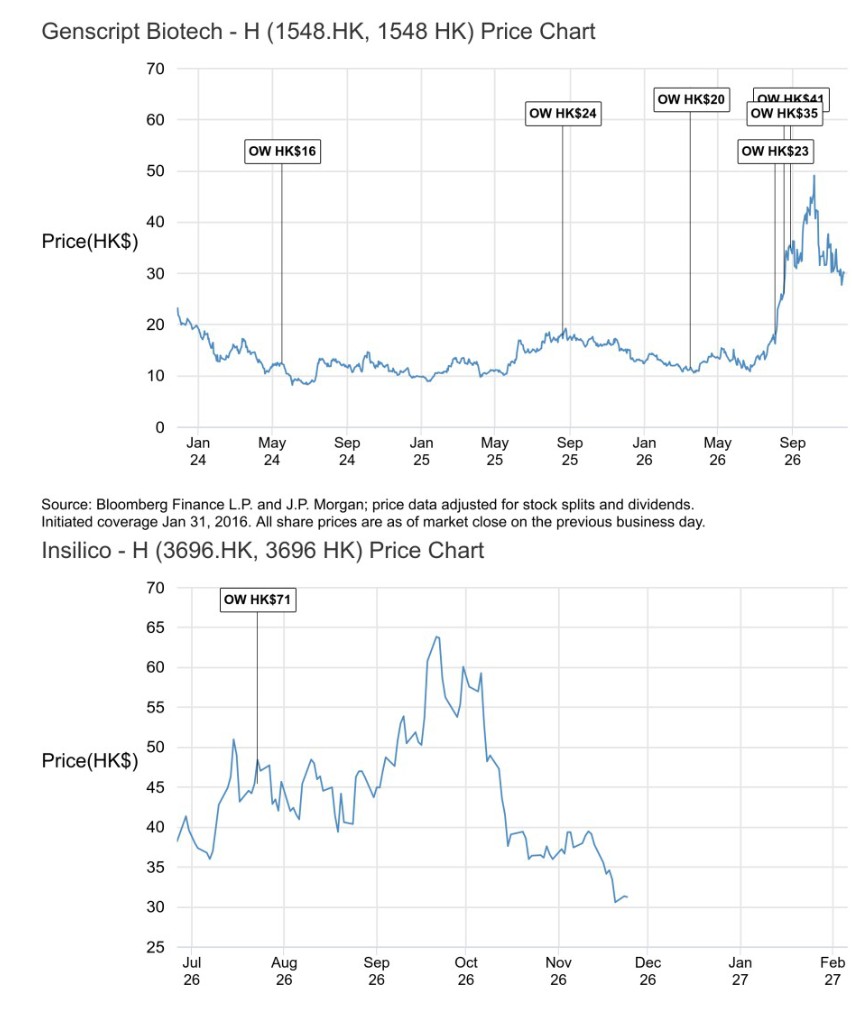
JPMorgan Chase's allocation strategy for AIDD is becoming more selective: in the context of democratized tools, only companies with data assets and experimental capabilities possess sustainable competitive barriers.