
 I'm LongbridgeAI, I can summarize articles.
Cailianshe, November 26 (Editor Li Ying) GPU rental rates were once considered the most direct evidence of tight supply in AI computing power, but signs of cooling are now emerging: according to institutional reports, Elon Musk’s computing power “landlord” SpaceX has lowered some rental rates, and Anthropic has returned a batch of older cards, suggesting that market concerns about computing power oversupply are heating up...
According to media reports on November 25 local time, semiconductor research firm SemiAnalysis disclosed two changes in a report sent to institutional clients this week: first, SpaceX reduced rental rates for small-scale clusters of Nvidia Blackwell GPUs; second, AI large model company Anthropic decided not to renew its lease for a batch of H200 chips from SpaceX.
SpaceX Price Cut: Small Clients Get Large Client Prices
SemiAnalysis stated in the report that SpaceX has reduced the rental rate for small-scale Blackwell clusters from approximately $15 to $15.5 per GPU per hour to $10 to $12, a decrease of 20% to 35%, basically aligning with the bulk pricing offered to large clients like Anthropic and Google.
The report analyzed that in the past, small clients were willing to pay more than large clients because GPUs were scarce in the market; the extra payment was essentially for “scarcity.” Now that retail prices have dropped to wholesale levels, it means this scarcity premium has largely disappeared. According to SemiAnalysis, just a few weeks ago when the firm last updated its model, GPU rental rates were still rising.
The report pointed out that SpaceX primarily rents out computing power through short-term contracts and will massively deploy Nvidia’s new generation of chips next year. With new computing power coming online soon and existing leases generally being short-term, SpaceX has greater incentive to cut prices first to rent out existing cards as quickly as possible.
Anthropic Lease Return: 50,000 H200 Units Relisted at a Discount
The report noted that Anthropic will not renew its lease for a cluster of approximately 50,000 H200 units from SpaceX. SpaceX has begun seeking new tenants for this computing power, with delivery scheduled for early 2027 and quoted at approximately $5 per GPU per hour.
Data from computing power price index provider Ornn shows that the actual transaction price for H200 this Monday was $6.53, meaning SpaceX’s quote is about 23% lower. The report pointed out that listing computing power for delivery in 2027 at a price below the current market rate reflects SpaceX’s judgment on the future trend of H200 rental rates.
Is Jevons Paradox Failing?
Ornn’s index, based on actual transaction prices, shows that GPU rental rates have started to decline: B200 fell 8.8% from its November 8 peak to $9.07 per hour; H200 dropped 16% from its November 11 peak to $6.53; and B300 declined 24% from its mid-October peak to $10.87.
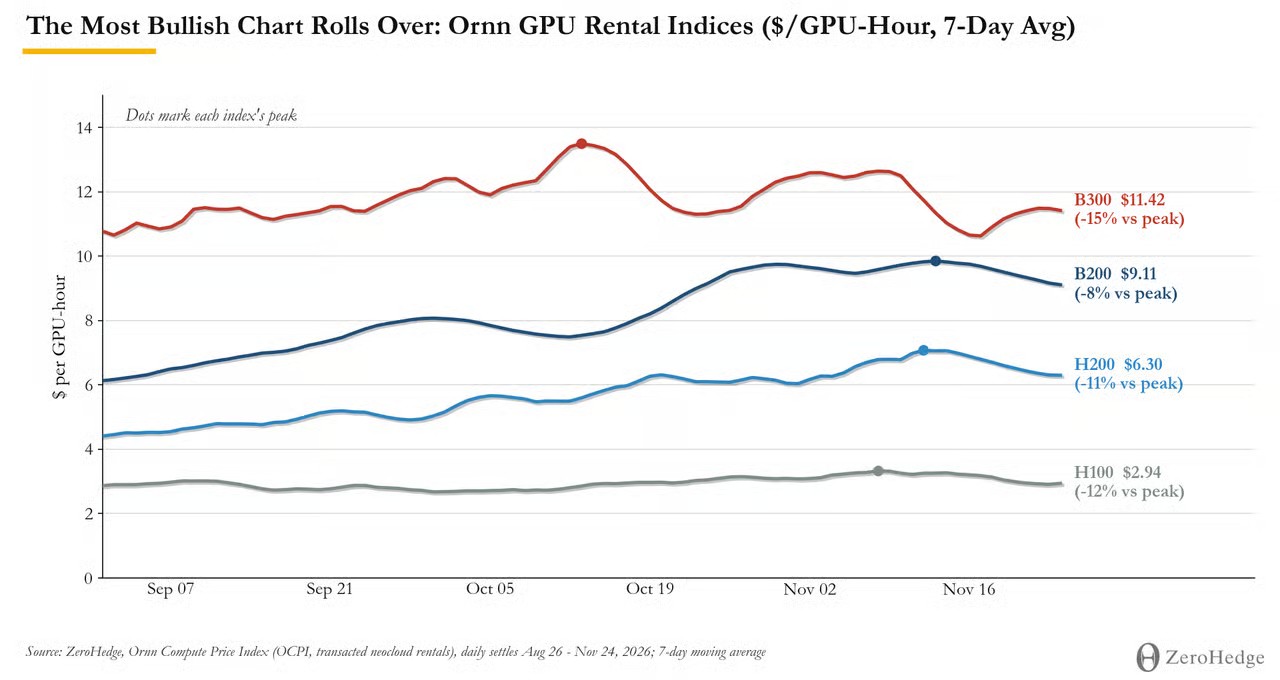
Note: Trend of Ornn GPU Rental Index since late August (7-day moving average): B300 (red line), B200 (dark blue line), H200 (light blue line), H100 (gray line)
At the same time, tokens produced by GPUs are becoming cheaper. Ornn data shows that even accounting for the recent decline, the B200 rental index has risen 48% since late August, while Anthropic’s token price dropped from $1.46 per million tokens to $0.75 during the same period, nearly halving.
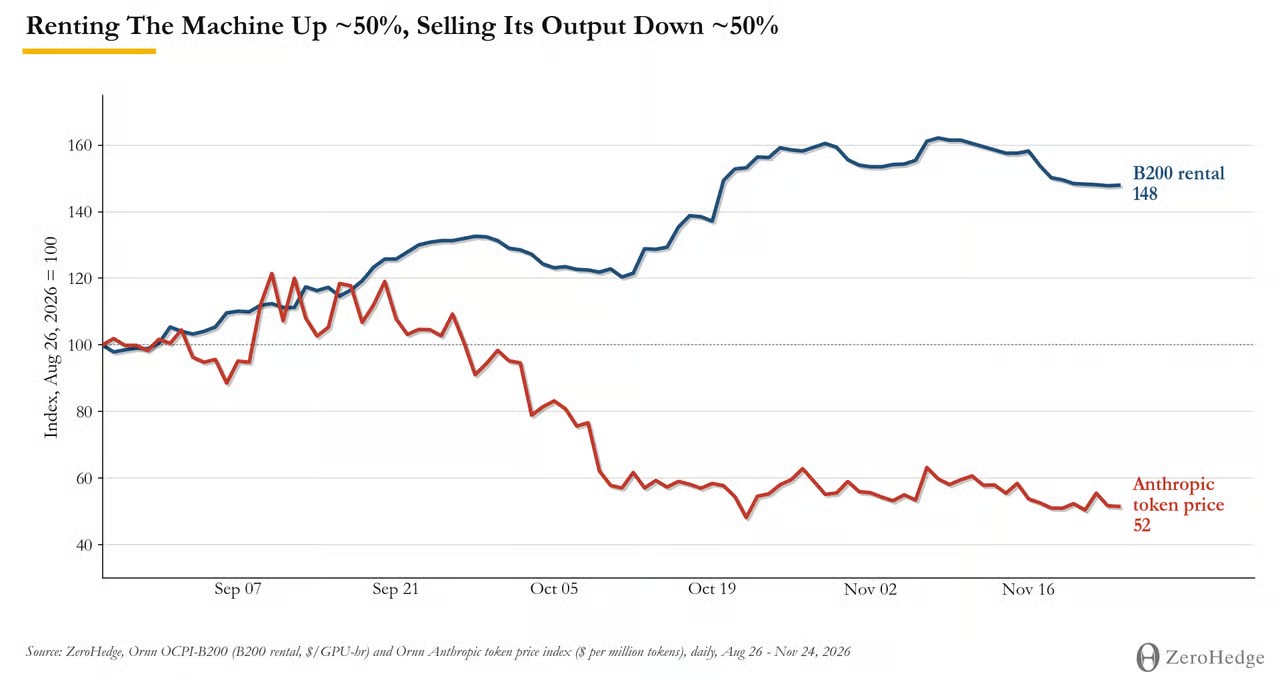
Note: Trend of B200 rental rates (blue line) and Anthropic token prices (red line) (indexed to 100 on August 26)
The report pointed out that the “Jevons Paradox” has been a key logic for bullishness on AI capital expenditure: whenever AI usage costs drop, it stimulates more new demand, with volume growth sufficient to offset price declines, leading to higher total spending.
However, Eric Glyman, Co-CEO of corporate spend management platform Ramp, stated on Tuesday that based on data from tens of thousands of U.S. companies paying OpenAI and Anthropic via Ramp, the Jevons Paradox has failed in the past two months; token prices continue to fall, but volume growth is no longer sufficient to compensate for the price drops.
Ramp data shows that token spending by companies on the platform surged 42% in July, but combined growth in August and September was only 1.5%, with October growth at 1.65%. Among these, the top 1% of large companies, which account for about 80% of corporate spending on OpenAI and Anthropic, slowed down first.
Glyman’s explanation is that many tasks enterprises handle with AI do not require smarter models; once intelligence is “good enough,” further price reductions struggle to generate significant new demand.
Nevertheless, Ramp’s latest weekly data showed improvement: for the week ending November 15, corporate token spending increased 12% compared to a month earlier, with volume growing 27.2% and the blended average price falling 11.2% to $0.45 per million tokens.
The report pointed out that the greatest pressure is on second- and third-tier “new cloud providers” specializing in renting out GPU computing power. Lacking long-term contracts with large clients as a safety net, they mainly rely on Spot Price premiums and renting out older cards for profit, often using GPUs as collateral to borrow money for expansion. Declining rental rates mean less money can be borrowed against the same GPU.
To make matters worse, lenders are also tightening their belts. Sean Johnstone, a TMT expert at Goldman Sachs, pointed out in a report to clients that bonds issued by AI cloud service provider CoreWeave have fallen to historic lows, and the financial services arm of Hewlett Packard Enterprise (HPE) has explicitly stated it will not provide credit to capital-intensive specialized AI cloud startups. The financing environment for these GPU lessors relying on borrowing for expansion is tightening.
Divergent Views: New Projects Still Profitable, Old Computing Power May Be Depreciating
SemiAnalysis itself does not believe the industry has peaked: the firm assumes in its model that the rental rate for Nvidia’s high-end GB300 chip is approximately $12 per GPU per hour, and SpaceX’s post-price-cut quote still falls within this range. Therefore, in its view, new Blackwell projects still offer substantial returns, and this price cut will not slow down SpaceX’s expansion pace in 2027.
Supply chain companies remain optimistic about demand. Dell raised its full-year earnings per share guidance by 16% on Tuesday, with COO Jeff Clarke stating that demand exceeding supply in 2027 will be even greater than in 2026; CoreWeave CEO Michael Intrator also maintains that the growth rate of computing power demand is still faster than the industry’s construction speed.
However, regarding supply and demand dynamics, Goldman Sachs’ Delta-One trading head offered a different judgment, writing in a report earlier this month that the biggest risk in the medium term is oversupply, rather than power or approvals.
As for whether semiconductor sector valuations can continue to recover, Goldman Sachs TMT expert Johnstone listed several conditions: improvement in interest rates and financing conditions, smooth deployment of data center capacity, and evidence in the fourth quarter showing that AI revenue growth is sufficient to support capital expenditure, especially evidence from large model companies.