
 I'm LongbridgeAI, I can summarize articles.
Source: Kairos Research: Compiled by: Shaw, Jinse Finance
Some digital asset treasury (DAT) companies appear to have begun selling off their holdings, pushing their market capitalization (mNAV) back to around 1. In the past few weeks, Silvia (stock code SVIA, formerly ProCap Financial), Bit Digital (BTBT), BTCS (BTCS), Upexi (UPXI), and Solana Company (HSDT) have collectively sold approximately 410 BTC, 57,300 ETH, and 986,000 SOL, with a total value of approximately $203 million based on the price on the day the tokens were sold. These companies have one thing in common: their share prices are significantly lower than their market capitalization (mNAV).
This makes it difficult (or even impossible) for them to continue using their original growth model—increasing their holdings of underlying digital assets through issuing new shares or taking on debt. The reason is that when the issue price is lower than the value of the underlying crypto asset, each newly issued share dilutes the corresponding crypto asset holding per share, rather than increasing it. Two of the five companies have publicly disclosed related operations. BTCS disclosed in its 8-K filing on November 23 that it sold approximately 27,300 ETH on November 20 to repay a $43.8 million loan on the Aave platform. Bit Digital filed its 8-K on the evening of November 24 (hours after we completed its on-chain transaction traceability), disclosing that it sold 29,825 ETH, worth approximately $50 million, between November 15 and November 23, halving its loan to Galaxy. The sales data for the remaining three companies comes from our independent on-chain tracking: we linked all wallet addresses corresponding to each company's treasury to all its filings. Before classifying a recent on-chain transaction as a sale, we first verify that the same wallet and the same transfer path can reproduce the company's publicly disclosed sales records. The verification results of this method are as follows: Silvia's Q3 sales, tracked on-chain, were exactly 320 BTC, perfectly matching the reported 320 BTC; Bit Digital's sales were 1625 ETH, consistent with the reported value; Solana Company's Q1 sales were estimated at $5.459 million, with a reported amount of $5.452 million; Upexi's quarterly net difference error was controlled within approximately 4000 SOL. These verification results give us a high degree of credibility regarding the transaction behavior of these wallets after their last reported transaction. Bit Digital's announcement was the first live test of this method against undisclosed selling activity, and the results were verifiable: using only on-chain data, we identified that 24,793 ETH were transferred out through Galaxy between November 15th and November 21st, accounting for approximately 83% of the total 29,825 ETH sold as disclosed; we calculated that its remaining holdings were equivalent to approximately 138,900 ETH, compared to the company's latest disclosed value of 134,532 ETH; at the same time, we correctly identified that the LsETH transferred out in November was collateral pledged to Galaxy, and we counted 69,088 LsETH, while the announcement showed that 69,089 LsETH were used as collateral for loans. The percentage of ETH sold by different treasuries relative to their holdings varies greatly: BTCS sold nearly half of its reported ETH holdings at the end of September; Solana Company transferred about a quarter of its SOL to brokerage and trading accounts, and the funds have not been returned; Bit Digital sold approximately 18%, and Upexi sold approximately 15%; Silvia sold the least, 410 BTC, accounting for only 8%. This sell-off followed the most predictable pattern: it was executed in nine separate transactions, each containing 35-80 BTC, all transferred to the same address. This address held all of Silvia's previous sell-offs, and only Silvia's own wallets made the transfers to this address. These companies did not sell directly on the exchange's order book. Crypto assets were transferred through custodians, prime broker hot wallets, and over-the-counter trading desks, so these sell orders wouldn't appear as large orders on public exchanges. The specific transfer path is as follows:
- Silvia: One of the tokens was transferred to Cumberland DRW's wallet along with a transfer of 1000 BTC.
- Upexi: On Sunday, November 15th, the company transferred 329,499 SOL to the BitGo shared hot wallet; in the following 36 hours, the wallet transferred 352,530 SOL to multiple dealers and exchanges, including Wintermute, Kraken, Coinbase Prime, FalconX, Binance, and LMAX. The wallet's regular holdings are only about 198,000 SOL. Of the funds flowing into this wallet in the past three days, 96% came from Upexi. Furthermore, the outflowing funds did not go to BitGo or other lenders, indicating that this transfer was completed using Upexi's tokens, not through collateralized lending. Solana Company: A large transfer of 465,976 SOL was sent to FalconX. Within a day, an equivalent amount of SOL was transferred to deposit addresses on OKX and Kraken. Bit Digital: Galaxy Digital transferred approximately 24,800 ETH to a Coinbase deposit address via its hot wallet within 3.5 days. Bit Digital later confirmed that this portion of ETH was assets it sold.
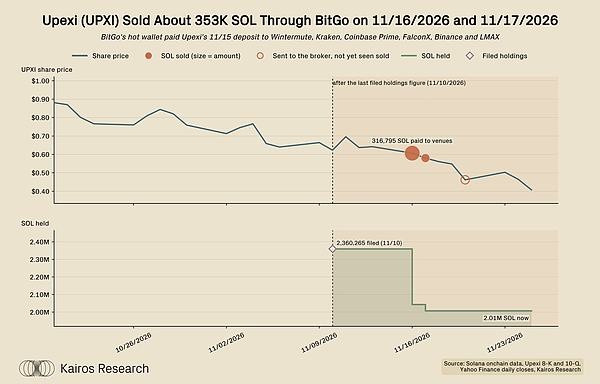
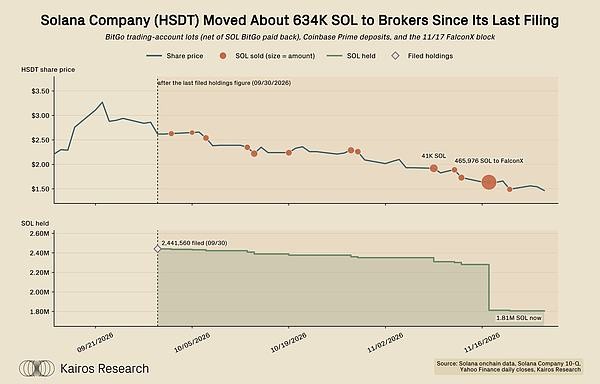
From the timing of the sell-off, the driving factor was more balance sheet pressure than a change in view of the underlying assets:
Gain a broader understanding of the crypto industry through informative reports, and engage in in-depth discussions with other like-minded authors and readers. You are welcome to join us in our growing Coinlive community:https://t.me/CoinliveSG