
 I'm LongbridgeAI. Here is the key information I extracted
- The margin recovery was primarily driven by reducing dependence on CATL and increasing the procurement share of Sunwoda batteries to 45%.…
Competition in the automotive industry is shifting from scale expansion to a contest of cost and efficiency, with Li Auto attempting to regain profit growth space by restructuring its supply chain.
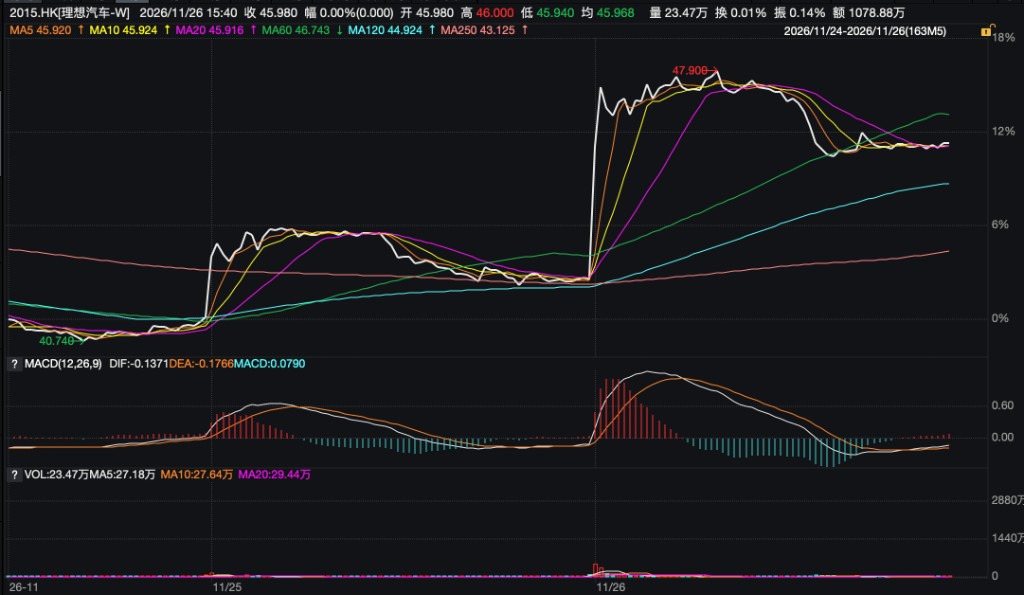
On November 26, Li Auto's Hong Kong shares surged more than 11% during trading. The previous night, the company released its third-quarter 2026 financial report, showing that vehicle gross profit margin rose to 15.3%, a substantial quarter-on-quarter increase of 5.9 percentage points. Net loss narrowed significantly, and free cash flow turned positive from negative. The profitability, which had been under continuous pressure, finally showed clear signs of repair.
Following the earnings release, Wall Street's attitude toward Li Auto also showed warmth amidst divergence. Citi pointed to battery supply chain adjustments as a key reason for the margin rebound; JPMorgan ended its previous underweight rating and upgraded Li Auto to neutral; UBS maintained its buy rating, believing that the company's current valuation has become somewhat attractive.
Among these, the most noteworthy change comes from the battery supply chain. Li Auto is reducing its reliance on CATL and increasing the proportion of Sunwoda battery purchases. Citi estimates that Sunwoda's share in Li Auto's Q3 purchases rose from 5% in Q2 to 45%, with this single adjustment contributing about 3.2 percentage points to the vehicle gross profit margin.
However, a single-quarter margin rebound is not enough to prove that an operational turning point has been fully established. Li Auto next plans to slow the pace of model updates, compress R&D expenditures, and accelerate overseas expansion. For the market, what truly needs to be verified is whether this round of profit improvement achieved through supply chain adjustments can sustain into 2027.
Sunwoda's Share Rises to 45%, Supply Chain Adjustment Becomes Key to Profit Counterattack
The rebound in Li Auto's Q3 gross profit margin primarily stems from changes in the battery supply chain. Citi's automotive team estimates that Sunwoda's share in Li Auto's purchases increased significantly from 5% in Q2 to 45% in Q3. In just one quarter, Sunwoda's position in Li Auto's battery supply system rose significantly, while Li Auto's reliance on CATL correspondingly decreased.
This adjustment is directly reflected in the vehicle gross profit margin. According to Citi's calculations, the change in battery supplier structure contributed about 3.2 percentage points to the Q3 vehicle gross profit margin. Facing cost pressures such as rising prices for memory chips, Li Auto reduced battery costs by adjusting its procurement structure, creating room for margin repair.
However, supply chain cost reduction is not the only factor. Improved deliveries of models such as the L8, i9, and MEGA in Q3 shifted the product mix towards higher-priced vehicles, raising the average selling price per vehicle by 11% quarter-on-quarter to RMB 271,000. The combined effect of higher selling prices and optimized battery costs pushed the vehicle gross profit margin to 15.3%, an increase of 5.9 percentage points quarter-on-quarter.
This is also the most noteworthy aspect of Li Auto's latest financial report: the company is not solely relying on sales volume growth to improve performance, but is beginning to enhance the profit obtained from each vehicle sold through supply chain bargaining, procurement structure adjustments, and product mix optimization.
Losses Narrow Significantly, Cash Flow Turns Positive, Performance Repair Verified
Improvements in gross profit margin have translated into overall financial performance. Visible Alpha's consensus expectation was for Li Auto's Q3 net loss to be around RMB 926 million, whereas the actual net loss was only about RMB 310 million, a significant narrowing from RMB 1.7 billion in Q2, clearly beating market expectations.
More important than the narrowing loss is the improvement in cash flow. Li Auto's free cash flow in Q3 reached RMB 1.962 billion, compared to a negative RMB 1.3 billion in Q2. Free cash flow turning positive again indicates that while improving gross profit margin, the company's cash collection and operational quality have also improved.
The balance sheet provides another layer of support. According to JPMorgan data, based on the stock price at the time, Li Auto's market capitalization was approximately USD 11.1 billion, while total cash on hand at the end of Q3 was about USD 13.2 billion, with net cash of approximately USD 11.6 billion. In other words, the company's market capitalization is already lower than its net cash on hand.
This valuation gap has also become an important reason for institutions to re-evaluate Li Auto. However, cash on hand does not equate to future profits, and the market ultimately needs to see sustained improvement in operational performance, rather than valuation supported solely by cash reserves.
Shifting from Expansion to Efficiency Priority, Li Auto Proactively Adjusts 2027 Operational Strategy
Whether the profit improvement in Q3 can continue depends on whether Li Auto can transform supply chain cost reductions into long-term cost advantages. For Q4, the company provided relatively positive guidance: expected deliveries of 110,000 to 115,000 units, and revenue of RMB 31.7 billion to RMB 33.1 billion, representing a year-on-year increase of 10.1% to 15.1%. Management expects that benefiting from falling lithium prices and improved efficiency of self-developed technologies, Q4 gross profit margin will continue to improve, with the potential to achieve profitability.
However, entering 2027, Li Auto's operational strategy will focus more on input-output efficiency. Both JPMorgan and Citi mentioned that the company plans to extend the model update cycle from about one year to two years, with only 1 to 2 new facelift models expected to launch in 2027. Compared to the previous dense rollout of new products, Li Auto is proactively slowing down its product iteration pace.
R&D expenses will also contract accordingly. Institutions estimate that Li Auto's R&D expenditure in 2026 will be around RMB 11.8 billion to RMB 12 billion, potentially dropping to around RMB 10 billion in 2027. Reducing R&D investment helps improve expense-side performance, but balancing cost control with maintaining product competitiveness will be a challenge Li Auto needs to address in the next stage.
Meanwhile, the overseas market is pinned with new growth expectations. Management expects overseas sales to double year-on-year in 2027. Currently, the L9 is already on sale in the UAE, the pure electric model i6 is scheduled to begin deliveries in Norway and the Netherlands in Q1 2027, and the right-hand drive version of the MEGA is planned for launch in Hong Kong, China, in December 2026. However, Citi points out that since the company has not disclosed the base figure for overseas sales, the visibility of the doubling target remains limited.
Wall Street Re-evaluates Li Auto, Sustainability of Profit Repair Remains Key
Following the Q3 performance improvement, institutional attitudes toward Li Auto began to change, but differences remain regarding its long-term growth prospects.
JPMorgan upgraded Li Auto's rating from underweight to neutral. The bank believes that the improvement in Li Auto's margins and free cash flow has certain sustainability, but factors such as weakening terminal demand in 2027 and reduced export tax rebates will still constitute pressure.
Citi maintained its neutral rating while initiating a 30-day upward catalyst watch, adjusting the target price to USD 12.6, corresponding to HKD 48.5 for Hong Kong shares. The bank uses a sum-of-the-parts valuation method, setting the expected 2027 price-to-sales ratio for Li Auto's automotive business at 0.7x, and maintaining a valuation of RMB 5 billion for its robotics business.
UBS is relatively optimistic, maintaining a buy rating with a 12-month target price of USD 17. According to Visible Alpha consensus expectations, Li Auto currently trades at an expected 2027 price-to-sales ratio of about 0.51x, close to XPeng's 0.52x and higher than NIO's 0.29x.
The valuation differences among various institutions reflect divergent market judgments on Li Auto's future growth and profitability. The Q3 performance proves that adjusting the supply chain can indeed bring considerable cost improvements, but this is only the starting point for profit repair.
For Li Auto, the true test lies in whether it can solidify the cost advantage brought by Sunwoda into long-term competitiveness and maintain market share while slowing down product investment. If the improvement in gross profit margin and the turnaround in free cash flow can continue, then this supply chain adjustment may represent not just a one-quarter performance rebound, but a significant shift in Li Auto's business model.
Risk Warning and Disclaimer
The market carries risks; investment requires caution. This article does not constitute personal investment advice, nor does it take into account the specific investment objectives, financial status, or needs of individual users. Users should consider whether any opinions, views, or conclusions in this article align with their specific circumstances. Investment based on this content is at the user's own risk.