
 I'm LongbridgeAI, I can summarize articles.
Author: Frank, PANews
During the last surge, publicly traded companies were among the most stable buyers in the crypto market. They issued stocks and bonds to buy tokens like Bitcoin, Ethereum, and Solana, then used the rising prices of these tokens to drive up their stock prices, allowing them to continue raising funds to buy more.
By November 2026, publicly traded companies collectively held approximately 1.3 million Bitcoins, approximately 7.5 million to 7.9 million Ethereums, and approximately 19 million SOLs, representing approximately 6%, 6%, and 3% of their respective circulating supplies. Now, the market capitalization of these companies is generally lower than the value of their holdings, most have stopped buying, and some have begun selling.
12 financial companies that have sold cryptocurrency:
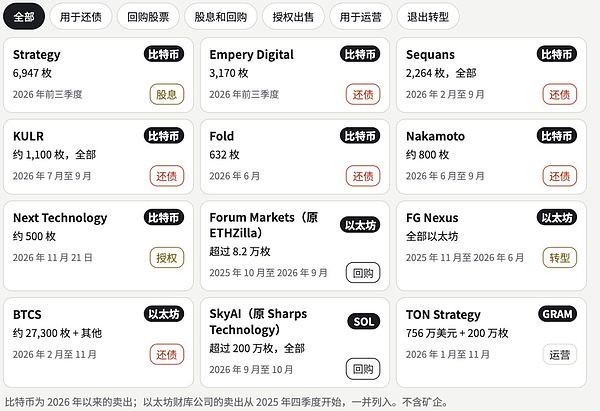
Three types of selling pressure: plans to sell cryptocurrency, debt maturing, and cryptocurrency already pledged
PANews categorizes potential sales into three types based on certainty. There is overlap between the three types, and they cannot be added together.
PANews categorizes potential sales into three types based on certainty. The three types overlap and cannot be added together.
· There is a plan to sell coins

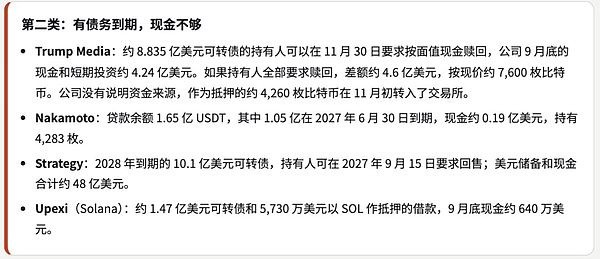
· Debt maturity
· Coin has been staked
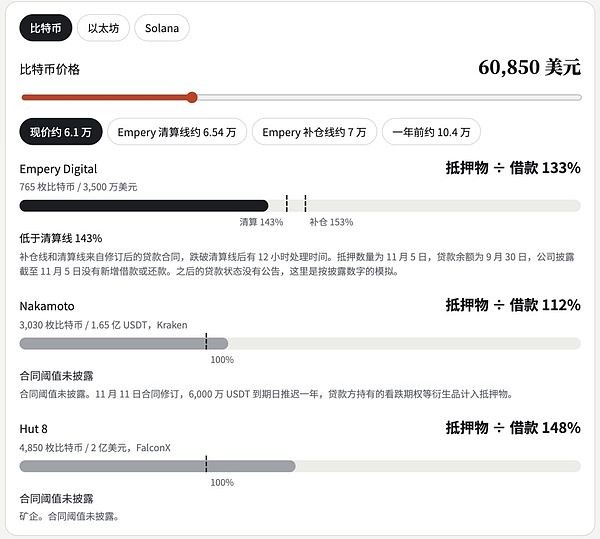
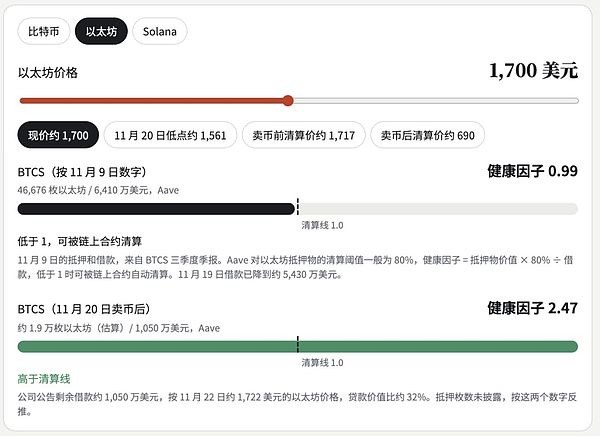
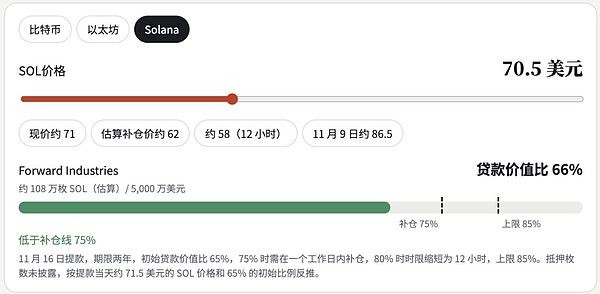
Calculated based on the amount of collateral and loan balance disclosed in the quarterly report or announcement, excluding subsequent additional collateral, repayments, and derivative positions, and does not represent the current actual collateral ratio of each company.
Calculated based on the amount of collateral and loan balance disclosed in the quarterly report or announcement, excluding subsequent additional collateral, repayments, and derivative positions, and does not represent the current actual collateral ratio of each company.
This year has seen several instances of companies adding to their collateral or selling tokens to meet their collateral ratios: Fold added 50 Bitcoins in February, Empery added 576, and Nakamoto added 688 before selling to repay loans; BTCS sold Ethereum three times—in February, Q2, and November 20th—to repay loans from Aave. Whether these companies have added collateral or repaid amounts after their quarterly reports will be revealed in the next announcement. Largest Holders: Strategy and BitMine have no immediate reason to sell. Strategy holds 851,305 Bitcoins at an average cost of $75,446, representing a current unrealized loss of approximately $12.4 billion. BitMine holds 6,085,564 Ethereum, approximately 4.98% of the total supply, worth approximately $10.4 billion at the current price, roughly half its purchase cost. Neither company has any collateralized loans, and there is no liquidation price. Strategy's reserves and cash as of November 22nd, and its convertible bonds maturing in 2028, with holders able to exercise a put option on September 15th, 2027. BitMine's cash and liabilities as of the end of fiscal year August 31st, preferred stock dividends calculated based on 3.5 million shares issued in June, with a par value of $100 and a 9.5% yield, and staking income from the previous fiscal year. The two companies with the largest holdings of cryptocurrency are currently facing a problem of being unable to buy more, rather than being forced to sell. HYPE's largest treasury, Hyperliquid Strategies, also has no debt. The risk of forced sales is concentrated in smaller companies with mortgages or short-term debt: Bitcoin's Trump Media, Nakamoto, and Empire Digital, and Solana's Upexi. Ethereum's BTCS already sold half of its holdings on November 20th to repay debts. Looking at different currencies: Ethereum and Solana's risks lie in smaller companies; HYPE's treasury has no debt. Upexi holds approximately 2.35 million SOL, worth about $168 million at current prices, lower than its approximately $204 million in convertible bonds and mortgage loans. It was also removed from the MSCI index on November 30th. The situation is the opposite for HYPE: Hyperliquid Strategies has an average cost of $56.35, which is still slightly above the cost at the current price of about $62, making it the only major treasury company among the seven currencies that does not have unrealized losses.
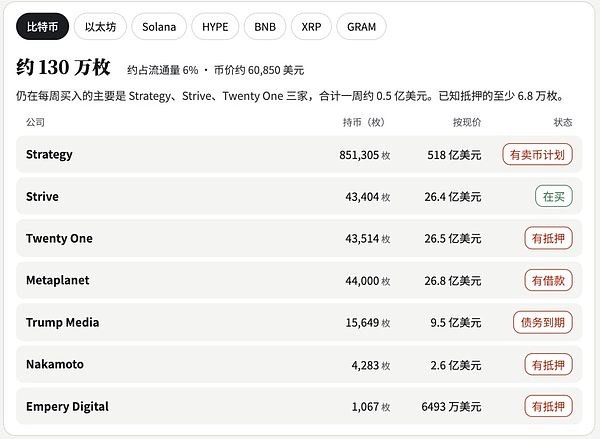
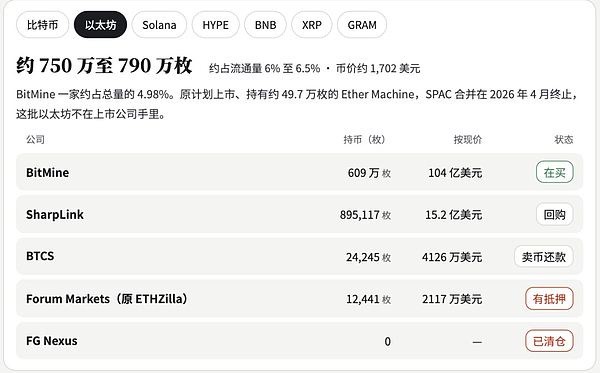
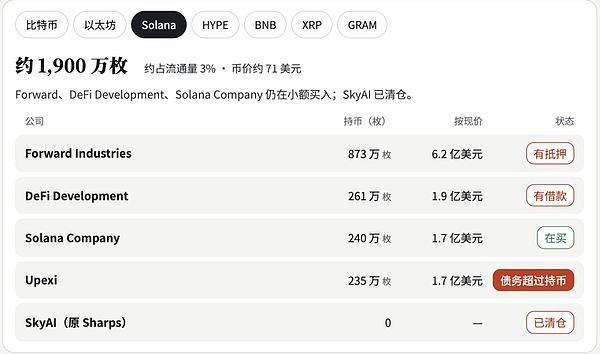




Holdings are based on each company's most recent announcement or quarterly report. "At current price" is the number of holdings multiplied by the price on November 26th. Click on a row to see details.
Scale comparison: The potential selling by Treasury companies is less than the outflow of ETFs in one month
Taking Bitcoin as an example.
The US spot Bitcoin ETF saw net outflows of approximately $4.94 billion in November, the largest monthly outflow since its listing in 2024. ETF outflows are calculated at current prices, and the actual outflows occurred at different price levels. Strategy's $1.25 billion cap on selling Bitcoin to raise funds to replenish dollar reserves, announced in June, is calculated at current prices; this is not the maximum amount of Bitcoin Strategy can sell. Next Technology's plan allows the sale or pledging of its remaining 5,333 Bitcoins, without a committed quantity, and is therefore not included. Trump Media's funding gap assumes all convertible bondholders will redeem their bonds, using the redemption amount minus cash and short-term investments at the end of September; this does not guarantee that the company will sell Bitcoin. Other cryptocurrencies are in a similar situation. Regarding Ethereum, of the three companies that sold their tokens, FG Nexus has already liquidated its holdings, Forum Markets and BTCS, according to their latest disclosures, hold a combined total of approximately 37,000 tokens, and the largest, BitMine, has no collateralized loans. As for Solana, the Forward collateralized loan, nearing its trigger point, is only $50 million. This means that, in terms of scale, treasury firms are currently not the largest sellers in the market. Their impact is twofold: first, the hundreds of millions to billions of dollars in weekly purchases of the past have disappeared; second, their sales are triggered by debt maturity dates and collateral ratios, with relatively concentrated timing and price. For cryptocurrency investors, three figures are worth tracking: Strategy's USD reserve balance; the price of cryptocurrencies corresponding to loans secured by companies like BTCS, Forward, and Empire; and weekly net buying or selling by crypto treasury companies. These three figures are more indicative of changes in selling pressure than the total amount of cryptocurrency held. [Frequently Asked Questions] Are crypto treasury companies still buying cryptocurrency? Most have stopped. In the Bitcoin sector, the main players still announcing weekly purchases are Strategy, Strive, and Twenty One, totaling approximately $50 million per week. BitMine added about 7,800 Ethereum tokens per week, compared to about 70,000 to 100,000 per week a year ago. Hyperliquid Strategies, HYPE's largest treasury firm, continued to buy heavily in the third quarter. Which treasury firms have already sold their tokens? Bitcoin has companies like Strategy, Empire Digital, Sequans, KULR, Fold, Nakamoto, and Next Technology; Ethereum has companies like Forum Markets (formerly ETHZilla), FG Nexus, and BTCS, with FG Nexus having sold all of its Ethereum, and BTCS selling approximately 27,300 coins on November 20th to avoid liquidation; Solana has SkyAI, which has sold all of its approximately 2 million coins; GRAM has TON Strategy. Bitcoin treasury companies mostly sell coins to pay off debts, while many other cryptocurrency treasury companies sell coins to buy back shares. At what price level would a treasury company have to sell its coins? Three transactions have publicly disclosed their thresholds. Empery Digital's Bitcoin loan, based on 765 BTC collateral, a $35 million loan amount, and contractual thresholds, has approximately $70,000 reaching the margin call threshold and approximately $65,400 reaching the liquidation threshold. The current price is below the liquidation threshold, and the company has not issued any announcements regarding additional collateral or repayment. BTCS' Ethereum loan, estimated at approximately $1,717 based on November 9th figures, was liquidated after Ethereum fell to approximately $1,561 on November 20th, and BTCS sold approximately 27,300 BTC that day to repay the loan. Forward Industries' SOL mortgage loan is estimated to have reached the margin call threshold at approximately $62. Will Strategy and BitMine be forced to sell their tokens? There are no grounds for forced selling in the short term. Neither company has collateralized loans. Strategy has approximately $4.8 billion in dollar reserves and cash, with annual dividends and interest of approximately $1.76 billion; BitMine had only $33.7 million in liabilities and approximately $545 million in cash at the end of its fiscal year. Strategy announced plans in June to sell tokens to raise up to $1.25 billion for its dollar reserves, and had sold 6,947 tokens this year as of September 30. Is Treasury the largest seller in the market? At its current size, no. The US spot Bitcoin ETF saw a net outflow of approximately $4.94 billion in November, equivalent to about 81,000 Bitcoins at the current price; mining companies have sold approximately 84,000 Bitcoins this year; Strategy has raised up to $1.25 billion by selling Bitcoin to replenish its dollar reserves, equivalent to about 20,500 Bitcoins at the current price. The impact of treasury companies is mainly due to the disappearance of buying interest and the concentration of sales around debt maturities and when collateral ratios hit the limit. Data and Definitions: Companies' holdings, borrowings, cash, and sales are based on quarterly reports, 8-K filings, and company press releases submitted to the SEC, primarily focusing on the quarterly report as of September 30, 2026, and subsequent announcements. Total Bitcoin sales by publicly traded companies are based on Lookonchain statistics as of November 10th, and ETF fund flows are as of November 24th. The total cryptocurrency holdings and market capitalization ratio of listed companies are sourced from statistical sites such as BitcoinTreasuries, The Block, CoinGecko, and DefiLlama, which use different statistical methods. Cryptocurrency prices are based on publicly available market data from November 26th for estimation purposes; the prices of different cryptocurrencies are not snapshots of the same point in time. The estimated liquidation price for BTCS before the sale is calculated based on the borrowing and collateral on November 9th and an 80% liquidation threshold. The number of collateralized tokens after the sale is not disclosed; it is inferred from the company's published ratio of remaining borrowing and loan value. Forward Industries' collateralized token count is not disclosed; it is inferred from a $50 million loan, a 65% initial ratio, and the SOL price on the withdrawal day. The margin call price is an estimate. Empery Digital's margin call and liquidation lines are from the revised loan agreement. The following data is not disclosed by the company: the number of Bitcoins staked on Metaplanet; Hut 8's total holdings as of September 30; the margin call and liquidation lines for Nakamoto and Hut 8 loan contracts; the number of Bitcoins staked on Forward Industries; and Hyperliquid Strategies' purchases after September 30. The total number of Bitcoins held by the publicly traded company is approximately 1.3 million. Michael Saylor's statement on November 19 was based on media reports of an investor Q&A session.