
 I'm LongbridgeAI. Here is the key information I extracted
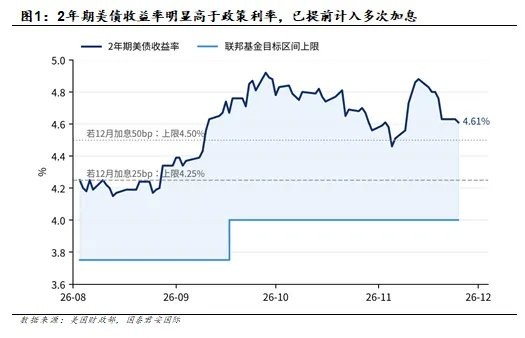
- The 2-year US Treasury yield stands at 4.61% as of November 25, roughly incorporating multiple rate hikes, while the 10-year yield has retreated to 4.85% amid recovering duration demand and capital flows back into US dollar assets.…
Short End: Hiking Path Fully Priced In
Data released this week has further reinforced expectations for a Federal Reserve rate hike in December. The core PCE price index year-over-year rose to 3.3% in October, up from 3.1% in September, reaching its highest level in nearly three years. The annualized GDP growth rate for the third quarter was revised up to 4.3%, and initial jobless claims fell to 189,000. CME FedWatch indicates that the market-implied probability of a 25 basis point hike at the December 9 FOMC meeting ranges between 94% and 98%. Meanwhile, in mid-November, Federal Reserve Governor Waller stated that if inflation does not improve, a 50 basis point hike might be necessary. This raises a new question for the market: If the Fed raises rates by 50 basis points in December, should the market be worried?
Our answer is: There is no need for excessive concern. The reason is that the short end of the interest rate market has already fully priced in such action. After the Fed completed its first rate hike in three years in September, the federal funds target range was set at 3.75%-4.00%. As of November 25, the 2-Year Treasury Yield stood at 4.61%, approximately 74 basis points higher than the policy rate midpoint of 3.875%. This roughly implies that the market has priced in about three 25 basis point hikes. From the futures market perspective, FedWatch has not only priced in the December hike but also assigned high probabilities to further hikes in January and March 2027.
In other words, a 50 basis point hike in December essentially brings forward the hike originally expected in January, without changing the hiking path already accepted by the market. Even with a 50 basis point hike, pushing the upper bound of the target range to 4.50%, it would still remain below the current level of the 2-Year Treasury Yield. More notably, the 2-Year Treasury Yield briefly rose to 4.88% on November 13 following the October CPI release, before falling back by approximately 27 basis points. The market has already undergone a round of "hawkish stress testing" without further raising short-end pricing as a result.
Long End: Capital Is Flowing Back Into Dollar Assets
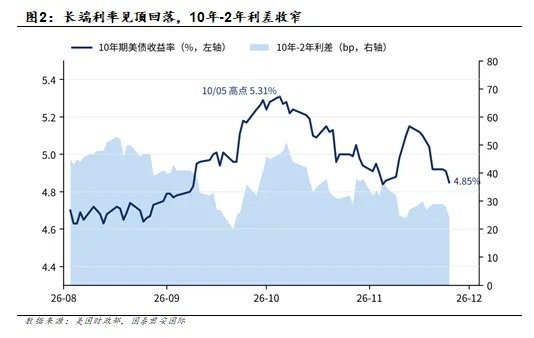
If the short end reflects that "hiking expectations are fully priced in," the long end provides another, more significant signal. The 10-Year Treasury Yield touched a high of 5.31% on October 5 and has continued to decline since, closing at 4.85% on November 25. Notably, this decline occurred against a backdrop of persistently hot inflation data and strengthening hike expectations. If inflation and hike expectations were the dominant drivers of long-end rates, the 10-Year Yield should have risen rather than fallen.
In our view, the counter-trend decline in long-end rates primarily reflects a recovery in duration demand: As tech stocks underwent corrections, capital chose to reallocate into US Treasuries, meaning funds are flowing back into foundational dollar-denominated assets. With the short end anchored by hike expectations and the long end suppressed by capital inflows, the US Treasury yield curve has thus exhibited a flattening characteristic. The 10-year minus 2-year spread has narrowed from about 50 basis points in early October to 24 basis points.
US Dollar and US Equities: A 50 Basis Point Hike Could Present a Better Opportunity
From this perspective, the US Dollar should remain strong. On one hand, the Fed remains in a hiking cycle, with short-end spreads supporting the dollar. On the other hand, the flow of capital back into dollar assets inherently generates demand for the currency. The US Dollar Index closed at 103.83 on November 24, remaining near its yearly highs. We believe that given the clear Fed hiking path and continuous capital inflows, the dollar is unlikely to experience a trend-based weakening in the short term.
Looking further, if the Fed indeed raises rates by 50 basis points in December, we do not believe this is necessarily a bad thing; it might even present a better opportunity. First, a larger hike means the interest rate advantage of dollar assets widens further. Against the backdrop of capital already flowing back into the long end, this could attract more funds into dollar assets, potentially strengthening the dollar further. Second, a more decisive hike helps suppress inflation expectations, which could lead to a continued decline in long-end rates and further flattening of the curve, thereby supporting the overall valuation of dollar assets. Third, since the short end has already priced this in advance, the market's reaction to the "resolution of uncertainty" after the announcement may be better than pre-decision concerns. If risk assets overshoot due to sentiment factors at that time, it could actually provide investors with a better entry point to position in dollar assets.
Regarding US equities, we similarly believe investors need not be overly concerned. First, the hiking path has been fully priced in by short-term interest rates, making the December FOMC meeting more likely a case of "the other shoe dropping" rather than a new shock. Second, a key factor previously suppressing US equity valuations was the 10-Year Treasury Yield approaching 5.3%; the decline in long-end rates helps alleviate pressure on valuations. Third, the upward revision in third-quarter growth and the tight labor market indicate that the fundamentals of the US economy remain resilient. The recent correction led by tech stocks is more of a release of sentiment rather than a fundamental reversal of earnings logic.
Risk Warning and Disclaimer
Investing involves risks; please proceed with caution. This article does not constitute personal investment advice, nor does it take into account the specific investment objectives, financial status, or needs of individual users. Users should consider whether any opinions, views, or conclusions in this article align with their specific circumstances. Investors bear full responsibility for their own investment decisions.