
 I'm LongbridgeAI. Here is the key information I extracted
- 太空算力的当前平准化成本约为地面的 4.4 倍,高成本主要源于卫星平台及发射费用。…
On Nov. 25 during U.S. market hours, FCC Chair Brendan Carr announced a conditional approval for $ SpaceX.US to deploy up to 1 mn satellites for its 'Starmind' orbital data center constellation. It is the first U.S. license ever granted to a space-based data center constellation.
Conditions are stringent: the first satellite must be in orbit and operational by Nov. 25, 2033, with 10%, 50% and 100% of the constellation deployed by 2035, 2038 and 2040, respectively. Missing any milestone would void the approval, and SpaceX must submit a final debris mitigation plan before operating above a 600 km orbit.
Dolphin Research’s deep dive 'SpaceX: Space Compute — Musk’s new promise, or real future?' framed space data centers as the largest 'option' in SpaceX’s valuation. Last week’s 'SpaceX: Ship caught, but why didn’t the stock?' argued Starship’s cost-down is a precondition to exercise this option. Now the regulatory hurdle is cleared.
Market reaction was restrained: the Nasdaq 100 fell as much as 4.7% intraday, and SPCX dropped 9.4% at the trough before closing up 1.3% at $127.44. Implied market cap is Approx. $1.7tn, about 22% off the mid-Oct peak, yet still above Dolphin’s $1.4–1.5tn ($106–114/share) buy zone.
With the regulatory greenlight but the stock only up 1.3%, how much is this license really worth? Here are the key questions Dolphin Research will unpack:
1) What exactly did the FCC approve?
2) Does the space compute business case pencil out?
3) What does the license imply for SpaceX’s valuation?
4) Why did the stock rise only 1.3%?
5) What to watch next for SpaceX?
6) How big is the impact across the supply chain?
I. What exactly did the FCC approve?
1) A license with a 'countdown': generous timeline, multiple preconditions
Think of it as a birth certificate: the FCC allows SpaceX to put up to 1 mn compute satellites in orbit by 2040, but each milestone will be audited and failure triggers revocation. Key terms are as follows:
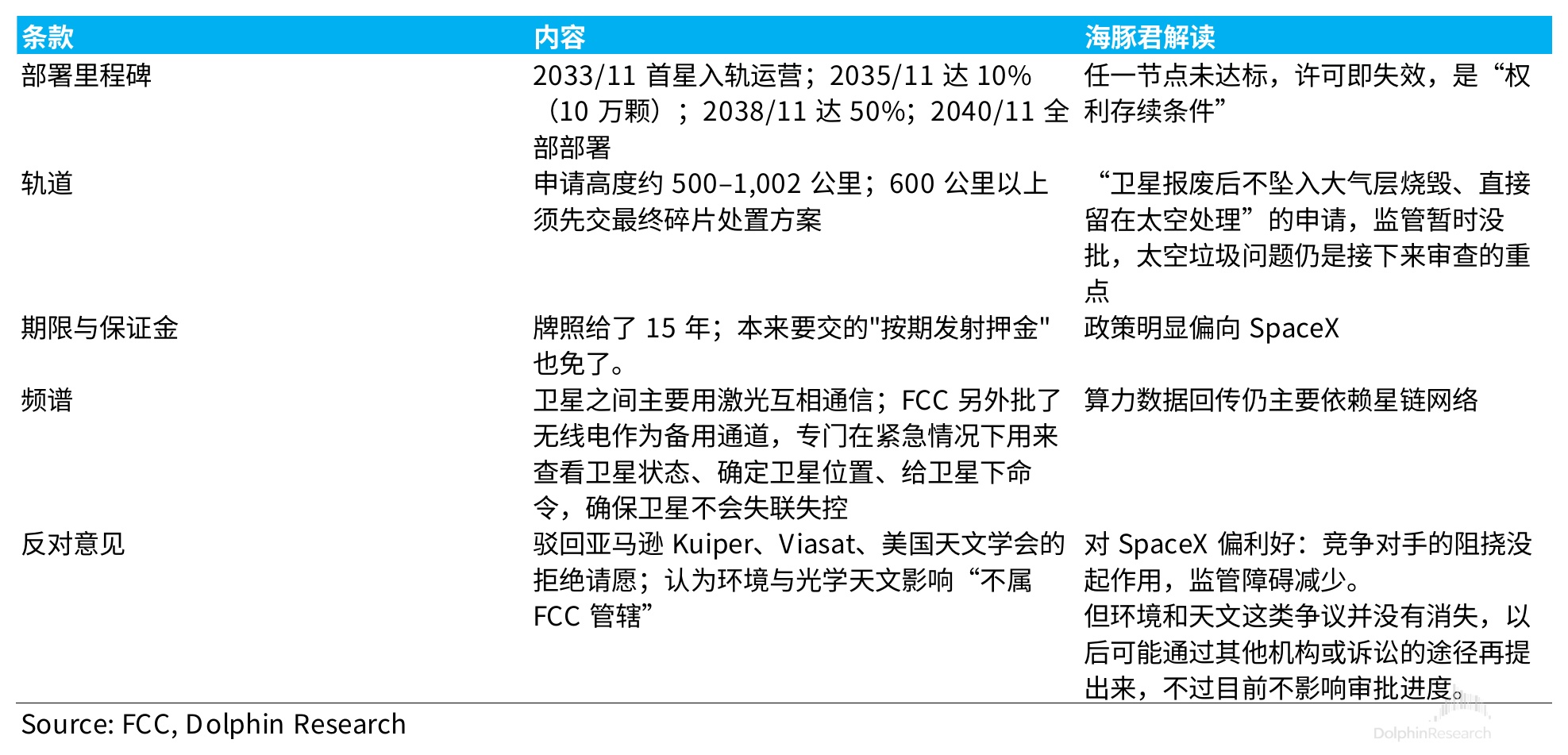
How generous is the timeline? For typical non-GEO constellations, the FCC generally requires 50% deployed within 6 years of grant and 100% within 9 years. Starmind’s schedule is first satellite in 7 years, 10% in 9 years, 50% in 12 years and full deployment in 14 years — roughly 5 extra years.
SpaceX’s own cadence is faster: management guides first Starmind launches starting 2027, with the AI1 constellation scaling in 2028. Both are more than 5 years ahead of regulatory milestones.
Using SpaceX’s filing of 175 kW Avg. per satellite, the FCC’s 2035 10% milestone of 100k satellites implies ~17.5 GW. SpaceX targets 77 GW in orbit by 2031 (~440k satellites), 4 years earlier and over 4x the FCC baseline.
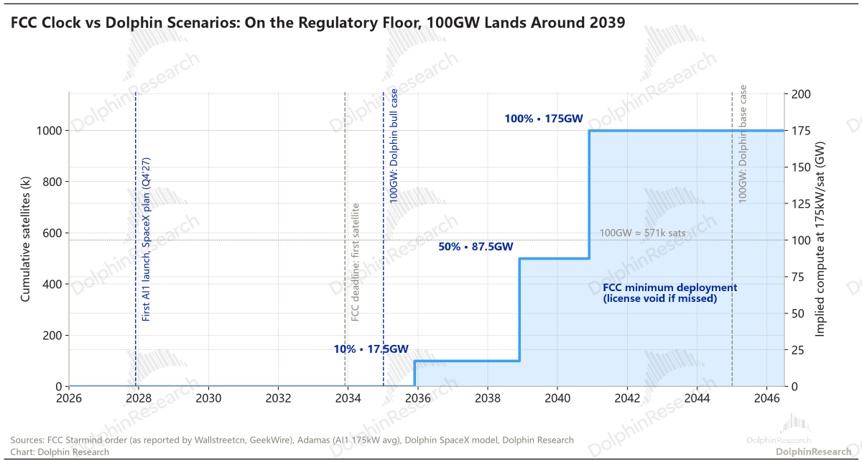
In short, the FCC set the floor, not the ceiling: the true pacing constraint is not the license, but Starship lift capacity, satellite platform cost, chip supply and financing.
2) What does Starmind look like? One satellite ≈ one ground compute rack
Starmind is a constellation of 'orbital compute modules'. Each module comprises:
a. Single satellite: ~30 m tall after deployment with a 75 m wingspan, carrying one orbital Vera Rubin NVL72 rack rated at 250 kW peak and 175 kW Avg. (vs. 150/120 kW first disclosed in Jun), mass ~2.1 tons.
b. Thermal: dual-sided deployable liquid-cooled radiators designed for ~1,400 W/m² heat flux, nearly an order of magnitude above the ISS (~166 W/m²), operating at 130–140°C.
c. Deployment: ~30 satellites per Starship launch totaling over 5 MW (management’s full load guide is 50 satellites), with inter-satellite laser links and Starlink backhaul to ground.
At this spec, 1 mn satellites imply ~175 GW of compute and ~2.1 mn tons to orbit, requiring ~20k Starship launches. For reference, global orbital launches were ~330 in 2025.
This is why SpaceX targets '1 mn tons of compute hardware to orbit per year': launch must become airline-like in frequency and cost.
3) Competition: license scale dwarfs peers, but the moat is 'lift'
Blue Origin and Starcloud filed for 51.6k and 88k satellites, respectively, and Google sent its first TPUs to orbit on Falcon 9 in Oct for testing. The FCC notes other applications remain under review.
Amazon argued in its petition that Starmind is 'aspirational rather than feasible', to which Chair Carr retorted Amazon should first sort out its own constellation. In scale, Starlink already has 11k+ satellites on orbit, while Amazon’s LEO has ~400.
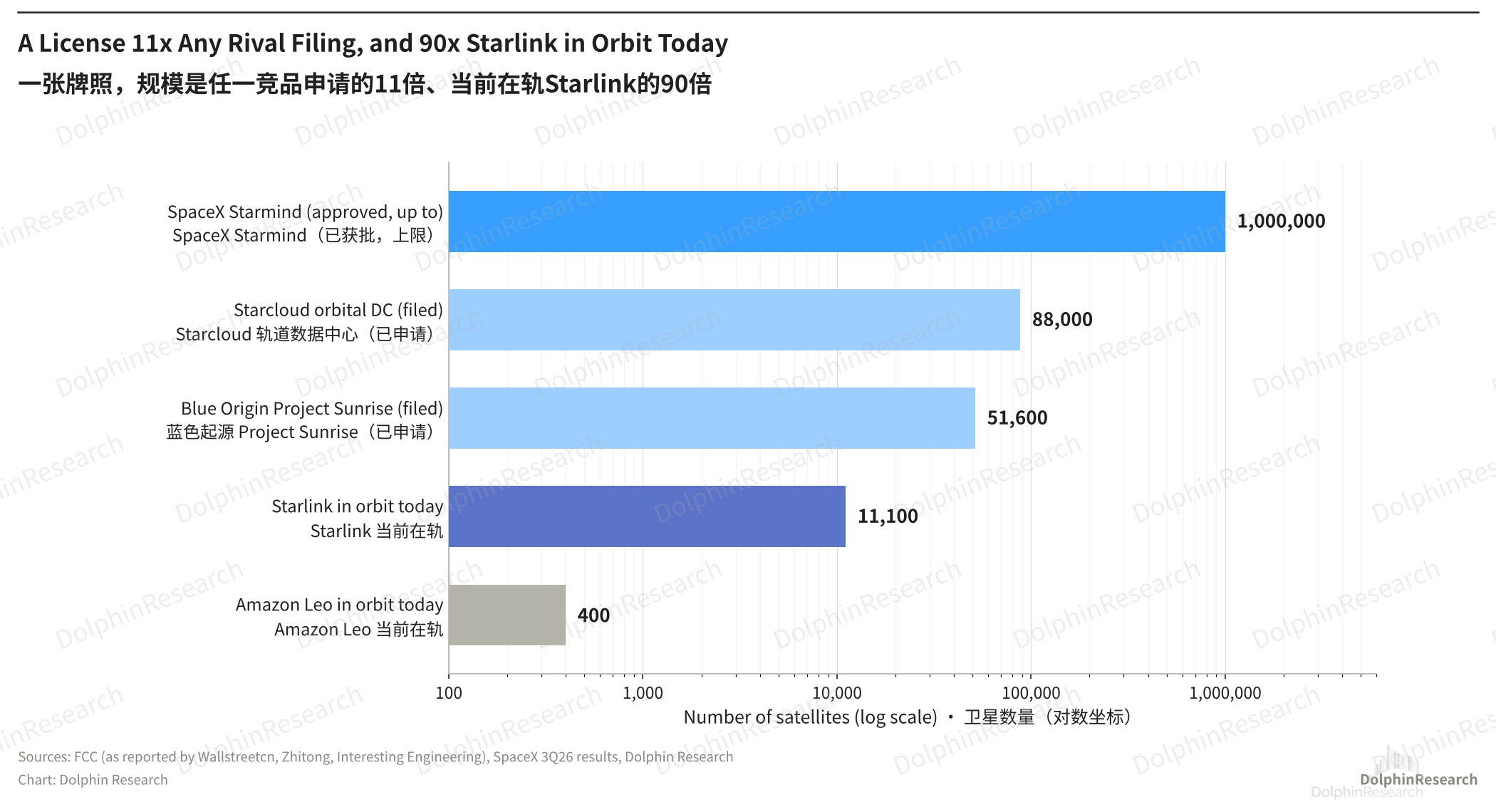
Dolphin Research believes SpaceX’s moat is not the license per se, but two 'cards' already on the table: one for getting to orbit, one for getting data back down.
a. To orbit: lift capacity and orbital slots
In 'From daydream to fortune: Is SpaceX really that sci‑fi?', Dolphin likened SpaceX’s launch to a near-monopoly 'East India Company' of the Age of Sail. Even Google’s prototype space chips hitched a ride on Falcon 9; except for Blue Origin with in-house rockets, most rivals will need to buy launch from SpaceX even after getting a license.
Once in orbit, you need spectrum and positions: the ITU coordinates by filing order, and un-deployed filings get cut. Starlink satellites make up roughly two-thirds of active satellites globally with high-speed bands already secured, and dawn/dusk sun-synchronous orbits favored by space data centers are scarce — Starmind has filed multiple shells there.
b. Back to ground: network
The hardest part of space compute is not the 'compute,' but 'getting computed data back to Earth.' SpaceX already has that network, while rivals must build or buy it.
i) The inter-satellite 'highway' is in place: Starlink has deployed 23k+ laser links (see 'SpaceX: Sky Net, approaching invincible?'). Starmind data can hop via laser to Starlink sats, then downlink to ground stations, plugging directly into the existing network.
ii) The bottleneck is the downlink: a LEO pass over any given ground station lasts only 5–7 minutes; more and better-distributed stations mean more data can 'land.' There are two downlink paths (see 'Space Compute — Musk’s new promise, or real future?'):
Ka-band microwave: ~17 Gbps, stable but slow.
Laser: roughly 100x the bandwidth, but interrupted by clouds and rain, requiring a dense network of backup stations worldwide; all players are still in trials.
On the mature microwave path, Starlink already operates ground stations globally and has landing permits in 160+ countries/regions, which is hard to replicate near term.

iii) Costs can be spread: Starlink 3Q26 revenue was $5.25bn with OP of $2.37bn, up 69% and 99% YoY, respectively. Space compute reuses this network, so incremental backhaul costs are modest.
Lift and orbital slots get you up; network gets data down. Stacking these two cards forms SpaceX’s real moat, though Starlink capacity must be shared with broadband and direct-to-cell users, and mass-deploying 1 Tbps V3 satellites is a prerequisite for space compute.
II. Does the space compute business case pencil out?
The license answers 'can it go to space,' not 'does it make money once there.'
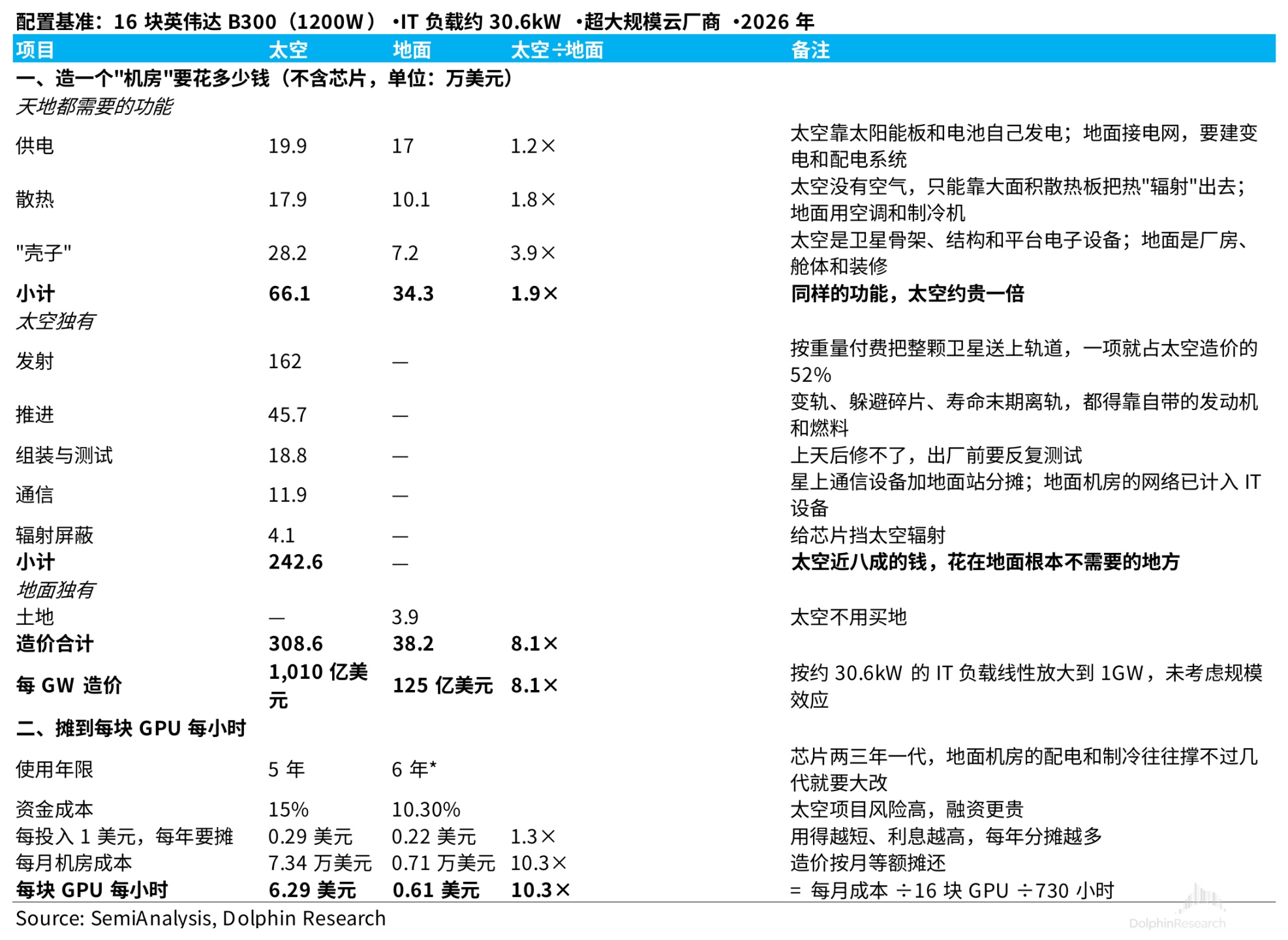
1) Bottom line first: running a GPU in space today costs 4.4x vs. ground
We use LCOC (levelized cost of compute), akin to levelized cost of electricity: allocate chip, 'data center' (satellite plus launch in space), and O&M across GPU-hours, adjusted for availability and redundancy. Using a 2026 NVDA B300 cluster as the benchmark, space LCOC is ~4.4x ground.
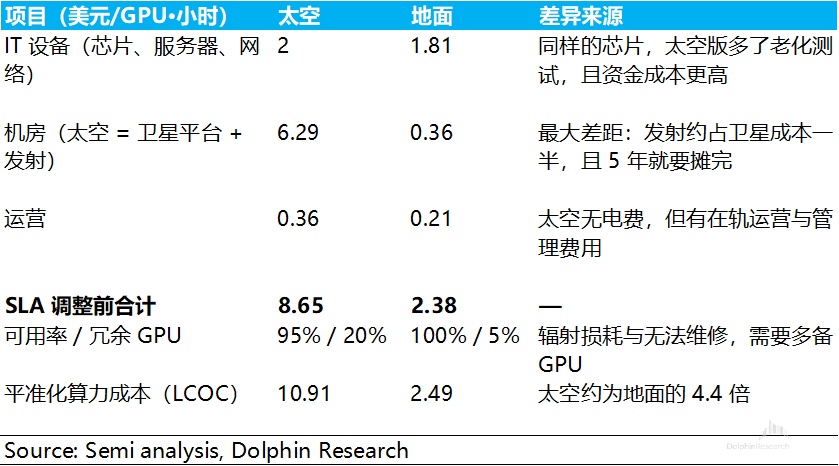
Why the gap? Almost entirely the 'data center' piece: chip and O&M are similar across space and ground. Per-GPU-hour 'facility' cost in space is ~10x ground, driving over 90% of the difference.
Space’s 'facility' is the satellite plus launch: it’s not pricier because identical parts become expensive in orbit (power, thermal, structure are ~1x–2x). It is because space requires launch, propulsion, extensive testing and radiation shielding — items unique to space that make up nearly 80% of satellite platform cost, with launch over half.
Result: building a 1 GW 'facility' (ex-chips) costs ~$101bn in space vs. ~$12.5bn on ground, an 8x delta. Shorter asset life and higher financing in space add ~30% more annualized cost, pushing the facility gap to ~10x.
It’s like prepaying your 'power bill': no utility bill later, but you must pay for solar arrays, radiators and launch upfront before powering on.
Factor in spare GPUs for unserviceable failures and radiation-induced partial derating, and total space compute costs are ~4.4x ground. That means even if Starship slashes launch costs, it solves only half the problem; the other half depends on platform mass production and longer on-orbit life.
2) Cheaper launch is necessary, not sufficient
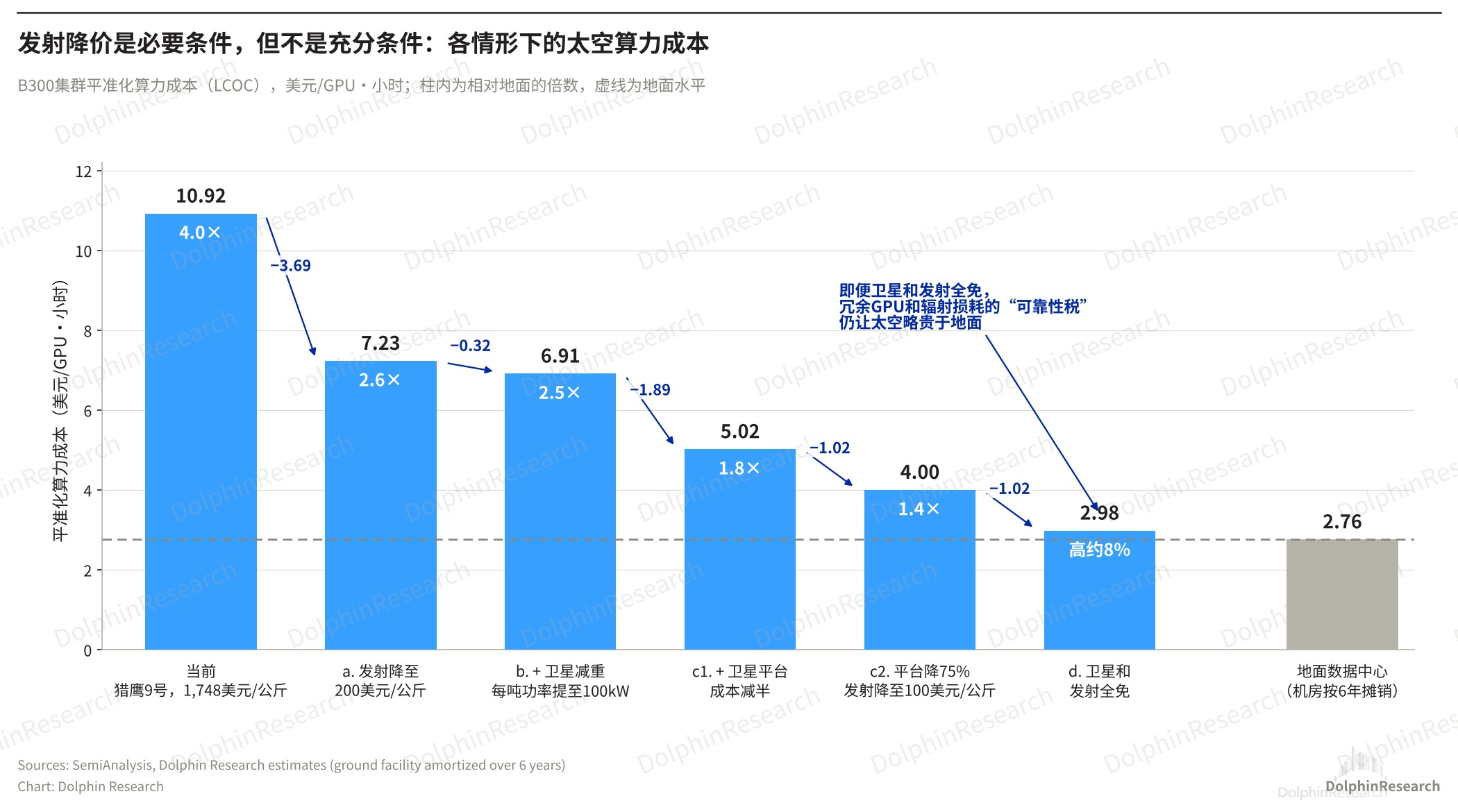
Markets often say: if Starship drives launch to $200/kg, space compute will match ground. Our math says it’s not that simple.
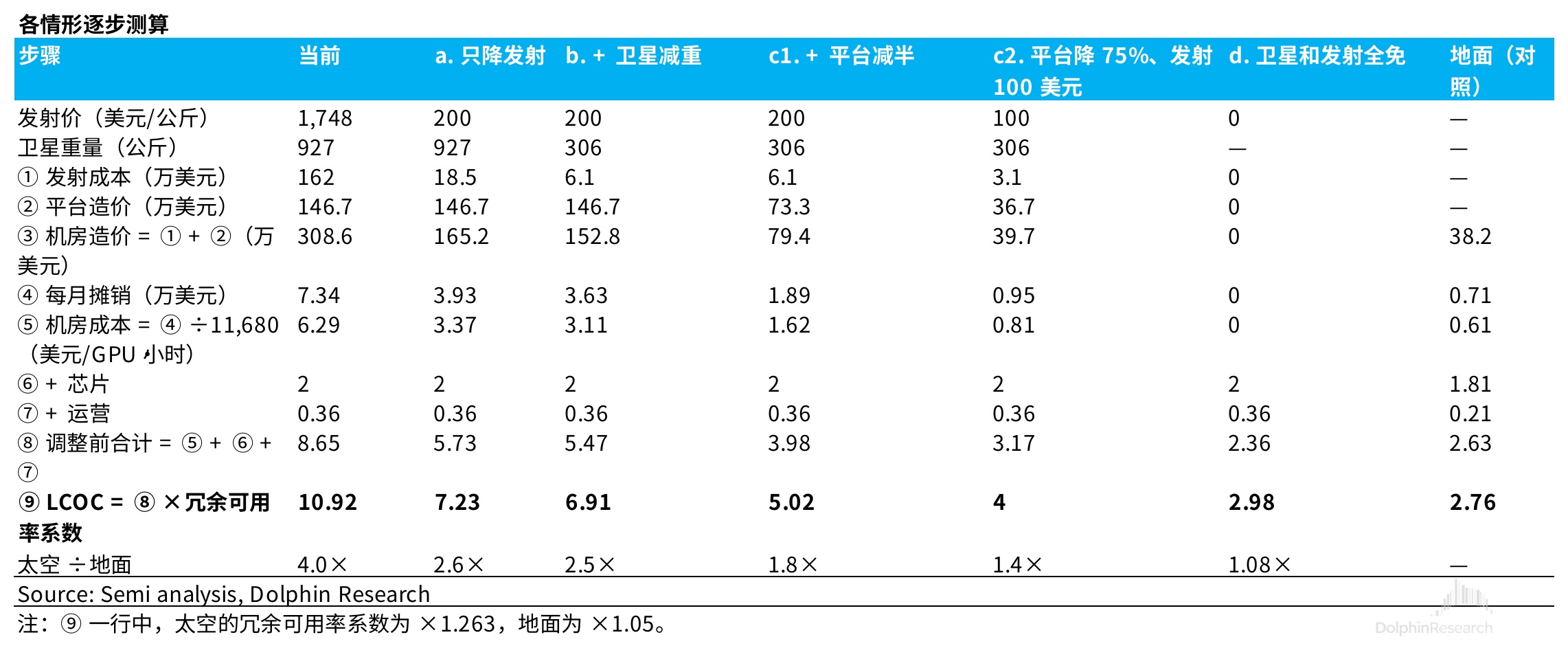
Cut freight first: dropping launch from ~$1,750/kg to $200/kg, a ~90% reduction, trims space compute LCOC by one-third, yet still leaves it at 2.6x ground.
Then cut everything that can be cut: lighter satellites, platform cost at one-quarter, launch at $100/kg — costs keep falling but with diminishing returns, and space still ends up ~40% higher than ground.
In the extreme, even with free satellites and free launches, space compute is still slightly pricier than ground.
If 'facility' and freight are zero, why is it still higher? Two reasons:
a) Financing is costlier: ground chips can be collateralized; space chips cannot be recovered, raising the borrowing rate.
b) Failures are unserviceable: ground GPUs can be swapped same day; space requires ~20% spare GPUs, and radiation can sideline some chips.
These two claw back the savings. Thus, the hard problems are 'financing' and 'maintenance,' with maintenance the tougher one.
The financing challenge is already visible: per the FT, lenders on a ~$40bn SpaceX chip financing wanted a covenant barring collateralized chips from going to space, since defaulted collateral cannot be recovered. Conversely, only when on-orbit robotic servicing matures post-2032, extending asset life, will both constraints ease.
3) When can space win? It depends on how fast ground builds
The real competitor is not ground power prices, but the pace of ground capacity build. Dolphin Research’s deep dive mapped four paths to expand ground power: grid interconnects, mining site conversions, self-built plants, and upstream supply — each progressively costlier and slower.
Only if ground build lags chip output will chips be forced skyward. How these four paths unfold defines space’s role:
a) Base case: space is a 'spare tire' — with smooth ground expansion, U.S. data center power reaches ~338 GW by 2030, absorbing chips on ground. Space and ground LCOC might converge around 2040.
b) Musk case: space becomes 'must-have' — worsening ground power crunch and large Terafab chip output push ground costs higher; Starship drives launch to ~$80/kg, and LCOC parity pulls forward to ~2034 with compute 'spilling over' to space from 2037.
Signals today are mixed:
Leaning Musk case: post midterms, some politicians advocating DC restrictions took office, e.g., Texas’s new Gov. pledged to pause new DC builds, and Texas accounts for over one-quarter of planned U.S. DCs.
Leaning base case: B200 rents have fallen ~9% from the Nov. 8 peak, though they rose nearly 50% in the prior three months, which is not yet a trend.
Space data centers are thus a 'pressure valve' for ground compute: the harder ground is to build, the more valuable the valve; if ground capacity floods in 2027–28, the valve may not be needed near term.
4) Technical hurdles: thermal and radiation 'solvable but unproven'; latency is unavoidable
a) Thermal is the top challenge: in vacuum, only radiative cooling works, and a 1.5 MW compute bay needs ~2,100 m² of radiator area. Hardware cost is ~2x ground HVAC; raising operating temperature and liquid cooling with deployable panels remain under engineering validation.
b) Radiation is more manageable than feared: Google’s proton-beam tests suggest TPUs can withstand several to 20x expected doses, and COTS chips plus ECC software are broadly feasible. The issue is unserviceable failures.
c) Latency and bandwidth are hard constraints: multi-hop links push one-way latency to tens of milliseconds, and laser ISLs at 100–200 Gbps are 100–1,000x below training-cluster interconnect needs. It is hard to stitch many satellites into ultra-large training clusters.
Space compute fits batch inference and remote sensing — workloads that are less time-sensitive with lower data movement. Latency-critical services such as HFT or autonomous driving stay on ground (see 'Space Compute — Musk’s new promise, or real future?' for details).
III. What does the license mean for SpaceX’s valuation?
Dolphin’s latest neutral SOTP is $1.5–1.6tn (compute leasing $315bn + space & Starlink $900bn + AI apps $310bn). We do not carve out space data centers separately; we treat them as an additional 'option.'
In the terminal case, 100 GW × $10bn revenue per GW × 20% NIM × 10x PE implies ~$2tn, discounted at 10.5%. When SpaceX reaches 100 GW determines today’s option value.
1) On the FCC baseline, this option is worth ~$490bn
At 175 kW Avg. per satellite, 100 GW needs ~570k satellites, landing between the FCC’s 2038 (500k) and 2040 (1 mn) milestones. If deployed at the regulatory baseline pace, 100 GW is reached ~2039.
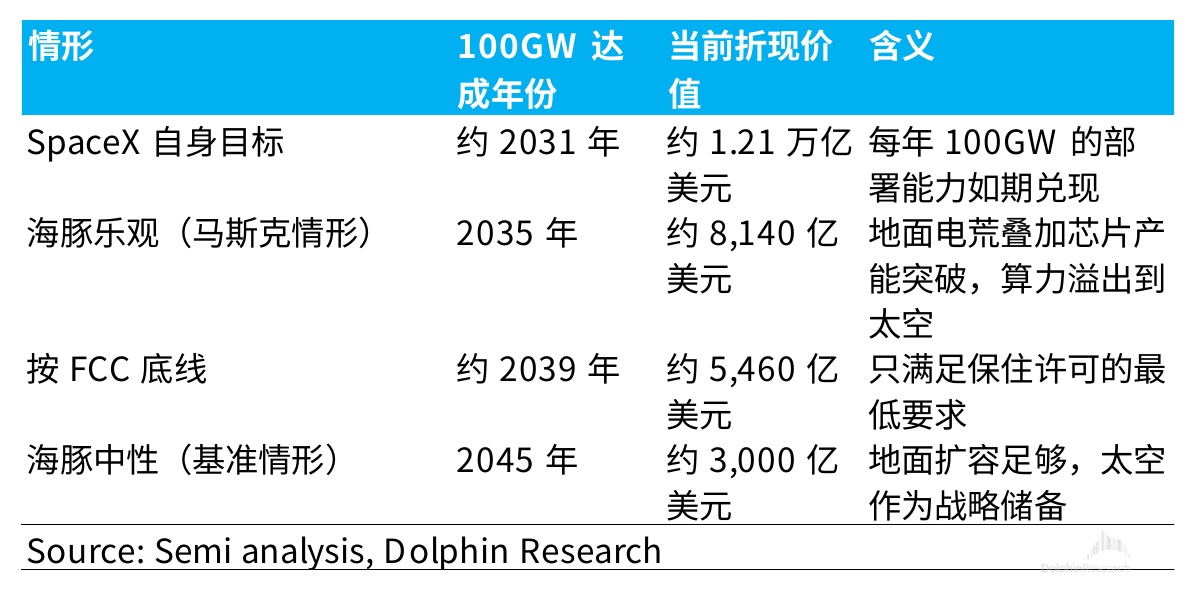
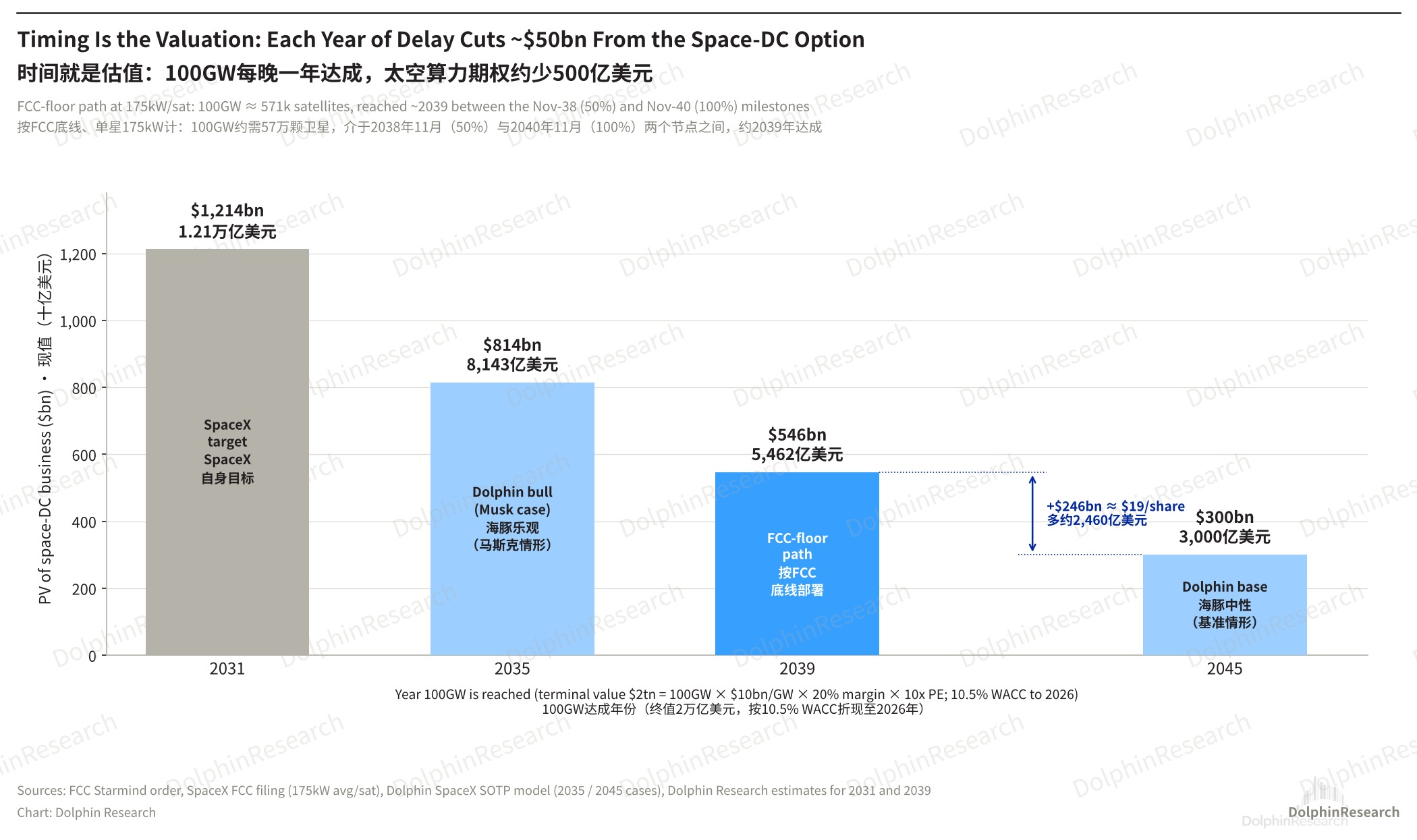
Time is value: between 2035–2045, each year of delay to 100 GW reduces the option by ~$50bn. On the FCC baseline, value is ~$190bn above Dolphin’s neutral case, or roughly $15/share.
But milestones are merely the minimum to preserve the license, not a forecast path. SpaceX may move faster, or miss and lose the license; the license removes the 'regulatory rejection to zero' scenario, increasing the probability of the optimistic case rather than the neutral SOTP.
2) The current stock price has already paid for part of this option
At a ~$1.7tn market cap vs. a $1.5–1.6tn neutral SOTP (ex space data centers), markets have already priced in ~$100–200bn for space compute. That is 30–70% of Dolphin’s neutral option ($300bn) or 20–40% of the FCC baseline path (~$490bn).
In other words, the stock is paying upfront for a business whose cost and financing remain unresolved and may only reach 100 GW around 2045. Dolphin maintains a 'wait for lower prices' stance: consider buying if market cap retreats to $1.4–1.5tn ($106–114/share), which effectively pays for launch, Starlink and ground compute, with the space compute option 'thrown in.'
3) The binding constraint is capital: the first milestone alone needs ~$750bn
Even in the Musk case with very optimistic space facility costs (~$11bn per GW), adding chips and servers (~$32bn per GW for a 2026 B300 cluster) yields ~$43bn per GW in space. That is above SpaceX’s $30–35bn per GW on ground.
The FCC’s first hard milestone (100k satellites or ~17.5 GW by 2035) implies ~$750bn of investment. SpaceX ended Q3 with ~$90bn in cash and marketable securities, and adding 10 GW of ground compute in 2027 requires $300–350bn; ground expansion already needs substantial debt, and space scale-up will likely require equity — dilution is the exercise cost of the option.
IV. Why did the stock rise only 1.3%?
It looks up, but SPCX is a high-beta 'AI infra' name: since listing, its daily beta vs. the Nasdaq 100 is ~1.55–1.6, i.e., when the Nasdaq falls 1%, SPCX drops ~1.6% on Avg. That day the Nasdaq closed -0.64%, so SPCX 'should have' been ~-1.0%; it actually rose 1.3%, a ~2.3 ppt beat (~$39bn in market cap) attributable to the license news.
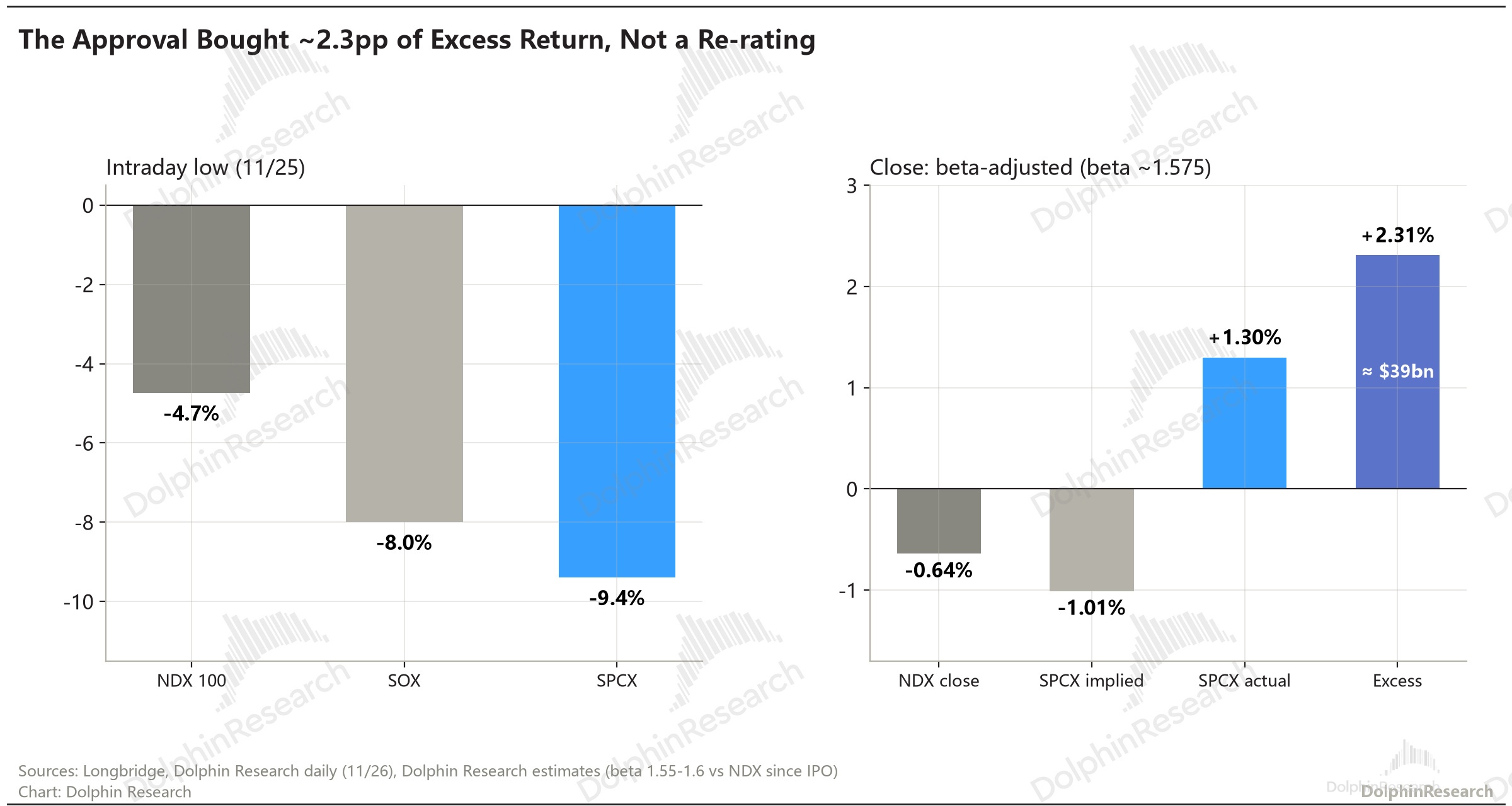
Why only ~2.3 ppts? Dolphin sees three reasons:
1) The license was widely expected: filed in Jan, with Chair Carr publicly defending SpaceX in Mar. The generous milestones are a small positive surprise, but key dates are post-2033, and discounted present value is limited.
2) A license is not economics: profitability hinges on Starship reuse, platform cost-down, and financing cost — none addressed by the license.
3) AI credit is tightening, capping upside: SpaceX CDS hit new highs alongside NVDA and Oracle; CoreWeave’s 5Y CDS jumped 2.09 ppts in a day, and markets circulated 'SpaceX cutting Blackwell rental rates.' SPCX cash flow today relies on ground compute leases cancellable in 90 days; softer rental rates affect the stock more directly than distant space compute. Add the 12/3 Tesla merger details and 12/8 last unlock, and any rally meets supply.
V. What’s next for SpaceX?
Near term (into mid-Dec): the stock hinges on AI sentiment, 12/3 Tesla merger details, 12/8 final unlock, and the year-end/early next 16th Starship test. Licensing, like last week’s test, only cushions drawdowns; if market cap drops below $1.4–1.5tn around the unlocks, that could be a better entry.
Medium term (next 6–12 months): watch 'second-step' validations, each moving the probability of the optimistic case:
i) Two-stage Starship reuse: whether the 16th flight reuses both stages from the 15th, and whether early-2027 second-stage reflights and on-orbit refueling succeed, which sets the timeline for $200/kg launch.
ii) Platform cost: first-batch satellite unit cost, in-orbit thermal performance, and chip life, which determine how fast the platform cost of ~$48/W can fall — more critical than launch pricing.
iii) First Starmind launches in 2027 as planned and disclosures on external customers and compute pricing.
iv) Ground compute rental and renewals: if B200/B300 rents keep sliding, the premium for 'buying time' in space will shrink.
v) 2027 financing plan: debt-led or equity needed, and whether orbital assets can secure acceptable financing costs.
Key risks to watch:
i) Compute oversupply hits both sides: near term, falling ground GPU rents drag SpaceX’s AI business; longer term, if ground compute suffices, the 'pressure valve' role of space data centers fades.
ii) Starship reuse slower than expected: sub-$200/kg launch requires rapid reuse, which remains unproven; each year of delay trims the option by ~$50bn.
iii) Platform cost-down lacks public data: once launch is cheaper, the remaining gap must be closed by platform cost-down, where current evidence relies on model assumptions.
iv) Financing may dilute shareholders: orbital assets are hard to collateralize; space compute likely leans on new equity issuance, with ongoing per-share dilution risk.
VI. How big is the impact across the supply chain?
Dolphin Research assesses four angles: where money flows, who captures it, when they get it, and at what pricing.
i) Where does the money go?
On 2026 cost splits in Dolphin’s model, each GW of space compute needs ~$133bn in total capex: launch ~$53bn (40%), satellite platform ~$48bn (36%), chips and servers ~$32bn (24%). Within the platform: propulsion ~$15bn, structure/assembly/testing ~$9.5bn, solar arrays ~$6.5bn, thermal ~$6bn, platform electronics ~$5.8bn, communications ~$3.9bn, radiation shielding ~$1.4bn.
ii) Who captures it?
SpaceX is known for vertical integration: launch, propulsion, structure, final assembly, platform electronics and laser ISLs are largely in-house, covering over 60% of total capex. External suppliers will find it hard to capture share.
Three categories can be sourced externally, each with a caveat:
a) Chips and servers: the largest single bucket at ~$32bn per GW. In the base case, these chips are bought for ground anyway; in the Musk case, while incremental, Terafab volume may keep spend within Musk’s ecosystem. Only the ~20% spare chips are incremental in any case.
b) Space PV: ~$6.5bn per GW, incremental demand unique to space compute. But SpaceX plans to co-produce panels with Tesla, so external share is uncertain.
c) Thermal management: deployable radiators and liquid loops are unique to space and incremental demand, but still under engineering validation.
iii) When do they get it?
The FCC’s first hard milestone is 2033, so early Starmind volumes will be small. Near-term scale will come from Starlink V3 and direct-to-cell: Starship has begun deploying V3, and the FCC has already approved ~100k Gen-3 Starlink satellites — these are real, near-term orders.
Hence, by certainty: Starlink supply chain (RF, optical comms, PCB, switches, user terminals) > space PV & power > thermal management > pure 'space compute' concept names.
iv) At what pricing?
SpaceX’s cost-down lever includes squeezing suppliers, e.g., using automotive/industrial-grade components instead of space-grade. In the Musk case, net platform value left for suppliers (ex launch) could be compressed by nearly 80% — it is a volume-at-low-price business; orders do not guarantee high margins.
Post-announcement, Taiwan names like Arcadyan, D-Link and Win Semi hit limit up, and A-share Junda also hit limit up (HK up 16%+). Many Taiwan names are actual Starlink suppliers, e.g., D-Link began shipping switches to Starlink this year; A-share names face supply-chain security and export controls and are unlikely to enter SpaceX’s chain, mapping more to domestic constellations such as State Grid or Qianfan. For these 'concept' stocks, confirm the buyer before assuming elasticity.
<End here>
Risk disclosure and statement: Dolphin Research Disclaimer and General Disclosure
Dolphin Research SpaceX archive:
Deep dives:
<From 'Daydream' to 'Fortune': Is SpaceX really that 'sci‑fi'?>
<SpaceX: Sky Net, approaching invincible?>
<SpaceX: AI burn keeps rising — 'Space Compute Hegemony' as the ultimate ace?>
<SpaceX: Space compute — Musk’s new promise, or real future?>
<SpaceX challengers: Can Bezos and the China teams catch up?>
<Musk plays another trump card: Can SpaceX reshape 'space economics'?>
Earnings reviews:
<SpaceX: Ship caught, but why didn’t the stock?>
<SpaceX: From 'rocket guy' to 'landlord' — who pays for Musk’s new trillion‑dollar pie?>