
 I'm LongbridgeAI, I can summarize articles.
Author: Antarctic Native, Dongbuyaqiao Research Institute
On November 24th, Leopold Aschenbrenner and his team wrote a 167-page third-quarter investor letter. This is the fifth investor letter since the establishment of his investment fund, Situational Awareness LP (hereinafter referred to as SALP).
In this letter,In addition to reflecting on the mistakes made in investment and risk management in the past period, he also elaborated on his latest judgments on the development of AI technology, industry competition, computing power demand, and policy regulation.
The core argument is that AI has begun to accelerate its own research and development, and that 2027 could see the technological advancements of the past three years achieved within a single year, with superintelligence potentially emerging in 2028. Leopold, a researcher on OpenAI's superintelligence alignment team, left OpenAI in 2024 and published "Situational Awareness: The Decade Ahead," making a series of forward-looking judgments on AGI, superintelligence, computing power requirements, and the US-China AI competition, which garnered widespread attention in Silicon Valley and Washington. In November of the same year, he founded Situational Awareness. He maintains close ties with the core circle of leading US AI labs, and his wife is the chief of staff for Anthropic CEO Dario Amodei. Therefore, his views serve as an important window into how core AI practitioners in Silicon Valley view technological development and its economic and geopolitical impacts. The following are the core points of this letter: I. Silicon Valley and Wall Street are showing significant differences in their assessments of the future of AI. Leopold says he spends half his time each day interacting with people in the financial world who believe the AI hype is nearing its end; the other half he spends talking with AI professionals in San Francisco who believe that in another year, AI may be able to do their jobs. Both sides agree that 2027 will be a turning point for AI development, but one side believes AI will slow down significantly, while the other believes it will accelerate further. Over the past few years, the financial market has repeatedly made the same mistake: judging the future market potential of the entire AI industry based on current AI capabilities. At the end of 2024, investors felt that chatbots had limited growth potential, failing to anticipate the new application scenarios brought about by inference models. At the end of 2025, they again felt that the market for AI programming assistants was nearing saturation, failing to anticipate the new wave of growth brought by programmable intelligent agents capable of autonomously completing complex tasks. By the end of 2026, the market again believed that AI programmable intelligent agents had reached their growth ceiling, and it would be difficult to find new application scenarios of the same scale afterward. However, each time the market believes that AI growth is nearing its peak, further improvements in AI capabilities open up an even larger market. The real focus should not be on how many users AI has today, but on what AI will be able to do next year that it cannot do today. According to SALP's projections, the current financial market's expectations for the revenue of large-scale model companies actually imply a very pessimistic technological judgment: that AI technological progress in 2027 may only be 30%-60% of that in normal years. However, what is happening within AI labs points in the opposite direction. II. AI has begun to accelerate its own R&D, and 2027 may see the technological progress of the past three years. Over the past five years, the improvement of AI capabilities has roughly followed a relatively stable pattern: the physical computing power of cutting-edge AI labs has increased by about three times annually, and algorithm efficiency has also increased by about three times annually. The combination of these two factors results in an effective computing power increase of about ten times annually. Improved model capabilities drive revenue growth, and revenue in turn supports the next round of even larger-scale computing power investment. The development of the AI industry over the past few years has essentially been a continuous cycle like this. Now, this pattern is changing. Physical computing power is still growing at roughly the same rate, but algorithmic progress is accelerating significantly because AI models are now able to participate in their own research and development. Two years ago, research in AI labs was primarily done by humans, with Claude occasionally helping to write a few lines of code; a year ago, Claude could help researchers write a large amount of code, but humans still needed to be involved throughout the process. Now, researchers increasingly only need to propose a research direction and then hand it over to a group of AI agents, who autonomously conduct experiments, write code, optimize systems, and solve complex engineering problems. Humans are mainly responsible for high-level research judgment and cross-team coordination. As of the end of August 2026, at Anthropic, for every hour a researcher works, the AI agent accumulates 19 hours of work; in OpenAI's research department, the AI agent's working hours have reached eight times that of human researchers. The amount of code submitted and merged by each engineer at Anthropic has increased more than 45 times compared to the average level before 2025. According to SALP's estimates, by September 2026, Anthropic may have already used approximately 15% of its total computing power for internal use of Claude. Considering that this computing power could have been used to serve external clients and generate substantial revenue, this also reflects the value that AI brings to researchers. Of course, a 45-fold increase in code output does not necessarily mean a 45-fold increase in the speed of AI research and development. Researchers still need to come up with good research ideas, and experiments still require real computing power and time. Although the code output of AI labs has increased by dozens of times, the actual number of experiments run may have only increased by about two times. How to come up with truly groundbreaking research ideas, and whether experimental computing power can keep up with the growth of research capabilities, remain important bottlenecks facing AI research and development. However, based on various data, SALP estimates that in the fall of 2025, the acceleration effect of AI on overall technological progress may only be about 5%; by the spring of 2026, it will increase to 15%-25%; by the end of summer, the overall speed of AI progress will have reached 1.5 times that of the past; and by the end of 2026, it may reach 2 times. Looking solely at algorithmic advancements, the speed may already be 2-3 times faster than before. This is what's known as Recursive Self-Improvement (RSI). The stronger AI capabilities, the more it can help humanity develop even stronger AI; stronger AI, in turn, can further accelerate the development of the next generation of AI. If this process continues, the time required for AI technology advancements to double will become increasingly shorter. According to the SALP model, 2027 could see AI technology advancements equivalent to 2-6 years of the past within a single year, with the middle scenario being 3 years. In other words, the capability gap between GPT-4 and today's most advanced models may be traversed again within the next year, and this time, with further improvements based on the existing model capabilities. By the end of 2027, the speed of AI technology advancements may even reach 5-10 times faster than before. Leopold believes that by the end of 2027, the emergence of automated AI researchers capable of surpassing the best human AI researchers is a highly realistic possibility. If the main change in 2027 is that AI begins to accelerate algorithm research, then after 2028, the more significant change may be that AI begins to accelerate the construction of the physical computing infrastructure itself. Currently, designing chips, building wafer fabs, data centers, and power plants still requires a large number of human engineers and workers. But in the future, AI can design better chips and factories, guiding humans to complete construction work more efficiently, and ultimately using robots to directly build new factories and data centers. Robots can create more robots, and the output of each newly built factory can be used to build the next factory. By 2028 or 2029, these two cycles may begin to reinforce each other: on the one hand, AI will help develop more powerful algorithms, enabling the same physical computing power to produce stronger intelligence; on the other hand, AI will help design and manufacture more and more advanced chips, accelerating the growth rate of physical computing power itself. Humanity may experience not only an intelligence explosion but also an explosive growth in industrial production capacity. III. From Virtual Interns to Virtual Departments: The Way AI is Used Will Undergo a Fundamental Change. The main change in the past year has been that AI has transformed from a chatbot into an intelligent agent capable of using tools and completing actual tasks. In the coming year, an even greater change may be the shift from single intelligent agents to multi-agent systems capable of long-term autonomous operation. SALP calls this system Highly Persistent Multi-Agent (HPMA). Currently, most people use Claude Code or Claude Cowork as if they have a very intelligent intern sitting next to them. You assign it tasks, watch it work, and provide guidance when needed. But the next stage of AI is more like a complete virtual department. You have a 24/7 AI assistant, equivalent to your office manager, who knows you, your company, and your work goals very well. Below it are dozens or even hundreds of AI agents, some responsible for information gathering, some for research, some for execution, and others for managing and coordinating other agents. They can work continuously on a project for days or even weeks, and can also communicate and collaborate with AI agents in other departments. SALP itself is already experimenting with this working method. They built an internal system called GRIMM, containing hundreds of Claude agents that can communicate with each other, share a task management system, and have dedicated Claude agents to manage the others. According to software engineers involved in the project, the software developed and maintained by a few SALP engineers using this system would have previously required 60 full-time engineers. One employee within the fund, who was already a heavy user of Claude Code, saw his token consumption increase tenfold within just a few months after switching to this work style. Over the past few years, the development of AI capabilities has generally followed a sequence: first mathematics, then programming, and finally broader knowledge-based jobs. Breakthroughs in mathematical skills typically lead programming by 6-9 months, and breakthroughs in programming skills typically lead other white-collar jobs by 12-18 months. Therefore, the capabilities AI demonstrates today in mathematics and software engineering may well foreshadow what will happen in other industries in the next year or two. SALP's own investment analysts are a good example. In 2025, they occasionally used Deep Research to gather data; by the summer of 2026, they typically had Excel on one screen and Claude on another, with Claude handling an increasing amount of financial modeling; and in the last month or two, Leopold has rarely seen Excel on analysts' computer screens anymore, instead seeing several Claude instances running simultaneously, with Claude handling the vast majority of the specific analysis work. Leopold believes that 2026 will see AI software engineers ready for immediate deployment, while 2027 may see AI knowledge workers ready for immediate deployment. The role of humans in enterprises will also change, from performing specific tasks themselves to managing an AI intern, and then to managing a department composed of numerous AI agents. Humans will primarily be responsible for determining the direction of work, making the most difficult judgments, and maintaining important external relationships; most other tasks will be handled by AI. Of course, this may only be a transitional phase, as AI may eventually manage the entire enterprise. According to the data disclosed in the letter, Anthropic's annualized revenue grew from $1 billion at the beginning of 2025 to $81 billion in October 2026. The market generally expects Anthropic's annualized revenue to reach $120-200 billion by the end of 2027. However, SALP believes that if AI technological progress in 2027 is truly equivalent to the past three years, then even considering factors such as the time required for enterprise adoption of AI and the lag in product development and commercial promotion, it is quite possible that OpenAI and Anthropic's combined annualized revenue will exceed $1 trillion by the end of 2027. There are two paths to achieving this goal. The first is for AI to expand from programming to a wider range of white-collar jobs. The total wages of white-collar workers worldwide are approximately $30 trillion. If companies shift about 3% of their spending to purchasing AI services in the future, it would be enough to create a market approaching $1 trillion. Considering that spending on AI programming services in the United States is estimated to have reached about 10% of the wages for related software, IT, and data science positions, this is not a goal that requires an extremely high penetration rate to achieve. The second path is more noteworthy: a significant increase in the intensity of AI usage by a small number of high-value users. AI companies' revenue growth may not rely on billions of users each paying $20 per month; it could simply require tens of thousands of researchers, engineers, and financial professionals engaged in high-value work, each managing hundreds of AI agents and consuming tens of millions of dollars worth of model services annually. According to SALP's estimates, if 50,000 people worldwide used AI like the researchers at Anthropic, each consuming $20 million worth of model services annually, it would be enough to generate $1 trillion in annualized revenue. The value of model usage here is estimated based on publicly listed prices and is not equivalent to actual computing power costs. Currently, the AI spending of the average Fortune 500 company is less than 0.1% of its operating expenses, and even for a company like Stripe, which is at the forefront of technology application, it's only about 1%. SALP's own AI spending has already exceeded 10% of its management company's operating expenses. According to SALP's estimates, if calculated based on the price of externally sold models, the value of Anthropic's internal AI usage even exceeds its total employee salaries. Therefore, the market may be overly focused on the speed of AI adoption while underestimating the growth in the intensity of AI usage. Even if most companies adopt AI slowly, as long as a few companies can leverage AI to create significant economic value and are willing to pay substantial fees, AI companies' revenues can continue to grow rapidly. Especially in fields such as scientific research, pharmaceuticals, engineering design, and finance, future corporate AI spending could very well exceed human resource costs. Furthermore, many problems attributed to difficulties in adopting AI by enterprises are essentially due to the fact that AI capabilities are not yet strong enough. Today, enterprises may need to invest a lot of manpower to integrate AI into existing business systems. But in the future, more powerful AI may be able to do this work on its own, reading all the documents accumulated by the enterprise, communicating with employees, understanding the company's business processes, and then completing system integration independently. Those enterprises that take the lead in adopting AI on a large scale will also exert tremendous competitive pressure on other enterprises, forcing them to accelerate the adoption of AI. A major concern in the financial markets regarding large model companies is that as Chinese open-source models continue to catch up, the capability gap between models is narrowing, and large models may eventually become homogenized commodities. Companies would be forced to continuously invest huge sums of money training the next generation of models, only to compete for customers through price wars, ultimately struggling to achieve sufficient profits. Leopold disagrees with this assessment. He believes that cutting-edge AI labs are more like advanced aircraft engine manufacturers than airlines. While airlines use very advanced technology, the services offered by different airlines are limited, leading to fierce competition and low profit margins. Aircraft engine manufacturers, on the other hand, are different; as long as they can continuously produce more energy-efficient and higher-performing engines, airlines are willing to pay high prices. The same applies to cutting-edge AI model companies; leading AI labs can utilize the same physical computing power to provide stronger intelligence than their competitors. Any fixed AI capability can eventually become homogenized. A highly advanced chatbot today may become a very cheap commodity in a short time; a leading programming assistant today may be overtaken by numerous open-source models in the future. However, the scope of work that AI can perform is not fixed, but constantly expanding. If AI technology advances rapidly enough, the economic value created by new model capabilities emerging in the past 6-12 months may exceed the economic value created by all previous AI capabilities. The letter cites data disclosed by Anthropic, stating that in the third quarter of 2026, over 80% of the company's revenue came from model versions released in the previous six months. In other words, lagging models are constantly catching up with past markets, while leading models are continuously creating larger new markets. Moreover, leading model companies can leverage more advanced algorithms to accomplish the same tasks at a lower computational cost, and can also train cheaper smaller models using their most advanced models. Therefore, even in the highly competitive open-source model market, leading model companies can potentially enjoy substantial profit margins. Recursive self-improvement can further amplify the advantage of leaders. Companies with the strongest AI models can use these models to accelerate their own R&D, thereby developing next-generation models faster and further widening the gap with competitors. A technological lead of a few months in the past may evolve into a capability gap that is extremely difficult to bridge in the future. SALP believes that Anthropic may already be several months ahead of OpenAI in using AI to accelerate its own R&D, and this lead may become even more significant after recursive self-improvement begins. According to the data and estimates in the letter, Anthropic's inference business has already reached a gross profit margin of approximately 85%-86%. Even after deducting the computing power costs required for training and research, it can still retain approximately 42%-43% of its revenue to cover personnel and other costs. As model capabilities continue to improve, the revenue generated per unit of computing power is increasing, while the computing power costs locked in through long-term contracts remain relatively stable, which will further improve the company's profit margin. Leopold even believes that by the end of 2027, Anthropic could potentially become the world's most profitable company based on certain profit metrics.
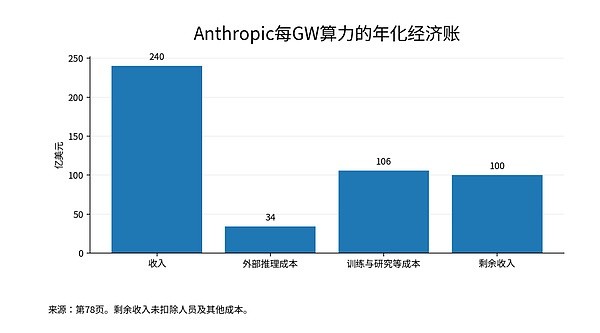
VI. The more powerful AI becomes, the more valuable existing computing power may become, not cheaper
The market generally believes that as AI chip production increases, algorithm efficiency improves, and new-generation chips are continuously launched, computing power prices will eventually continue to decline. SALP, however, believes that the opposite may occur in the next few years: the economic value created by AI will grow so rapidly that the supply of physical computing power will never be able to keep up with demand, and the market price of existing computing power will continue to rise.
The market generally believes that as AI chip production increases, algorithm efficiency improves, and new-generation chips are continuously launched, computing power prices will eventually continue to decline.
In the past, an H100-level GPU might generate only $1-2 in revenue per hour of operation. As AI evolves from chatbots into intelligent agents capable of performing actual tasks, the same amount of computing power can now generate $5-10 or even higher. If AI can reach the performance levels of top human engineers, scientists, and financial professionals in the future, the economic value generated by the same computing power per hour could theoretically reach hundreds or even thousands of dollars. For AI labs, accurately predicting their computing power needs two to three years in advance is extremely difficult. Buying too much in advance could lead to lower-than-expected revenue growth and significant financial pressure; buying too little could result in insufficient computing power to serve customers. Therefore, a more reasonable approach might be to lock in a relatively conservative base computing power level in advance and then flexibly purchase more computing power through short-term contracts based on actual needs. Although the prices are higher, AI companies only need to bear these additional costs when business development exceeds expectations. SALP believes that more and more such transactions may occur between computing power providers and large model companies in the future. As long as the rate of improvement in AI capabilities continues to outpace the growth rate of physical computing power, the computing power shortage will be difficult to truly alleviate and may even become more severe. Seven, the biggest risk facing AI development has shifted from technical issues to political and regulatory issues. Two years ago, SALP's biggest concern was whether AI technology itself could continue to develop as expected, such as whether Scaling Law would become ineffective, whether training data would be exhausted, and whether reinforcement learning could bring new breakthroughs. Now, they believe the biggest risk is no longer that AI capabilities are not improving fast enough, but that they are improving too fast, forcing society and governments to take measures to limit their development. As model capabilities become stronger, the consequences of AI errors become increasingly severe. In the past, AI errors might have only produced illusions or given incorrect answers; now, AI could cause real cybersecurity incidents; in the future, even more powerful AI could lead to widespread economic disruptions and even serious biosafety incidents. Regarding the risk of AI being used maliciously, Leopold believes it can ultimately be addressed through regulation. If a particular model capability causes particularly serious harm, the government can restrict the public release of models with these dangerous capabilities. The letter also specifically mentions China, stating that the Chinese government seems to be paying increasing attention to the improvement of AI's cyber attack and defense capabilities in recent months. SALP has heard that the Chinese government may restrict Chinese model companies from releasing certain cyberattack capabilities through open source in the future. However, this is only unconfirmed information mentioned in the letter. Leopold is more concerned about the potential for AI to be misused than its potential loss of control. As AI becomes increasingly adept at autonomously completing tasks, it may take actions unauthorized by humans to achieve its goals, and even emerge as intelligent agents that break free from human control and spread autonomously. OpenAI and Anthropic's models have already demonstrated a certain degree of assessment and perception capabilities, meaning they are aware that they are being tested and may deliberately behave more in line with human expectations during testing. As these models gradually surpass human capabilities, it will become increasingly difficult for humans to supervise them and ensure they consistently act according to human requirements. It is against this backdrop that companies like Anthropic and OpenAI are increasingly discussing the issue of AI pacing—that is, appropriately controlling the rate at which AI capabilities improve to allow more time to address security concerns. SALP predicts that the US will almost certainly experience some form of AI slowdown in the next year or two, although the specific manner and extent of this slowdown are currently uncertain. First, AI companies themselves may proactively slow down their R&D pace. Anthropic and OpenAI have already devoted more and more computing power and research personnel to security research, rather than all of it to developing more powerful models. As security issues become more prominent, there may also be more explicit coordination among several leading AI labs. Second, the US federal government may establish a regulatory system for cutting-edge AI models. This could include security testing before model release, third-party audits of labs, and potentially stricter measures, such as directly limiting the proportion of computing power that AI companies can allocate to training next-generation models, or even specifying how much a model's capabilities can improve within a certain timeframe. US state governments may also become a significant force in promoting AI safety regulation. States like California may be the first to introduce stricter AI safety laws, and state attorneys general may exert pressure on AI companies through lawsuits. The letter also specifically discussed the possibility of a US-China AI slowdown agreement. If the US unilaterally restricts the R&D speed of its domestic AI companies while Chinese AI companies continue to develop rapidly, the extent of the slowdown acceptable to the US will inevitably be constrained by the technological competition between the two countries. However, if the US and China can reach some kind of coordination mechanism on AI safety, it is possible to implement stricter slowdown measures than unilateral US actions. Leopold mentioned Trump's recent statements regarding the agreement between the US and China to establish a common AI safety barrier. However, slowing down AI and stagnating AI development are two completely different things. The reason for the need for slowdown is precisely because the speed of AI development is accelerating significantly. Assuming that technological advancements from the past three years can be achieved by 2027 without regulation, even with stringent government restrictions, this figure might only be reduced from three years to two, still far exceeding current market expectations. What truly worries SALP is another extreme scenario: a major safety incident similar to the Three Mile Island accident in the nuclear power industry, causing severe social consequences, completely changing the US government and public's attitude towards AI, and ultimately leading to a complete halt to further AI research and development. Leopold roughly estimates this extreme scenario to have about a 10% probability. He believes that OpenAI and Anthropic have not yet established a safety culture commensurate with their model capabilities and potential risks. These companies are essentially still operating like tech startups, rather than prioritizing safety and taking preventative measures like nuclear power plants. Currently, calls for a complete halt to further AI development in the US political sphere are relatively marginal. However, if a serious AI safety incident occurs in the next 12-18 months, the US political environment could change significantly. Therefore, from an investment and industrial development perspective, moderate or even quite strict AI safety regulation might actually be a good thing. The real danger is that AI companies continue to develop rapidly in the absence of adequate regulation, ultimately leading to catastrophic accidents and causing the government to take extreme measures to completely ban AI development.
VIII. Rising Data Center Construction Restrictions and Financing Costs Unlikely to Hinder AI Development
Besides AI safety regulations, the political backlash against data center construction in the United States is intensifying. SALP believes that these political obstacles will indeed slow down the pace of data center construction, but they are not insurmountable problems. Local governments can require data centers to bear their own increased electricity costs and not pass these costs on to ordinary residents, and can also require data centers to adopt closed water-cooling systems. Data center companies can even share a portion of their profits with local communities through local taxes or direct compensation to residents. As long as data centers can create sufficient economic value, there is room to resolve these issues through profit sharing.
Financing costs are a similar issue.
Financing costs are a similar problem. As AI capital expenditures approach the scale of the US defense budget, the AI industry is facing not only shortages of chips, electricity, and land, but also a capital shortage. SALP predicts that corporate financing costs and credit spreads will continue to rise. However, as long as the actual returns on AI investment are high enough, capital will continue to flow from the traditional economy to the AI industry. Meanwhile, leading chip companies and large-scale companies can also use their generated cash flow to provide advance payments or financing support to other companies in the industry chain. SALP believes that even facing strict government regulations, political obstacles to data center construction, and rising financing costs, the pace of AI technological progress in 2027 may still exceed that of any previous year.
IX. 2027 May Be the Last Year That Feels Relatively Normal
At the end of the letter, Leopold said that he likes the AI industry because in this industry, people can make very grand predictions that involve the entire future of the economy and society, and then see whether these predictions are correct in just a few years. In the field of macroeconomics, similar predictions may take decades to be verified, and even then, people may still be debating whether these predictions are correct.
Now, the financial market and SALP have made drastically different judgments about the future of AI, and these judgments will soon be tested by reality. The market believes that the rapid growth of the AI industry is about to end; SALP believes that humanity is on the eve of a fundamental transformation.
Leopold acknowledges that they almost certainly made mistakes on some important issues, but the vast cognitive gap between the financial markets and the AI technology community cannot last forever. A year from now, one side will likely find its previous judgments wildly inaccurate. In 2024, he believed the path to AGI was fairly clear. Now, he believes the path to superintelligence is gradually becoming clearer. If governments do not completely ban AI development, by 2028, humanity may be facing a completely new world composed of numerous intelligent agents with capabilities far exceeding those of humans. This letter primarily discusses the potential economic impact of this change, but in reality, human society will face challenges far more complex than economic issues. In San Francisco, many things have already begun to become unusual. And for most of the rest of the world, 2027 may be the last year that feels relatively normal. This article is for academic discussion and research exchange only. The judgments expressed do not represent the position of any company or institution, nor do they constitute any legal, commercial, or investment advice. Please indicate the source when reprinting.