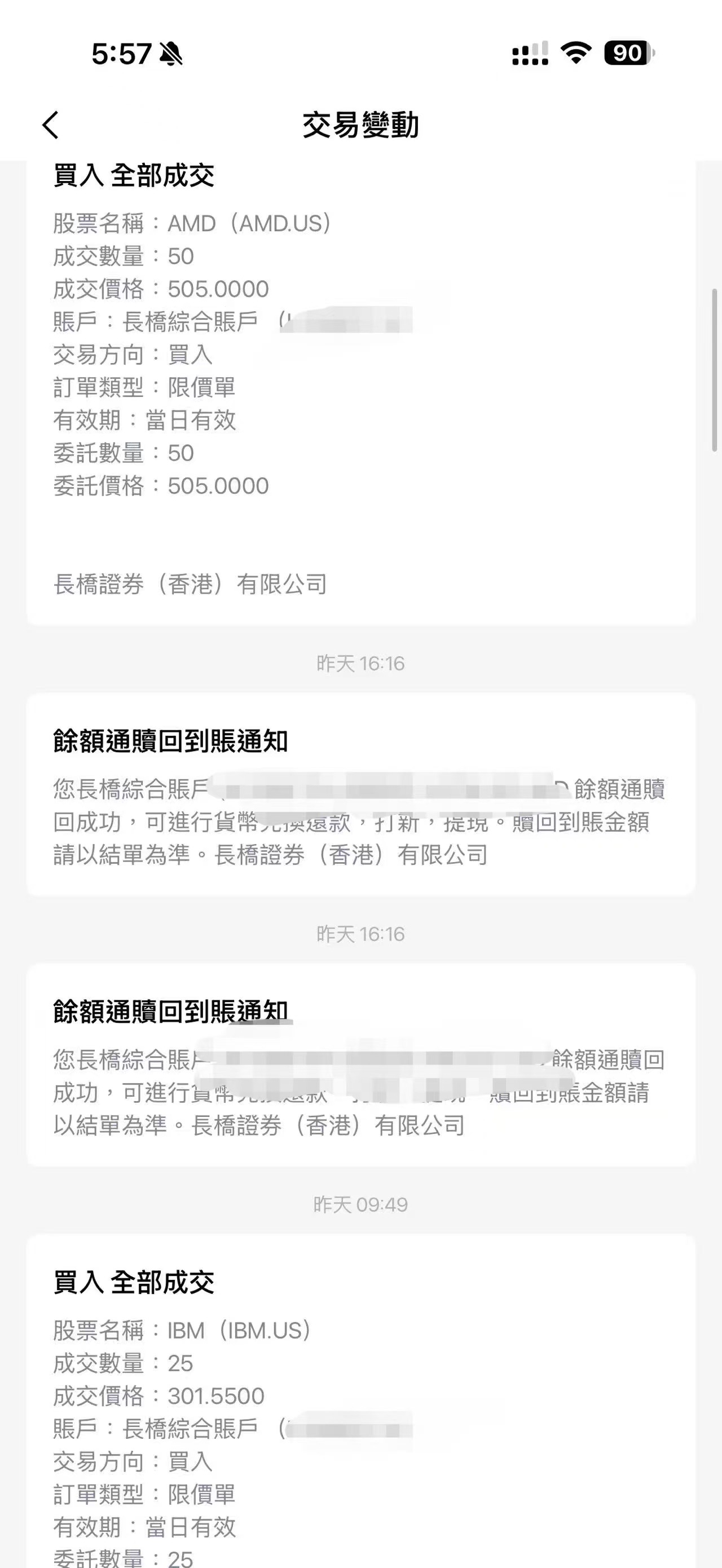
$IBM(IBM.US) announced its earnings report early, catching everyone off guard! Risk control management still needs work!$NVIDIA(NVDA.US)$Invesco QQQ Trust(QQQ.US)


佳昊札记
AssetsTop 3%ReturnsTop 6%MidBlend
投资拥有全球顶尖人才管理的先进企业,分享其不断成长所带来的成果,岂不美哉!!

 佳昊札记
佳昊札记Suggestions for you to follow


佳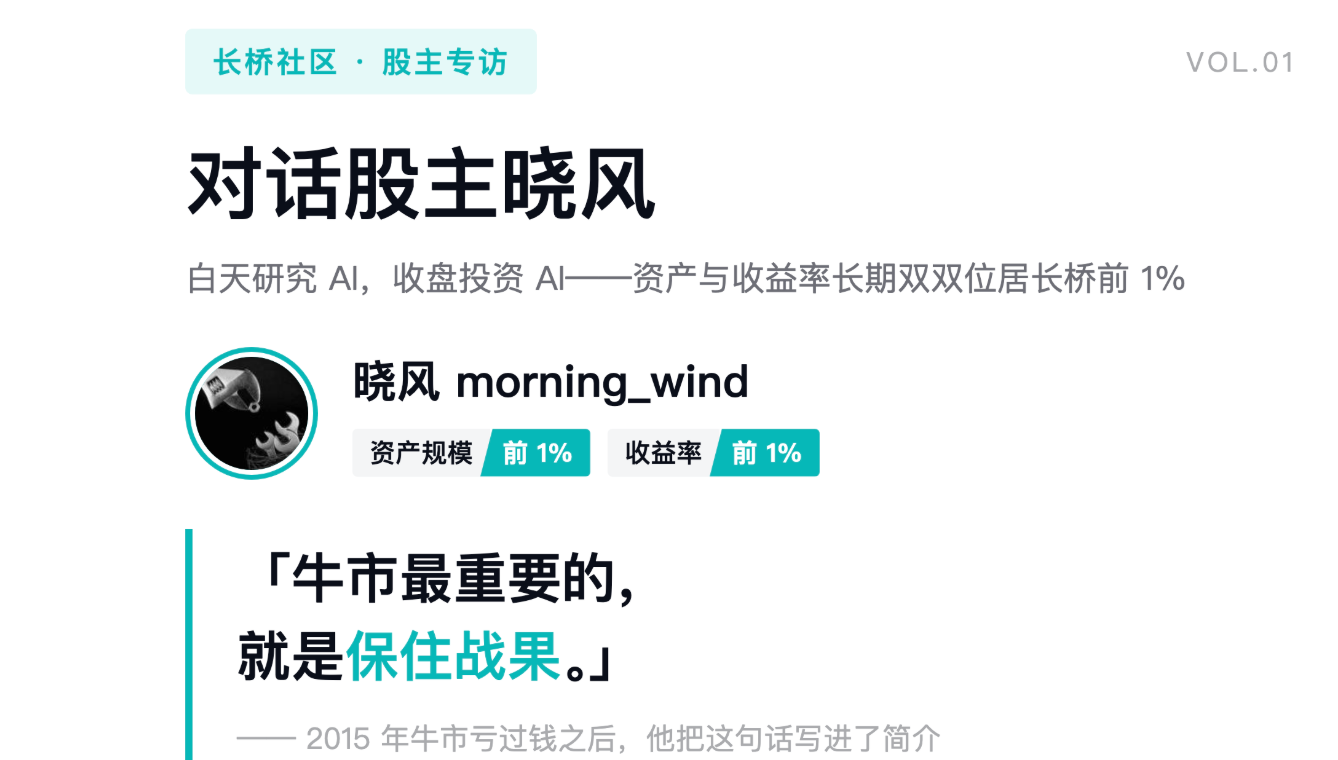

 +6
+6
After reading it, I've gained a lot. Thanks to @StockPro Administration for the thoughtful planning and organization, and also to @晓风 morning_wind for sharing their investment insights without holding back! Looking forward to more high-quality, in-depth interview content in the future.$Invesco QQQ Trust(QQQ.US)$Taiwan Semiconductor(TSM.US)$NVIDIA(NVDA.US)

Featured对话股主晓风:不满仓、不裸杠杆、先保战果——AI 从业者的投资自律
编者按@晓风 morning_wind 是长桥资产及收益率均长期排在 TOP1% 的头部作者,但在长桥社区里,他的简介只有一句很低调的话:「据说现在是牛市,牛市最重要的就是保住战果」这句话不是鸡汤。往前倒十年,2015 年那轮著名的大牛市,他从头做到尾,年底一算账——不但没赚,其实还亏了。从那以后,「保住战果」四个字,才一笔一笔写进了他的仓位纪律里。 晓风长期在科技行业工作...
+6
佳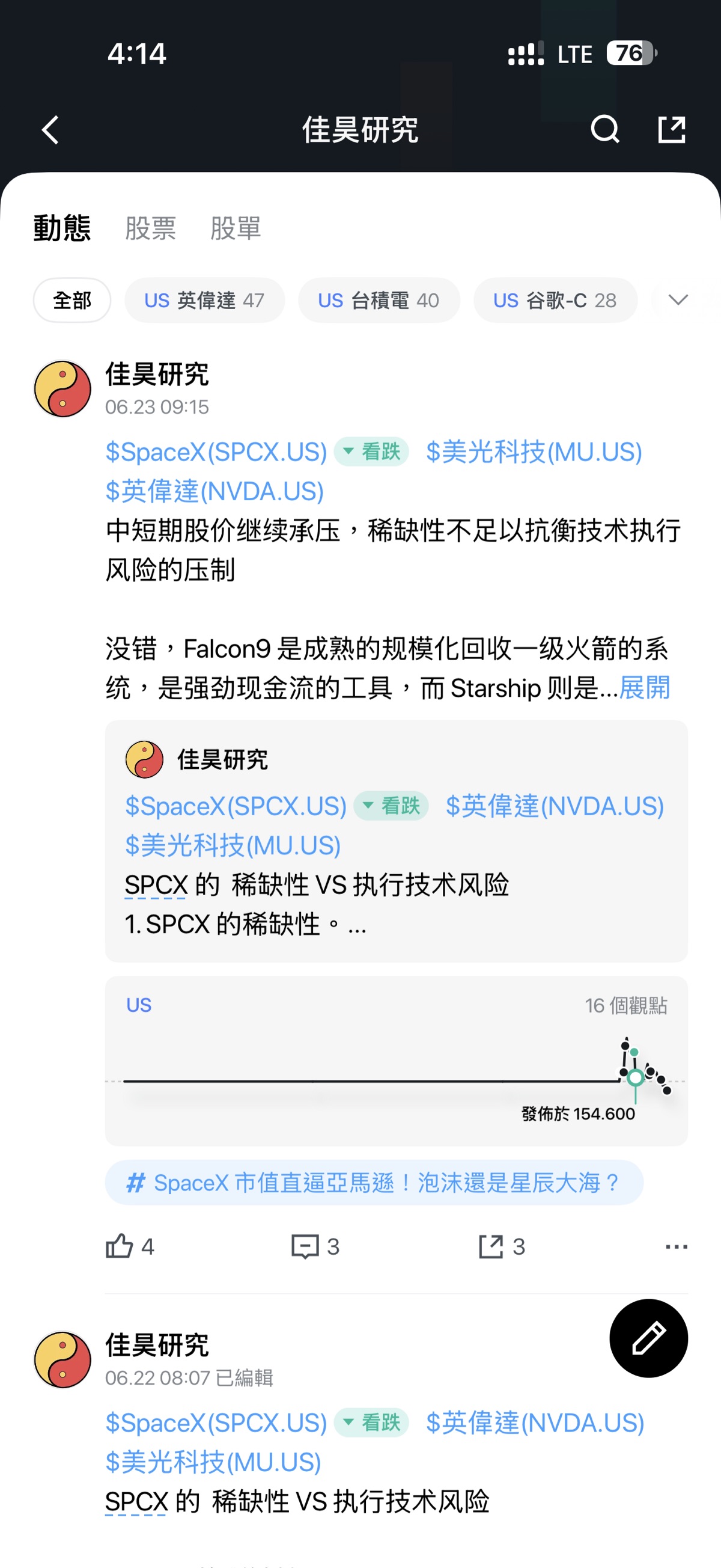
$Taiwan Semiconductor(TSM.US)$Micron Tech(MU.US)$Invesco QQQ Trust(QQQ.US)
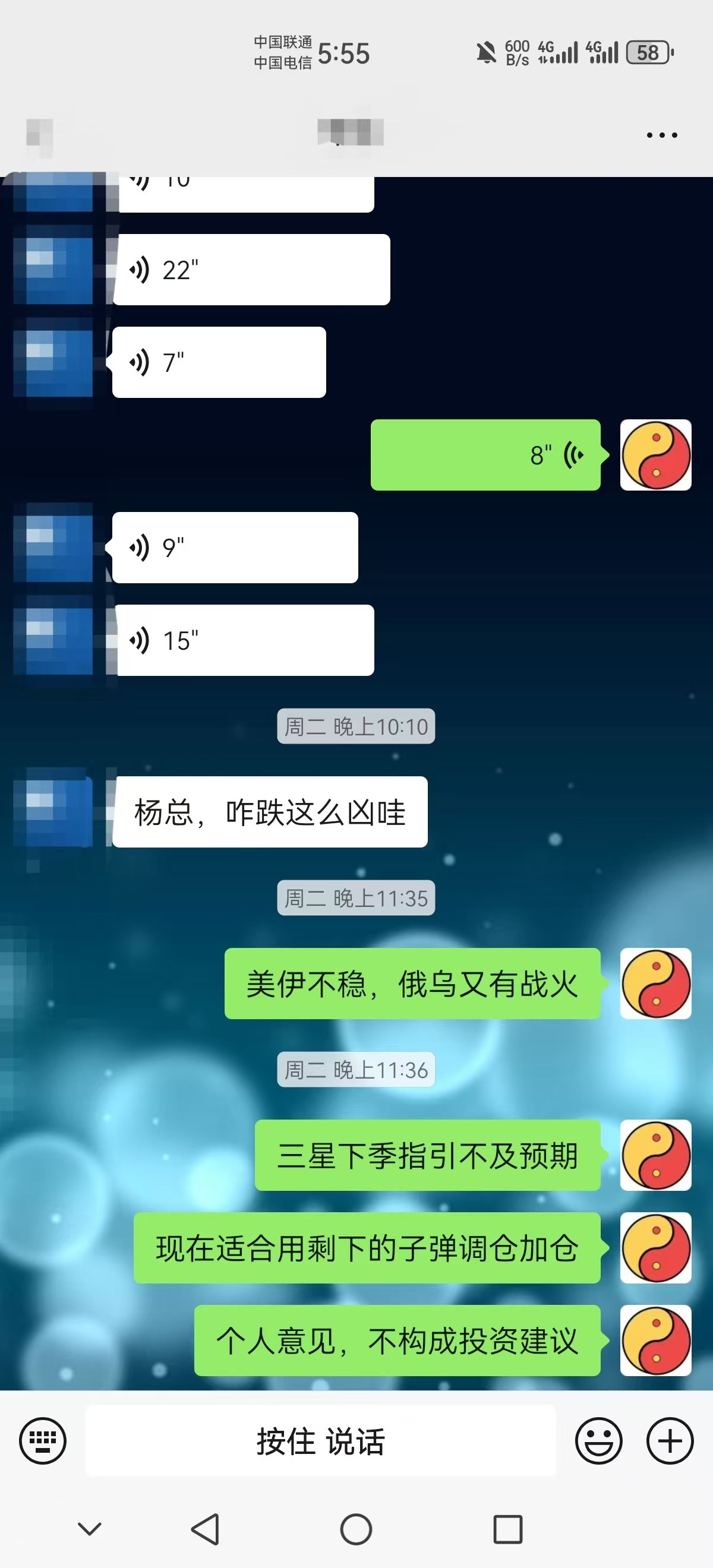
The capital market is always full of unknowns and variables. We should always maintain a sense of reverence, consistently implement risk hedging and risk control planning, and rigorously execute position and sub-account management. This is particularly important in the current environment of volatility and divergence.
$SpaceX(SPCX.US)$NVIDIA(NVDA.US)$SK Hynix(SKHY.US)
Do you still remember my initial judgment on SPCX when it went public? At its IPO, the stock was severely overvalued, with prominent risks in its own technology implementation. Coupled with the current market's consensus expectation of a prolonged Middle East geopolitical conflict, rising inflationary pressures further reinforce the logic of interest rate hike trades. Undoubtedly, SPCX will bear the brunt of the pressure first.
However, this sector possesses scarce barriers, and the long-term growth logic still holds. It is suitable for me to make a small, light-position trial-and-error layout.
The above is only a personal opinion and does not constitute any investment advice!
https://longbridge.com/topics/42629585?channel=SH000001&invite-code=7CFYR9&app_id=longbridge&utm_source=longbridge_app_share&locale=zh-HK&share_track_id=2d795be7-81cc-47da-8d4c-8c1176f19075&dialect_language=zh-YUE

Waller heads to Senate hearing tonight as PPI data drops simultaneously
佳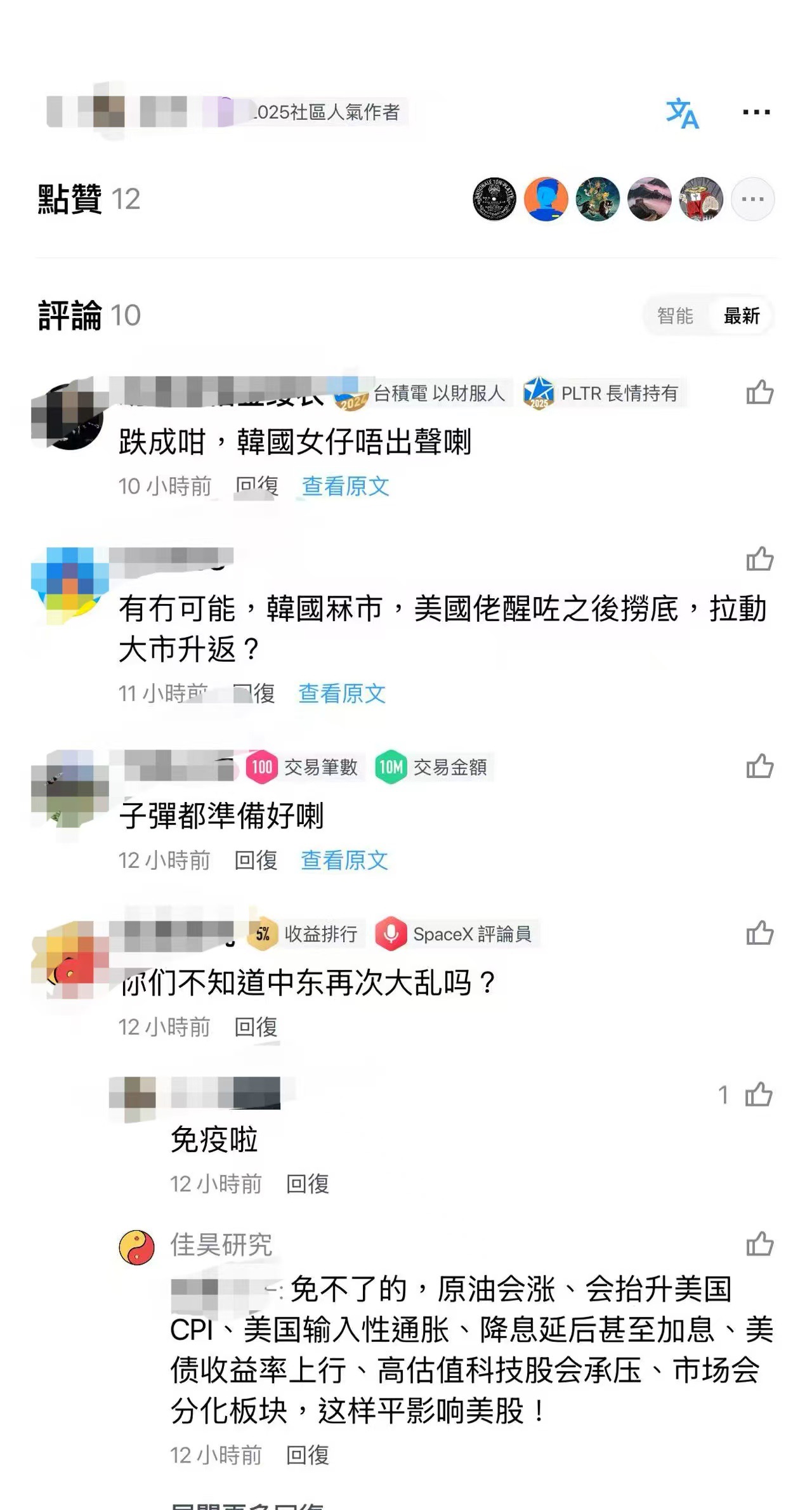

$SpaceX(SPCX.US)$NVIDIA(NVDA.US)$SK Hynix(SKHY.US)
Do you still remember my initial judgment on SPCX when it went public? At its IPO, the stock was severely overvalued, with prominent risks in its own technology implementation. Coupled with the current market's consensus expectation of a prolonged Middle East geopolitical conflict, rising inflationary pressures further reinforce the logic of interest rate hike trades. Undoubtedly, SPCX will bear the brunt of the pressure first.
However, this sector possesses scarce barriers, and the long-term growth logic still holds. It is suitable for me to make a small, light-position trial-and-error layout.
The above is only a personal opinion and does not constitute any investment advice!
https://longbridge.com/topics/42629585?channel=SH000001&invite-code=7CFYR9&app_id=longbridge&utm_source=longbridge_app_share&locale=zh-HK&share_track_id=2d795be7-81cc-47da-8d4c-8c1176f19075&dialect_language=zh-YUE
市場免疫地緣風險?美伊局勢將扭轉美股行情邏輯 - Longbridge
近期唔少投資者覺得美股早就對中東衝突形成免疫,事實恰恰相反。美伊局勢持續動盪反覆,市場已經形成中東地緣衝突常態化嘅一致預期;原油價格持續上行會持續推升美國 CPI,加劇輸入性通脹壓力,市場之前嘅減息預期會逐步消退,甚至會強化重啟加息嘅交易邏輯,呢對美股形成極強壓制。高估值 AI 科技板塊首當其衝承壓,市場正式進入結構性分化調整階段,之前 AI 賽道單邊震盪上行嘅行情宣告階段性剎車...
市場免疫地緣風險?美伊局勢將扭轉美股行情邏輯 - Longbridge
SpaceX
USSPCX
Waller heads to Senate hearing tonight as PPI data drops simultaneously
佳
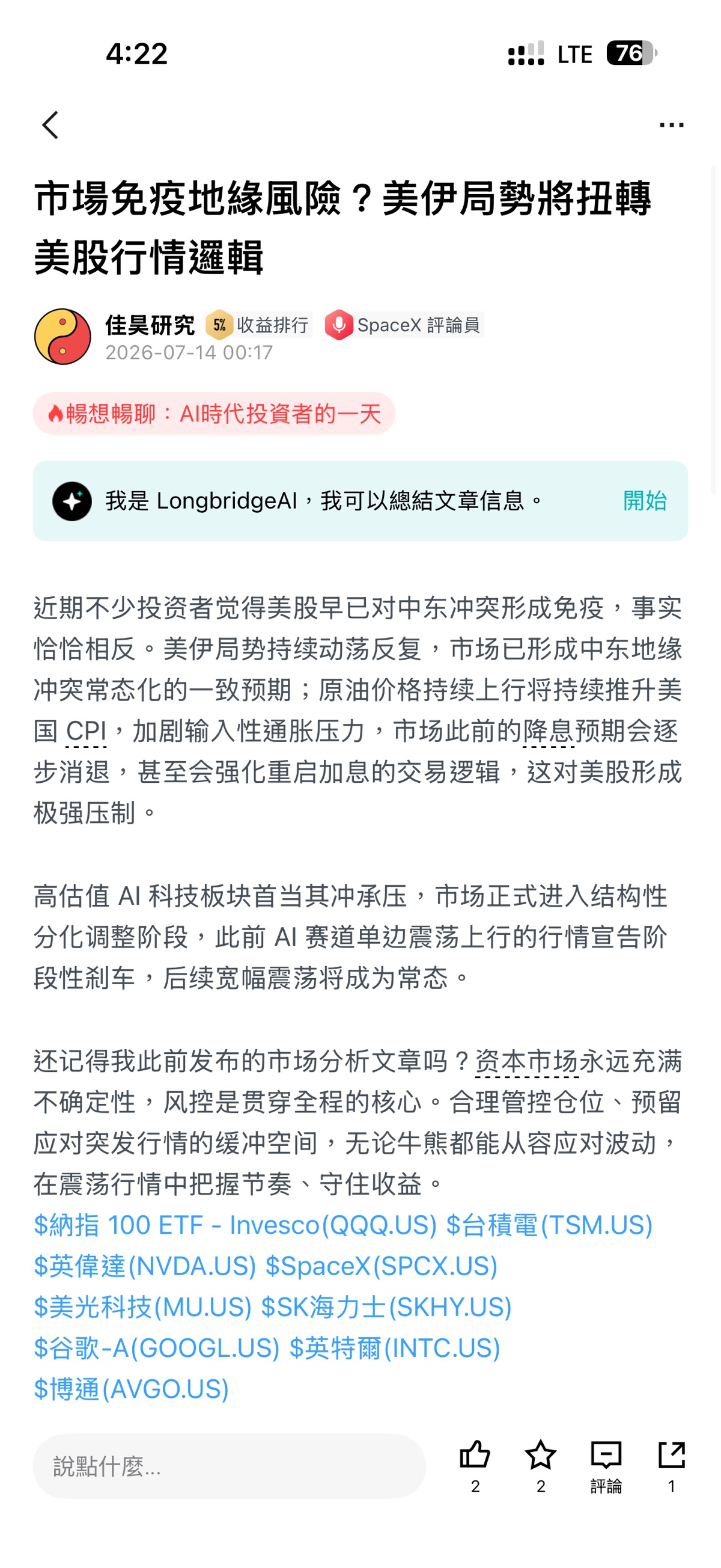
Is the Market Immune to Geopolitical Risks? The US-Iran Situation Will Reverse the Logic of US Stock Market Trends
Recently, many investors believe that the U.S. stock market has long been immune to Middle East conflicts, but the reality is quite the opposite. The ongoing and volatile U.S.-Iran situation has led the market to form a consensus expectation of the normalization of Middle East geopolitical conflicts. The continuous rise in crude oil prices will persistently push up U.S. CPI, exacerbating imported inflationary pressures. The market's previous expectations for interest rate cuts will gradually fade and may even strengthen the trading logic for restarting rate hikes, creating strong downward pressure on U.S. stocks. The high-valuation AI technology sector is the first to bear the brunt of this pressure. The market has officially entered a phase of structural differentiation and adjustment, and the previously one-sided, volatile upward trend in the AI sector has announced a temporary halt...
Open Mic: A Day in the Life of an Investor in the AI Era
佳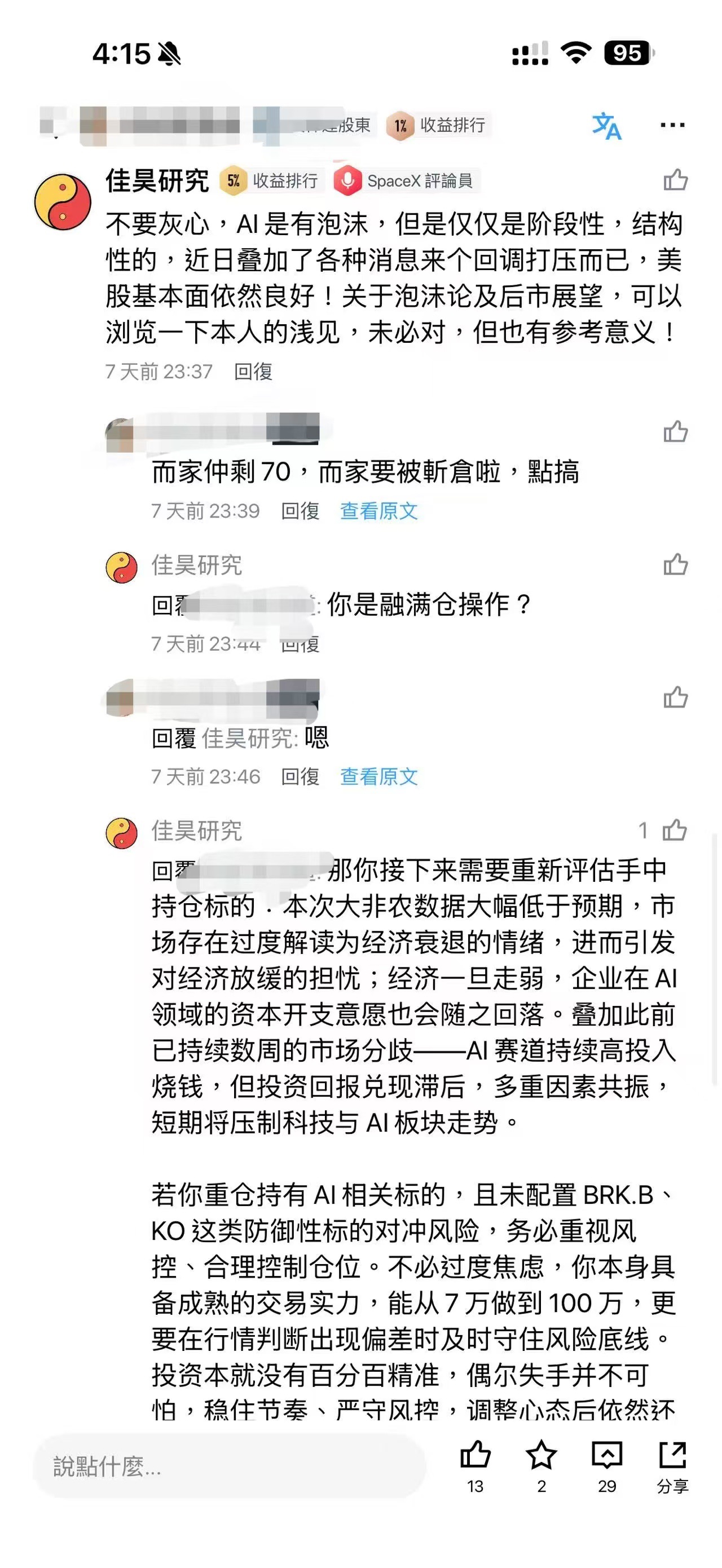
 +1
+1
Stay tuned, I will periodically share exclusive commentary on the narrative logic and market performance of the AI sector.$Broadcom(AVGO.US)$Marvell Tech(MRVL.US)$Sandisk(SNDK.US)
AI 泡沫论再起:为何产业全力看多,市场却持续大跌?我们应该如何做?
$Taiwan Semiconductor(TSM.US) $NVIDIA(NVDA.US) $Broadcom(AVGO.US)AI 泡沫论再度刷屏全网,市场多空博弈进入极致白热化阶段。近期美股 AI 赛道剧烈回调,恐慌情绪快速扩散,哪怕是收益稳定、收益率稳前 1% 的资深桥友,也纷纷出现分歧、开始谨慎避险(见附图)。针对当下市场集体恐慌的状态,我系统梳理盘面逻辑、拆解本轮大跌本质,并结合当下行情格局,分享个人最新持仓思路与后市应对策略...
+1
佳+1
Follow me for irregular updates on AI sector narratives and market commentary.$Taiwan Semiconductor(TSM.US)$Micron Tech(MU.US)$Alphabet(GOOGL.US)
AI 泡沫论再起:为何产业全力看多,市场却持续大跌?我们应该如何做?
$Taiwan Semiconductor(TSM.US) $NVIDIA(NVDA.US) $Broadcom(AVGO.US)AI 泡沫论再度刷屏全网,市场多空博弈进入极致白热化阶段。近期美股 AI 赛道剧烈回调,恐慌情绪快速扩散,哪怕是收益稳定、收益率稳前 1% 的资深桥友,也纷纷出现分歧、开始谨慎避险(见附图)。针对当下市场集体恐慌的状态,我系统梳理盘面逻辑、拆解本轮大跌本质,并结合当下行情格局,分享个人最新持仓思路与后市应对策略...
+1佳+1
$Taiwan Semiconductor(TSM.US)$NVIDIA(NVDA.US)$SpaceX(SPCX.US) Finally found time to finish writing my thoughts!
AI 泡沫论再起:为何产业全力看多,市场却持续大跌?我们应该如何做?
$Taiwan Semiconductor(TSM.US) $NVIDIA(NVDA.US) $Broadcom(AVGO.US)AI 泡沫论再度刷屏全网,市场多空博弈进入极致白热化阶段。近期美股 AI 赛道剧烈回调,恐慌情绪快速扩散,哪怕是收益稳定、收益率稳前 1% 的资深桥友,也纷纷出现分歧、开始谨慎避险(见附图)。针对当下市场集体恐慌的状态,我系统梳理盘面逻辑、拆解本轮大跌本质,并结合当下行情格局,分享个人最新持仓思路与后市应对策略...
+1佳
$Intel(INTC.US)$Taiwan Semiconductor(TSM.US)$Invesco QQQ Trust(QQQ.US)Recently, the debate over an AI bubble has reignited, with market divergence intensifying. I will take some time in the next couple of days to analyze and break it down, and share my views!
Intel
USINTC
佳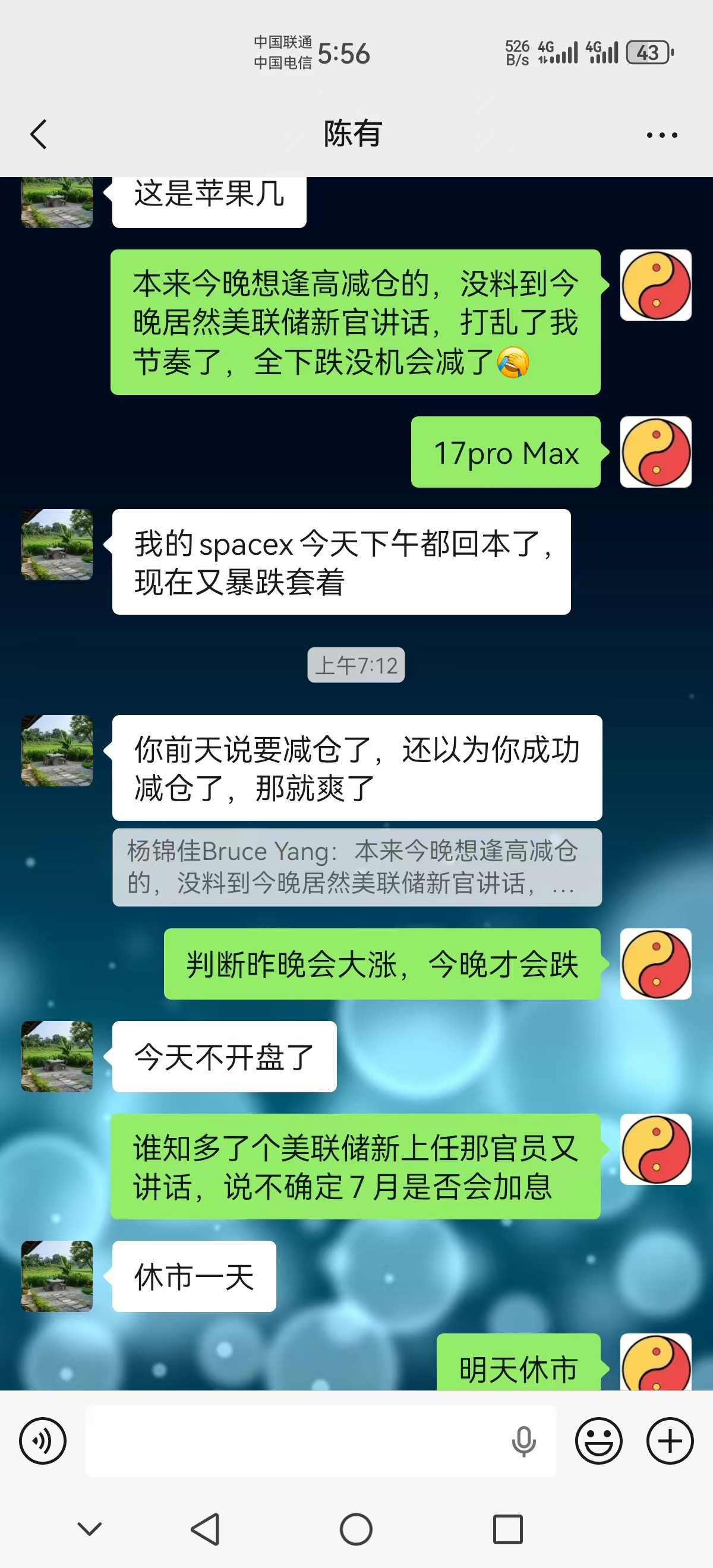

$Micron Tech(MU.US)$NVIDIA(NVDA.US)$SpaceX(SPCX.US)
This judgment was a mistake. Work has been hectic recently, and I couldn't keep up with real-time information from sources like Jin10 Data. The June Non-Farm Payrolls will be announced tonight. Going forward, it's essential to manage risks well and handle market fluctuations cautiously. $
Micron Tech
USMU
今晚非農數據出爐:“注水” 有多少?
佳
Half-year Trading Review and In-depth Market Thoughts Part 2 ~Analysis on Whether the AI Industry Has a Bubble
The current AI bubble is by no means a repeat of the 2000 internet bubble $Invesco QQQ Trust(QQQ.US) $Micron Tech(MU.US) $Meta Platforms(META.US) As global leading AI companies have been disclosing their earnings reports in succession, the industry is ramping up capital expenditures on a large scale. Coupled with the recent deep correction in the South Korean memory sector, market debates about "AI repeating the 2000 internet bubble" have heated up again. It is undeniable that there is indeed a bubble in the current AI sector, but it is a phased, structural, and localized bubble...

SK Hynix ADR Surges: The Start of a Memory Cycle Reversal?
佳
Half-Year Trading Review and Deep Market Thoughts Part One ~Half-Year Trading Journey + Risk Control Transformation Review
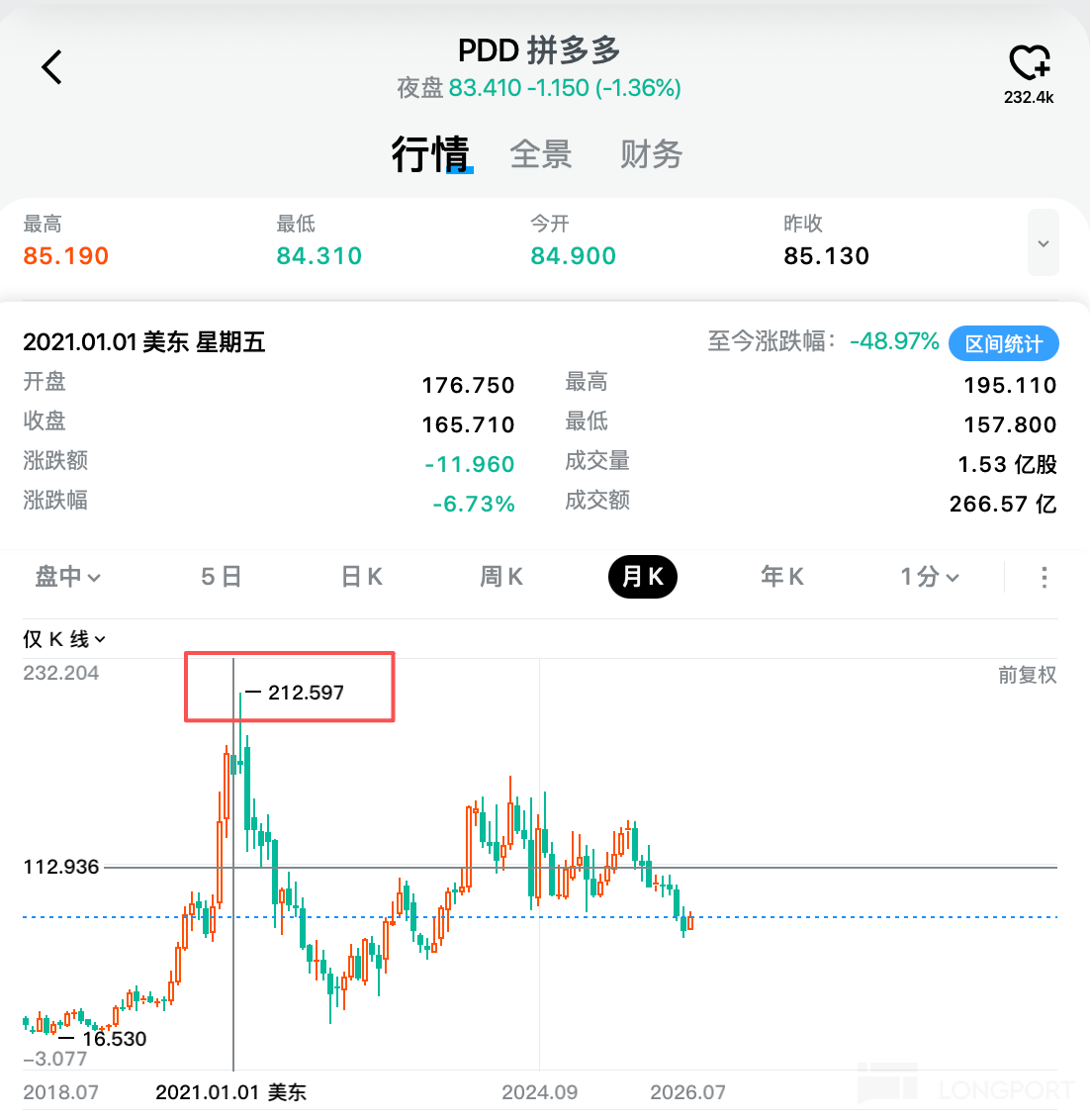
Finally found time today to summarize my half-year journey in stock investing. $Taiwan Semiconductor(TSM.US) $NVIDIA(NVDA.US) $SpaceX(SPCX.US) After six months of twists and turns, with several adjustments and repeated operations, although the process was quite troublesome, fortunately, continuous review and optimization led to a final return of 56%, completing a full round of practical training amidst volatility. I'm very grateful that there have been constant small black swan events over the past year or two, especially this year's US-Iran geopolitical risk event, which allowed me to truly understand and establish my own risk control mindset in investing. To be honest...
佳
$Micron Tech(MU.US)$SpaceX(SPCX.US)$NVIDIA(NVDA.US)
Share #5 - Better to miss out than to make a mistake
During this US market correction, a friend got excited about CRBS at $194 and asked for my opinion. As always, risk control is paramount in capital markets. It's better to miss an opportunity than to make a mistake out of greed. Opportunities are always there; learn to lie low, wait for the right moment, and then strike.
PS: Micron reports earnings tonight. Focus on its Q4 guidance, HBM shipments, and gross margin. If it's only a slight miss with optimistic guidance, the impact on the semiconductor sector will be manageable. If it's a big miss with downward guidance, the entire sector could see a significant adjustment. It's advisable to monitor real-time futures and sector ETF reactions.
Investing involves risks. Be cautious when entering the market. The above personal views do not constitute investment advice.
$SpaceX(SPCX.US)$Micron Tech(MU.US)$NVIDIA(NVDA.US)
Part Two: Position Control
Yesterday, I talked about risk control in crude language. Today, I'll extend that to discuss position management.
In fact, the core of risk control is position management. As we all know, "don't put all your eggs in one basket," which is particularly important in financial markets. Imagine if you were fully invested in a single stock, and it plummeted due to major negative news, your account would suffer a synchronous sharp decline with no other holdings to buffer or hedge against it.
Managing your position size is crucial. You need to diversify across different sectors while also having a focus on certain sectors to allow your assets to grow steadily through market fluctuations. My personal position allocation is: ① Focus on core AI chip/semiconductor holdings ~50%, ② Allocate to AI infrastructure/energy holdings ~20%, ③ Allocate to stable large-cap tech stocks (Google, etc.) ~20%, ④ Materials and others ~10%.
To be able to attack and defend, maintaining sufficient cash reserves is very important. Personally, I suggest your invested position should not exceed 60%, and for the A-share market, it should not exceed 50%.
Market changes often hit our holdings hard, but isn't that also an opportunity for us? In recent years, the US stock market has given us several opportunities to do day trading to lower costs. If you have no cash, can you buy the dip to average down and day trade when everyone is in despair? The answer is no.
Of course, don't rush to add to your positions during a sharp decline. You need to have certain principles and operating rules, such as: ① Execute in batches: Don't add your entire cash position at once; add 10-20% of your cash at key support levels each time. ② Target weight: The weight of a single stock should not exceed 25%. ③ Trigger conditions: Technical pullbacks of 5%-15%, oversold conditions after earnings reports, negative macro data, etc. For major indices, especially the Nasdaq, when it falls by 5%-10% or more over a period. ④ Cash position control: It is recommended to use the cash position (60%-70%) as the core day trading pool + (30%-40%) as a safety buffer to deal with more sudden intermediate declines. ⑤ Stop-loss and take-profit: Lock in profits and sell when there's a 5-10% rebound or when short-term targets are met; limit single-trade losses to no more than 3-5% and cut losses quickly.
Remember, there are countless paths in finance, but risk control is the first rule. Don't be greedy and chase highs, fearing you'll miss out. Opportunities are always there. Whether it's A-shares or US stocks, there will be geopolitical events or technical pullbacks from time to time. Especially during Donald Trump's administration, I believe there will be even more opportunities, as his business mindset determines that he will inevitably create opportunities for day trading.
The market carries risks; invest with caution. The above is merely a personal opinion and does not constitute any investment advice. Profits and losses are your own responsibility.
Micron Earnings Blow Out — When Does the AI Memory Cycle Peak?
佳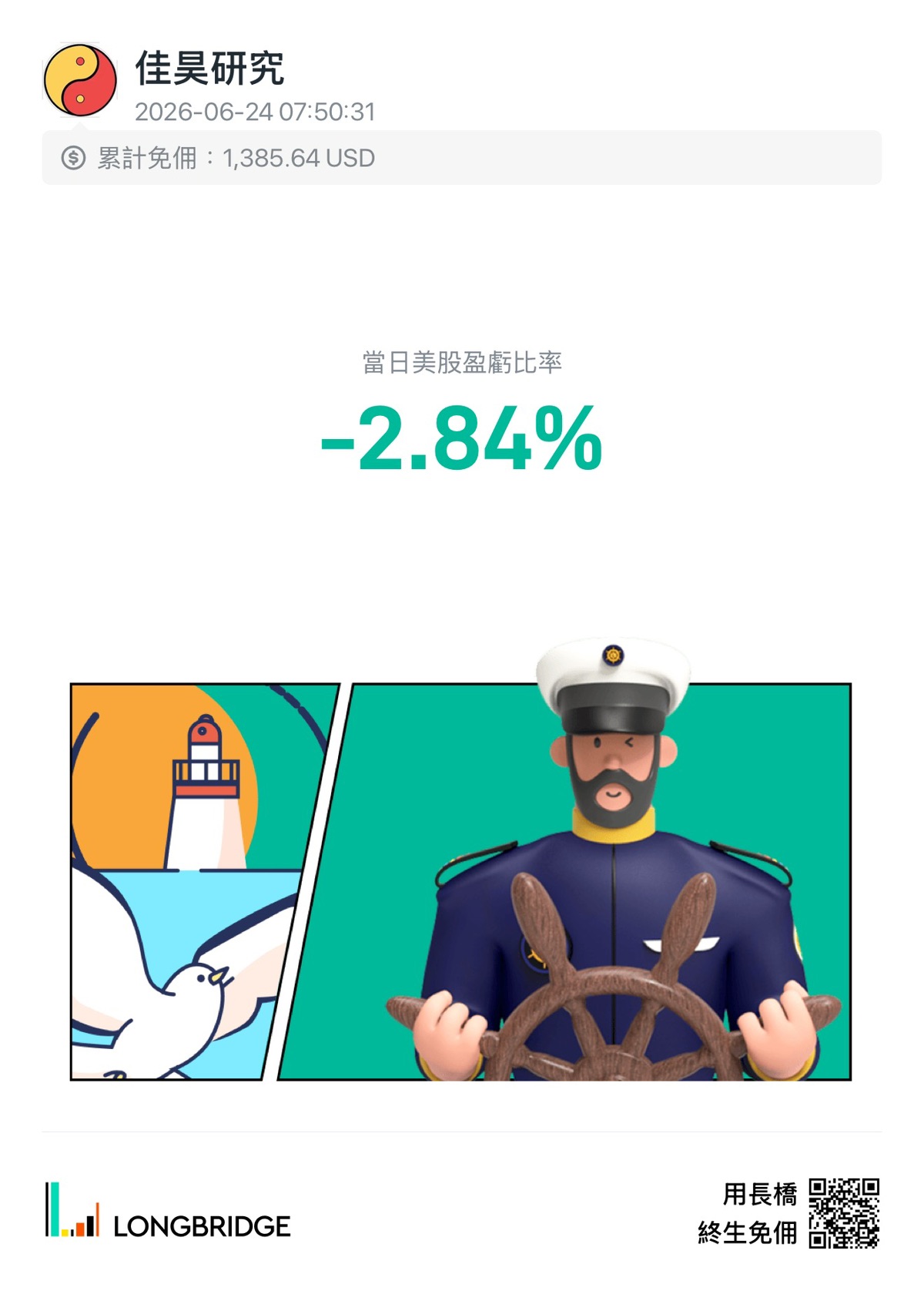
$Micron Tech(MU.US)$SpaceX(SPCX.US)$NVIDIA(NVDA.US)
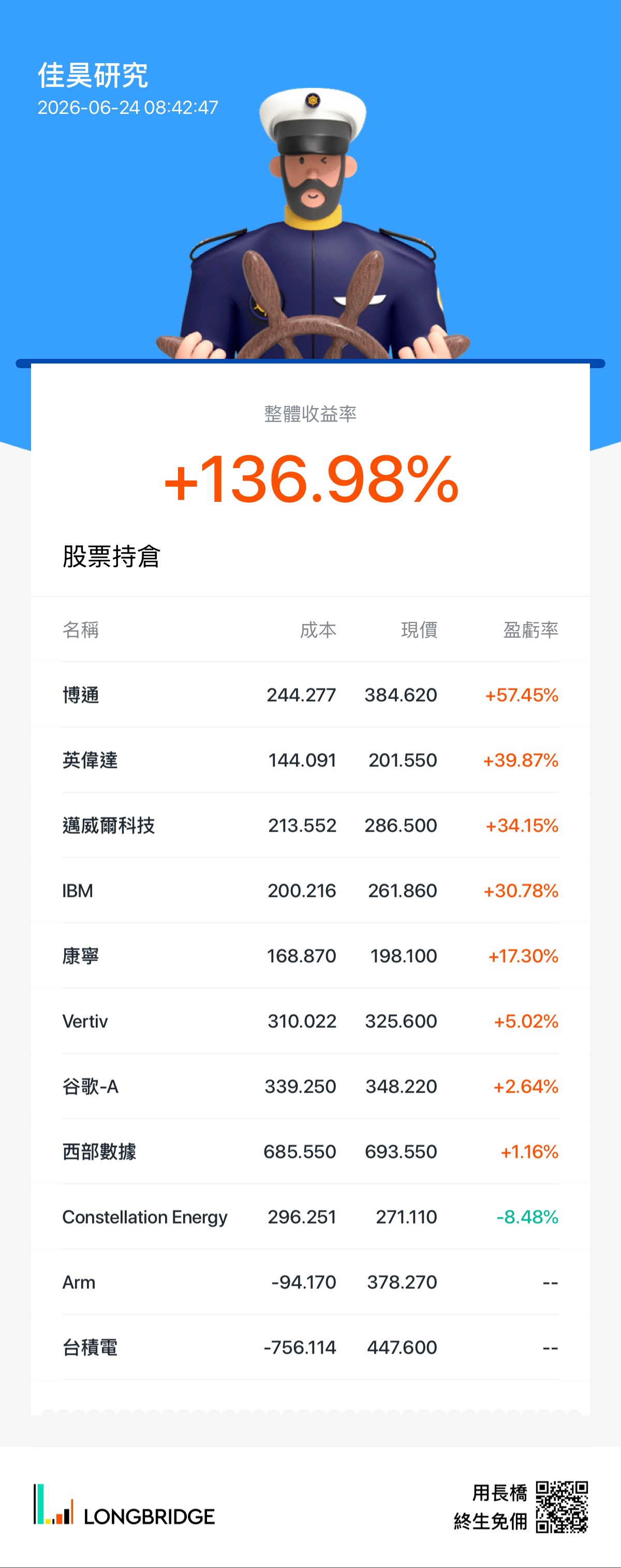
This once again proves that risk management is crucial, especially position sizing. ^_^. It was a night of heavy blows. When most stocks were down over 6%, only losing about 3% overall is acceptable!
Micron Tech
USMU
Korean Market Circuit Breaker Drags Down Asia-Pacific — Can U.S. Stocks Stage a Reversal Tonight?
佳
$SpaceX(SPCX.US)$Micron Tech(MU.US)$NVIDIA(NVDA.US)
Short-to-medium term stock prices continue to face pressure; scarcity is insufficient to counterbalance the suppression from technology execution risks.
That's right, Falcon 9 is a mature, scaled system for recovering first-stage rockets, a tool for strong cash flow, while Starship is the most promising future cash king for commercialization, the world's most advanced next-generation fully reusable and recoverable system, and the future cash-generating hope for SPCX. Combined with the full industry chain integration advantages of deep space/orbital economy/space AI, it is indeed the core driving force behind SPCX's high valuation and long-term growth.
Undoubtedly, the core reason the market gives a high premium is based on the expectation of technological leadership in reusable systems, but its technology execution risk is simply too high. Admittedly, the absolute admiration for Elon Musk, the market's overheated frenzy for the IPO, and the unparalleled scarcity did lead to a significant surge right after listing. However, the excessively high technology execution risk, especially the four major incidents this year, will inevitably damage confidence in the still-immature Starship system. Coupled with the upcoming earnings report and further share unlock, the massive bond issuance for Cursor, and the instability of the ever-changing Middle East situation suppressing high-valuation tech stock prices, once the market hype fades, a rational downward correction in value is inevitable. After all, the surge to over $2 trillion in market cap within days of listing clearly overdrew future value expectations. Personally, I still believe SPCX's short-to-medium term stock price will continue to face pressure.
The stock market carries risks; invest with caution. The above is merely a personal view and does not constitute any investment advice.
$SpaceX(SPCX.US)$NVIDIA(NVDA.US)$Micron Tech(MU.US)
SPCX's Scarcity vs. Execution Technology Risk
1. SPCX's Scarcity.
SPCX is currently the only company in the world capable of mature, large-scale recovery of first-stage rockets. This capability directly reduces launch costs to a fraction of other companies', creating an extremely deep moat. Starlink's low-orbit satellite network also has no comparable rival at the moment.
The market's ability to assign a high valuation to SPCX is largely based on its next-generation fully reusable system, Starship. Starship is SPCX's biggest cost advantage, as both the booster and the spacecraft can be fully recovered and rapidly reused, allowing for repeated operations like an airplane. Starship also possesses the following characteristics: massive payload capacity, orbital refueling capability, and adaptability to multiple missions.
SpaceX has both the main operational rocket Falcon 9 as a primary revenue generator and Starship as a revolutionary next-generation leading technology. This is where the market gives it a premium, representing SPCX's greatest advantage and its core scarcity value.
2. SPCX's Execution Technology Risk
SpaceX's execution technology risk also lies with Starship, due to its far greater complexity compared to Falcon 9.
Although Starship, which has not yet entered mature commercial operation, has enormous potential, its current execution technology risk is too high. Why is that? In fact, Starship is still in an intensive testing phase. Despite multiple test flights, issues like engine failures and landing failures are frequent during testing. It has already experienced four major technical incidents in the first half of this year, indicating that the execution risk is indeed significant.
In reality, the premium the market gives SPCX is largely built on the expectation of technological leadership in reusable systems. However, if Starship's progress is severely delayed, or if there are several more major failures or incidents, investor confidence in its moat will be shaken.
Considering points 1 and 2 above, it's not hard to see that Starship is SPCX's double-edged sword. It can bring scarcity premiums but also severe execution technology risks, leading to significant valuation downgrades.
The end of July and early August will see SPCX's first earnings report and a new round of lock-up expirations since its IPO. Coupled with Starship's consecutive failures this year, the technology execution risk is further amplified. Although the moat still exists, market confidence has already been affected.
In the short to medium term, its scarcity has been clearly suppressed by technology execution risk. Personally, I believe the $2 trillion market cap has clearly overdrawn future expectations, and the stock price is likely to face pressure in the short to medium term. Of course, this doesn't mean I'm bearish on SPCX; I am also very bullish on its long-term value. One day, Starship will truly mature, and its scarcity will be unparalleled.
The above represents only personal views and does not constitute any investment advice!
SpaceX 市值直逼亞馬遜!泡沫還是星辰大海?