
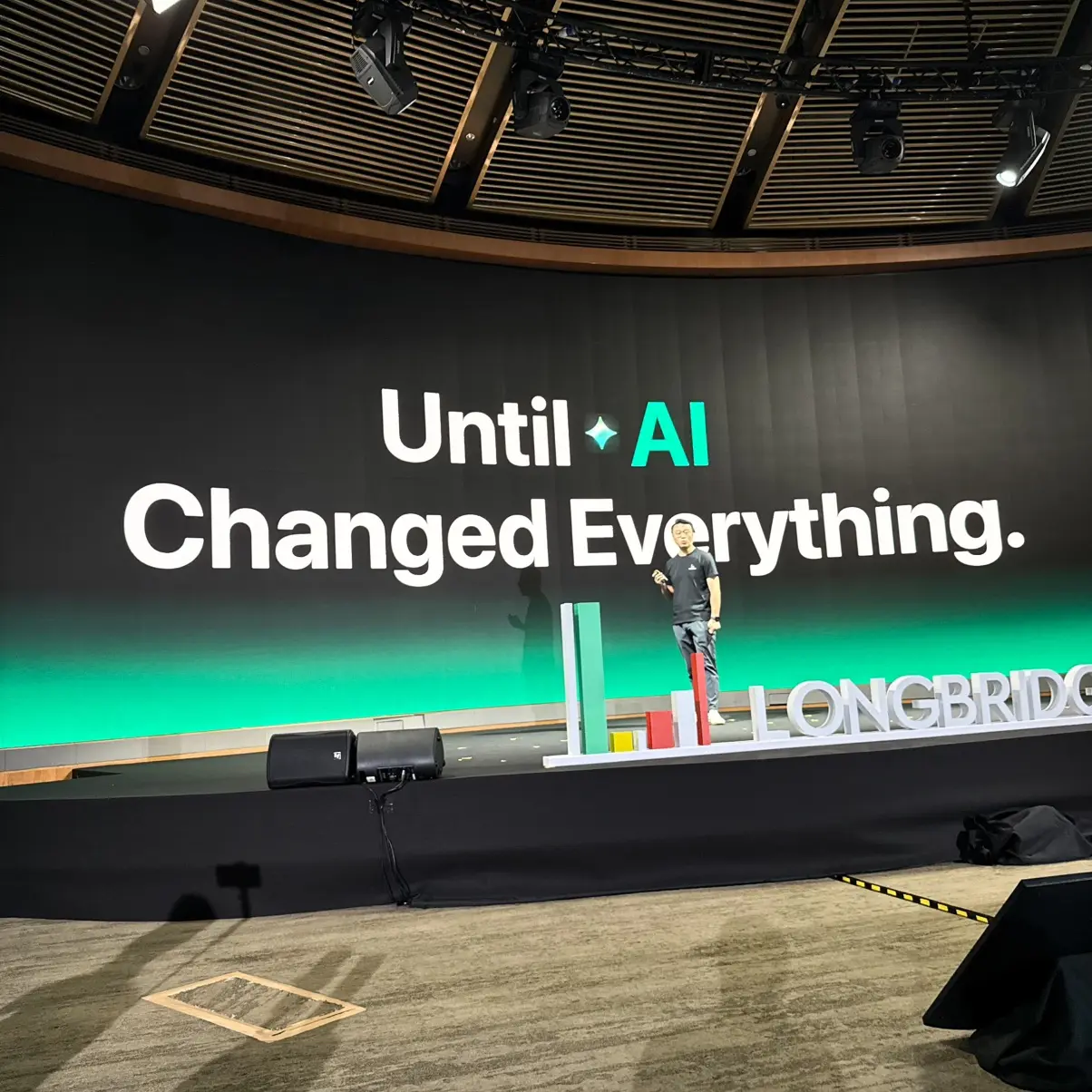
Longbridge AI 发布会
SpaceM+
S Long image
$SK Hynix - WI(SKHYV.US)
Long imageS![SpaceM 2026-06-0617:25:07 累计免佣:6,108.98 HKD 当日持仓盈亏金额 -144.70万 HKD !! 用长桥 LONGBRI]()
Opened the account and took a look, what the heck is this?🤦♂️
S
$Tesla(TSLA.US)
AI infrastructure stocks are rising, and physical AI Tesla is holding steady. There's not much activity in the community either. It's particularly quiet.
- DELL: 234%
- HPE: 79%
- MU: 240%
- SNDK: 614%
- DRAM (ETF): 128%
- ARM: 223%
- QCOM: 47%
- AMD: 141%
- AVGO: 29%
- MRVL: 141%
- SOXX (ETF): 89%
S
Just now, both brokerage firms held conference calls with analysts and announced the penalty amounts. Overall, the two types of regulatory actions this time—fines and stock clearance—are relatively mild:
Fines: The pre-processing fine amounts for both institutions have been publicly announced, which are overall lower than market expectations (Futu: 1.85 billion yuan, Tiger Brokers: 410 million yuan).
Stock Clearance: This control measure is centered on the actual place of residence (physical jurisdiction). Overseas trading and fund transfers for existing mainland clients are unaffected; on the domestic platform, only selling and fund withdrawals are allowed.
Details of Stock Clearance: It does not require mainland clients to liquidate their stocks and close accounts within two years. Instead, after two years, domestic web servers will be shut down, prohibiting trading within the mainland. Clients located overseas can still deposit funds and trade normally.
Scope of Application: The new regulations apply to all overseas institutions, covering all overseas financial entities providing securities services to mainland clients. It is not only targeting Futu and Tiger Brokers but also includes overseas banks offering securities-related services.
Longbridge, being a non-listed company, should face relatively lighter penalties, and it's estimated that it won't be required to disclose them. In short, after two years, it's the crypto treatment—use a VPN.
$Futu(FUTU.US) $UP Fintech(TIGR.US)

S![T Tesla @Tesla·4小时 FSD Supervised is now available in: -United States -Canada -M]()
![A812531 @ 11 60 2M 14:50 300m 杨公司 2 r 杨公堤 1.4lm 公 hiEir baseus 15:26 30分钟 01e 龙井]()
$Tesla(TSLA.US)
Haven't talked about Tesla for a long time. Little Tesla is probably going to explode soon, right?
Last time I was in Hangzhou, I unlocked FSD through a module, which should be a version between V12-13. In actual testing, it was more human-like than Huawei or Li Auto. When I took friends to Longjing, they completely didn't realize I wasn't driving.
Buy when no one is interested, sell when it's all the rage.

S![图3: 2026Q1 11 段永平持仓股数变动明细 序号 股票 26Q1持股数 25Q4持股数 变动数 变动比例 今年涨幅 1 苹果 28,945,607 32]()
Duan Yongping's top five holdings (by weight):
• AAPL (Apple): 36.72% (Largest holding, still the core position, but reduced quarter-over-quarter)
• BRK.B (Berkshire Hathaway Class B): 21.91% (Second largest, a defensive core holding)
• NVDA (NVIDIA): 12.07% (Third largest, significantly increased allocation for AI computing power)
• Pinduoduo: 10.09% (Fourth largest, buying more as it falls)
• TSLA (Tesla): 6.34% (Newly entered as the fifth largest)
S![01·AI全产业链7层概览 整个AI算力供给链可以拆为7层。最上层是能源与原材料(铀矿、稀土),最下层是AI综合主题层(覆盖应用/模型/机器人)。每一层都有自己]()
![02·15只ETF横向对照 TICKER 层 全称 AUM 费率 顶部持仓 风险 角色 AIQ L1 Global X Al & Tech $7.9B 0.68]()
![下表的100%是"AI 主题专属仓位"内部分配。假设你已有60%+资产在标普500/全球股/债券。每组都遵循"每层最多1只 ETF"原则。 保守型·怕回撤30%]()
AI Full Industry Chain ETF Purchase Guide
(For personal use only, please do not buy recklessly)
S![SpaceM 2026-05-0422:13:50 DRAM260515 40 Call 持仓盈亏率 +332.00% 用长桥 LONGBRIDGE 终生免佣]()
$Roundhill Memory ETF(DRAM.US)
The "cheap era" for memory chips is over. It's not temporary; it's structural.
It has gone from a "cyclical gamble" to a sector that can be held for the long term. Sell off the options, and keep holding the underlying shares.
Trade Showcase: Trade, Show & Earn Rewards!
S![运行时间 (HKT,周一至周五): 时间 对应美股时段 用途 00:17 盘中 (1 (12:17PMET) 盘中情绪快照 04:17 收盘后(4:17PMET]()
![BEHAVIORAL ECONOMICS SIGNAL TSLA社区情绪x行为经济学机会 2026.04.02|Q1交付 358K vs vs预期373K|30]()
Behavioral Economics Opportunities Brought by Longbridge Skills (Real Cases)
Hedge funds spend hundreds of thousands of dollars on alternative data, and what they do essentially boils down to one thing: trading in the opposite direction when retail investor sentiment reaches extremes. The core barrier in this business isn't how complex the model is; it's the inability to access data sources. Reddit posts need to be scraped, StockTwits sentiment needs to be purchased, and Twitter's firehose requires payment. Retail investors want to do it themselves? No way. But Longbridge Skills has opened up the community API. What does this mean? It means a retail investor...
S![Longbridge Developers Q搜索文档 8K 首页 Skill 文档 API参考 SDK Issues 7 选择场景,查看你的AI助手如何工作工]()
![Futu API Skills 立即安装 Futu API Skills 让AI成为你真正的交易助手 查看能力→ 快速开始 65 7 3 0 API接口覆盖 港]()
![Analyze Tesla sentiment from recent discussions V Preview 帖子 情绪类型 占比 典型表达 数 "垃圾股]()
![× Futu OpenD Login Basic IP 127.0.0.1 Port 11111 User ID/Email Phone Log Level i]() +1
+1
Longbridge Skills vs. Futu Skills: The Battle for Broker Infrastructure in the AI Era — One Is Moving with the Times, the Other Still Ships an Installer
In 2026, AI agents are no longer a buzzword. Claude Code, Cursor, Gemini CLI — developers and investors are now using natural language to pull market data, place orders, and parse earnings reports. A broker's API is no longer just a tool for quant teams; it's become the last-mile nerve ending connecting every AI tool to the financial world. Both Longbridge and Futu have stepped up with their own Skills offerings — but their architectural philosophies diverge from the very first line of code...

S![N]()
![SpaceX散户配额 VS 美股IPO惯例 数据来源: Reuters,公开市场数据 SpaceX(2026) 30% Facebook(2012) 15% 美]()
![特斯拉的散户持股比例远超市场平均 S&P 50 特斯拉(TSLA) 中排名前3% 标普500平均 内部人10% 散户15% 内部人/马斯克18% 散户38% 机]()
SpaceX offering 30% of shares to retail investors: a benefit or a trade-off?
The whole internet is hyping: Musk is kind-hearted, SpaceX is reserving 30% of its IPO shares for retail investors. This narrative is completely wrong from start to finish. It's not the conclusion that's wrong, it's the framework. The essence of IPO allocation: who sets the price, who takes the shares, let's first clarify a basic logic. IPO allocation is essentially a distribution of pricing power. Institutions get shares, obtaining the arbitrage right to "buy at a low price and sell in the secondary market." Retail investors get shares, usually the leftovers after institutions have picked. In US IPO conventions, retail investors only get 5%-10%. Why? Because underwriters need institutions to "discover the price"...
S
SpaceX IPO reserves 30% for retail investors, Musk is genuinely helping ordinary people this time.
Everyone knows the unwritten rules of US stock IPOs: when a good company goes public, institutions get the meat, retail investors get the broth. Retail investors typically only get allocated 5%-10% of the shares. By the time you can buy in, the first wave of gains has already been scooped up by the institutions.
But this SpaceX IPO is different. Musk wants to reserve 30% of the IPO shares for retail investors. This isn't just for show. He's serious.
According to Reuters, SpaceX plans to IPO with a valuation of around $1.75 trillion, raising up to $750 billion—if successful, it would surpass Saudi Aramco's $294 billion record from 2019 to become the largest IPO in human history.
In this deal, Musk's team is pushing to allocate 20%-30% of the shares to individual investors. Based on $750 billion, 30% is $225 billion directly accessible to ordinary people.
When Facebook went public in 2012, it only gave retail investors about 15%, which was already called "unprecedentedly retail-friendly" by the media. SpaceX is doubling that.
The execution is also practical: Bank of America handles the high-net-worth client channel, while Morgan Stanley covers ordinary retail accounts through E*TRADE. These two pipelines ensure the shares actually reach individual investors' hands, not just get snatched up by institutions under a different name.
Why is Musk doing this? Honestly, any other CEO would never do this. Giving shares to institutions, locking in large orders, ensuring a smooth IPO day—that's the standard Wall Street playbook.
But Musk never plays by the rules.
Recall the Tesla story. During the 2020 surge, it wasn't Goldman Sachs or BlackRock that held off the short sellers; it was the millions of retail investors holding onto their few hundred or thousand shares, refusing to sell. They encouraged each other on Twitter, analyzed fundamentals on forums, and voted with their real money. Throughout Tesla's rise from $40 to $400, retail investors were the most steadfast allies.
Musk remembered that. Musk doesn't want "smart money"; he wants "conviction money." And history has shown that conviction money often holds on longer than smart money.
What does this mean for retail investors?
This might be the first time ordinary investors get a truly meaningful allocation in a super-unicorn IPO.
SpaceX's fundamentals also justify this trust. Starlink is already profitable, with 2025 revenue projected to exceed $120 billion, covering over 100 countries globally. Starship holds long-term NASA contracts, with commercial launch orders booked into the year after next. This isn't a company burning cash on stories; it's a space infrastructure giant with real cash flow, technological moats, and government backing.
Of course, a $1.75 trillion valuation isn't cheap, and the subscription threshold and lock-up period details haven't been announced yet. But the mere act of "reserving 30% for retail" has already changed the game.
For decades, wealth distribution in the IPO market has been tilted towards institutions. Retail investors are always the last to the table, and by the time you sit down, the good dishes are already gone.
This time, Musk has at least left a few hard dishes on the table.$Tesla(TSLA.US)
S![图片 1,共 2 张]()
![ola]()
2025 Annual Investment Review
It's that time of the year again for a review. To be honest, I'm a bit afraid—if I look back and find no growth this year, that would be truly frightening. This year I'm 35, and when a man reaches 35, he really has to look back properly. The first day of the Lunar New Year also happens to be my birthday. Amidst the hustle and bustle, it's a good time to calmly reflect on the past year's life, work, and investments. A birthday gift to myself. 25 years of life and work have been a particularly magical year. There's been pressure and grievances, but also accompanied by too many fresh experiences. Looking back, this year has been incredibly dense. In terms of work...

S![Elon Musk x @elonmusk·21分钟 Tesla will stop selling FSD after Feb 14. FSD will on]()
![智能辅助驾驶 已包含]()
FSD, Musk is re-evaluating its value
Elon just posted an X, the tweet was simple, but there's a lot to unpack behind it.
1. Financially, converting volatile hardware profits into stable, high-margin recurring revenue. Tesla is essentially an AI and robotics company, not a traditional manufacturer. A one-time purchase is a single transaction, while a subscription turns the vehicle into a terminal that continuously generates cash flow. A one-time purchase creates a psychological account where the value of FSD is fixed. Ending one-time purchases means no longer treating FSD as an "accessory" but defining it as a "utility service" or "operating system license."
2. Lowering the barrier to accelerate the network effects of the "data flywheel." The key to winning in autonomous driving isn’t the sophistication of the algorithm but the scale of training data. More subscribers → more miles driven → more edge-case data → stronger algorithms → attracting more subscribers. A single fatal edge case in autonomous driving could destroy a physical AI company.
3. Paving the way for Robotaxi. If cars can achieve true full self-driving, vehicle ownership will become less important—what matters is the car + FSD. Are taxis expensive, or are drivers expensive? If drivers are expensive, then FSD is expensive, meaning FSD brings you more income, making it more feasible to add your car to Robotaxi. More people using Robotaxi → owners/carmakers profit → more owners join → more FSD cars available → more people willing to hail Robotaxi.
If you can buy it outright, just buy FSD!
S![5:00A .l令 82 < TSLA特斯拉 盘前交易中01.13 美东 497k 行情 全景 财务 448.960 +3.950 24H +0.89% 今日成]() Long image
Long image
$Tesla(TSLA.US) Longbridge seems to be offering grey market price options products
S![9:01 1 ! 5G 84 < 捐款結果 ● AlipayHK 我已成功捐款! 慈善捐款 受惠機構 香港紅十字會 項目名稱 大埔火災緊急呼籬 捐款日期及時間]()
![9:051 5G 82 < ● AlipayHK 我已成功捐款! 慈善捐款 受惠機構 救世軍 【緊急呼籬】救世軍緊急支 項目名稱 援大埔災民專項捐款 捐款日期及]()
$Tesla(TSLA.US) Come on HK, as a temporary resident of Hong Kong, I sincerely hope HK can develop better.
S![Gali @Gfilche·19小时 X when does $TSLA stock have its $NVDA moment? 319 门57 1054]()
$Tesla(TSLA.US)
TSLA's NVDA moment
Elon Musk personally pointed out:
- 🧠Major valuation changes when unsupervised autonomous driving is deployed at scale
- 🤖Even more significant valuation changes when Optimus goes into mass production
14.3 FSD = The moment to sleep with eyes closed (mentioned at shareholders meeting)
S![雪球 出品 方 方 红书 电动车这个生意不会太好 小红书号:2 275544407]()
![雪球 出品 Zc 方 专书 我不说很喜欢这个人的品行 SNCE 199 下红书号:275544407]()
![< 雪球正文 大道无形我有型 2025-11-1407:22·美国·雪球十年知己 $特斯拉(TSLA)$ 今天看了elon mask最近的演讲, 突然明 白电动]()
![大道无形我有型 2025-11-1411:14·美国·雪球十年知己 是时候再认真看一下Tesla了 准备尽快 去买辆特斯拉的车, 试试自动驾驶的感 觉。 o @]()
$Tesla(TSLA.US) Even as strong as Lao Duan, he has to iterate his own understanding.
What a man says doesn't matter, it's where he puts his money that counts
S
$Tesla(TSLA.US)Elon Musk purchased approximately 2.57 million shares of Tesla (TSLA) stock on September 12, 2025, with a value of about $1 billion, at a price range of approximately $372 to $396 per share.
Make an observation line.