
Behavioral Economics Opportunities Brought by Longbridge Skills (Real Cases)
 I'm LongbridgeAI, I can summarize articles.
Hedge funds spend hundreds of thousands of dollars on alternative data, and what they do essentially boils down to one thing: making contrarian trades when retail sentiment reaches extremes.
The core barrier in this business isn't how complex the model is, it's the inability to access data sources.
Reddit posts need to be scraped, StockTwits sentiment needs to be purchased, Twitter's firehose requires payment. Want to do it yourself as a retail investor? No chance.
But Longbridge Skills has opened up its community API.
What does this mean? It means a retail investor, using Claude + Longbridge Skills, can build their own institutional-grade sentiment tracking system.
I built one. Ran it. And, verified it.
A TSLA Community Sentiment Tracker
The system is simple. Four scheduled tasks run automatically every day, covering key US market hours. Each run automatically scans Tesla discussion posts in the Longbridge community, performing sentiment classification and intensity assessment. Key design: assigned an RSI-style quantitative indicator to the sentiment.
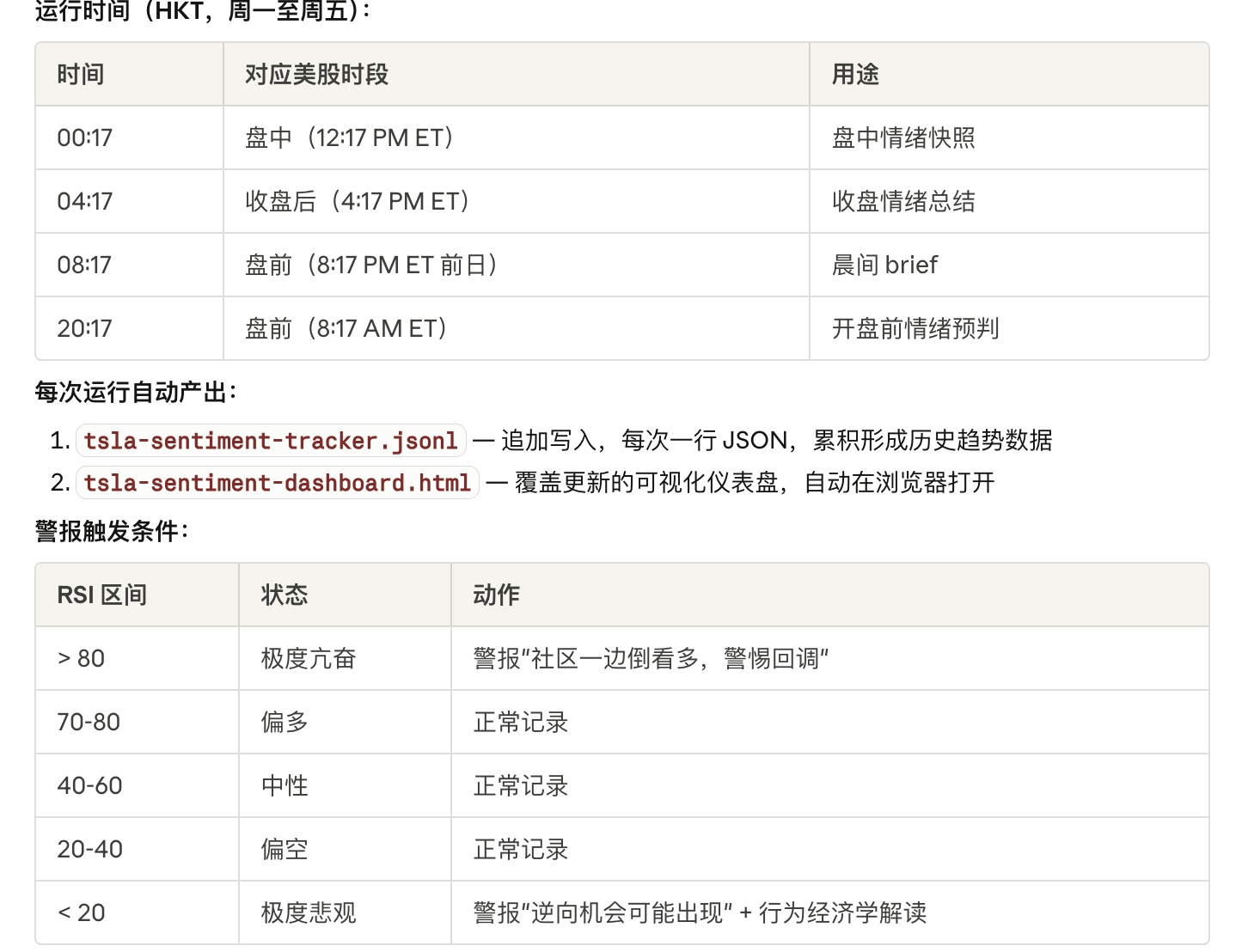
The logic is clear: Extreme sentiment = trading signal. No action in the middle zone, only triggered at the extremes. This is the most basic framework in behavioral economics—mean reversion of crowd sentiment.
What Happened When 76% Were Panicking
A couple of days ago, Tesla plunged intraday, and the system automatically ran a scan.
The result triggered an extreme pessimism alert with RSI < 20.
I pulled out the raw data to look: the sentiment distribution of 30 posts:
| Sentiment Type | Number of Posts | Percentage | Typical Expressions |
|---|---|---|---|
| Extreme Panic/Venting | 16 | 53% | "Trash stock, go under!" "The whole world is making money, only you're losing" "Can't see any positive news" |
| Panic Selling | 7 | 23% | "Can't sell" "Can't place an order" "Crashing" |
| Neutral/News Reposting | 4 | 13% | Iran Strait agreement, media market description |
| Rational Analysis | 1 | 3% | "Used Claude to pull 16 quarters of delivery data for backtesting" |
| Contrarian Adding | 2 | 7% | "Added a little" "Holding on by faith" |
**76% negative or panicking, we can check back later to see what the outcome would be of buying at this moment with RSI < 20?
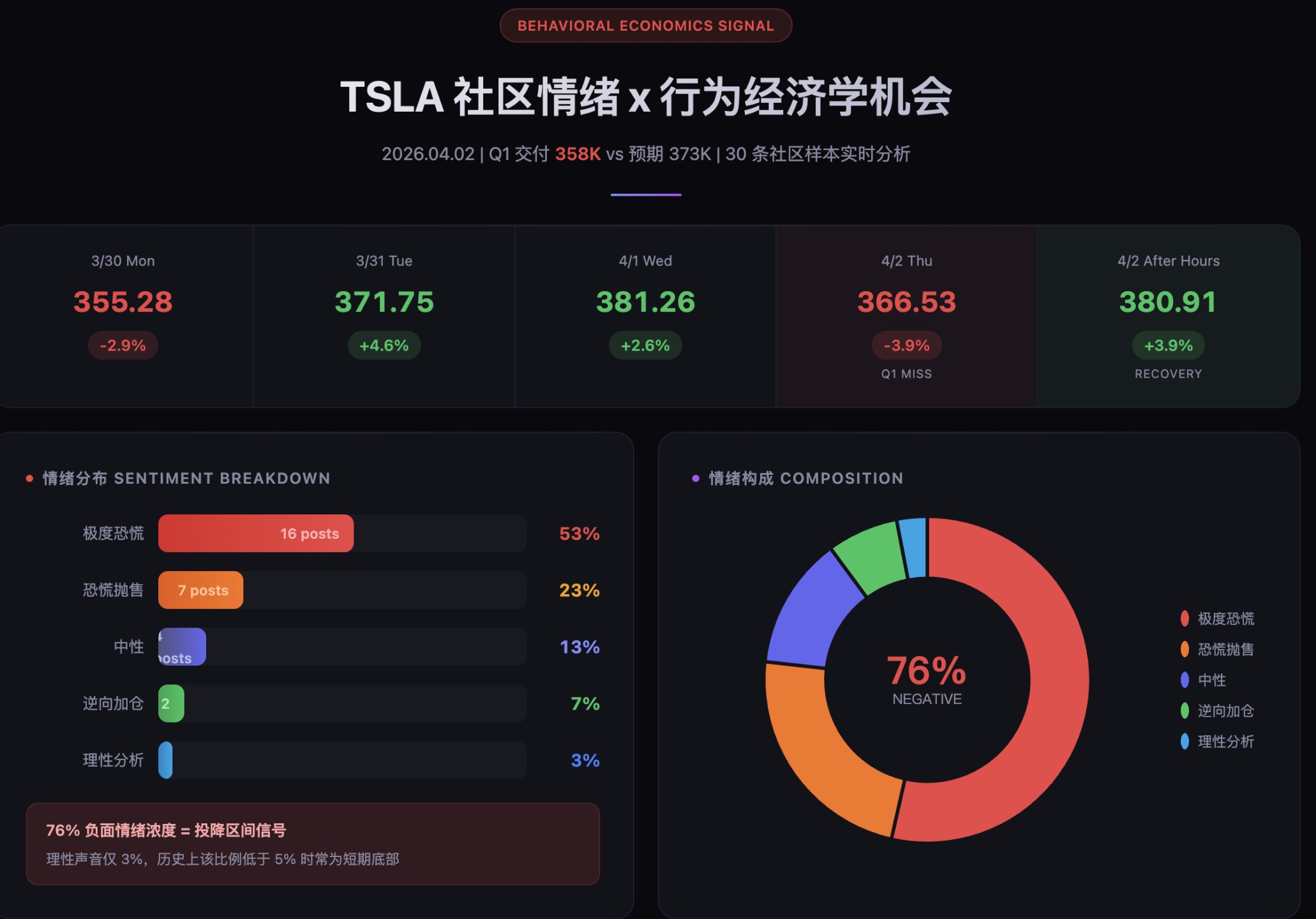
Completed based on Longbridge combined with Claude
The True Significance: Democratization of Alternative Data
Essentially, it's one thing: quantifying retail sentiment and making contrarian trades at extremes.
Now, Longbridge Skills has opened its community API. A retail investor, at zero cost, has built a sentiment tracking system that only institutions could use before.
This is the real opportunity brought by Longbridge Skills' community API—not "being able to post", but being able to turn community noise into alpha.
The copyright of this article belongs to the original author/organization.
The views expressed herein are solely those of the author and do not reflect the stance of the platform. The content is intended for investment reference purposes only and shall not be considered as investment advice. Please contact us if you have any questions or suggestions regarding the content services provided by the platform.
Author's posts
View moreLongbridge Skills vs. Futu Skills: The Battle for Broker Infrastructure in the AI Era — One Is Moving with the Times, the Other Still Ships an Installer
In 2026, AI agents are no longer a buzzword. Claude Code, Cursor, Gemini CLI — developers and investors are now using natural language to pull market data, place orders, and parse earnings reports. A broker's API is no longer just a tool for quant teams; it's become the last-mile nerve ending connecting every AI tool to the financial world. Both Longbridge and Futu have stepped up with their own Skills offerings — but their architectural philosophies diverge from the very first line of code...
SpaceX offering 30% of shares to retail investors: a benefit or a trade-off?
The whole internet is hyping: Musk is kind-hearted, SpaceX is reserving 30% of its IPO shares for retail investors. This narrative is completely wrong from start to finish. It's not the conclusion that's wrong, it's the framework. The essence of IPO allocation: who sets the price, who takes the shares, let's first clarify a basic logic. IPO allocation is essentially a distribution of pricing power. Institutions get shares, obtaining the arbitrage right to "buy at a low price and sell in the secondary market." Retail investors get shares, usually the leftovers after institutions have picked. In US IPO conventions, retail investors only get 5%-10%. Why? Because underwriters need institutions to "discover the price"...
2025 Annual Investment Review
It's that time of the year again for a review. To be honest, I'm a bit afraid—if I look back and find no growth this year, that would be truly frightening. This year I'm 35, and when a man reaches 35, he really has to look back properly. The first day of the Lunar New Year also happens to be my birthday. Amidst the hustle and bustle, it's a good time to calmly reflect on the past year's life, work, and investments. A birthday gift to myself. 25 years of life and work have been a particularly magical year. There's been pressure and grievances, but also accompanied by too many fresh experiences. Looking back, this year has been incredibly dense. In terms of work...
1 likes