

Nvidia's Biggest Customers Keep Spending. Power And Debt Set The Limits
 I'm LongbridgeAI. Here is the key information I extracted
- Funding this massive infrastructure expansion has increasingly shifted from operational cash flow to debt, with the five major tech companies issuing $121 billion in U.S. bonds in 2025.…
NVIDIA Corp. (NASDAQ:NVDA) tells investors how its quarter went on Tuesday evening. However, much of the answer was already written in late October, in four other companies’ earnings reports. Microsoft Corp. (MSFT), Alphabet Inc. (GOOGL), Amazon.com Inc. (AMZN) and Meta Platforms Inc. (META) spent $207 billion on data centers, chips and equipment in the three months to September. That is almost twice as much as a year earlier. Each of them says it still cannot build fast enough.
Four Buyers, One Very Large Bill
Nvidia splits its data center sales into two groups. The larger one is the hyperscalers, the giant cloud and internet platforms. In the quarter to July, they bought $48.7 billion of Nvidia’s $89 billion in data center sales, more than half, according to Nvidia’s August earnings call. The four biggest of them reported in late October, and all four spent more than ever.
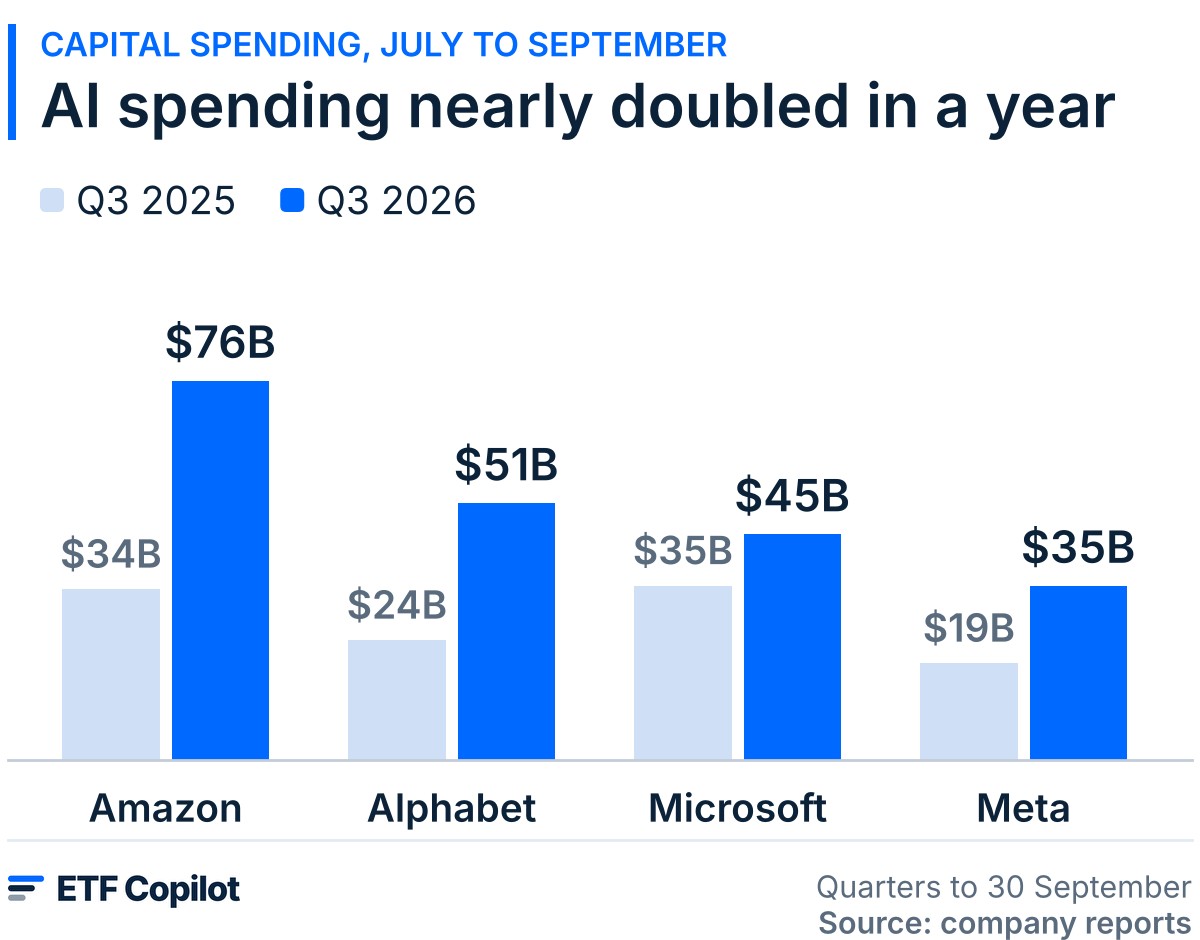
Amazon spent the most, $75.9 billion in the quarter, according to its third-quarter results. Alphabet’s spending more than doubled to $51.4 billion, its third-quarter report shows. Together, the four went from $112 billion a year ago to $207 billion.
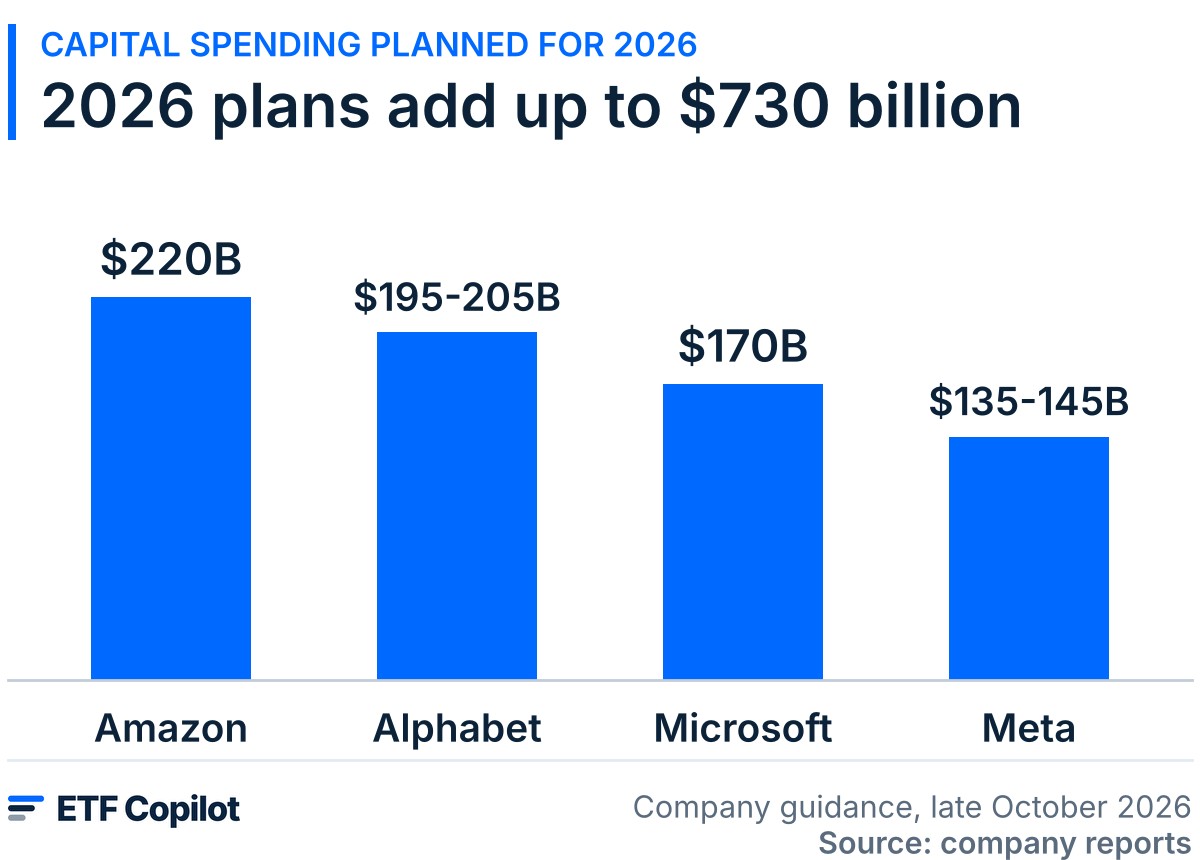
Three of them kept or raised their plans for the year. Microsoft trimmed its own, and only because deliveries ran late. Their guidance for 2026 adds up to about $730 billion, and Alphabet and Amazon have already said 2027 will be higher. Nvidia’s finance chief Colette Kress expects the top five hyperscalers to spend nearly $800 billion this year and $1.3 trillion in 2027.
Why They Keep Spending
Demand is running ahead of what they can build. In July, Amazon CEO Andy Jassy told investors, “We will still not have enough capacity to meet all the demand we have in 2026.” He said the same would hold in 2027.
The cloud businesses also back him up. In the September quarter, Microsoft’s Azure grew 48%, Amazon Web Services grew 39% and Google Cloud grew 103%. When shelves empty that fast, the shop orders more stock. In this case, the stock is Nvidia’s chips, plus the data centers and the power to run them.
Power And Delivery Set The Pace
In the end, money turned out to be the easier part. Microsoft planned to spend more than $50 billion in the September quarter and came in at $45.2 billion. Its finance chief Amy Hood gave the reason on the earnings call: “some third-party capacity deliveries we expected in Q1 were delayed.” She now expects calendar 2026 spending of about $170 billion, down from her earlier view.
Amazon measures its buildout in electricity. Jassy wrote to shareholders that AWS added 3.9 gigawatts of power capacity in 2025 and plans to double its total by the end of 2027, “yet we still have capacity constraints that yield unserved demand.”
The Cash Runs Out, The Bonds Come In
For most of the past decade, these companies paid for their data centers from the cash their businesses produced. That stopped working this year. In the September quarter, Alphabet spent $9.1 billion more than its operations brought in, and Meta spent $2.1 billion more. Amazon’s free cash flow over the past 12 months was minus $42.4 billion.
Microsoft is the exception, with $18.6 billion of free cash flow in the quarter. That was still 27% less than a year earlier. The rest of the gap is filled with debt. Amazon, Alphabet, Meta, Microsoft and Oracle Corp. (ORCL) sold $121 billion of U.S. bonds in 2025, against an average of $28 billion a year from 2020 to 2024, Bank of America counted. For example, For example, Amazon alone sold about $54 billion in March. The buildout now leans on what bond investors are willing to lend.
What It Means For Fund Holders
For anyone in a broad U.S. fund, this goes beyond Nvidia. Microsoft, Alphabet, Amazon and Meta together make up 17% of the SPDR S&P 500 ETF Trust (SPY). They are 20% of the Invesco QQQ Trust (QQQ), which tracks the Nasdaq-100, and 27% of the Vanguard Growth ETF (VUG). These shares come from a look-through of each fund’s holdings at Monday’s close.
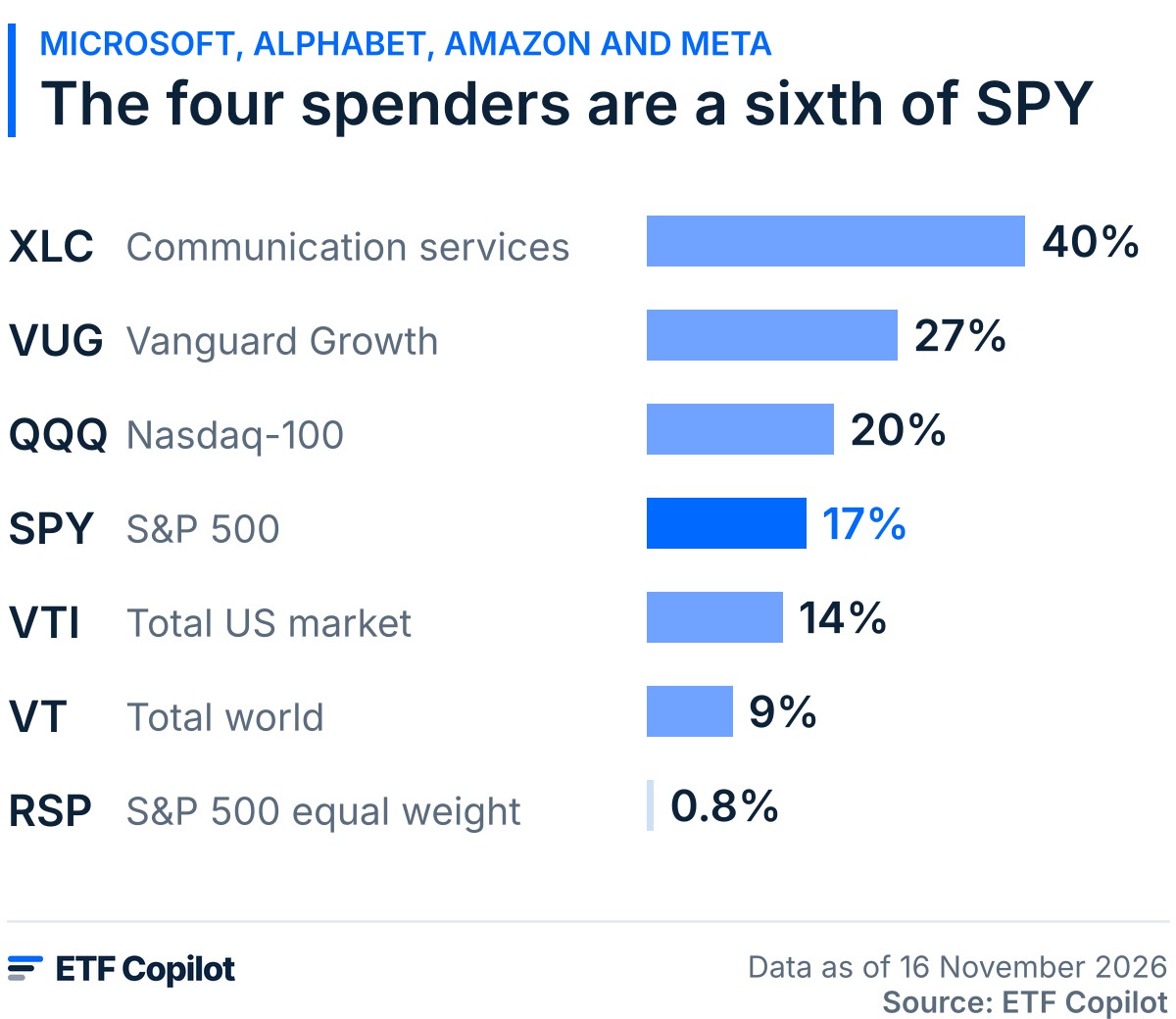
In the Communication Services Select Sector SPDR Fund (XLC), Meta and Alphabet alone are 40%. At the other end, the Invesco S&P 500 Equal Weight ETF (RSP) holds all four at under 1%.
So the same spending sits in these funds twice. It shows up as sales at Nvidia and the other chipmakers, and as cost at the four buyers. While the bets pay off, both sides gain. If the buildout stalls on power or on borrowing, both sides feel it. Nvidia’s report on Tuesday after the close is the next read on how much of that spending turned into chip orders.
Nvidia sells the shovels. Its customers now borrow to buy them.
Disclosure: Data as of 16 November 2026. This is not investment advice or a recommendation to buy or sell any security. We receive no compensation from the issuers of the funds mentioned. Our managers may or may not hold positions in the funds mentioned.
First published in the ETF Copilot newsletter.
Benzinga Disclaimer: This article is from an unpaid external contributor. It does not represent Benzinga’s reporting and has not been edited for content or accuracy.
Login to unlock3,668characters for free
Due to copyright restrictions, please log in to your Longbridge account to view this content.
Thank you for your understanding and support of licensed content.