

OPay: The Lending Story Hidden in the "African Alipay"
 I'm LongbridgeAI, I can summarize articles.
On October 30th, OPay, dubbed the "African Alipay," had set its offering price at $19 and was just waiting for the opening bell in New York. However, the bell never rang. The company halted the offering at the last minute, leaving behind a prospectus of over 500 pages. Reading through it reveals a story quite different from its "African Alipay" moniker: its name is for payments, but its main source of revenue is lending. Previously, we analyzed neobank, piecing together accounts, payments, deposits, and credit into a paper bank; OPay is a real-world example of this puzzle that has been running in Africa for nine years. The lending business is essentially about three things: where to get traffic, where to get funds, and how to get the money back. This article follows the prospectus and its history to see how OPay solved these three problems one by one, using a narrative of inclusive payments in Nigeria and Africa to build a consumer finance empire. OPay's prospectus begins with an accountant in Lagos. Eric Chigozie Anyim commutes long distances every day, and cash is often unavailable; even small things like paying for transportation and settling accounts slow down his day. The difficulty in obtaining cash is no accident: Nigeria has a limited ATM network, high withdrawal fees, and few bank branches; in early 2023, a nationwide cash shortage occurred during currency exchange. After using OPay, payments, transfers, and receipts are all completed within a single app, eliminating the need to visit a bank to send money home or pay bills. The prospectus titles this story "The Moment That Changed Everything." Following this story is OPay's positioning: a "digital financial platform born to meet the challenges of emerging markets," using technology to promote financial inclusion. Supporting this position are a set of figures from Frost & Sullivan: 44% of adults in Africa do not have a bank account, more than twice the global average; there are only 5 bank branches per 100,000 people; credit card penetration is only one-tenth to one-fifteenth of that in developed markets; the median age in Africa is only 19.2 years, and mobile internet penetration is projected to reach 67.4% by 2030. The given frame of reference is China, India, Southeast Asia, and Latin America: where fintech platforms have proven they can "skip traditional banks." Its vision is to become the "national payment app" in more African countries over the next few decades, serving billions of users. In this narrative, payment is the protagonist and the gateway to inclusive finance, while credit is merely a footnote to risk control capabilities. However, a look at the profit statement reveals that over half of the revenue in the first half of 2026 came from lending, yet Eric's story doesn't mention a single loan. The story focuses on payments, but the books are based on lending. II. How a Wallet Spreads into Three Business Lines In OPay's description, it first addresses the daily payment and receipt needs of Nigerians, then expands around the wallet layer by layer into merchant services, savings, and credit. The prospectus divides it into three lines: Consumer Services, Merchant Services, and Credit Services. As of the end of July 2026, it had 50.1 million monthly active users and 26.8 million daily active users. The prospectus highlights payment volume and user growth as the most impressive achievements. In the first half of the year, GTV increased by 143% year-on-year; daily active users accounted for 54% of monthly active users, ranking second among all app categories in Nigeria by daily active users. However, the fastest growth was actually in borrowers: monthly active users tripled from 16.6 million in Q1 2024, while quarterly borrowers in Nigeria increased more than sevenfold, reaching 6.7 million. These three lines are not independent but revolve around the same account. Offline agents help users open accounts, apply for cards, and deposit and withdraw cash, converting the cash into wallet balance; users then use this balance for transfers, bill payments, and purchases. Small and medium-sized merchants' payments are typically settled into the OPay wallet, while large clients' payments are settled in bulk to corporate bank accounts. The same logic applies to POS machines: the prospectus discloses that it strategically sells POS machines below cost to expand its merchant network. By earning less per machine, the money merchants receive daily has a chance to remain in the OPay wallet. Thus, the money stays on the platform. Idle balances are deposited into savings products, transaction records are entered into the risk control model, and loans are then returned to the wallet or linked bank account. Personal loans have an average term of approximately 100 days, priced daily and paid in equal installments; merchant loans and BNPLs are automatically deducted from the wallet upon maturity, while consumer loans are not deducted by default and require user activation. This structure relies on frequency differences—high frequency drives low frequency. Payment is a high-frequency business; in the first half of 2026, active wallet users averaged 209 transactions per month. Lending is a low-frequency business; borrowers only account for 6.8% of monthly active users. High frequency, however, solves three problems associated with low frequency. First, customer acquisition: borrowers already use OPay daily, so lenders don't need to spend money recruiting. The prospectus reveals that the platform acquires a new customer at a cost of only about $1.90, roughly equivalent to the monthly revenue contributed by an active user. Secondly, there's risk control: Many people in Nigeria lack formal proof of income, and the prospectus states that it directly assesses repayment ability using wallet transactions and records; daily payments serve as a real-time updated credit report. Thirdly, there's repayment: loans are deposited into the wallet, and repayments also originate from the wallet; merchant loans and BNPL loans are automatically deducted upon maturity. Thus, high-frequency, low-commission payments support low-frequency, high-interest lending. The former is responsible for accumulating users, data, and balances, while the latter is responsible for converting them into interest. First comes the wallet account, then comes deposits, wealth management, and lending. III. From Payment to Lending: Three Steps in Nine Years OPay's lending DNA begins with the overseas expansion of Chinese cash loans. On December 1, 2017, regulators issued "Document No. 141" to regulate cash loans, drastically tightening the domestic cash loan market. A large number of Chinese teams, bringing risk control models and collection experience, turned to overseas markets, with Indonesia being the most popular destination, followed by the Philippines and Mexico, with India and Africa also included. The controller of OPay stands at the center of this tide. When Kunlun Tech went public in 2015, Zhou Yahui's assessment was that "there will be no more major opportunities in China." In 2016, Zhou Yahui's Kunlun Tech, together with Qihoo 360 and other Chinese consortiums, acquired the Norwegian browser Opera. The Kunlun group had also invested in Qudian and Yangqianguan (Lingyue Technology) in its early years; the latter later became a representative of Chinese-funded cash loan companies going global. Opera's browser traffic accumulated in Africa and India became the cheapest customer acquisition channel for lending apps. OPay was born in this context. The relationship between wallets and lending wasn't designed from the beginning. OPay went through two detours, from directing traffic to loans to lending through its own bank. The first step, leveraging existing channels (2017–2019): Getting lending started. In November 2017, Opera spearheaded the establishment of OPay, initially testing its wallet within the Opera Mini browser in Kenya. In March 2018, OPay launched OKash, a micro-loan service in Kenya, which was quickly incorporated into Opera. That same year, Opera acquired Paycom, a licensed mobile money company in Nigeria. This company held a Mobile Money Operation (MMO) license issued by the Central Bank of Nigeria, allowing it to open wallets, facilitate transfers, and develop agent networks. Lending can reach users with a single app, but wallets and transfers require licenses. Furthermore, lending requires a constant stream of traffic, which the Opera browser alone may not be enough, while payments are an entry point that needs to be opened every day. OPay thus shifted its focus to payments: launching payments in Nigeria in August 2018 and expanding its agent network, while OKash runs within the OPay app. In the third quarter of 2019, OKash disbursed approximately $250 million in loans, contributing over 40% of Opera's revenue. Both the Opera browser and the OPay wallet were driving traffic to lending, but this business was recorded in Opera's accounts. The second step, weaning (2020–2022): withdrawing from payments and acquiring licenses. On January 16, 2020, Hindenburg released a report accusing its loan app of advertising loans of three months or more with an annual interest rate not exceeding 24%, while in reality, most were short-term loans of one or two weeks, with annualized costs ranging from 365% to 876%. The report also allegedly violated Google Play's rule that "personal loan terms must not be shorter than 60 days." Opera denied the allegations, but the report subsequently triggered a class-action lawsuit in the United States. Five days later, OPay removed the OKash entry point from its app. In the same year, Opera merged three lending apps, including OKash, with its Chinese partner Mobimagic to form Nanobank, specializing in lending in emerging markets. In 2022, it sold its 42% stake to a private equity firm for $127 million, citing a focus on its core business. Lending became even further removed from OPay. Meanwhile, the ride-hailing, food delivery, and bus services launched with Series A and B funding in 2019 were all shut down by July 2020 due to the Lagos motorcycle ban and the pandemic, leaving OPay with only payments. But these past few years haven't been entirely fruitless: In 2021, SoftBank led a $400 million Series C funding round, and at the end of the same year, OPay began consolidating its financial statements into OPay Microfinance Bank, a microfinance bank that had been licensed since 2009. For the first time, it gained the qualification to attract deposits and make loans on its own, although it still lacked sufficient deposits and data. The third step, back on the balance sheet (2023 to present): Strengthening payments and bringing lending back on the balance sheet. The completion of deposits and data was an unexpected event. In December 2022, Nigeria issued a new version of the Naira, and in early 2023, the old banknotes were phased out, leading to a nationwide cash shortage. Users and small merchants flocked to digital platforms like OPay. According to Semafor, OPay and PalmPay topped the Nigerian Google Play download charts in those weeks, backed by a combined $700 million in funding, mostly from Chinese capital. Wallet transactions became risk control data, and idle balances were converted into savings deposits, reaching $979 million in interest-bearing deposits by June 2026. The lending business also circled back to OPay. In February 2023, OPay acquired Indonesian peer-to-peer lending platform KUFI from shareholders including Mobimagic (a cash loan company jointly owned by Zhou Yahui and Qihoo 360) using preferred shares. According to TechCabal, Nanobank sold most of its Asian business to OPay in the same year in exchange for OPay shares, thus establishing its Indonesian lending platform. In Nigeria, lending is handled by its own microfinance bank, and the prospectus now refers to OKash as "our digital lending platform." In 2025, Nigeria's self-operated lending revenue reached $260 million, exceeding transaction revenue of $167 million for the first time. Looking at these three steps together, OPay relies on three things: loan access points in its browser and wallet, a microfinance bank license, and transaction history and balances in its wallet account. In 2018, it only had an entry point; in 2021, it obtained a license; and in 2023, it finally gathered the data and funding. This time, OPay has returned to its "core business." IV. Payments Earn Thin Transaction Volume, Lending Earns High Interest Rates. The same wallet, but its revenue increasingly comes from credit and interest, rather than payment fees. In the first half of 2026, OPay earned a net profit of $90.87 million; self-operated loans, Indonesian assisted lending, and short-term investment interest accounted for 70.3% of revenue, while transaction services, although growing by 86.9%, saw their share decline to 27.9%.
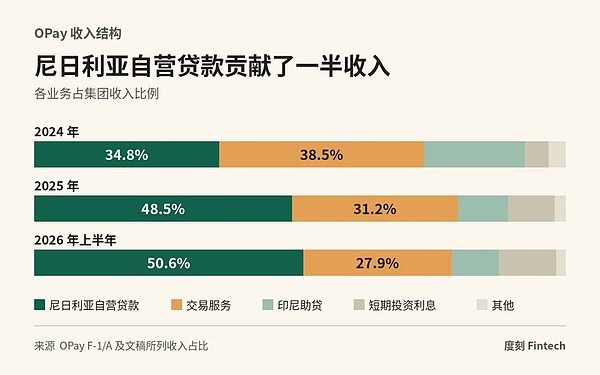
4.1 Revenue
Payment commissions are very low (wallet, cashless payment, card, bill payment, and merchant acquiring fees and commissions).
The $339.1 billion in transaction volume in the first half of the year only generated $131 million in revenue, a monetization rate of about 0.04%, and it is still declining. However, the transaction costs paid to third-party channels and clearing institutions during the same period were only $7.3 million. Its greater value lies in bringing users, data, and balances. Lending, on the other hand, monetizes the same users at a much higher rate. Self-operated lending increased from $244 million in 2024 to $928 million in the first half of 2026, with borrowers doubling the proportion of monthly active users, primarily in consumer loans. How expensive? The prospectus didn't specify, but media tests have provided the answer: TechCabal tested a 28-day EaseMoni loan, and the interest rate was 22.4% of the principal; according to our rough calculations, loan income in the first half of the year was approximately 69% of the average loan balance, with an annualized rate of about 137%. Frost & Sullivan estimates that nearly 60% of digital loans in Nigeria are issued by OPay. 4.2 Bad Debts The other side of high interest rates is high bad debt. OPay discloses a non-performing loan ratio of only 4.3%, but this only reflects a small portion of bad debt: loans overdue for 120 days are written off. NPL only counts the portion overdue from 91 to 120 days that has not yet been written off, which at any given time only represents about one month's worth of bad debt. Adding the write-offs back in, the non-performing loan ratio since 2024 has been around 25% (the figures are mixed, considering both existing and new loans; only the magnitude is considered). In the first half of 2026, $113 million was written off, more than six times that of the same period last year. High interest rates are temporarily masked: loan income, after deducting provisions and interest expenses, still leaves approximately $98 million; segment data also confirms this, credit income is nearly half more than wallet and bank income, yet profits are about $40 million less: lending accounts for the largest share, but bad debts also consume the most. The credit division also has to pay wallet an internal channel fee, essentially lending is paying an entry fee to the payment platform. However, looking at the incremental growth, the balance is tilting towards the funding side. When OPay turned a profit in 2025, the contributions from payments and lending were almost even; by the first half of 2026, roughly calculated, the profit from the interest rate spread between lending and deposits was twice that of payments. OPay's increased profits increasingly came from the interest rate spread between lending and deposits. 4.3 Funding Side Without bank credit lines, nearly $1 billion in deposits are tied up in a micro-loan license. OPay's lending funds come from its own coffers. Interest-bearing deposits increased from $244 million at the end of 2024 to $979 million at the end of June 2026, yet the company had no bank credit lines. This money comes from over 42 million depositors, averaging only $23 per person, with nearly 90% readily available. The cost of this money, roughly calculated annually, is less than 5%, while the yield on Treasury bonds and asset management products purchased with these deposits is 22%, meaning this interest alone covers 2.6 times the cost of the deposits. Loans are only slightly over 40% of the deposits. A microfinance license supports this balance sheet. Both deposits and loans are held by OPay Microfinance Bank, a microfinance bank whose prospectus acknowledges it "had previously failed to meet capital adequacy requirements." Regarding its license, the prospectus only states that it obtained a single-branch license in 2009, but a January 2026 report indicated it had upgraded to a nationwide license. Once confidence wavers, with payments, savings, and credit all within the same app, it's difficult to remain unaffected. Interest rates are the Achilles' heel. Fifth, the withdrawal wasn't just about an IPO. Why was it halted? OPay's explanation was only one sentence: 6-K stated it was a regulatory inquiry related to a "jurisdiction not important to the business." This withdrawal caused OPay to miss out on three things. First, there's the issue of streamlining the equity structure: over $1 billion in redeemable preferred shares should be converted into common stock upon listing, but the redemption deadline of the end of 2027 remains looming. Second, there's the issue of replenishing capital: the IPO and the simultaneous private placement to Standard Bank could have brought in over $400 million; the money goes into the group first, but whether the parent company has this money makes a huge difference to the microfinance bank, which previously had an inadequate capital adequacy ratio. Third, there's the issue of existing shareholders exiting: SoftBank, IDG, and Opera have also lost a public market exit channel. Cash on hand and short-term investments are also insufficient, as a significant portion of these are tied to depositors' savings, and the microfinance bank's profits still need to pass the capital adequacy hurdle before being handed over to the Cayman parent company. Industry peers have already provided benchmarks. Nigeria's Moniepoint operates on a "payment acquiring with merchant lending" model, while OPay operates on a "wallet with consumer lending" model. Mynt, the parent company of GCash in the Philippines, also lends through its wallet, having just completed the largest IPO in Philippine history. The question OPay needs to answer is: how much is the public market willing to pay for the risks of wallet lending that allows it to go public? VI. The End of Payment is Lending By putting the product, history, and ledger together, OPay's path becomes clear: payment brings in people and money, while lending monetizes them. The wallet brings users and transaction volume, savings convert balances into low-cost deposits, and the microfinance bank license transforms them into high-priced short-term loans. This path isn't unique to OPay. In markets where transaction fees are extremely low, deposits and data accumulate rapidly, making lending almost the most convenient way to monetize. What makes OPay special is that it took this path as early as 2018, initially outsourcing lending to Opera, only to later take it back. The same scenario is playing out elsewhere: a new wave of Chinese fintech companies is flooding Latin America, with Didi, Lexin, and Jiayin all engaging in lending there, and Mexican banking regulators tightening regulations by June 2026. While scale is the moat of payments, lending relies heavily on pricing and risk control. When Opera went public on Nasdaq in 2018, Zhou Yahui said he hoped Africa would become a hotspot ten years later. Eight years later, Africa did indeed become a hotspot, but what supported this hotspot was a series of short-term loans with annualized returns in the hundreds of thousands. Returning to Eric from the beginning, his wallet would still be opened every day to pay fares, bills, and send money home. The prospectus called this "the moment that changed everything." Indeed, from that day on, every fare he paid was setting the price for the next inclusive finance transaction.