

Nvidia Doubled Revenue. P/E Fell To A 10-Year Low
 I'm LongbridgeAI. Here is the key information I extracted
- Despite the financial growth, Nvidia stock fell 2.9% following the earnings release, contributing to a price-to-earnings multiple dropping to a ten-year low of 16x trailing earnings.…
“Our momentum is real,” Colette Kress said on 17 November in the third-quarter results of NVIDIA Corp (NASDAQ:NVDA). It was her first results release as interim CEO. The figures supported her statement. Revenue more than doubled in a year, to $115.8 billion. The forecast for the current quarter also came in above what analysts expected. Even so, Nvidia stock fell 2.9% the next day.
That is Nvidia’s puzzle right now. The company earns more every quarter. Yet the market pays less for each dollar of those earnings. At the 18 November close, Nvidia traded at its lowest multiple of earnings in at least ten years. The report itself explains a good part of the reason.
Rubin’s Record Start
In the three months to 25 October, Nvidia sold nearly twice as much as it did in all of fiscal 2024. Data center sales made up $107.6 billion of that total, up 110%. This business covers the chips, networking and systems that train and run AI models.
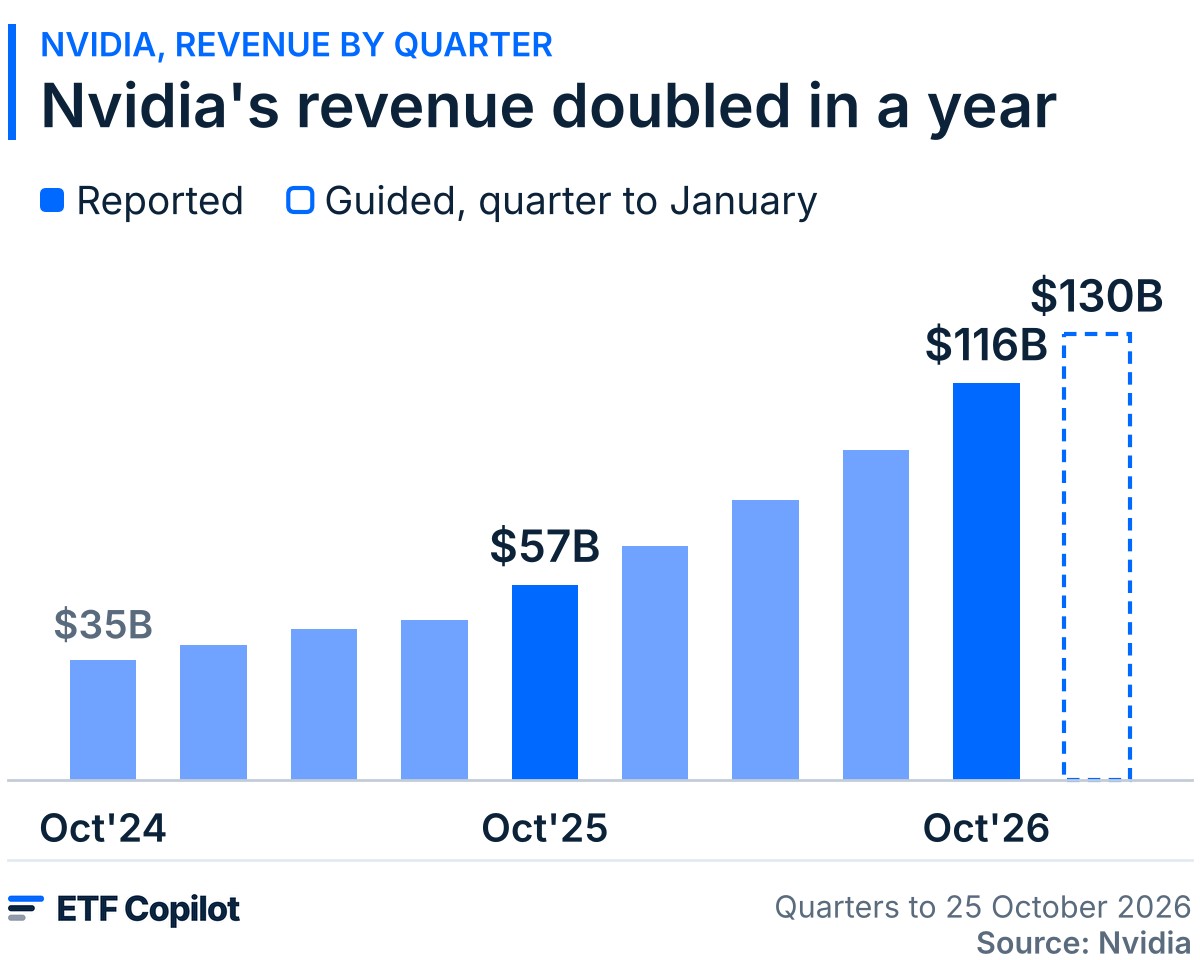
Much of the jump came from Vera Rubin, the rack-scale system that began shipping in the quarter. On the earnings call, Kress told analysts that it brought in nearly $20 billion in its first quarter. She called it the fastest product ramp in Nvidia’s history. Networking, the equipment that links thousands of chips into one machine, passed $21 billion.
The rest of Nvidia is now reported as Edge Computing. That business grew 42% to $8.2 billion, helped by workstations and chips for robots and cars. Higher memory prices, however, weighed on gaming PCs.
Nvidia Revenue By Customer
Nvidia now splits its data center sales by type of customer, and the split tells a new story. According to the company’s CFO commentary, sales to hyperscale customers rose 71% to $60.1 billion. These are the giant cloud and internet platforms. Sales to everyone else nearly tripled to $47.5 billion. That second group includes AI clouds, industrial companies and enterprises.
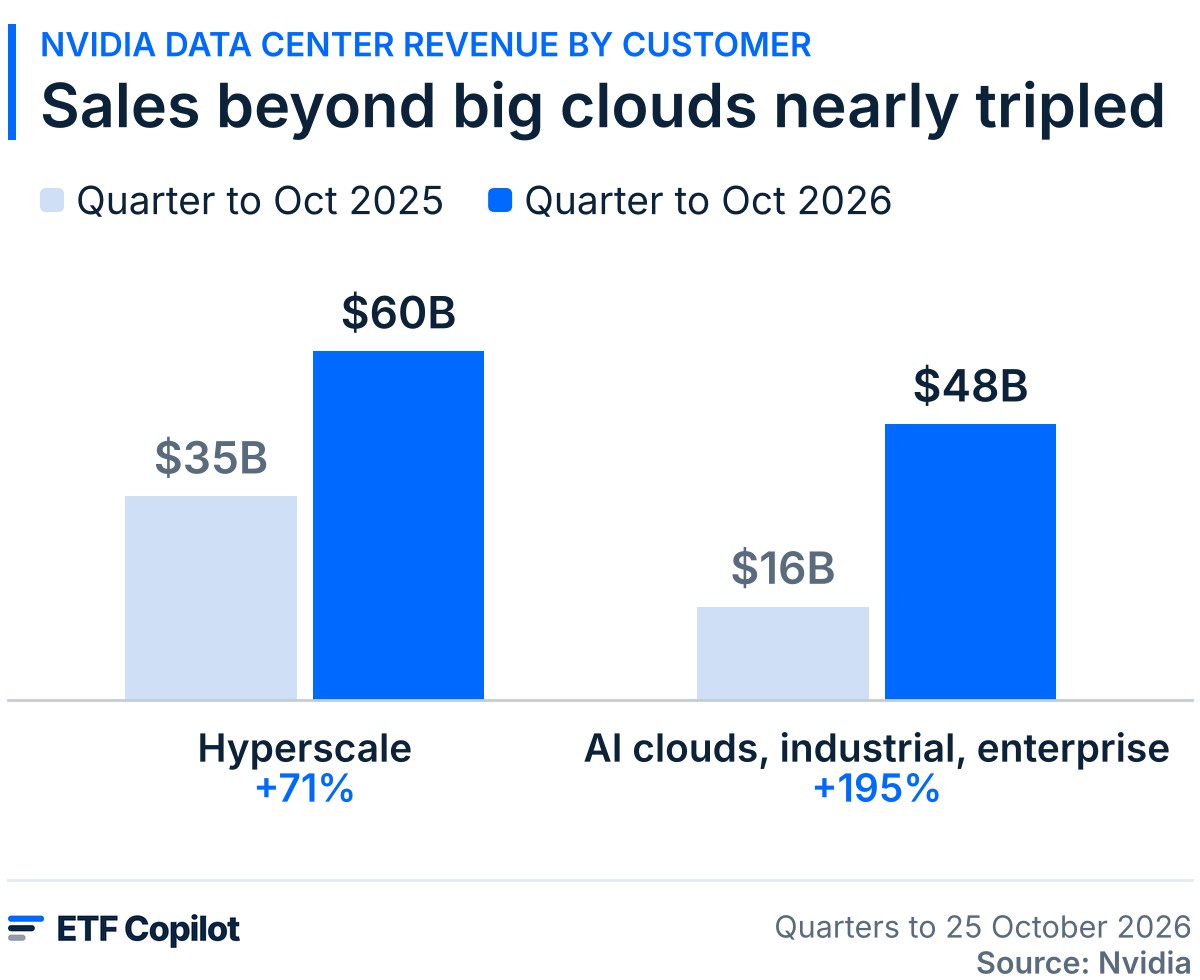
A year ago, the second group made up under a third of data center sales. Now it accounts for 44%. A longer customer list spreads Nvidia’s risk. At the same time, it brings in buyers with far less cash of their own than Microsoft Corp (MSFT) or Amazon.com Inc (AMZN). The young AI cloud companies stand out in that respect.
How The Buildout Gets Paid For
Those newer buyers need money, and Nvidia increasingly provides the backing. Its $32 billion of agreements with neoclouds, the young AI cloud companies, depend on those partners raising financing. Nvidia has also agreed to guarantee up to $105 billion of credit support for SB Energy’s campus in Ohio. The campus will host Nvidia systems under 20-year leases to OpenAI.
Customers are also paying more slowly. Money owed to Nvidia for chips already delivered rose to $81 billion. The average customer now takes 64 days to pay, up from 60 days a quarter earlier. Nvidia says part of that comes from longer payment terms on large multi-quarter deals with some investment-grade customers.
Even so, the cash still pours in. Free cash flow nearly doubled from a year earlier. Nvidia also returned a record $28.1 billion to shareholders, and $22.1 billion of it went to buybacks.
Nvidia’s biggest customers already lean on borrowing to pay for data centers. Now the supplier stands behind part of the bill as well.
Why Nvidia Stock Fell After Earnings
Meanwhile, the share price went the other way. Nvidia’s earnings per share over the last four quarters rose 130% from a year earlier. Over the same year, Nvidia stock fell 17%. At the 18 November close, it sat 37% below its record close on 6 October.
Put those two facts together, and the multiple collapses. Nvidia traded at 16x its trailing earnings. That is below every month-end reading of the past ten years. The previous low was 18x, in December 2018. The ten-year median is 54x.
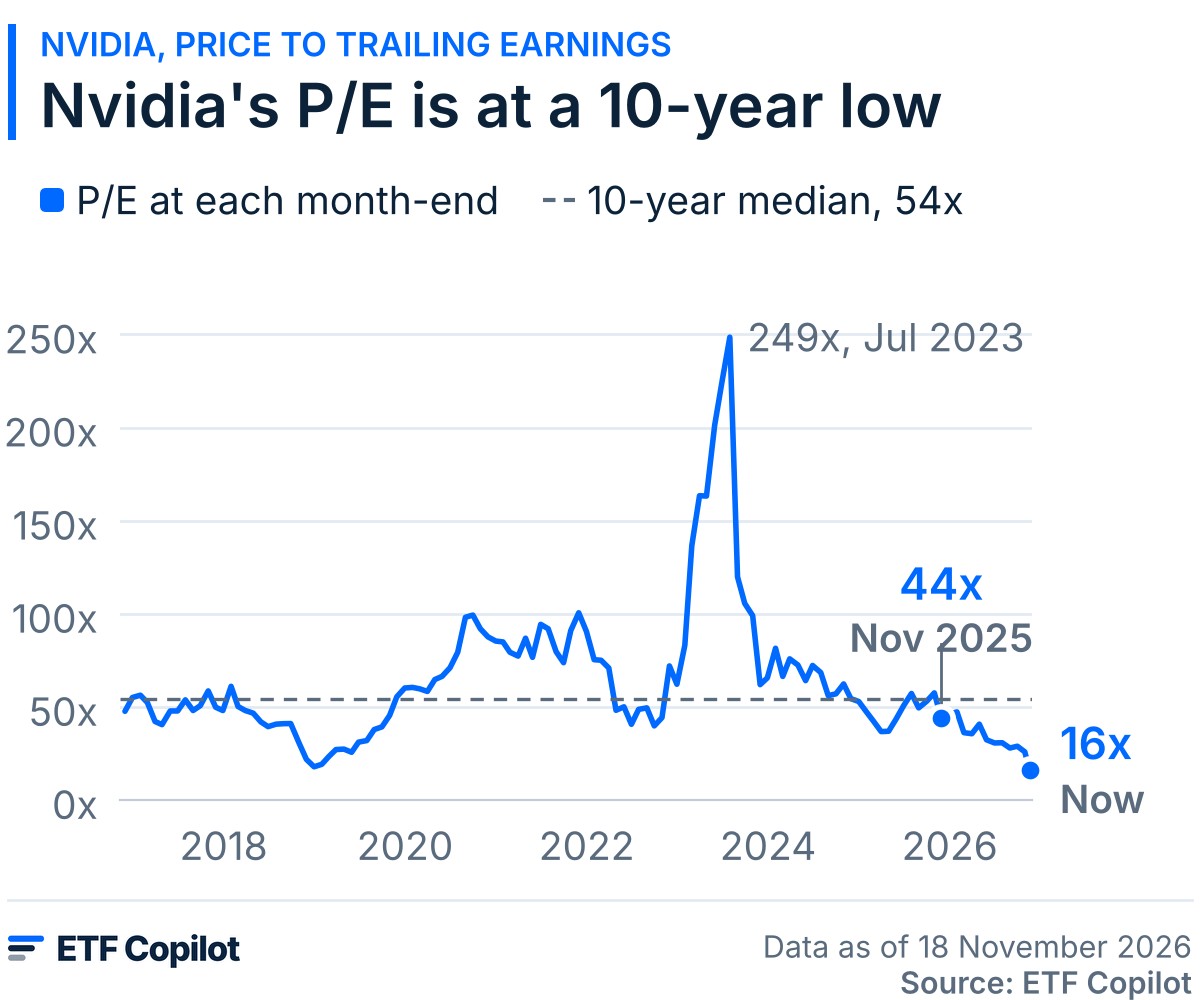
Two things explain much of the latest drop. The first is at the top of the company. Jensen Huang, who co-founded Nvidia and ran it from the start, resigned as CEO on 12 November. The filing gave no reason. Kress runs the company until the board names a successor, and Harvey Jones became the board’s first chair. An independent board committee is still investigating. On the earnings call, Jones said the board does not intend to bring Huang back. From the last close before the news, Nvidia stock lost 13%.
The second factor is the forecast. The quarter to January has an extra week. As a result, $130 billion is only about 4% above this quarter’s pace on a weekly basis, by our arithmetic. By comparison, revenue grew 20% from the quarter before.
The $2.4 billion of chips that Nvidia sold to China this quarter also drops out of the forecast. In addition, gross margin is guided down to between 71% and 72% as Rubin ramps up. Kress still expects revenue to grow about 75% next fiscal year.
How Much Nvidia Stock Is In The S&P 500 And Other ETFs
Most investors own Nvidia through a fund, and how much they own depends on the fund. Nvidia makes up about 6% of the SPDR S&P 500 ETF Trust (SPY). It is also about 6% of the Invesco QQQ Trust (QQQ), which tracks the Nasdaq-100. Growth and tech funds hold more. Nvidia is about 10% of the Vanguard Growth ETF (VUG) and 14% of the Vanguard Information Technology ETF (VGT).
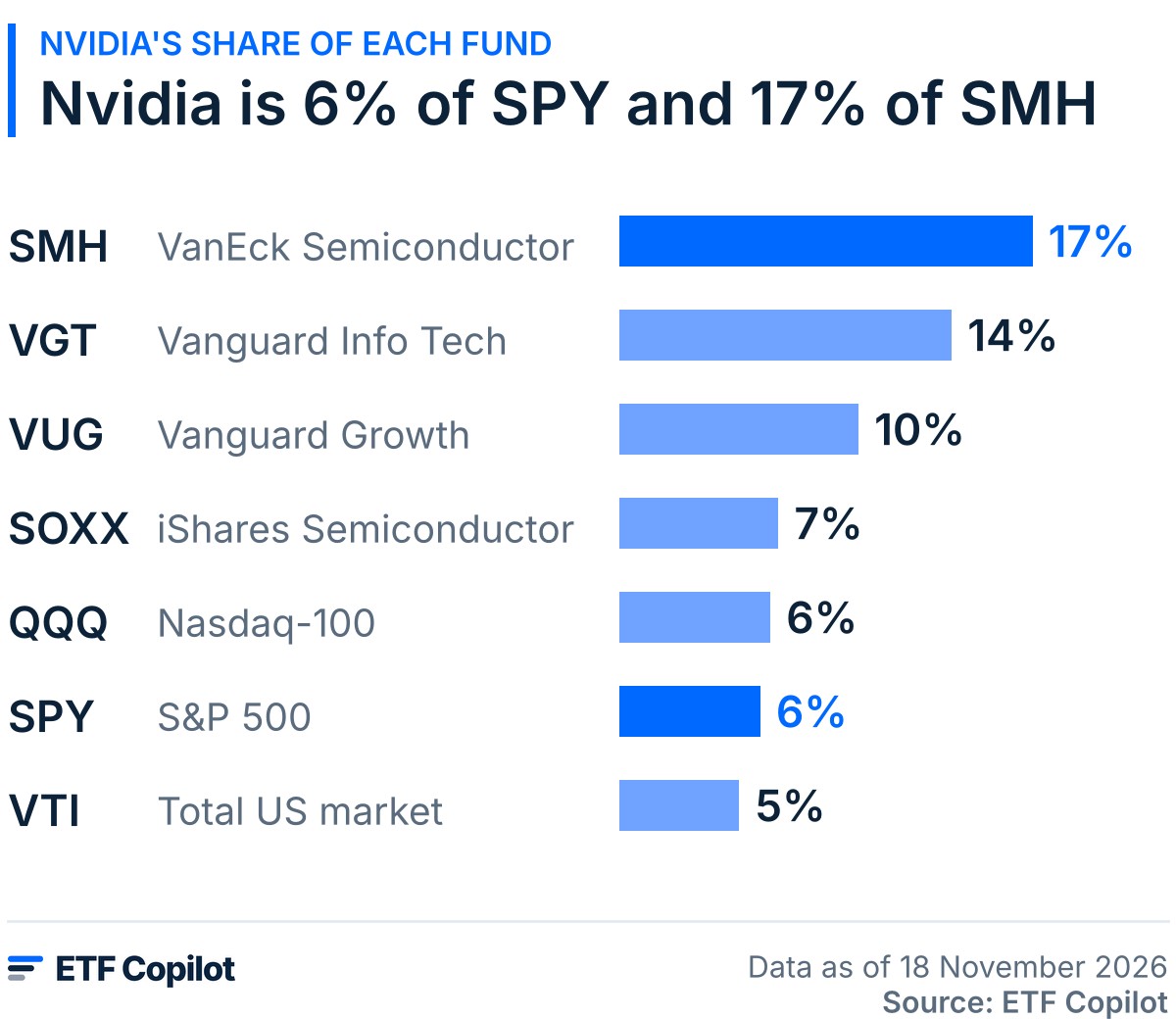
Of these funds, the VanEck Semiconductor ETF (SMH) holds the biggest share, at 17%. The iShares Semiconductor ETF (SOXX) holds about 7%, because its index caps the weight of its largest companies.
That share works as a lever. With everything else unchanged, a 10% move in Nvidia stock moves SPY by about 0.6% and SMH by about 1.7%.
The P/E here is the share price over the last four quarters of reported earnings per share. The fund shares come from our look-through of each fund’s holdings at the 18 November close.
Kress called the momentum real, and the report agrees. Still, what the market will pay for it has not been this low in ten years. First published in the ETF Copilot newsletter.
Disclosure: Data as of 18 November 2026. We have no business relationship with, and receives no compensation from, the issuers of the funds mentioned. Our managers may or may not hold positions in the funds mentioned. Not investment advice.
Benzinga Disclaimer: This article is from an unpaid external contributor. It does not represent Benzinga’s reporting and has not been edited for content or accuracy.
Login to unlock4,713characters for free
Due to copyright restrictions, please log in to your Longbridge account to view this content.
Thank you for your understanding and support of licensed content.