
S
Jul 23, 2025 at 10:00 PM
Did Tesla's Earnings Report Crash? Is Musk’s Dream Still Appealing?
 I'm LongbridgeAI, I can summarize articles.
Tesla ($Tesla(TSLA.US) ) just released its latest Q2 earnings report, and it delivered a "disappointing" result:
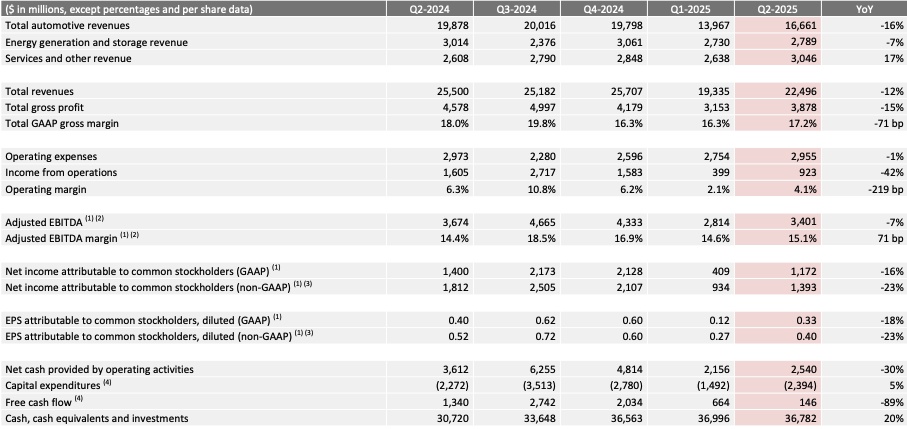
- Total revenue was $22.5 billion, falling short of market expectations of $22.74 billion, marking a year-over-year decline. This marks the second consecutive quarter of a revenue drop, with the core automotive business seeing a 16% YoY plunge, totaling $16.7 billion. The money made from selling environmental credits also dropped significantly to $439 million, almost halving.
- EPS came in at $0.40 (non-GAAP), slightly missing the expected $0.43. Net income dropped by 16% YoY, from $1.4 billion to $1.17 billion.
- The stock has fallen 18% this year, underperforming other tech giants.
But the problem isn't just the financials. Once a symbol of the future, Tesla is gradually losing its competitive edge in the real world. In Q2, deliveries dropped 14% YoY, totaling only 384,000 vehicles. What's more concerning is the legendary "affordable car" Model 2, which is still nowhere to be seen. Musk mentioned in the earnings call that trial production just started in June, with mass production expected only in the second half of 2025. Meanwhile, competitors like BYD, Xiaomi, WM Motor, Hyundai, and even Volkswagen have already surged into the $15,000 to $25,000 EV price range, while Tesla remains stuck above $25,000.
In this situation, Musk is still holding on to his “future narrative.”
He emphasized Robotaxi (autonomous ride-hailing) and Optimus (humanoid robots) in the earnings call. Currently, there’s a small-scale test of Robotaxi in Austin, with “human safety drivers” accompanying the cars. His goal is to have "half of the U.S. population" able to access Tesla’s self-driving ride service by the end of the year — but that depends on regulatory approval.
Musk still firmly believes that in the future, Tesla won’t make money just by selling cars, but through Robotaxi, where you can "earn while you sleep," and Optimus robots will help with childcare and factory work. While this still sounds like a "remote future" dream, the market is less convinced. Waymo (Google’s self-driving company) is already in commercial operation in several cities, and Tesla feels like a latecomer.
But not all of Tesla’s businesses are in decline. The Supercharger network performed well, with Supercharger growth of 18% year-over-year, and gross profit rising 17%. The improvement in service and other business areas also indicates that Tesla’s competitive moat is not limited to just its vehicles.
Additionally, Tesla's digital assets (mainly Bitcoin) have reached a market value of $1.24 billion, a significant increase from last year, contributing to a rebound in paper profits.
Final Thoughts:
This earnings report can be seen as a "reality check" for Musk’s story: With declining sales and profit pressure, can the narrative continue to support the stock price? If you believe in Robotaxi, AI, and self-driving, Tesla remains a "warrant." However, if you are more focused on real-world sales, profit, and valuation, its short-term fundamentals don’t look great, and you could even argue that its valuation is still too high.



The copyright of this article belongs to the original author/organization.
The views expressed herein are solely those of the author and do not reflect the stance of the platform. The content is intended for investment reference purposes only and shall not be considered as investment advice. Please contact us if you have any questions or suggestions regarding the content services provided by the platform.