
Memory Stocks Are Hitting Records Everywhere — But This Isn't 2018 All Over Again
 I'm LongbridgeAI, I can summarize articles.
Over the past six months, memory-chip companies from New York to Seoul to Shenzhen have rallied almost in lockstep. Micron touched a US$1 trillion market capitalisation in late May. South Korea's SK Hynix overtook Samsung to become the country's most valuable listed company. On China's A-share market, names like Longsys and Biwin have more than doubled.
The instinctive reaction is familiar: memory is a brutally cyclical business, so a sharp run-up is just begging for a sharp fall.
But look closely at how this rally is happening, and it doesn't rhyme with any past memory cycle — including the famous 2017–18 boom that ended in tears.
First, what's actually happening: a synchronised, cross-market record run
For decades, memory's reputation was "vicious." A small supply–demand mismatch sent prices on a rollercoaster: fat profits one year, deep losses the next. It was the textbook example of a deep-cyclical industry.
This time, the rhythm has changed.
Prices moved first. Industry trackers put the Q1 2026 rise in DRAM contract prices at roughly 90% quarter-on-quarter; in Q2, mainstream DRAM contract prices climbed another 58–63%, with NAND flash contract prices up 70–75%. DDR5 has been the most extreme — contract pricing has run from around US$7 per unit in 2025 to about US$19.50, more than doubling.
What does a doubling in price actually mean downstream? Phone and PC makers' biggest headache right now isn't selling units — it's securing memory. One estimate puts the average smartphone selling price at a record US$523 in 2026, while PC makers are broadly warning of 15–20% price increases.
The price moves landed straight on the income statement.
Micron's fiscal quarter reported on 24 June showed revenue of roughly US$35 billion, up close to 280% year-on-year, with gross margin at 81.6%. Its guidance for the following quarter was even bigger — record revenue of around US$50 billion, give or take US$1 billion, at a gross margin near 86%.
China's supply chain has been just as dramatic. In the first quarter, Longsys posted net profit of RMB 3.86 billion, up 2,644% year-on-year; Biwin RMB 2.90 billion, up 1,568%; GigaDevice RMB 1.46 billion, up 523%. These aren't "recovery" numbers — they're a re-rating.
Share prices followed. Micron hit an intraday high of US$1,133.99 this year, nearly tripling from its late-March low; SanDisk is up roughly 350% year-to-date, Western Digital has more than doubled, and Seagate has nearly tripled. On the A-share side, Longsys, Biwin and Demingli are up about 97%, 171% and 149% respectively.
In one line: from the US to Korea to China, the entire memory chain has hit new highs almost hand in hand — a globally synchronised move that is rare in this industry's history.
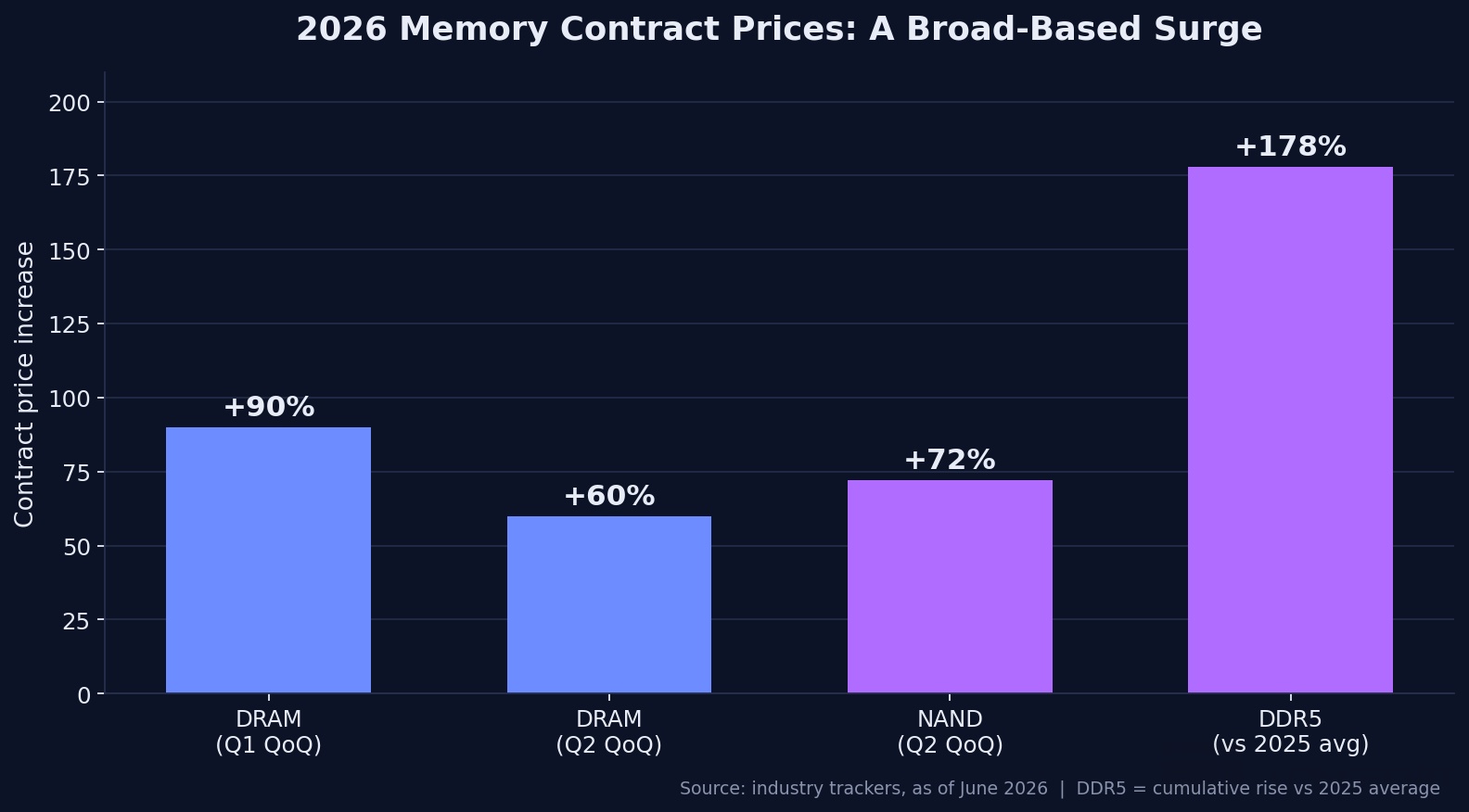
Memory contract prices rose across the board in 2026. Source: industry trackers.
The real question: is this a cycle, or a regime change?
To answer it, start with one fact — this shortage was, in large part, deliberately created by AI.
At the centre of the story is HBM (high-bandwidth memory) — the "bodyguard" memory that sits beside Nvidia's AI chips. Without it, even the most powerful GPU starves for data.
The catch is that HBM is greedy with capacity. Producing one HBM stack consumes far more wafer area than the equivalent capacity of ordinary DRAM. So the three giants — Samsung, SK Hynix and Micron, which together control more than 95% of global DRAM output — made an entirely rational choice: shift production lines en masse toward higher-margin HBM. By some estimates, the three have collectively redirected around 93% of their combined output toward HBM for AI data centres.
Think of a noodle shop that discovers its premium custom bowls are wildly more profitable, and converts most of its kitchen to make them. Ordinary noodles become scarce — and their price gets bid up. Today's DRAM and NAND shortage is, essentially, squeezed out by HBM.
That's layer one. The second layer is what truly separates this cycle from the past — the contract structure has changed.
Memory used to be sold at the spot of the market: prices rose in good times and were slashed in bad ones. This time, Micron signed 16 five-year long-term agreements carrying take-or-pay clauses, deposits and price floors. Translation: customers lock in volume and price up front, and pay even if they don't take the goods. More striking still, Micron's entire 2026 HBM output was sold out and priced before it left the line. Western Digital is in a similar spot — its 2026 hard-drive output was sold out before mid-year, with long-term contracts stretching to 2028.
When a deeply cyclical industry starts locking in demand with five-year, price-floor contracts, its "cyclicality" gets meaningfully dialled down. (There's a hole in that logic — more on it below.)
Who's eating well, and who's just getting by?
Memory is a long chain, and the AI wind doesn't fall evenly. It splits the winners structurally. Pull them apart and it gets clearer.
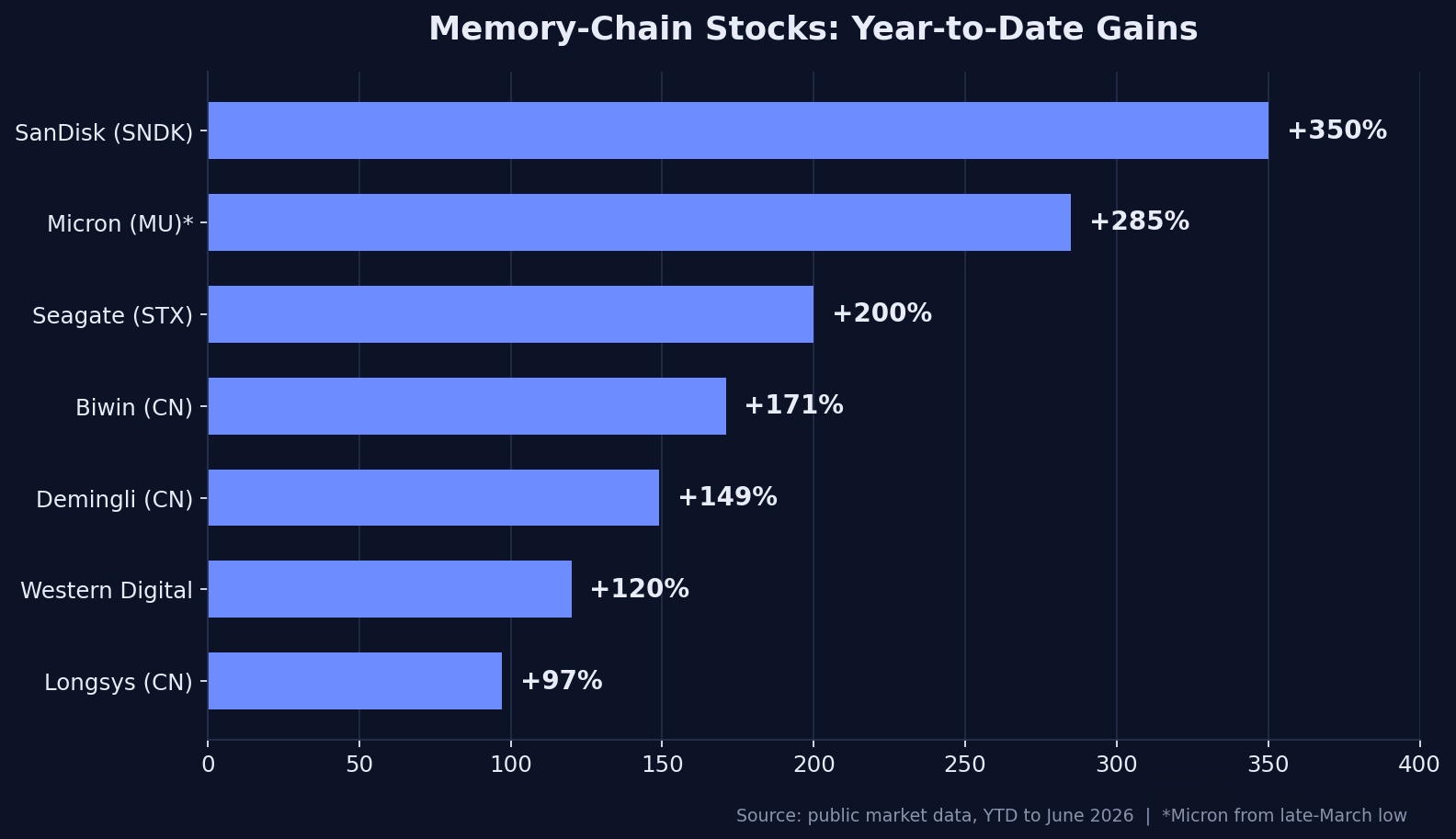
Memory-chain stocks rose together year-to-date. Source: public market data.
Tier one: the direct suppliers of HBM and DDR5.
SK Hynix is the single biggest winner here. It holds roughly 57% of HBM revenue share against Samsung's ~22%, and took more than two-thirds of HBM orders for Nvidia's next-generation Vera Rubin platform. On the back of AI memory, its 2025 operating profit surpassed Samsung's for the first time, and its market value did the same — making it Korea's most valuable company.
Tellingly, SK Hynix recently made a counter-intuitive call: slowing some HBM4 line conversions to keep capacity on DDR5, because DDR5 is simply too profitable right now, with operating margins this year projected to approach 90%. When a company is willing to make even its most advanced HBM4 give way to conventional memory, you know how fierce this commodity-memory upcycle is. Micron is the other lead actor, with HBM4 supplying Nvidia's most advanced platforms.
Tier two: the high-capacity hard-disk-drive duopoly.
Many assumed solid-state drives would bury mechanical drives in the AI era. The opposite is happening. The data volumes AI training must store are astronomical, and flash is simply too expensive for that job — HDDs remain the most cost-effective "data warehouse." Western Digital and Seagate, the HDD duopoly, are reaping the benefit: high-capacity drive prices have risen about 60% within months, and WD's 2026 capacity is sold out.
Tier three: the rising Chinese supply chain.
Shortages and price hikes are pushing downstream buyers toward local suppliers. CXMT posted Q1 2026 revenue of RMB 50.8 billion, up 719% year-on-year, with net profit of RMB 24.76 billion; both CXMT and YMTC are accelerating their IPO plans. Among the module players, Longsys, GigaDevice, Biwin and Demingli are capturing a double dividend of higher prices and import substitution. Honestly, this tier offers the most upside and the most volatility — it rides both the global pricing beta and a domestic-substitution alpha. Higher payoff, lower certainty than tiers one and two.
The Singapore angle: there's no memory maker here, but there is a supply chain
This is where Singapore-based readers usually hit a wall: the SGX has no pure-play memory manufacturer. The way to play the theme locally is not the chips themselves, but the "picks and shovels" — the precision engineering and test names that benefit as Samsung, SK Hynix, Micron and the Chinese makers ramp their capital spending.
AEM Holdings (SGX: AWX) is the most direct AI-linked name of the group, providing semiconductor test solutions. Its Test Cell Solutions revenue jumped 72% year-on-year to S$88.1 million in Q1 2026 — over three-quarters of group revenue — driven by a ramp at its fabless AI/HPC customer. The shares were around S$10.60 in late June, and the analyst stance is broadly constructive, though profitability is still climbing off a low base.
UMS Integration (SGX: 558) is a front-end semiconductor equipment contract manufacturer whose key customer is Applied Materials — the equipment supplier whose tools sit inside the fabs building this memory capacity. UMS shares have roughly doubled over the past year, from a low near S$0.73 to about S$1.36, for a market cap around S$1.2 billion.
Frencken Group (SGX: E28) rounds out the trio, a precision-engineering player with a semiconductor segment, also generally rated positively by analysts though seen as the less-preferred of the three.
A word of caution: these are broad semiconductor plays, not memory pure-plays. Their fortunes track overall AI-driven equipment and test demand, of which memory capex is one slice — not the whole story. If you're buying them specifically for the memory cycle, size that exposure honestly.
What matters most: how long can this supercycle last?
At these levels, the better question than "how much higher?" is "when does it end?"
Three things need to hold for the rally to continue: AI data-centre capital spending mustn't roll over (or HBM demand fades); the three giants must stay disciplined and not flood the market with new commodity-DRAM capacity; and those five-year contracts must actually be honoured rather than broken.
The warning signs, when they come, tend to hide in two places.
The first is capacity. Supply, not demand, has always ended memory cycles. Everyone is racing to expand HBM capacity today; when that wave lands in two or three years and AI demand growth merely slows, the supply–demand balance can flip. Every past memory downturn began with the words "the new fabs came online."
The second is inventory and pricing at the margin. The leading indicator to watch isn't the share price — it's whether the quarter-on-quarter pace of DRAM and NAND contract-price increases starts to narrow, and whether downstream buyers (phones, PCs, servers) shift from "scrambling for parts" to "well-stocked." When price gains go from "+60% QoQ" to "+5% QoQ," the logic of the rally has quietly changed, even if prices are still rising.
My read: this cycle is probably mid-stage, not late-stage. HBM demand is driven by AI capex, and that spending is still climbing; the price-floor contracts put a safety net under producers' earnings, pushing the downside risk further out. But stay clear-eyed — "cyclicality reduced" is not "cyclicality abolished." Memory's gravity is still there. It will simply arrive later, and more gently, than it used to.
Memory's most expensive phrase has always been "this time it's different." For decades, anyone who said it was eventually taught a hard lesson by the cycle.
This time, at least one thing genuinely is different: when the world's compute has to be fed by memory, the sector has gone — for the first time — from being the unloved "child of the cycle" to a chip on the AI table that nobody can route around.
How long it stays on the table? Watch capacity, watch the quarter-on-quarter price prints. The answer will be written in those two numbers.


The copyright of this article belongs to the original author/organization.
The views expressed herein are solely those of the author and do not reflect the stance of the platform. The content is intended for investment reference purposes only and shall not be considered as investment advice. Please contact us if you have any questions or suggestions regarding the content services provided by the platform.