

Daily Lesson | Anthropic’s IPO Price Range Is Still $70–$78. So Why Are Reports Pointing Higher?
 I'm LongbridgeAI, I can summarize articles.
Anthropic’s IPO is back in the headlines.
On November 17, the company filed an updated prospectus with the US Securities and Exchange Commission (SEC). The filing still lists an expected offering price range of $70–$78 per share, with 825 million shares on offer.
But that same day, media reports citing people familiar with the deal suggested that the final IPO price could come in above that range.
Wait a minute. If the prospectus says $70–$78, how could the shares end up selling for more?
That’s where a few common IPO terms come in: raising the price, upsizing, oversubscription, and the greenshoe option.
They may all sound like signs of a hot IPO, but they describe very different things.
Let’s break them down using Anthropic as an example.
The Price Range: Is $70–$78 Already Set?
Not yet.
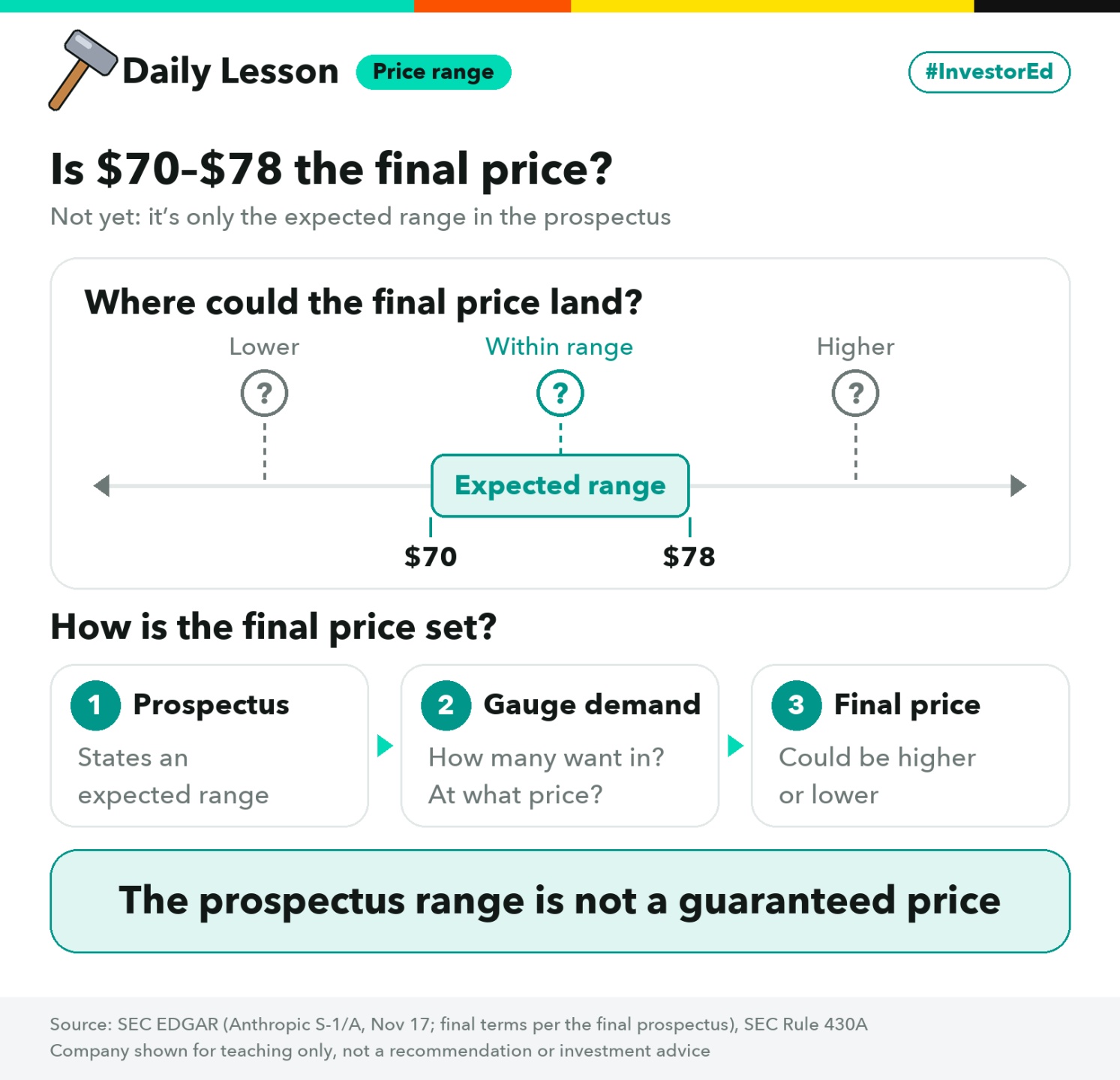
The price range is simply the company telling the market: This is roughly how much we expect to charge for each share.
Anthropic’s $70–$78 range is an estimate, not the final offering price.
Before the IPO is priced, the investment banks managing the offering — known as underwriters — gauge investor demand.
How much interest is there? How many shares do investors want? And what price are they willing to pay?
That feedback helps determine the final offering price.
So the range in the prospectus isn’t a guaranteed price. The final IPO price could be higher or lower.
Raising the IPO Price: How Can a Stock Get Pricier Before It Even Trades?
Let’s use Anthropic again.
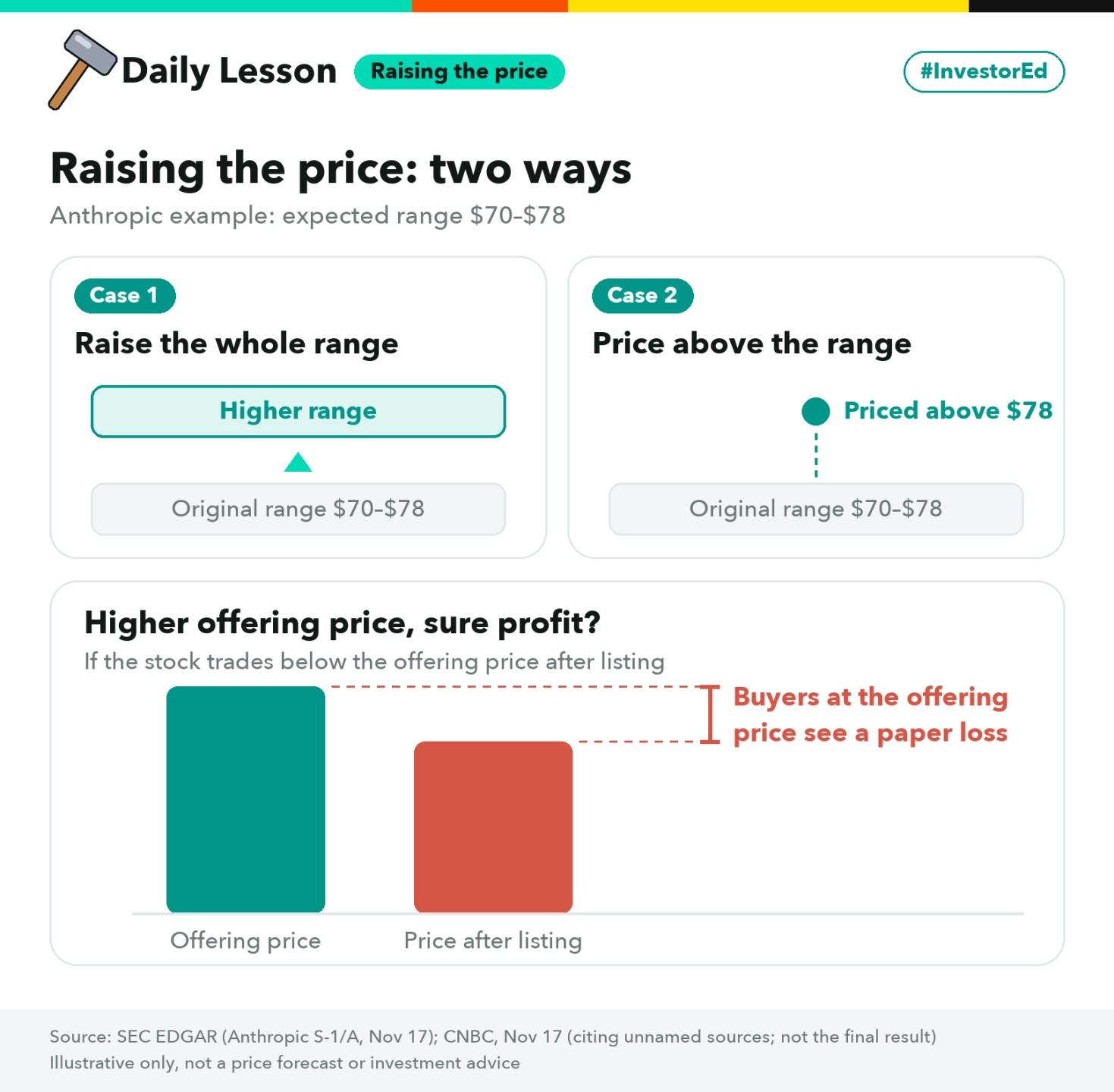
Its expected price range is $70–$78. Suppose the underwriters find that plenty of investors are willing to pay more.
The company could revise its expected price range upward, or it could simply set the final offering price above $78.
That’s usually what headlines about raising the IPO price mean. It’s also what the reports mentioned at the beginning of this lesson are talking about.
But here’s the important part:
A higher offering price doesn't mean you'll make money after buying the stock.
The offering price is what investors who receive an IPO allocation pay for their shares.
Once the stock starts trading on the exchange, its market price is determined by buyers and sellers.
Imagine the IPO is priced above the range, but the stock later trades below that price.
An investor who received shares at the offering price would be sitting on a paper loss.
There's another way to think about it: you're still buying shares in the same company, but at a higher price.
If nothing else changes, paying a higher price means investing at a higher cost.
So when you see an IPO price being raised, it may suggest investors are willing to accept a higher offering price.
It doesn't mean the stock is guaranteed to trade above that price after listing.
Upsizing: Can an IPO Raise More Money Without Increasing the Share Price?
Yes, it can.
Raising the IPO price means charging more for each share.
Upsizing, on the other hand, means increasing the number of shares being offered.
Let's look at Anthropic's planned offering.
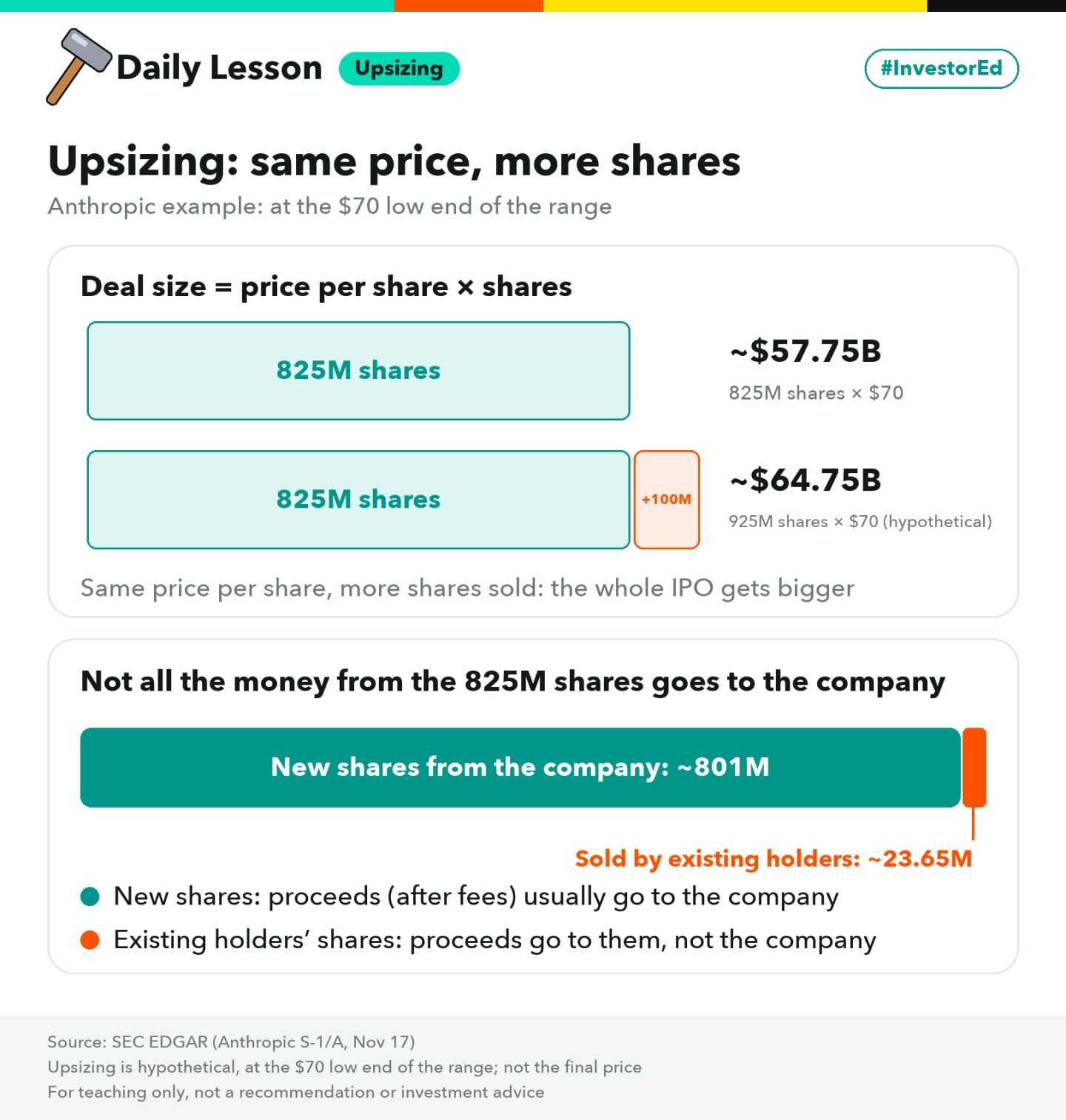
The company plans to sell 825 million shares. At the low end of its expected range — $70 per share — the total offering would be worth approximately $57.75 billion.
Now imagine, purely as an example, that the offering is upsized to 925 million shares while the price stays at $70.
The total offering value would rise to approximately $64.75 billion.
The price per share hasn't changed. But because more shares are being sold, the overall IPO has become larger.
There's another detail investors should know:
Not every share sold in an IPO is necessarily a newly issued share from the company.
Of the 825 million shares in Anthropic's planned offering, approximately 801 million would be issued by the company, while another 23.65 million would be sold by existing shareholders.
What's the difference?
When a company issues new shares, the proceeds generally go to the company after the relevant fees and expenses.
When existing shareholders sell shares they already own, the proceeds go to those shareholders instead.
So when you hear that an IPO is worth tens of billions of dollars, don't assume all that money is going into the company's bank account.
Oversubscription: If Everyone Wants In, Does That Mean Easy Profits?
This is one of the most common phrases in IPO headlines.
Anthropic plans to offer 825 million shares.
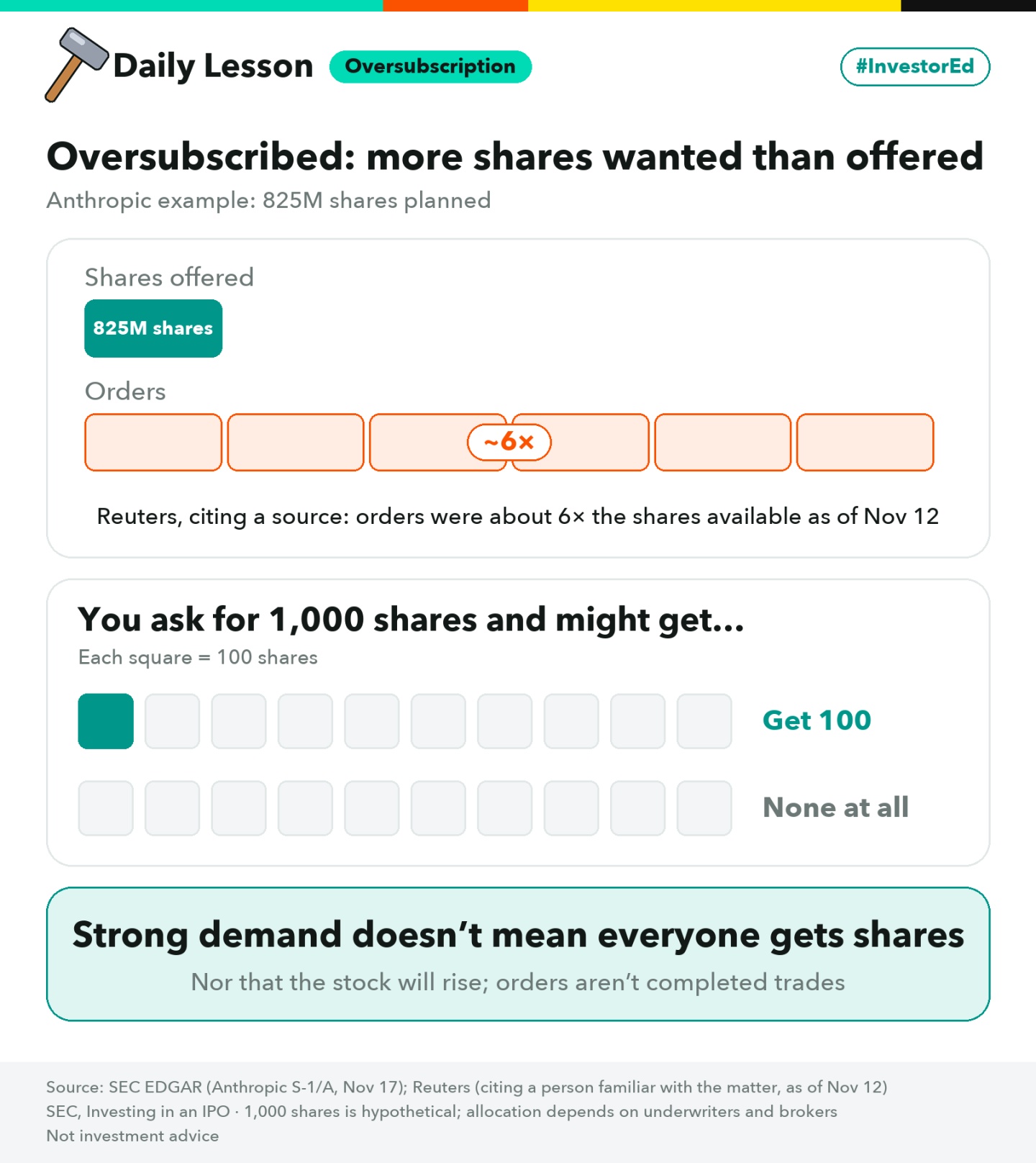
According to a Reuters report citing a person familiar with the deal, by November 12, the underwriters had received orders for roughly six times the number of shares available.
That's what an oversubscribed IPO looks like: investors want to buy more shares than are being offered.
Sounds exciting, right?
But here's the catch.
If a company is selling 825 million shares and investors want several times that amount, not everyone can get the number of shares they asked for.
Say you tell your broker you'd like to buy 1,000 shares.
You might receive an allocation of just 100 shares — or none at all.
And an indication of interest isn't the same as a completed purchase. It tells the underwriters how much someone would like to buy, not how many shares have already changed hands.
More importantly, strong demand before an IPO doesn't guarantee that investors will pay an even higher price once the stock starts trading.
So an oversubscribed offering tells you that demand is strong.
It doesn't guarantee you'll receive an allocation, and it certainly doesn't guarantee a profit.
Now, there's another term that sounds very similar: over-allotment.
Oversubscription and over-allotment may sound alike, but they mean two different things.
The Greenshoe Option: How Can an IPO Sell More Shares Than Originally Planned?
First, let's clear up the difference.
- Oversubscription means investors want to buy more shares than are available.
- Over-allotment means underwriters actually sell investors more shares than the original offering size.
Let's use Anthropic's figures.
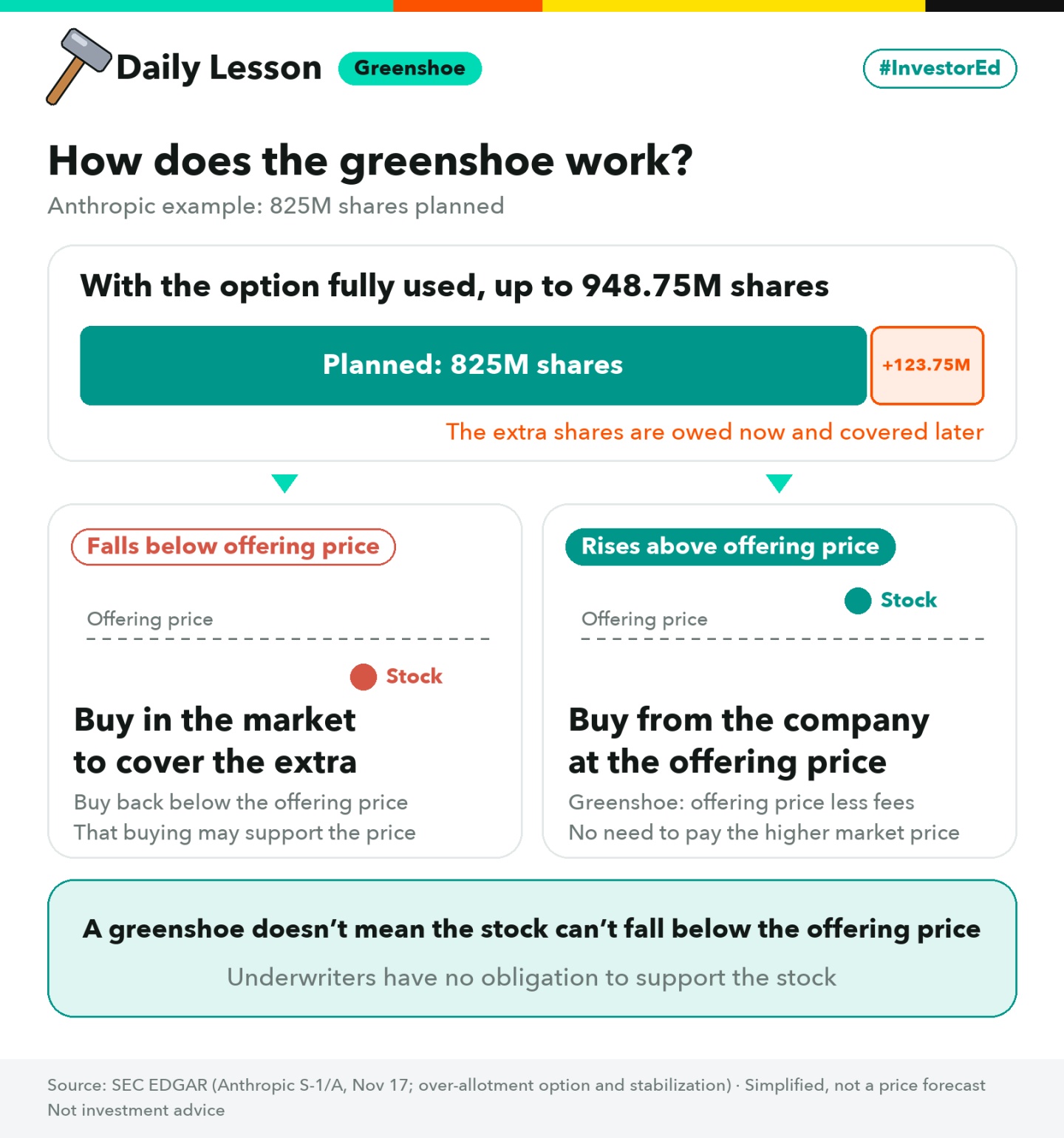
The company plans to offer 825 million shares. Its prospectus also gives the underwriters an option to purchase up to 123.75 million additional shares, equal to 15% of the original offering.
If the full additional amount is sold, the total could reach 948.75 million shares.
But where do those extra shares come from?
In a typical over-allotment arrangement, the underwriters can initially sell more shares than the original offering size.
That leaves them with a short position — meaning they need to obtain shares later to cover what they've sold.
How do they do that?
This is where the greenshoe option, formally known as the over-allotment option, comes in.
Put simply, the greenshoe gives underwriters the right, for a limited period, to purchase additional shares from the issuer at a predetermined price.
So when might they use it?
Imagine two possible scenarios after Anthropic begins trading.
Scenario 1: The stock falls below its IPO price.
The underwriters may choose to buy shares in the open market at a price below the offering price to cover their short position.
Those purchases may also provide some support for the stock price.
Scenario 2: The stock rises above its IPO price.
If the underwriters buy shares in the market, they would have to pay the higher trading price.
Instead, they may choose to exercise the greenshoe option and obtain additional shares from Anthropic at the agreed offering price, less underwriting discounts and commissions.
They can then use those shares to cover their short position.
In other words, rather than buying at the higher market price, the underwriters can obtain shares under the terms agreed upon before the IPO.
This option is granted to the underwriters, not to ordinary IPO investors.
That's the basic idea behind a greenshoe.
Anthropic's prospectus provides for a 30-day over-allotment option covering up to 123.75 million additional shares, or 15% of the original offering.
But here's what investors shouldn't misunderstand:
A greenshoe is not insurance against an IPO falling below its offering price.
Underwriters aren't required to step in and support the stock price. Whether they engage in stabilization activities, and how they do so, depends on market conditions and the offering arrangements.
Even when an IPO includes a greenshoe, the stock can still trade below its offering price.
And one more thing: oversubscription doesn't automatically trigger a greenshoe.
Oversubscription describes investor demand. The greenshoe is an underwriting arrangement agreed upon as part of the offering.
They're related to the IPO process, but one doesn't automatically cause the other.
So, How Should You Read IPO Headlines Next Time?
Put today's terms side by side, and the differences become much clearer.
- Price range: The estimated price the company expects to charge per share.
- Raising the IPO price: The expected or final offering price moves higher.
- Upsizing: More shares are added to the planned offering.
- Oversubscription: Investors want to buy more shares than are available.
- Greenshoe: An option that lets underwriters purchase additional shares to cover over-allotments and can be part of price stabilization arrangements.
Once you know these terms, you can tell whether an IPO headline is talking about price, offering size, investor demand, or underwriting arrangements.
But here's what matters most when you're thinking about investing:
A hot IPO doesn't necessarily mean a good investment.
Strong demand doesn't guarantee you'll get shares. A higher IPO price doesn't guarantee a first-day gain. And a greenshoe doesn't guarantee the stock won't fall below its offering price.
Understanding how an IPO works is one thing.
Deciding whether the shares are worth buying at the offering price is another.
Today's quiz
Next question: You're thinking about participating in a US IPO when you see a headline saying: “Demand is red-hot, and the IPO price may be raised.” Which of the following is the most reasonable takeaway?
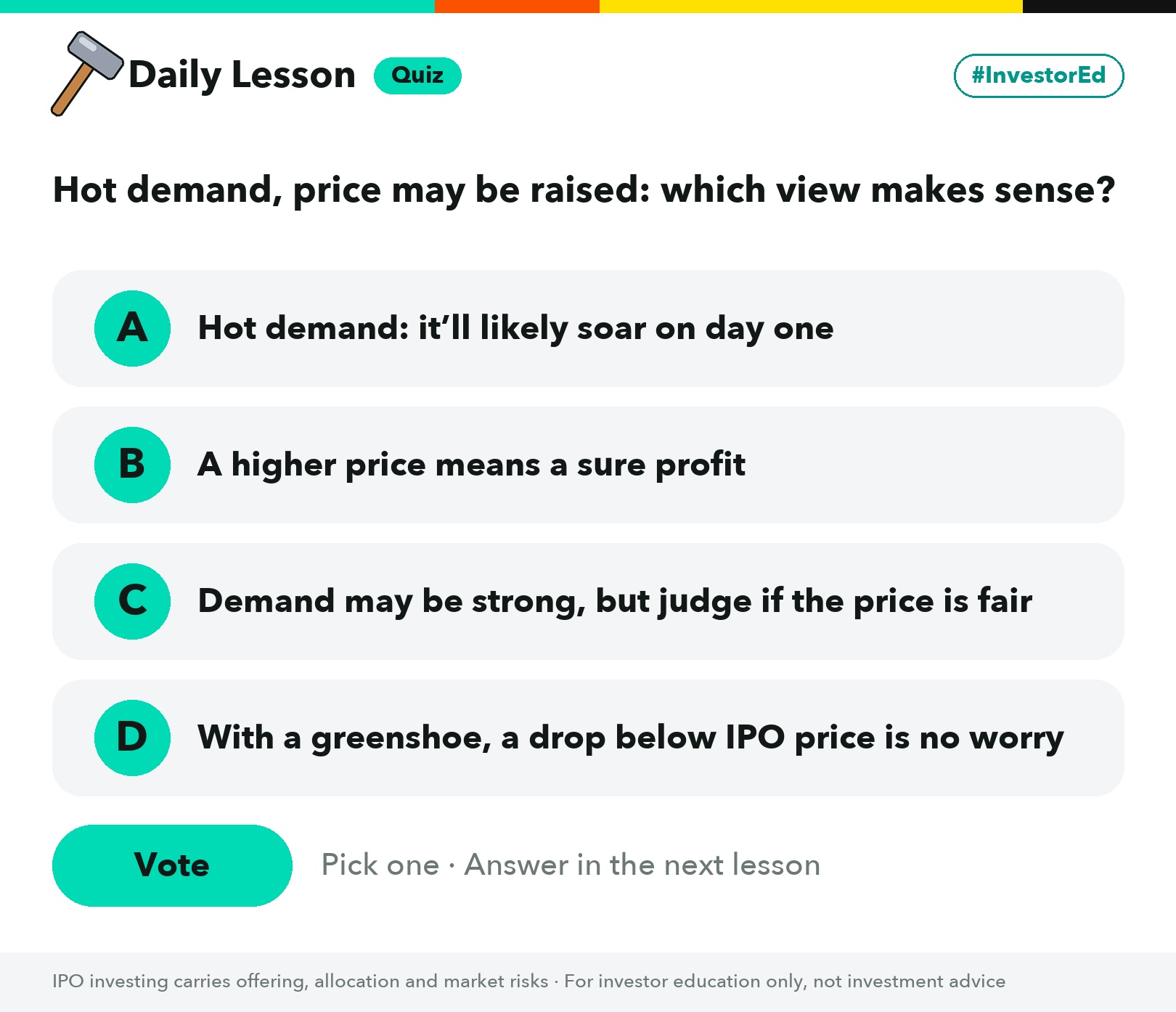
Scroll down to the poll and cast your vote. We'll reveal the answer in the next lesson.
🎁 Vote, comment, earn rewards
- Pick the correct answer in the poll: 88 Task coins
- Pick the correct answer and tell us in the comments which of today's terms you'd check first in an IPO headline, and why (at least 15 words): 188 Task coins
Poll closes Thu, 19 Nov, 6pm SGT. We'll reveal the answer and the number of winners in our next post. Rewards will be credited within 7 working days. One entry per account. Comments must relate to today's topic. T&Cs apply.
Disclaimer: This content is provided for investor education purposes only and does not constitute investment advice, an offer, or a recommendation to buy or sell any security. Investing involves risk. Please make investment decisions carefully. The author and publisher accept no liability for any direct or indirect losses arising from reliance on this content.
The copyright of this article belongs to the original author/organization.
The views expressed herein are solely those of the author and do not reflect the stance of the platform. The content is intended for investment reference purposes only and shall not be considered as investment advice. Please contact us if you have any questions or suggestions regarding the content services provided by the platform.