

 Top 10 Influencers in 2024
Nvidia's earnings report tomorrow morning, bullish or bearish?

First, the conclusion: This time it's unclear, with no clear bullish or bearish view.
If forced to give a view, it would be 55% bearish and 45% bullish.
The last two times were clearly bullish, mainly because the market cap was low (1.66 trillion and 2.33 trillion respectively), the bull market sentiment was strong, and earnings growth was rapid.


Reasons for the uncertainty:
1. The current price level is awkward, with a market cap of 3.15 trillion. The rebound has already taken it from 90 to 130. This earnings report is different from the previous two—the market cap is no longer low.
2. This quarter's earnings show a slowdown in year-over-year growth (due to a high base last year), and the market may worry about further slowdowns next year.
Investment bank forecasts: Beating expectations is the consensus—the key is by how much.
Bloomberg consensus expects FY25Q2 revenue of $28.8 billion, yoy+113%. Adjusted net profit of $16 billion, yoy+137%.
By segment:
Data center revenue: $25 billion, yoy+142%, with slower growth due to the high base in FY24Q2.
Gaming revenue: $2.8 billion, yoy+12%.
Professional visualization: $450 million, yoy+19%.
NVIDIA's data center business continues to grow, and quarterly chip deliveries are expected to be revised upward.
For valuation, a simple calculation: $16 billion ✖️4 gives a market cap of 3.15 trillion, with a PE of 49x. Assuming 40% profit growth next year (a rough estimate), the forward PE would be 30x, similar to other tech giants.
At the start of the year, 2024 net profit was projected at $50 billion with a market cap of 1.3 trillion, giving a PE of just 26x. With earnings growing several times, it was a no-brainer to go long—simple math. But now, with the higher market cap, the situation has changed.
Reason for slower growth in 2025: Major clients' cloud capex is starting to slow.
NVIDIA's biggest clients—Microsoft, Meta, Google, Amazon—saw explosive capex growth in 2024, but 2025 growth is slowing.
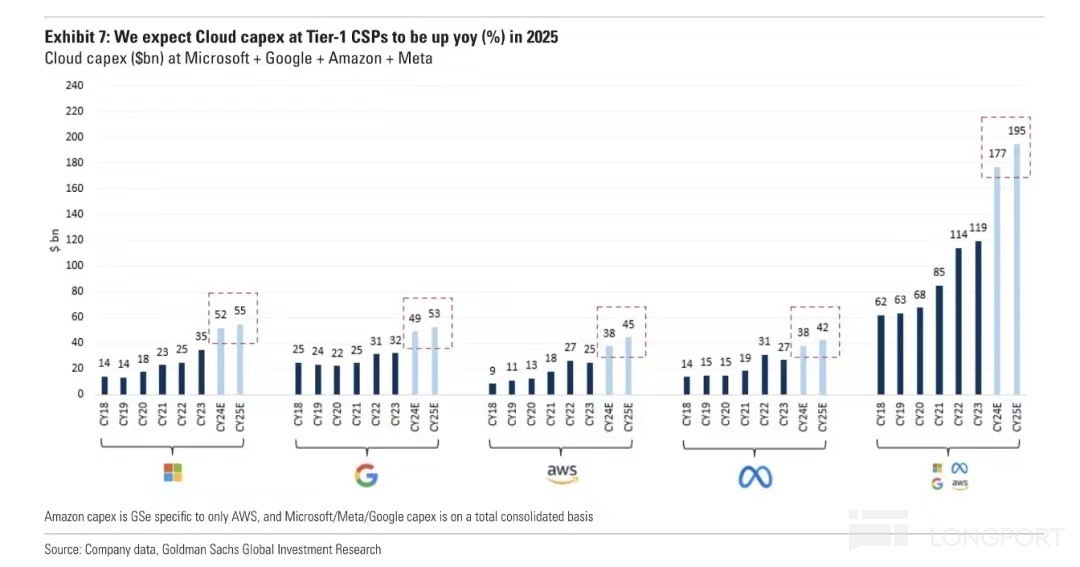
(Goldman Sachs forecast from May)
Take Microsoft as an example:
2023 cloud capex: $35 billion; 2024 (forecast): $52 billion, yoy+48%.
2025 (forecast): $55 billion, yoy+5.7%.
For the four giants combined, 2024 saw 48.7% growth over 2023, while 2025 is only expected to grow 10% over 2024.
This is the main reason for NVIDIA's slower earnings growth next year—data-wise.
From a common-sense perspective, these giants can't keep spending so much on GPUs while maintaining high growth rates.
Goldman Sachs recently made bullish, neutral, and bearish forecasts for next year. The neutral scenario seems most logical.
That is, a stock price of $135, with data center revenue growing 39% YoY (to $154.2 billion):
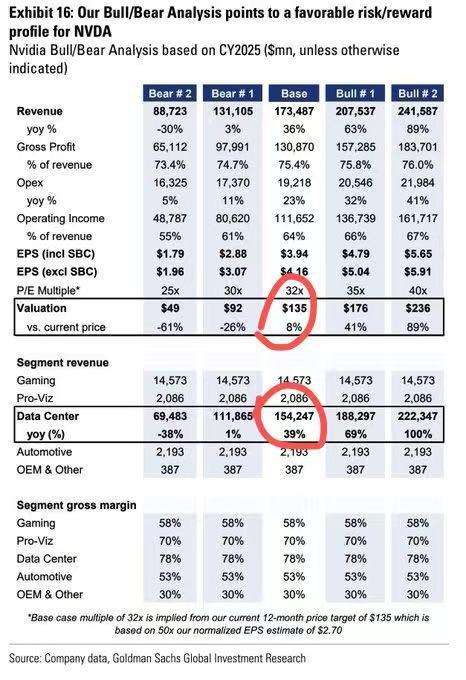
The earnings data itself is one focus; another is the earnings call.
My concern is that the call might touch on growth expectations for next year (or analysts might ask). This could be overthinking, but the next earnings report (November) will likely address this.
If it were me, I wouldn't bet on call options before earnings this time—I don't have a clear view, and 3 trillion already hits my aggressive 2024 target.
Beyond 3 trillion, I think it's driven by sentiment, which is the hardest to predict.
Good luck making money—this is not investment advice.
$NVIDIA(NVDA.US) $AMD(AMD.US)
The copyright of this article belongs to the original author/organization.
The views expressed herein are solely those of the author and do not reflect the stance of the platform. The content is intended for investment reference purposes only and shall not be considered as investment advice. Please contact us if you have any questions or suggestions regarding the content services provided by the platform.
