

Hillhouse and BeiGene, parting ways amicably


“Time's friend” Hillhouse has officially exited the ranks of BeiGene's shareholders with more than 5% stake.
From the first reduction in 2023 to now, Hillhouse's stake in BeiGene has plummeted from 11.02% in 2022 to 4.89%. As BeiGene's earliest institutional investor, Hillhouse has accompanied this pharmaceutical company from its startup phase to its listing in three locations, with a total investment of over 1.3 billion USD, and their relationship has long surpassed the scope of ordinary financial investment.
Hillhouse's significant reduction in holdings is not a simple capital arbitrage but reflects the deep logic of China's biopharmaceutical industry in the wave of globalization.
01 Hillhouse's "Heavy Investment in China"
The story of Hillhouse and BeiGene began in 2014.
At that time, China's innovative drug industry was still a barren land, and domestic investment institutions were still focused on the huge profits of generic drugs, with little attention to innovative drugs. Scientists returning to start businesses could hardly find financing.
In this context, Hillhouse Capital led the A round financing of BeiGene with 75 million USD, starting a long 11-year capital "marathon".
Over eleven years, Hillhouse participated in eight rounds of financing for BeiGene, becoming its "only full-process lead investor".
The largest investment was in July 2020, when Hillhouse, as an anchor investor, added 1 billion USD, helping BeiGene complete a 2.08 billion USD financing, setting the record for the largest equity financing in the history of global biopharmaceuticals. This 1 billion USD also became the largest single investment in the history of global biopharmaceuticals.
By the end of 2024, Hillhouse's cumulative investment in BeiGene had exceeded 1.3 billion USD, with a shareholding ratio once as high as 11.02%.
This almost obsessive persistence is rooted in Hillhouse's belief in the underlying logic of "heavy investment in China".
As early as 2005, when Hillhouse Capital was founded, founder Zhang Lei used the metaphor "China is rising rapidly, the high-speed train is leaving the station, please get on board immediately" to persuade investors to obtain 20 million USD in startup funds.
In the following 20 years, the creed of "heavy investment in China" helped Hillhouse achieve unexpected excess returns, whether it was early bets on internet companies like Tencent and JD.com or now deeply cultivating the pharmaceutical industry. With this strategy, Hillhouse grew from a 20 million USD startup fund to the largest investment institution in the Asia-Pacific region by asset size.
Looking at Hillhouse's investments in China, they mainly focus on consumption and pharmaceuticals, especially the latter.
Many years ago, Zhang Lei predicted that "healthcare is the biggest investment opportunity, and life sciences and biotechnology are expected to usher in a Cambrian explosion era."
By 2020, Hillhouse had invested in more than 160 companies in the fields of biopharmaceuticals, medical devices, medical services, and pharmaceutical retail, with over 100 Chinese companies, totaling more than 120 billion RMB in investment, and the total market value of the invested companies exceeded 2.5 trillion RMB.
The strategies of "heavy investment in China" and "focus on healthcare" are deeply aligned with BeiGene's genes. Founder Wang Xiaodong, as the first returning academician of the American Academy of Sciences, has both an international top scientific research vision and always emphasizes "keeping the achievements of Chinese scientists in the local area".
Under a long-term investment strategy, Hillhouse decided to lock in BeiGene for the long term, just like Buffett's long-term lock-in of Coca-Cola.
Hillhouse's capital infusion and strategic empowerment played a key role in BeiGene's rise.
In 2016, when the company was on the verge of a funding chain break due to heavy R&D investment, Hillhouse participated in its NASDAQ listing as a cornerstone investor, helping to raise 182 million USD; during the 2018 Hong Kong IPO, it added 585 million HKD in support; before the 2021 STAR Market listing, it injected key funds through private equity financing.
This cross-market, full-cycle capital escort helped BeiGene become the world's first biotechnology company listed on the US, Hong Kong, and A-share markets, with a peak market value exceeding 320 billion RMB.
It can be said that without Hillhouse, there would be no BeiGene today.
02 BeiGene "Distancing" from China
It was with Hillhouse's endorsement that BeiGene was able to achieve a "high-profile" model and overtake on curves.
Over eleven years, BeiGene's cumulative R&D investment exceeded 70 billion RMB, with cumulative unrecouped losses reaching 62.667 billion RMB.
But the returns are equally significant: in 2019, Zanubrutinib was approved by the FDA, becoming China's first successful overseas anti-cancer new drug, and in "head-to-head" trials, it defeated Ibrutinib, with global sales exceeding 18.859 billion RMB in 2024; Tislelizumab was included in medical insurance with 13 indications, with sales in China reaching 3.36 billion RMB in 2024.
Meanwhile, BeiGene has laid out 77 pipeline projects, covering small molecules, CDAC, monoclonal antibodies, bispecific/trispecific antibodies, ADC, cell therapy, mRNA, and other technology platforms and treatment modes, covering high-incidence tumor types in the fields of hematological tumors and solid tumors.
In the first quarter of 2025, BeiGene's revenue was 8.048 billion RMB, a year-on-year increase of 50.2%, and the net loss narrowed from 1.908 billion RMB in the same period last year to 94.5 million RMB, achieving a quarterly profit of 1.27 million USD according to US GAAP.
At the JPM conference at the beginning of this year, BeiGene's Oleg Strong publicly stated that BeiGene is expected to achieve positive operating profit for the full year of 2025, marking the official entry of this long-term loss-making pharmaceutical company into the profit track.
Just as BeiGene is about to reach a performance turning point, Hillhouse Capital chose to accelerate its exit.
Since the reduction began in June 2023, Hillhouse has reduced its shareholding from 11.02% to 4.89% in 23 months, cashing out nearly 10 billion HKD.
Some believe that this choice of "leaving before dawn" may have more or less ideological conflicts behind it.
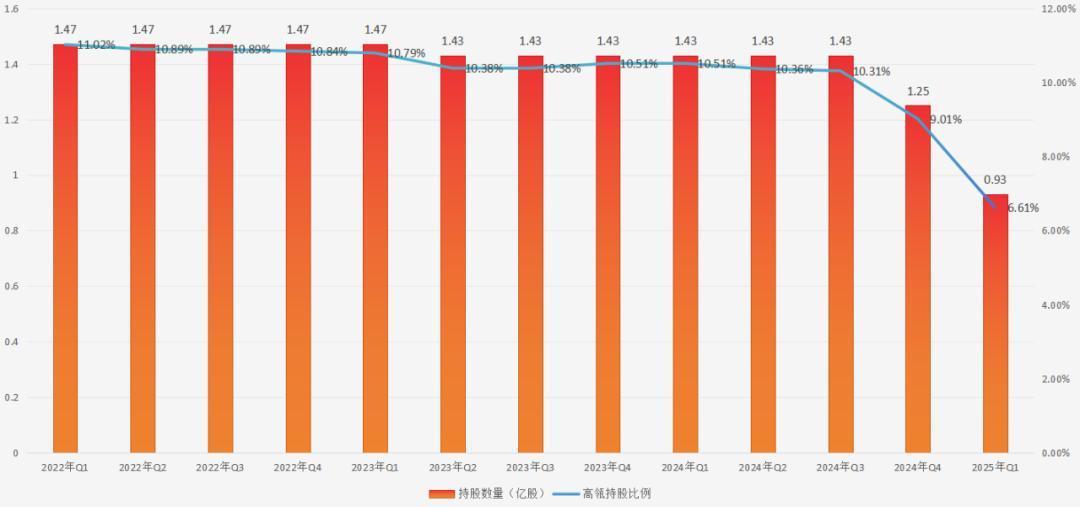
Figure: Hillhouse's shareholding ratio in BeiGene, source: Jinduan Research Institute
BeiGene's internationalization process can be described as aggressive. Since its establishment in 2010, it has benchmarked against top global pharmaceutical companies, with its R&D pipeline, clinical strategy, and even corporate governance deeply integrated into the international system. In 2024, BeiGene's revenue from the US market accounted for 51.4%, surpassing the 37% of the Chinese market for the first time, and it continues to widen at a visible speed.
As the pace of internationalization accelerates, BeiGene's emphasis on the local market inevitably shifts. The most direct manifestation is the change in the company's name. In November 2024, BeiGene announced that it would change its English name from "BeiGene" to "BeOne" and gradually weaken the use of its Chinese name in public.
At the same time, BeiGene also changed the registration place of its listed entity from the Cayman Islands to Switzerland, launching its strategic plan of "based in Europe, radiating globally." From "China's BeiGene to the world's BeiGene," the ambition is evident.
In addition, BeiGene's governance structure is becoming increasingly international. Foreigners occupy important positions in the company's executive team, including CEO Oleg Strong and several core members from the US. The proportion of international background investors and advisors on the board continues to rise, while the voice of local industrial capital is gradually weakening.
This "de-localization" governance model makes BeiGene more inclined to meet the needs of the global market rather than catering to the particularities of the Chinese market when making decisions.
For example, BeiGene invested 800 million USD in building a flagship biopharmaceutical production base and clinical R&D center in New Jersey, USA, far exceeding its capacity expansion in China.
At least intuitively, this transformation directly conflicts with Hillhouse's underlying logic. Zhang Lei once emphasized that "heavy investment in China" is confidence in the development of a major country, and the investment target must be rooted in the local market and promote industrial upgrading. However, BeiGene's valuation system relies on the premium of the European and American markets, gradually moving away from the positioning of "China's innovative drugs."
After reducing its holdings in BeiGene, Hillhouse quickly invested 200 million USD as a cornerstone investor to subscribe to the Hong Kong IPO of CATL and also invested 40 million USD to subscribe to the Hong Kong IPO of Hengrui Medicine. These two operations directly target "core local assets," demonstrating a deep focus on the foundation of China's industry and a strategic return.
03 Choices Are Not About Right or Wrong
Putting aside ideological differences, from an investment perspective alone, BeiGene is also difficult to call an "investor-friendly" investment target.
All along, BeiGene's "burning money for growth" model, frequent financing, and capital consumption constitute a difficult deadlock. The model of frequent issuance and dilution of shareholder equity has become the norm.
Since 2014, BeiGene has raised nearly 70 billion RMB through US, Hong Kong, and A-share markets, and in March 2025 alone, it issued an additional 6.5 million shares, causing early investors to be passively diluted in their shareholding ratio.
This "financing - burning money - refinancing" cycle has caused the company's share capital to expand from about 30 million shares at the time of its US IPO in 2016 to 1.405 billion shares in 2025, an increase of more than 40 times, with shareholder equity continuously diluted.
From Q1 2022 to Q1 2023, Hillhouse did not reduce its holdings of BeiGene's stock, but its holdings fell from the initial 11.02% to 10.79%, diluted by 0.23 percentage points in one year.
The unsustainability of "burning money for growth" is becoming increasingly apparent.
As of the first quarter of 2025, BeiGene's total cash on hand was 18.274 billion RMB, insufficient for its R&D expenditure for one and a half years.
More critically, unlike most domestic Biotech companies that go overseas through the "License out" model, BeiGene chooses to "build ships to go overseas," building its own sales team for overseas marketing and promotion, further exacerbating the financial pressure.
From 2019 to 2024, BeiGene's sales expenses increased from 1.359 billion RMB to 8.856 billion RMB, growing faster than R&D investment.
This "high-profile" model places high demands on corporate financing and its own hematopoietic ability, adding uncertainty to corporate operations.
BeiGene is expected to achieve profitability in 2025, but its current revenue mainly relies on Zanubrutinib and Tislelizumab, with these two products contributing more than 85% of revenue. However, its over-reliance on the European and American markets exposes it to policy uncertainties: in May 2025, Trump signed the "Drug Price Reduction Executive Order," which, although not directly affecting Zanubrutinib, which relies on commercial insurance, also caused its A-share to plummet by 9.04% in a single day.
Even from a technical barrier perspective, BeiGene's "moat" is far from reassuring.
Although Zanubrutinib temporarily leads the BTK inhibitor market, Lilly's third-generation BTK inhibitor Pirtobrutinib has launched head-to-head clinical trials, and its advantage in overcoming resistance mutations may disrupt the existing pattern; BeiGene's bet on the BTK PROTAC drug BGB-16673 faces encirclement from at least four pharmaceutical companies, including Nurix, with clinical prospects full of variables.
In addition, Zanubrutinib is continuously embroiled in patent disputes with AbbVie, and in terms of generics, although it has settled with Sandoz and MSN, it still needs to deal with patent challenges from generic drug companies in the future.
Facing significant financial pressure, BeiGene is still "burning money" to expand its global R&D pipeline. However, looking at the subsequent pipeline, although its layout is rich, it is difficult to see a "blockbuster drug" that can "take the lead" in the short term:
The fastest-progressing HER2 bispecific antibody Zanidatamab, BeiGene only owns the development and commercialization rights in Asia (excluding Japan), Australia, and New Zealand, with limited sales space; the BCL-2 inhibitor Sonrotoclax in Phase III clinical trials is lagging behind Ascentage Pharma's APG-2575, which submitted a listing application last November.
What worries investors even more is that in April this year, BeiGene announced the clinical failure of the TIGIT antibody Ociperlimab, which had accumulated an investment of over 2.09 billion RMB.
When BeiGene officially crowned itself as China's "Pharmaceutical King," its investment logic had fundamentally changed.
For Hillhouse, when the "China story" cannot support the valuation, the safety margin of capital needs to be reassessed. BeiGene's globalization narrative must continuously attract larger capital to enter, which is not friendly to existing investors.
Hillhouse's departure from BeiGene is a choice that is not about right or wrong. Hillhouse is still "heavily investing in China," and BeiGene is becoming more "international." It seems that they themselves have not changed, and after parting ways, I sincerely hope they both have a bright future.
This article is based on public information and is for information exchange purposes only and does not constitute any investment advice.
$BeOne Medicines(688235.SH) $BEONE MEDICINES(06160.HK) $Beigene(BGNE.US)
The copyright of this article belongs to the original author/organization.
The views expressed herein are solely those of the author and do not reflect the stance of the platform. The content is intended for investment reference purposes only and shall not be considered as investment advice. Please contact us if you have any questions or suggestions regarding the content services provided by the platform.
