


Mid-Year Review: The wave of share buybacks in Hong Kong continues, with more companies participating, and Tencent once again 'crowned the king'.

As the first half of 2025 came to a close, the Hong Kong stock market experienced significant volatility amid a complex and ever-changing international economic and trade landscape.
In April, the Hang Seng Index fell to 19,260 points due to the impact of U.S. tariff policies, but the market quickly rebounded and recovered its losses. Meanwhile, the rise of technology and emerging industries injected new vitality into the Hong Kong market, attracting a large influx of southbound and foreign capital, driving the Hang Seng Index to a 20% gain in the first half of the year.
Against the backdrop of significant market fluctuations, listed companies continued the trend of share buybacks that began in 2024 to boost investor confidence.
Significant Increase in the Number of Companies Conducting Buybacks
The U.S.-China tariff dispute has caused turbulence in global financial markets, leading to a noticeable increase in the willingness of Hong Kong-listed companies to repurchase shares in the first half of this year.
According to Wind data, 203 Hong Kong-listed companies initiated share buyback plans in the first half of 2025, significantly exceeding the 185 companies in the first half of 2024 and approaching the 205 companies for the entire year of 2023.
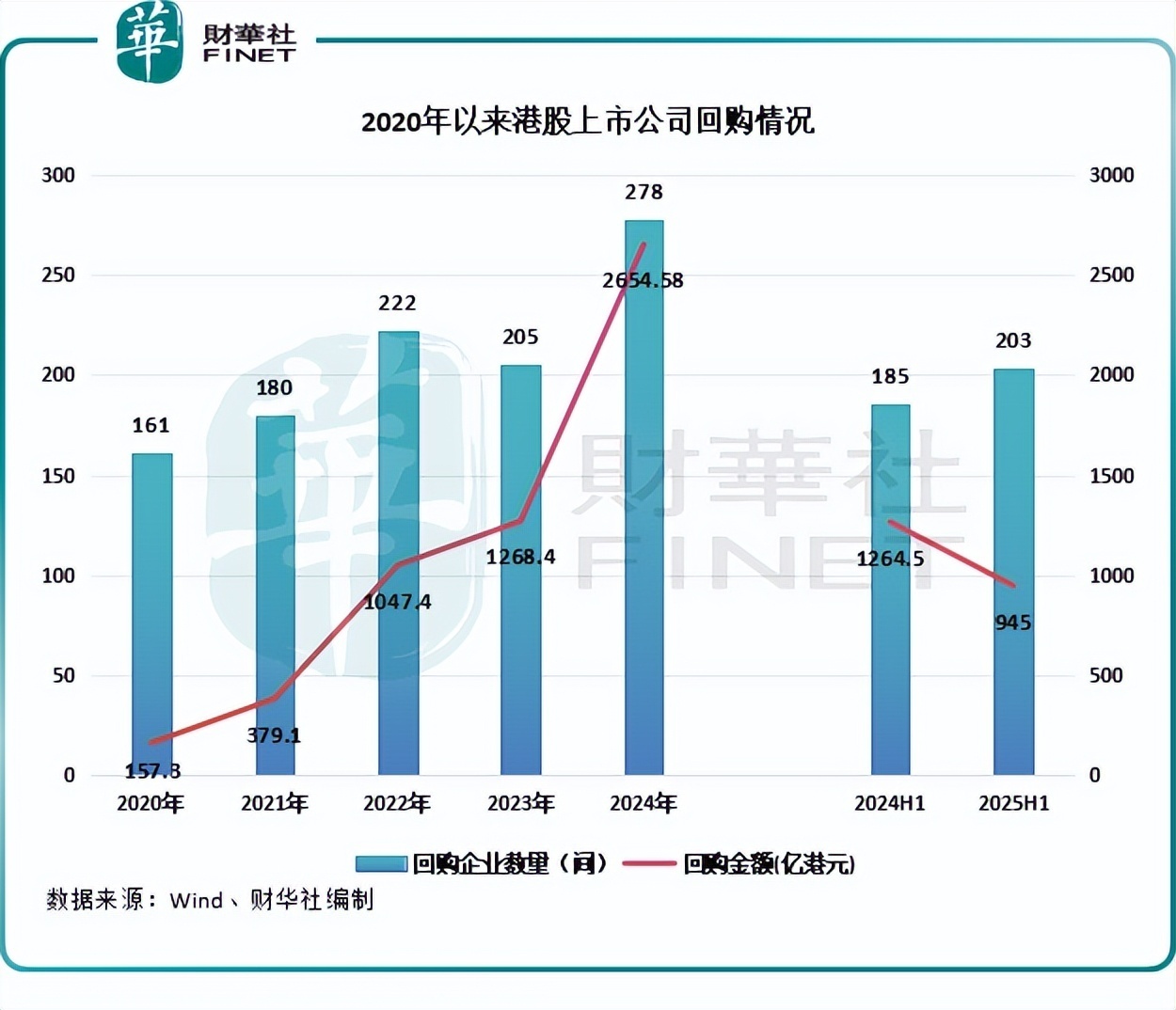
In terms of buyback amounts, the market showed a trend of "increasing number of companies conducting buybacks but declining buyback amounts year-on-year." In the first half of 2025, the total buyback amount in the Hong Kong market was approximately HK$94.5 billion, down about 25% from HK$126.45 billion in the same period last year. This change was mainly due to the high base in 2024.
As shown in the chart above, from 2021 to 2024, the scale of buybacks in the Hong Kong market showed a step-by-step upward trend, with cumulative buybacks reaching approximately HK$265.5 billion in 2024, involving nearly 10 billion shares. The reason was that many companies (especially internet and financial leaders) believed their stock prices were severely undervalued in 2024, leading to large-scale buybacks to boost market confidence.
In the first half of 2025, as the market recovered and the Hang Seng Index rebounded, some companies' stock prices moved away from the bottom range, increasing buyback costs. As a result, some leading companies reduced their buyback efforts. However, more small and small-to-medium-cap companies joined the buyback trend, leading to an overall increase in the number of companies conducting buybacks.
This indicates that market confidence continues to spread, with more companies believing their stock prices remain attractive.
Tianfeng Securities stated in its latest research report that as of July 1, 2025, the Hang Seng Tech Index's TTM P/E ratio was 20.10, with a historical percentile of 8.95%, indicating a relatively low valuation level. The report noted that, unlike in the past when internet companies focused more on shareholder returns, Chinese internet companies in 2025 have returned to a more aggressive and evolutionary approach.
Policy changes have also been a driver behind the increase in the number of companies conducting buybacks. In 2024, the Hong Kong Stock Exchange advanced reforms to the treasury share mechanism, allowing listed companies to hold repurchased shares as treasury shares, provided they comply with the laws of their jurisdiction and their articles of association.
These treasury shares can be used for resale, employee incentives, mergers and acquisitions, or bonus share issuance. This reform has significantly enhanced the capital management flexibility of listed companies and encouraged more Hong Kong-listed companies to join the buyback trend.
Tencent Leads Buybacks Again; Consumer and Pharma Stocks Show Increased Interest
Industry giants have led the wave of buybacks in the Hong Kong market since 2024, with internet tech and financial blue-chip stocks being the main drivers.
In the first half of this year, $TENCENT(00700.HK) , $HSBC HOLDINGS(00005.HK) , and $AIA(01299.HK) were among the top companies in terms of buyback amounts. These companies not only conducted frequent buybacks but also executed large-scale repurchases.
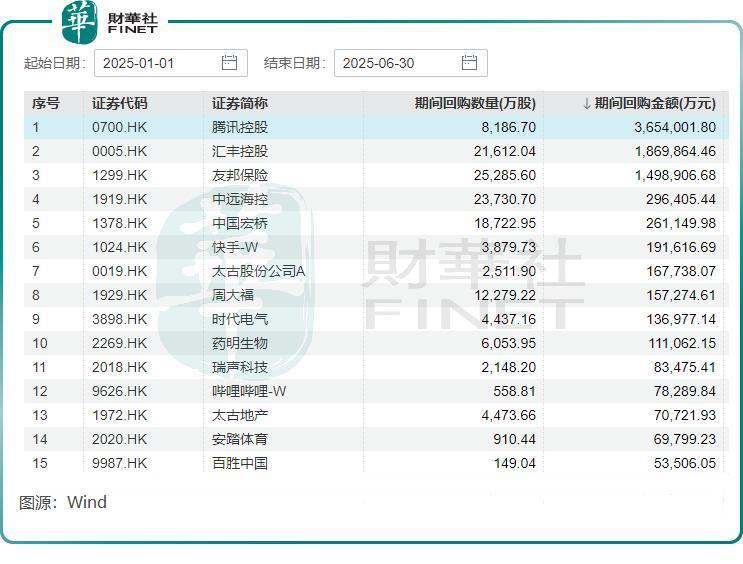
Wind data shows that Tencent continued to lead in buyback amounts in the first half of the year, with a total of HK$36.54 billion. HSBC and AIA followed, repurchasing approximately HK$18.7 billion and HK$15 billion, respectively. These three companies accounted for over 74% of the total buyback amount in the Hong Kong market, while the top 10 companies accounted for nearly 90%.
Tencent, the "buyback king," has topped the Hong Kong market in buyback amounts for three consecutive years. In its 2024 annual report, Tencent also announced plans to further enhance shareholder returns in 2025, with a commitment to repurchase at least HK$80 billion worth of shares.
By sector, internet and financial giants remain the main drivers of buybacks, but some consumer and pharmaceutical companies have also increased their buyback efforts.
In the first half of the year, consumer companies such as Anta (02020.HK), MINISO (09896.HK), and Mengniu (02319.HK) repurchased HK$698 million, HK$260 million, and HK$197 million, respectively. In the pharmaceutical sector, $WUXI BIO(02269.HK) repurchased over 60 million shares, totaling HK$1.11 billion, while $CSPC PHARMA(01093.HK) repurchased nearly HK$300 million worth of shares.
Compared to the same period last year, these companies saw varying degrees of increase in buyback amounts, with WuXi Biologics having no buyback activity in the first half of 2024. Due to market volatility and macroeconomic conditions, stock prices in sectors like consumer and pharmaceuticals experienced corrections or were undervalued. Companies with strong cash flows actively repurchased shares as the market recovered, further boosting investor confidence.
Huatai Securities noted in its research report that the rising trend of buybacks in Hong Kong reflects management's confidence in their companies' value. Buybacks not only enhance investor confidence but also improve financial conditions and shareholder returns.
Conclusion
The wave of buybacks in the Hong Kong market in the first half of 2025 reflects companies' confidence in their own value and the overall recovery of market confidence. With policy support and improving market conditions, the attractiveness of the Hong Kong market continues to grow. In the future, as more companies join the buyback trend, the Hong Kong market is expected to remain active, offering more opportunities for investors.
Author: Yao Yuan
The copyright of this article belongs to the original author/organization.
The views expressed herein are solely those of the author and do not reflect the stance of the platform. The content is intended for investment reference purposes only and shall not be considered as investment advice. Please contact us if you have any questions or suggestions regarding the content services provided by the platform.
