

[New Stock Encyclopedia] What does the failure of the greenshoe option mean? Is it reliable to rely on the greenshoe after a price drop?

"Green Shoe", the full name is "Over-allotment Option" or "Greenshoe Option", the name originates from the first company in U.S. history to use this mechanism, specifically traced back to the IPO of Green Shoe Manufacturing Company (now Stride Rite Corporation) in Boston in 1963.
In 1963, Green Shoe Manufacturing Company first adopted the "Over-allotment Option" mechanism in its IPO. At that time, underwriters designed a flexible allocation method to stabilize the stock price after listing: allowing underwriters to issue an additional 15% of shares when market demand was strong or to buy back shares from the secondary market to support the price if the stock price fell.
Where can we find Green Shoe information? Before the IPO, we can directly see in the prospectus whether the company has a Green Shoe for this issuance and the maximum proportion of the Green Shoe (usually 15%). The specific amount of the Green Shoe can be seen in the allocation announcement on the night of the grey market.
Taking Lens Technology as an example, the company's prospectus shows that the over-allotment option grants no more than 39,338,400 shares or 45,239,200 shares.
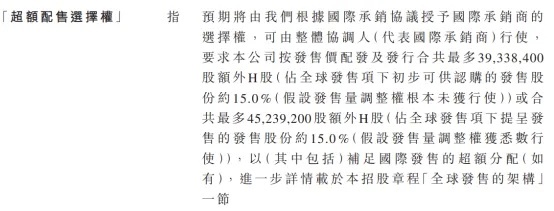
In the final allocation announcement, we see that the over-allotment shares were 39,338,400, which is also the final number of Green Shoe shares.
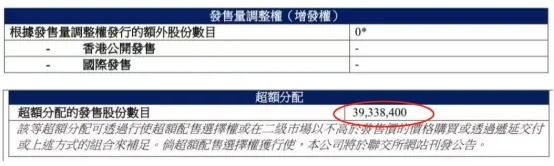
Why wasn't it 45,239,200 shares? This involves another concept, the "Volume Adjustment Right". Both the Over-allotment Option and the Volume Adjustment Right involve adjustments to the number of shares issued, but their purposes, definitions, and usage scenarios are different.
The Green Shoe is used to stabilize prices, while the additional shares under the Volume Adjustment Right are based on market subscription (usually strong demand), actively adjusting the initial issuance quantity. It is essentially a "volume adjustment tool" during the issuance stage, aiming to match market demand and maximize financing scale.
Therefore, if the additional issuance right is exercised, Lens Technology's Green Shoe should be 45,239,200 shares. However, according to the allocation announcement, the number of additional shares issued was 0, so the Green Shoe was only 39,338,400 shares.
Having explained where to find the Green Shoe, let's talk about how it is exercised and takes effect.
It's actually simple. After Green Shoe participants subscribe to the Green Shoe shares, if the stock price rises and the stabilizer does not exercise the Green Shoe (it is generally not exercised in a rising market), these shares are additionally issued by the issuer after the stabilization period ends and handed over to Green Shoe participants (usually institutional investors). When the institutions sell, wow, they make a fortune~
However, if the stock price falls after listing, the stabilizer will use the money from the Green Shoe subscription to buy shares in the open market to support the price. After the stabilization period ends, the bought shares are directly handed over to the institutions.
The Green Shoe is different from anchoring. It can only be sold after the stabilization period ends, so the risk is relatively high.
This leads to another concept, Green Shoe Failure.
The Green Shoe is essentially an additional issuance in the international placement. Therefore, if the international placement is insufficient, priority is given to the allocation part, so all stocks with malicious clawbacks have no Green Shoe.
Another situation, as mentioned earlier, the risk of the Green Shoe is not small. If institutions believe the stock has a risk of breaking issue price, they may not want to take the Green Shoe. The most notable case is Jiuyuan Gene. This stock had Huatai as the sponsor, bookrunner, underwriter, and stabilizer. Although the prospectus mentioned the Over-allotment Option, the final allocation announcement showed no over-allocation, likely because no Green Shoe takers were found. As a result, the first-day drop expanded from 28.5% in the grey market to 38.4%.

Alright, theory is done. So, if there is a Green Shoe, can we say the stock price is stable? It helps, but it doesn't guarantee no break.
First, as of 2024, the probability of stocks with Green Shoes breaking issue price is 29.2%, while stocks without Green Shoes have a lower probability of 16.1%.
However, Green Shoes do help stabilize prices. For stocks that break issue price in the grey market, once the international placement trading opens on the first day, a sell-off is likely. For stocks that break issue price in the grey market without Green Shoes, the average drop in the grey market is 16.45%, and the average drop on the first day is 29.17%, a significant expansion. For stocks with Green Shoes, the average drop in the grey market is 11.65%, and the average drop on the first day is 11.45%, not expanding but slightly narrowing.
Although Green Shoes have some effect in controlling drops, if you want to profit from Green Shoes, be cautious about catching falling knives in the grey market, especially for stocks that drop more than 20% in the grey market. Even with Green Shoes, the average loss still expands by 11%. Once a sell-off occurs, the Green Shoe can't stabilize it.
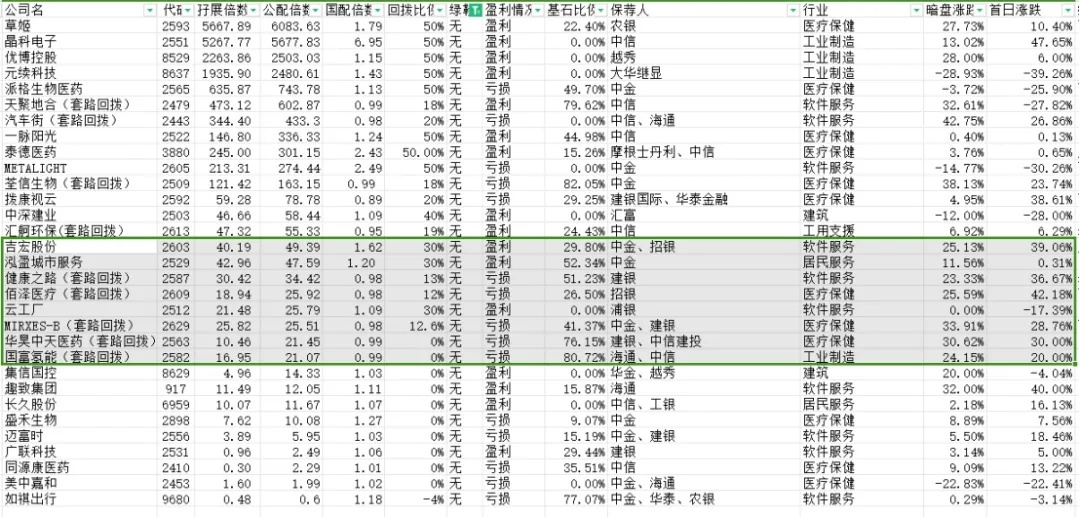
After all this, is there any positive guidance from Green Shoes? Yes. Historical data shows that for stocks with a margin multiple of 15-50 times and no Green Shoes, excluding A+H's Jinhong Group, there are 7 stocks, 5 of which had malicious clawbacks, a probability as high as 71.4%, and zero breaks in the grey market. Therefore, if the margin is around 10-40 times and there's no Green Shoe, maybe you can bet on a malicious clawback?
The copyright of this article belongs to the original author/organization.
The views expressed herein are solely those of the author and do not reflect the stance of the platform. The content is intended for investment reference purposes only and shall not be considered as investment advice. Please contact us if you have any questions or suggestions regarding the content services provided by the platform.
