


Four players compete in unmanned urban delivery, the battle for position intensifies.

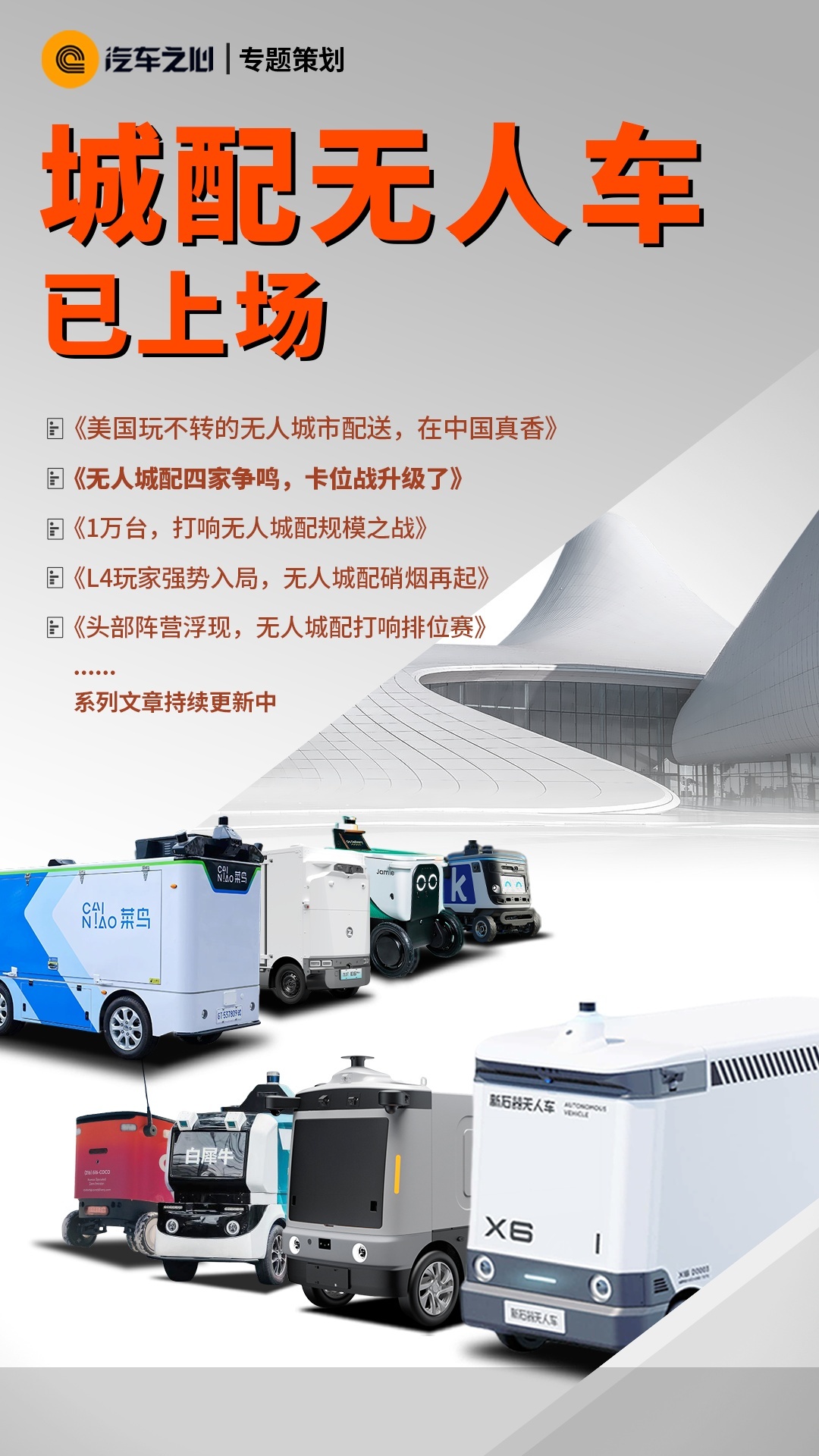
When depicting the future of autonomous driving, the commercialization path for cargo seems clearer than for passengers.
At this moment, in the streets and alleys of Beijing, Shanghai, Guangzhou, and Shenzhen, the unmanned delivery vehicles of New Stone, Nine Knowledge, and White Rhino are already shuttling between regional logistics points and stations, weaving a dense unmanned delivery network that continuously reduces costs and increases efficiency for partner companies.
New Stone founder Yu Enyuan once calculated that unmanned vehicles can reduce the urban short-haul costs of logistics companies by more than 40%. He painted a blueprint that if a network of one million unmanned delivery vehicles could be built, it could save the entire express logistics industry hundreds of billions of yuan annually.
Under the real temptation of "saving money," market demand naturally rises. Guojin Securities' research report shows that the domestic urban distribution market has reached a trillion-level scale.
This means the cake of unmanned urban distribution is far from being fully cut.
Today, those eyeing this cake include logistics companies like Cainiao, JD.com, Meituan, as well as startups like New Stone, Nine Knowledge, and White Rhino, and new players crossing over from the Robotaxi track—WeRide.
In February this year, WeRide released a new generation of unmanned vehicles designed for urban open roads—Robovan W5, with the first batch of 20 vehicles already commercially operating in Guangzhou.
Interestingly, this player, who has already occupied a high ground in the Robotaxi field, appears to be at ease when entering unmanned urban distribution, thanks to the dimensional reduction reuse accumulated from L4-level autonomous driving technology.
Fundamentally, the entire unmanned urban distribution track is still in the early exploratory stage, and even though pioneers have established a preliminary scale of thousands of vehicles, latecomers still have the possibility of overtaking with differentiated strategies.
Thus, as the focus of competition shifts to the hardcore battle of technology and products, the unmanned urban distribution arena is becoming more lively with the addition of new variables.
01、Unmanned urban distribution is a systematic proposition
Any landing of autonomous driving is a systematic proposition concerning road rights, technology, and business.
Unmanned urban distribution naturally does not escape this narrative logic.
In the past, unmanned vehicles were more directed towards unmanned logistics in closed scenarios, limited to parks and factories, executing transportation tasks along fixed routes in controllable environments.
Today's unmanned vehicles have entered urban open roads, running regular operations in urban distribution scenarios such as express delivery connections, supermarket fulfillment, and instant delivery.
From the experimental field gradually entering the main arena, it also somewhat selects the players' capabilities.
In fact, the current unmanned urban distribution market pattern has gradually become clear. New Stone and Nine Knowledge, due to their early efforts and outstanding technical advantages, are in the first tier. Reports indicate that the two leading companies are expected to occupy 80% of the market share this year.
Although White Rhino is smaller in scale, it still has potential due to mature technical verification and scenario adaptation; WeRide, with its accumulated technical verification advantages in fields like Robotaxi and L4, can still quickly get started in the unmanned urban distribution field.
Thus, from these four representative players, some common strategies can be seen:
First is crossing from "usable" to "useful" in algorithms, thoroughly penetrating generalization.
In fact, the technical challenges faced by unmanned urban distribution vehicles have jumped from "simple levels" to "difficult modes."
On one hand, the road has become wild. Structured scenarios have expanded to slopes in mountainous and rural areas, with a significant increase in the uncertainty of traffic participants' behavior.
On the other hand, the road has widened. Open roads, as unstructured scenarios, pose stricter requirements for the comprehensiveness of environmental perception, the robustness of decision logic, and the reliability of system redundancy.
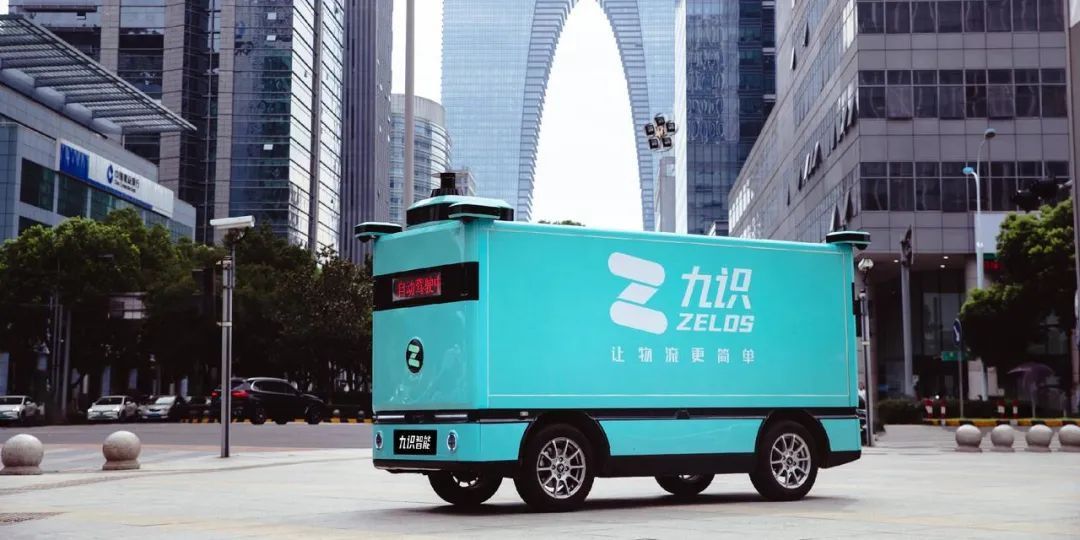
Unmanned urban distribution vehicles need to have all-weather, all-time, and all-scenario road traffic capabilities, requiring continuous honing in algorithm technology.
And Nine Knowledge, White Rhino, and WeRide are all companies that have grown from the field of autonomous driving technology.
Interestingly, Nine Knowledge founder Kong Qi, White Rhino founders Zhu Lei and Xia Tian, and WeRide founder Han Xu all held key positions in Baidu's autonomous driving team, accumulating rich project experience from R&D to landing in autonomous driving, leading their companies to quickly complete the construction of unmanned urban distribution vehicle technology systems.
Especially WeRide, although a latecomer in the unmanned urban distribution field, its technical leadership has already been verified in the Robotaxi field with 1900 days of operation, 1200 fleet vehicles, and 40 million kilometers of autonomous driving data.
Therefore, based on WeRide's self-developed WeRide One general autonomous driving platform, the technical experience of Robotaxi can be quickly replicated.
Another player, New Stone, despite the founder's background in the logistics industry, is also making relentless efforts in algorithm system construction.
Last year, New Stone launched its self-developed L4-level 4D One Model perception model, enabling unmanned vehicles to drive at speeds exceeding 70 km/h on open roads, unaffected by extreme weather or complex road conditions such as nighttime, rain, and smog.
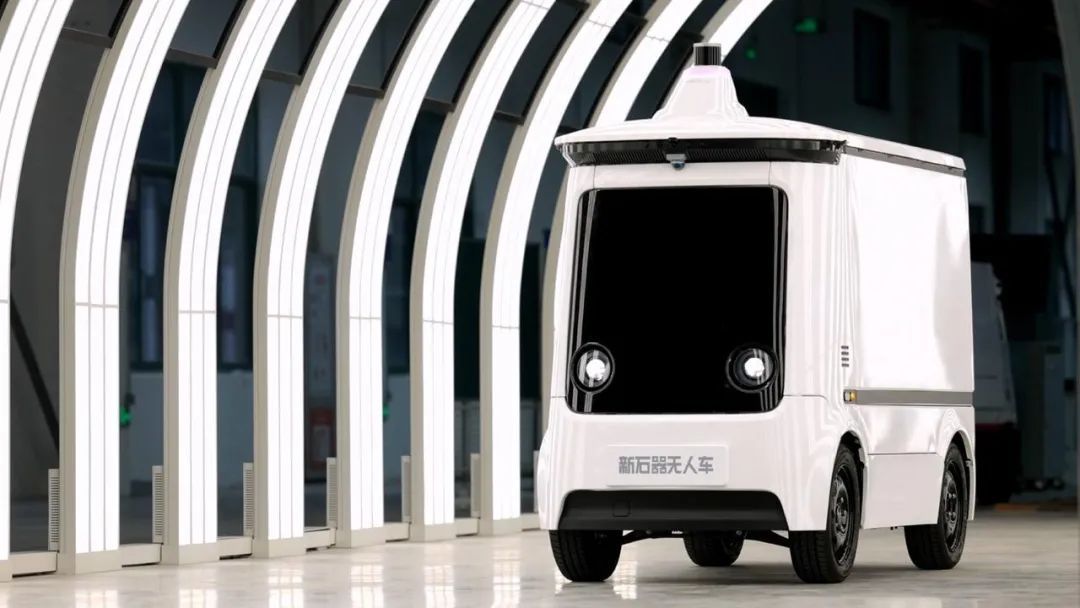
Second is obtaining as many "pass permits" as possible in road rights.
Road rights are the key to opening the door to commercialization for unmanned urban distribution vehicles. Compared to Robotaxi, unmanned urban distribution vehicles have gained greater tolerance in road rights policies. Currently, local governments' openness to autonomous driving policies is prioritized for cargo over passengers, and low to medium speeds over medium to high speeds.
This policy tilt allows industry-leading companies to quickly layout. Nine Knowledge Intelligence revealed that road rights are no longer a development obstacle, and in some regions, local customers even proactively apply to the Ministry of Industry and Information Technology, Postal, or Transportation departments to help companies obtain road qualifications.
Thus, leading players have woven a dense transportation network.
Leading the way are New Stone and Nine Knowledge:
- The former has obtained road rights in over 250 cities nationwide, with over 2000 unmanned vehicles deployed by the end of 2024;
- The latter has also obtained road qualifications in 29 provinces and regions nationwide, covering approximately 200 cities.
White Rhino is also closely following, with unmanned delivery services covering more than 40 cities including Beijing, Shanghai, Guangzhou, and Chengdu.
And WeRide, leveraging its accumulated experience in government-enterprise cooperation in fields like Robotaxi and unmanned minibuses, can also quickly open the unmanned urban distribution vehicle market. It first achieved landing in its Guangzhou base and obtained China's first city open road L4 freight vehicle "pure unmanned + cargo" test permit, covering 797 roads and supporting 7×24-hour all-weather operation, demonstrating strong scenario coverage capabilities.
Third is binding more B-end leading enterprises in commercial landing.
The essence of unmanned urban distribution is a B2B business, pointing to a clear commercial cooperation path: using leading customers as entry points, refining products through model projects and then scaling replication, forming long-term binding relationships through services + technology.
In fact, the current commercial model of unmanned urban distribution is mainly "hardware + service," with specific differences being that Nine Knowledge, WeRide, and New Stone choose to sell vehicles and charge technical service fees, while White Rhino chooses to rent vehicles and charge maintenance fees.
Nine Knowledge, New Stone, and White Rhino have all built cooperation chains along this path, such as Nine Knowledge's partners including JD.com, Yunda, and Meituan, New Stone's partners including SF Express, Deppon, and Zhongtong, and White Rhino also establishing cooperation with SF Express, JD.com, and Meituan.
Of course, behind the cooperation often intertwines capital ties, such as SF Express participating in White Rhino's latest round of financing, and Meituan having strategically invested in Nine Knowledge, further strengthening the deep binding between enterprises and customers.
Although WeRide is just starting in the unmanned urban distribution field, it has already entered Zhongtong's cooperation system early on, and now unmanned urban distribution vehicles have landed in Guangzhou, also securing the smart logistics project led by the Guangzhou government, undertaking material transportation and municipal delivery within the park.
Thus, the four players have quickly established a closed-loop commercialization model, determining a replicable expansion path in the unmanned urban distribution field.
02、One side is heavy asset betting, the other side is light asset integration
Under commonality, there are specific commercialization differences.
It is well known that the fundamental logic of business is to reduce costs and increase efficiency, but before unmanned urban distribution players themselves achieve cost reduction and efficiency increase, they need to first help customers solve this problem.
In short, to get money from customers, you must first convince them that you can help them save money. Along this main axis of cost reduction and efficiency increase, the four players have differentiated into two commercialization paths.
Path one is low price to boost volume, relying on heavy assets to scale. Representative players are New Stone and Nine Knowledge.
That is, through low-price strategies to promote a large number of commercial cooperation, forming a replicable scale effect. But this flywheel needs to run at high speed, requiring strong product power and engineering capabilities as support.
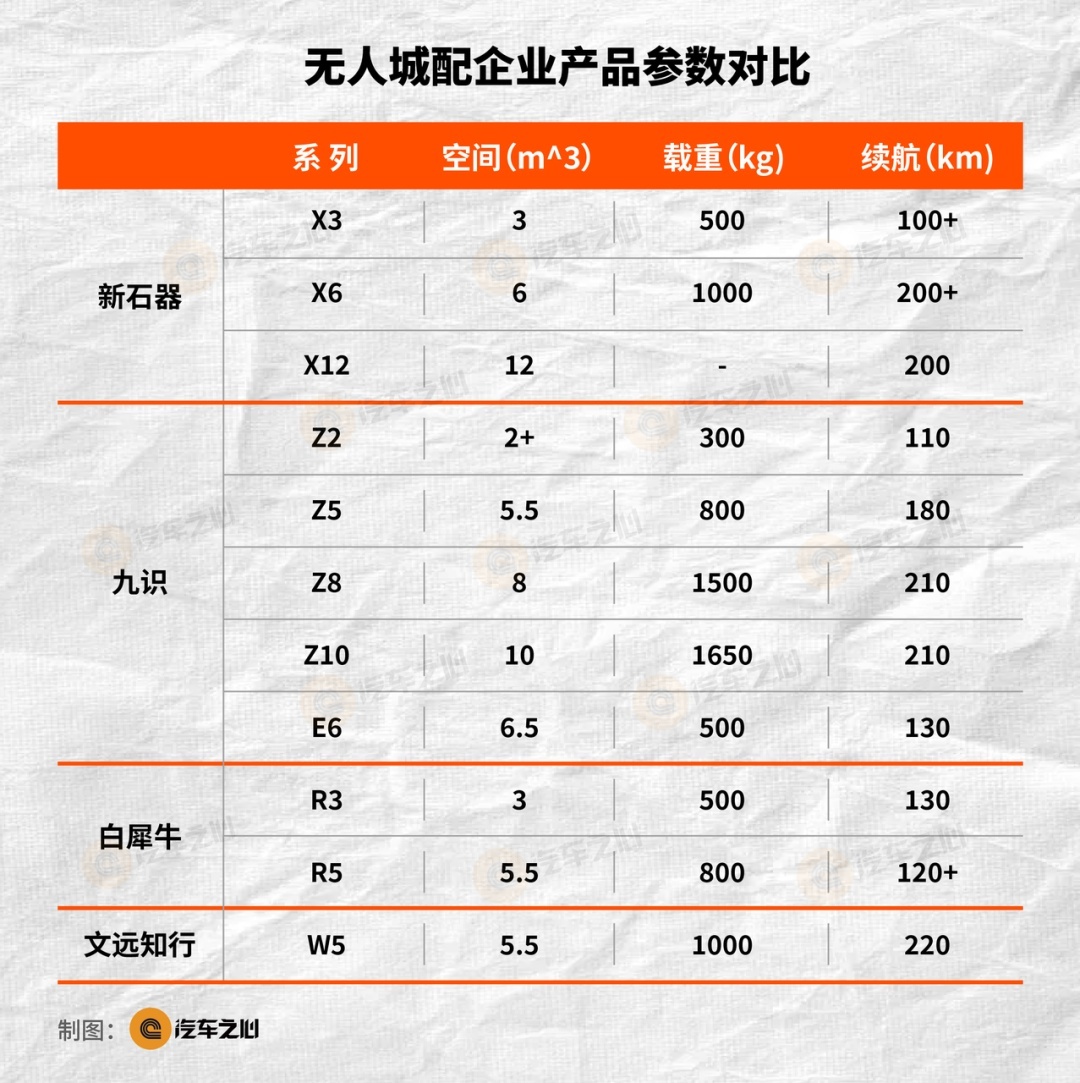
The concretization of product power lies in being many and precise. New Stone's unmanned vehicles have completed 6 iterations, forming a product matrix of X3, X6, and X12, with X3 and X6 as the main products, priced as low as 40,000 and 50,000 yuan respectively.
It is reported that after 35 New Stone unmanned vehicles were put into use at a Zhongtong Chengdu station, delivery costs dropped from 0.15 yuan to 0.06 yuan, significantly reducing by 60%.
And Nine Knowledge has iterated from the early Z series to the latest E series, with a product matrix covering different loading needs from 2 cubic meters to 10 cubic meters.
Especially the E6 product, as a price cutter, is priced as low as 19,800 yuan, and adopts a 1,800 yuan/month FSD subscription model, significantly lowering the trial and error threshold for customers. On the day of product release, this model received 5,290 orders, breaking the global daily sales record for unmanned vehicles.
And the continuous high demand on the demand side often requires a rapid response on the supply side.
Holding tens of thousands of orders and massive customization needs, both players choose to build their own production capacity.
- New Stone Yancheng Base: Claimed to be the world's first L4 vehicle factory with an annual production capacity of 30,000 units, with over 3,000 units delivered within the year.
- Nine Knowledge Sichuan Factory: Started production in April this year, with a target annual production capacity of 3,000 units, focusing on covering orders in the southwest region.
Clearly, both companies can effectively strengthen scenario customization capabilities and reduce overall supply chain costs through the heavy model of "hardware self-research + software definition + supply chain self-control."
Path two is mainly light assets, leveraging strength. White Rhino and WeRide belong to this category. The keywords are ecological niche positioning and resource integration.
Including White Rhino and WeRide, both choose extremely simple product lines. White Rhino currently has only two models, R3 and R5, with R5 as the main model. And WeRide has only one model, W5.
The focus is that White Rhino has received capital bets from SF Express and Xinyuan Auto, forming an "L4 enterprise + express delivery leader + car company" iron triangle cooperation relationship, tightly holding the L4 brain, binding Xinyuan Auto to solve manufacturing problems, and then leveraging SF Express's massive order flow to open the commercial closed loop.
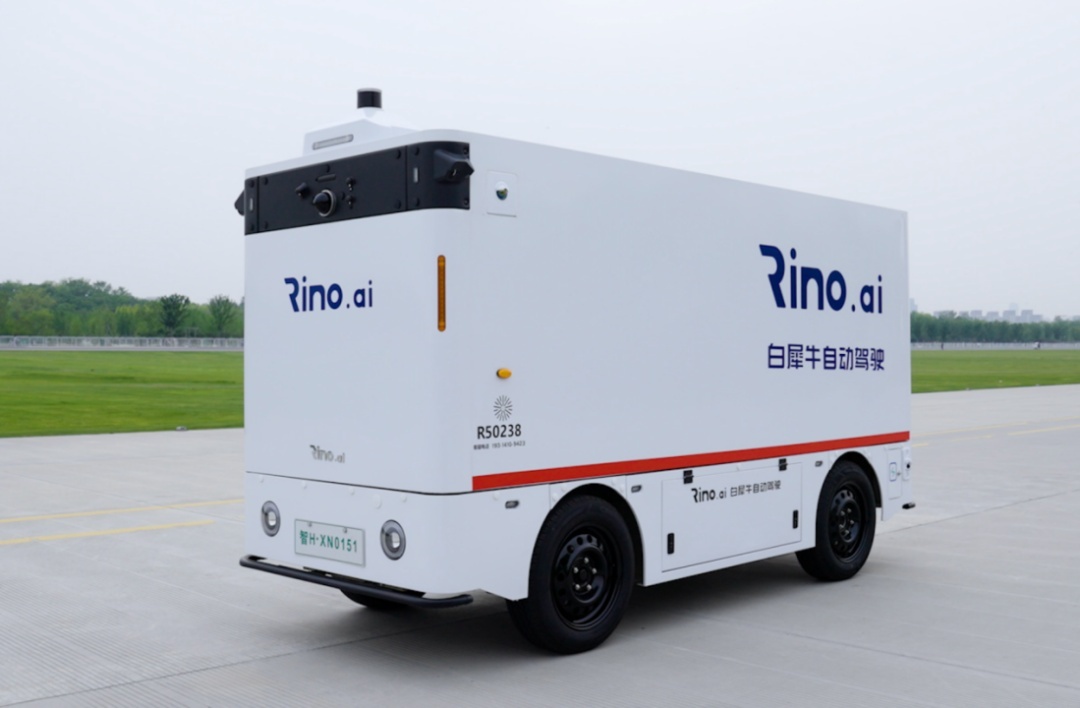
Backed by two big trees, White Rhino can focus on algorithm and operation optimization, and currently its daily active unmanned vehicle count has reached several hundred, with a target of reaching 5,000 daily active units.
If White Rhino is leveraging external forces to play a cooperative battle, WeRide is leveraging internal forces to play resource integration.
Although WeRide essentially also adopts a division of labor cooperation form, focusing on algorithm technology, unlike White Rhino, WeRide has already built a hard core—general autonomous driving technology platform, and has been honed in fields like Robotaxi, unmanned minibuses, unmanned sanitation, and L2, so when entering the new field of unmanned urban distribution, the software and hardware experience on the platform can be quickly replicated.
It is worth mentioning that although there is only one product, from the product parameter comparison, it can be seen that WeRide wants to eat the fattest piece of meat with a single model.
Clearly, W5 has absorbed the advantages of other flagship products, also adopting modular design, supporting multiple compartment combination cargo boxes, and adapting to diverse scenarios. But the superior point is that W5 has designed the cargo capacity to be the largest market demand of 5.5 cubic meters, and has raised the maximum load and endurance parameters to higher levels, meeting the logistics distribution needs of long distances and large batches.
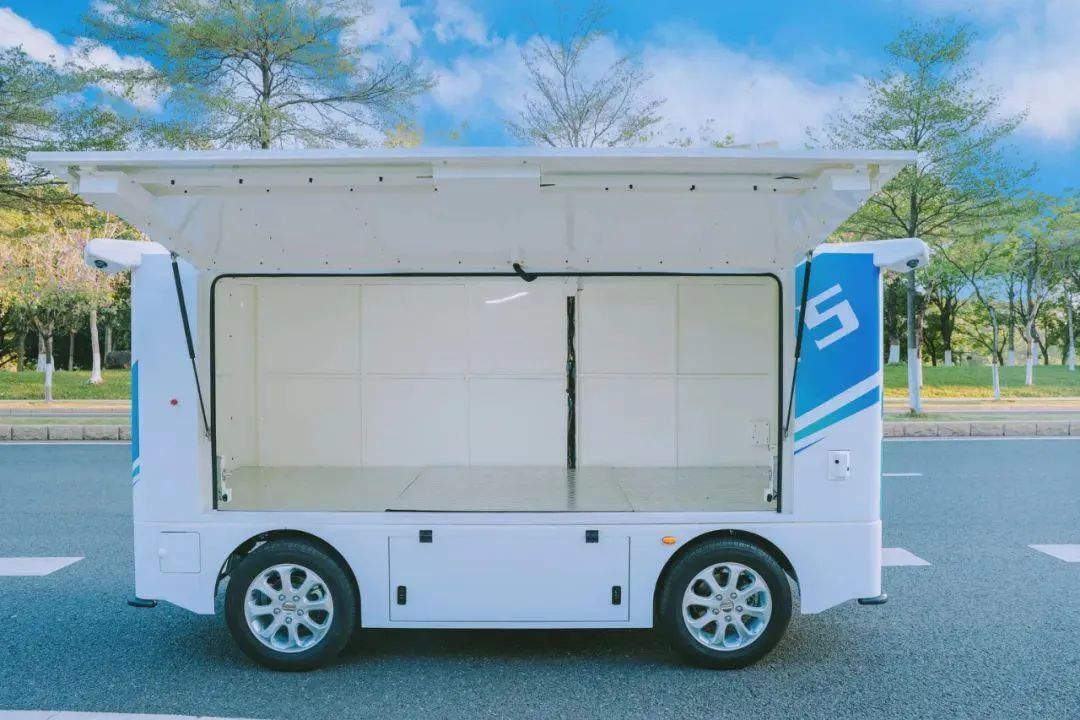
Additionally, strong product power is also combined with remote OTA, 7x24-hour response, on-site training, and other after-sales services, showing that WeRide is indeed well-prepared.
Of course, whether it is the aggressive approach of New Stone and Nine Knowledge, or the stable approach of White Rhino and WeRide, the core challenge is always who can more quickly and steadily turn the promise of "helping customers reduce costs" into a sustainable profit model for themselves.
And this point still needs to be seen in the subsequent scale expansion.
03、From 1 to 10, starting a new tug-of-war
A basic fact is that although the unmanned urban distribution field pattern is initially set, overall, everyone is still in the pre-commercialization night, and the gap has not been completely opened.
Yu Enyuan once said very directly in an interview: "We are all pecking at each other with our peers, none of us are strong."
Thus, although the four players have completed the start-up stage from 0 to 1 through different strategies, from 1 to 10 is the real tug-of-war.
Following the direction of the unmanned urban distribution market tide, two expansion trends can be seen.
First is in the domestic market, eating both big and small fish.
Nine Knowledge founder Kong Qi proposed a market maturity measurement standard, which is a company having over 20,000 unmanned vehicles nationwide, with single-city deployment reaching 500 units in some cities.
And to build a dense transportation network in a city, it cannot rely solely on logistics and retail giant companies, but also needs to tap into small-scale customers and individual customers.
In fact, small and medium-sized customers are the more real market testing ground.
On one hand, small and medium-sized customers spending money means they have already calculated the "saving money" account clearly, and this word-of-mouth diffusion effect will reverse drive big customer decisions.
On the other hand, although small and medium-sized customers have high requirements for product engineering standards, they have fewer customization needs, instead giving companies higher bargaining power, making them the customer layer most likely to generate profits in unmanned urban distribution.
Second is going overseas, "changing water to raise fish" in rich markets.
Going overseas is already a consensus in the entire autonomous driving industry, and the strong competitiveness forged in the fierce domestic environment will constitute a significant advantage in participating in international competition.
Today, these players have already taken this step.
New Stone's unmanned urban distribution vehicles are the first to run, entering 13 countries including Germany, the UAE, and Japan, and Nine Knowledge has also obtained Singapore's first unmanned vehicle license and entered the Japanese, Korean, and Middle Eastern markets.
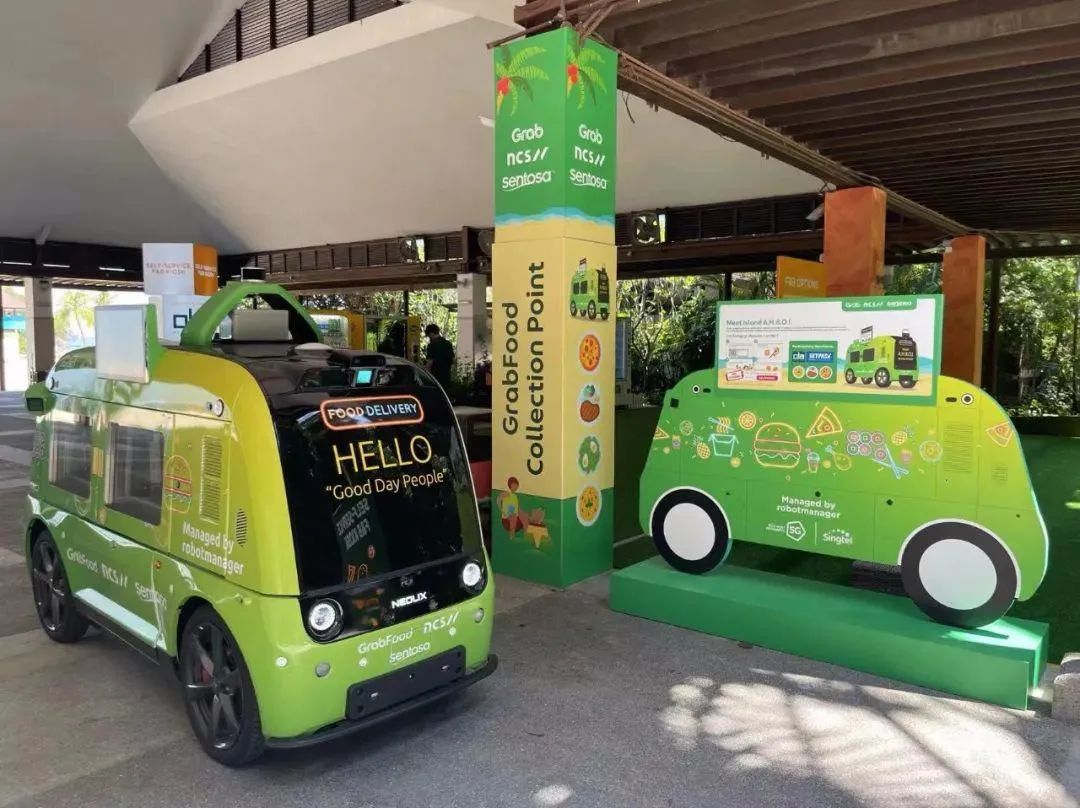
And standing on the shoulders of SF Express, White Rhino can also extend its transportation network to international markets.
For WeRide, going overseas is a path already taken by Robotaxi, unmanned minibuses, and unmanned sanitation, and this first-mover advantage can also be projected into the unmanned urban distribution field.
For example, the unmanned driving license issued by the UAE can cover all scenarios and models, and with Robotaxi opening the way, unmanned urban distribution vehicles can enter by simply going with the flow.
In fact, the later stage of the unmanned urban distribution vehicle field is not about "who can run," but "who can dig the moat deeper."
Now all four have found their own development rhythm, New Stone and Nine Knowledge rely on first-mover advantage to eat up market scale, while White Rhino and WeRide use late-mover advantage to play out efficiency differences.
Especially WeRide, although not the earliest starter in the unmanned urban distribution field, it has a foundation that others find difficult to replicate.
The algorithm capabilities, engineering landing system, and global operation experience accumulated over years of practical experience in the Robotaxi field all provide it with an acceleration channel that can be directly reused. Whether it is a highly automated dispatch system, a multi-model integrated capability platform, or familiarity with overseas policy environments, WeRide has already undergone complete polishing on the Robotaxi battlefield.
And when these "existing certainties" are transferred to urban distribution vehicles, their speed, stability, and cost advantages will become apparent.
Therefore, if viewed separately, although each player still needs to run a bit more in the pre-commercialization night, they all have the potential to cross the finish line.
But if viewed together, with the promotion of the four players, the prospects of unmanned urban distribution are gradually becoming clear, and the profit point of this track will arrive earlier than Robotaxi, which is undoubtedly more exciting.
$WeRide(WRD.US) $Meituan(MPNGY.US)
The copyright of this article belongs to the original author/organization.
The views expressed herein are solely those of the author and do not reflect the stance of the platform. The content is intended for investment reference purposes only and shall not be considered as investment advice. Please contact us if you have any questions or suggestions regarding the content services provided by the platform.
