


10,000 units, the battle for unmanned urban distribution scale has begun.

As the helmsman of the world's first company to surpass a market capitalization of $4 trillion and reach the pinnacle of global valuation, NVIDIA CEO Jensen Huang has repeatedly emphasized: the next wave will be 'Physical AI.'
In an earlier public speech, Jensen Huang stated that there are only two types of robotic systems that can be deployed at scale: autonomous vehicles and humanoid robots.
Currently, humanoid robots are still in the technological validation phase, but autonomous vehicles are infiltrating daily life in another form—unmanned urban delivery vehicles, frequently appearing on streets to deliver packages, fresh produce, and pharmaceuticals, becoming a typical carrier for 'Physical AI'.
Unmanned urban delivery is emerging as the fastest-growing, most commercially viable, and most rapidly developing application of autonomous driving technology.
Data from the State Post Bureau shows that by 2024, over 6,000 unmanned delivery vehicles have been deployed, far surpassing the number of Robotaxis, another application of autonomous driving technology, where the leading companies operate fewer than 3,000 vehicles.
The market potential for unmanned urban delivery is vast.
According to Zhiyan Consulting, China's unmanned urban delivery market grew from 4 billion yuan in 2022 to 6.5 billion yuan in 2023, with a compound annual growth rate exceeding 62%. It is projected to reach 17 billion yuan this year.
China's urban delivery market has maintained a trillion-yuan scale since 2016. From billions to trillions, there is still untapped market potential.
Among the players, Neolix and Jushi Intelligence are the first to reach the initial milestone of scaling unmanned urban delivery, targeting cumulative production and delivery of 10,000 units this year.
Neolix founder Yu Enyuan revealed that the industry's growth rate this year is ten times that of last year, with Neolix delivering over 1,000 vehicles monthly. In April alone, deliveries exceeded the total for all of 2024, when only 2,000 vehicles were deployed.
As of July this year, Neolix has deployed 6,600 unmanned urban delivery vehicles, while Jushi has delivered over 5,000 units.
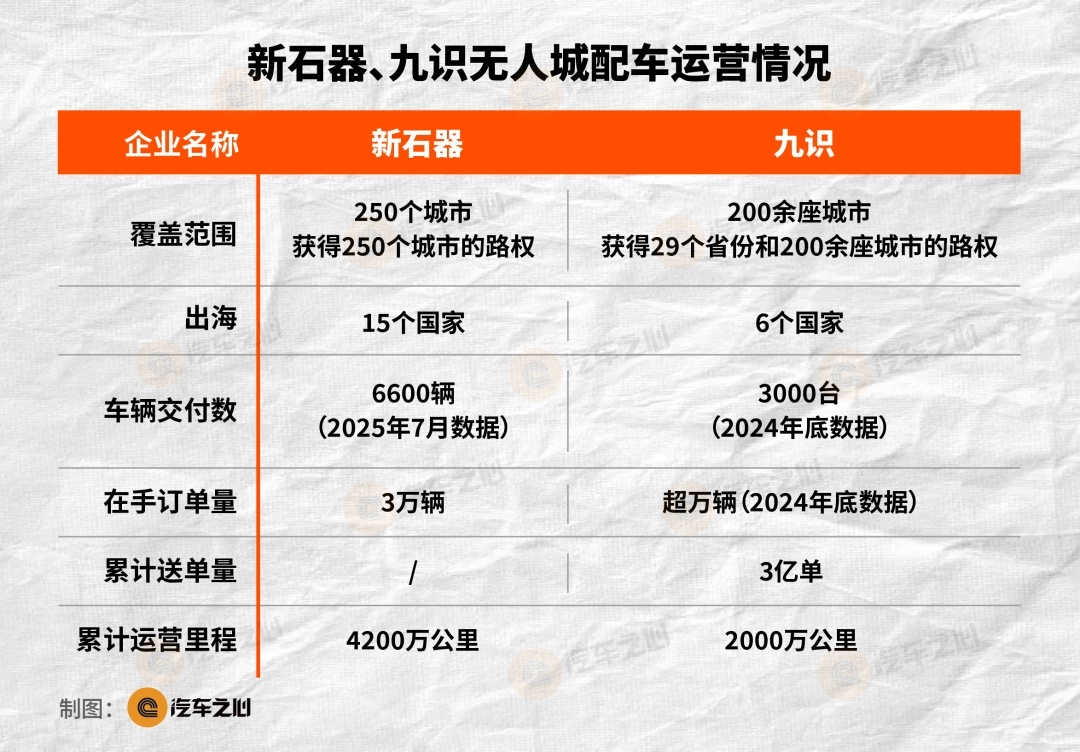
Based on current delivery trends, the path to 10,000 units is becoming clear.
This signals the transition of unmanned urban delivery from small-scale validation to large-scale application, testing the technical maturity, cost control, mass production, and operational capabilities of leading companies.
Meanwhile, major players like JD.com, Meituan, and Cainiao, which once led the development of unmanned urban delivery, appear sluggish in this scaling race, with no signs of reaching the 10,000-unit milestone.
As the industry approaches the 10,000-unit milestone, we explore three questions:
- Why are Neolix and Jushi leading the race?
- What challenges must be overcome to achieve 10,000 units, and what benefits will it bring?
- Why are major players lagging in scaling unmanned urban delivery?
On the eve of industrial replication, the race to 10,000 units may mark the beginning of a shift in industry dynamics.
01. Four Essential Capabilities for 10,000-Unit Production
Unmanned urban delivery vehicles, as tools for cost reduction and efficiency improvement, test not only technical maturity but also a team's understanding of scenarios, cost control, and product strategy.
Neolix and Jushi have focused on these four dimensions to reach the 10,000-unit milestone.
Technically, both companies' products achieve L4 autonomous driving, adapting to various road conditions, times, and scenarios.
- Neolix vehicles can navigate point-to-point and park autonomously, operating in all weather and scenarios.
- Jushi vehicles handle narrow roads, industrial logistics, and express delivery, meeting urban operational needs.
In scenario understanding, both founders have deep logistics expertise, a key driver for commercialization. Other startups lack this foundational knowledge.
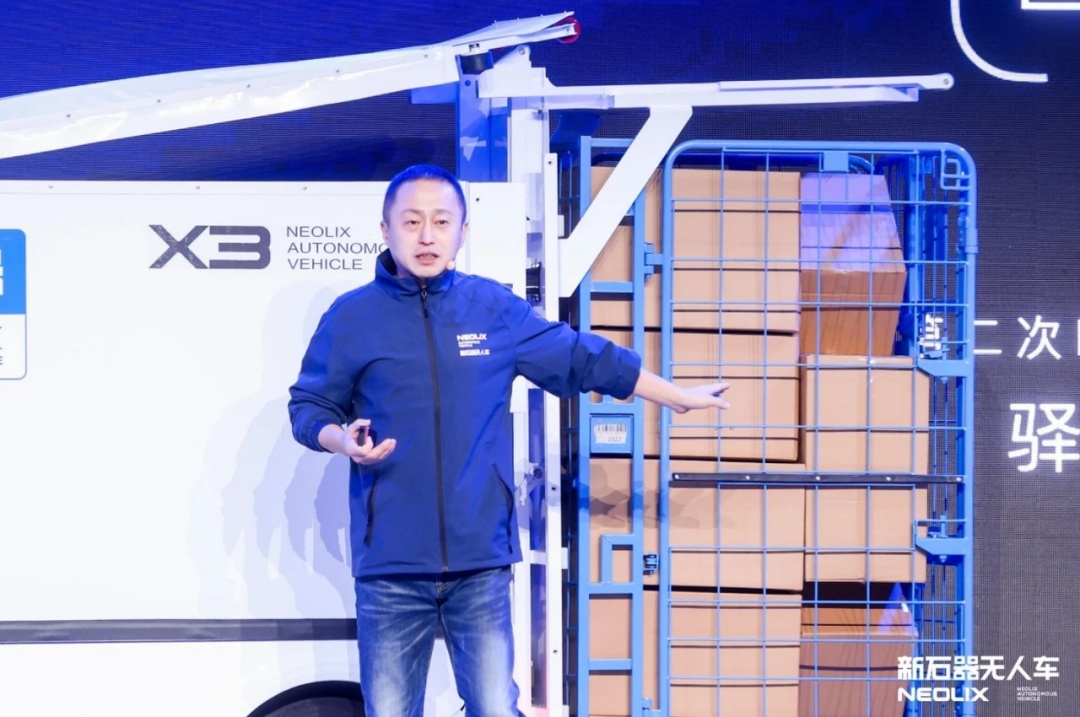
Neolix founder and CEO Yu Enyuan grew up in logistics, developing China's first PDA for couriers and smart lockers. In 2015, he began researching logistics efficiency and founded Neolix in 2018.
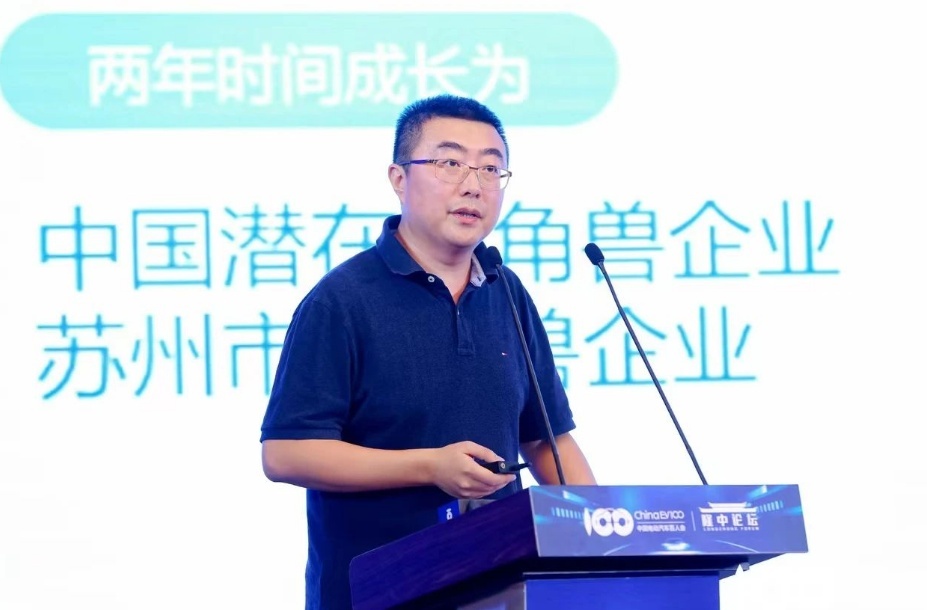
Jushi founder Kong Qi has a stronger technical background but also logistics experience. He led Baidu Apollo's unmanned logistics R&D, joined JD.com in 2018 as JD Logistics' Chief Scientist for Autonomous Driving, and founded Jushi in 2021.
Kong Qi said, "From Baidu to JD.com, it was a shift from theory to practice."
Their logistics expertise led both founders to prioritize cost reduction early, given the industry's razor-thin margins.
Both companies have slashed prices from millions to tens of thousands of yuan, with Jushi's base model priced at 19,800 yuan.
Neolix's operating costs are 70% lower than traditional logistics, with 20% faster delivery times.
Yu Enyuan noted that Neolix reduces delivery costs from 0.15 yuan to 0.06 yuan per item.
A Jushi user reported costs dropping from 0.17 yuan to 0.1 yuan per item. Co-founder Pan Yuchang said monthly operating costs range from 2,000 to 3,000 yuan per vehicle.
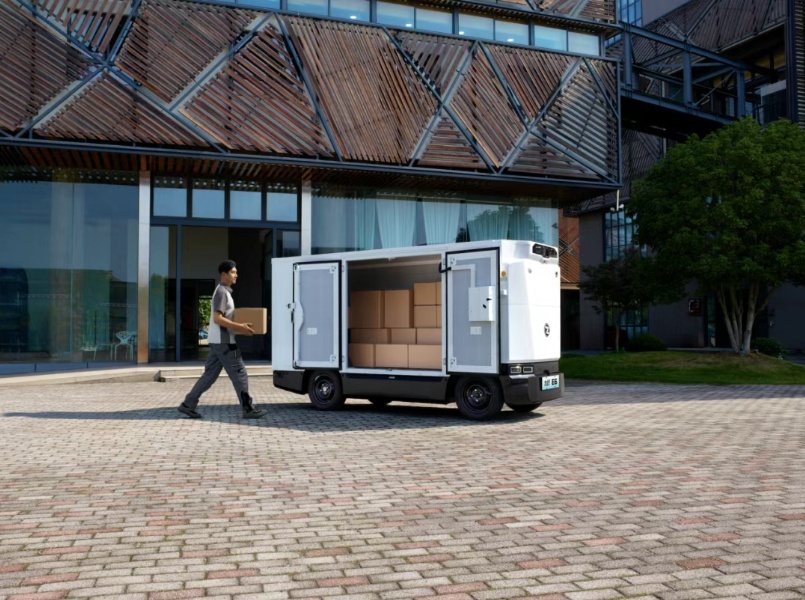
Jushi Unmanned Urban Delivery Vehicle
Mature technology and lower costs are driving demand.
To meet demand, both companies offer diverse product lines, replacing tricycles, vans, and light trucks.
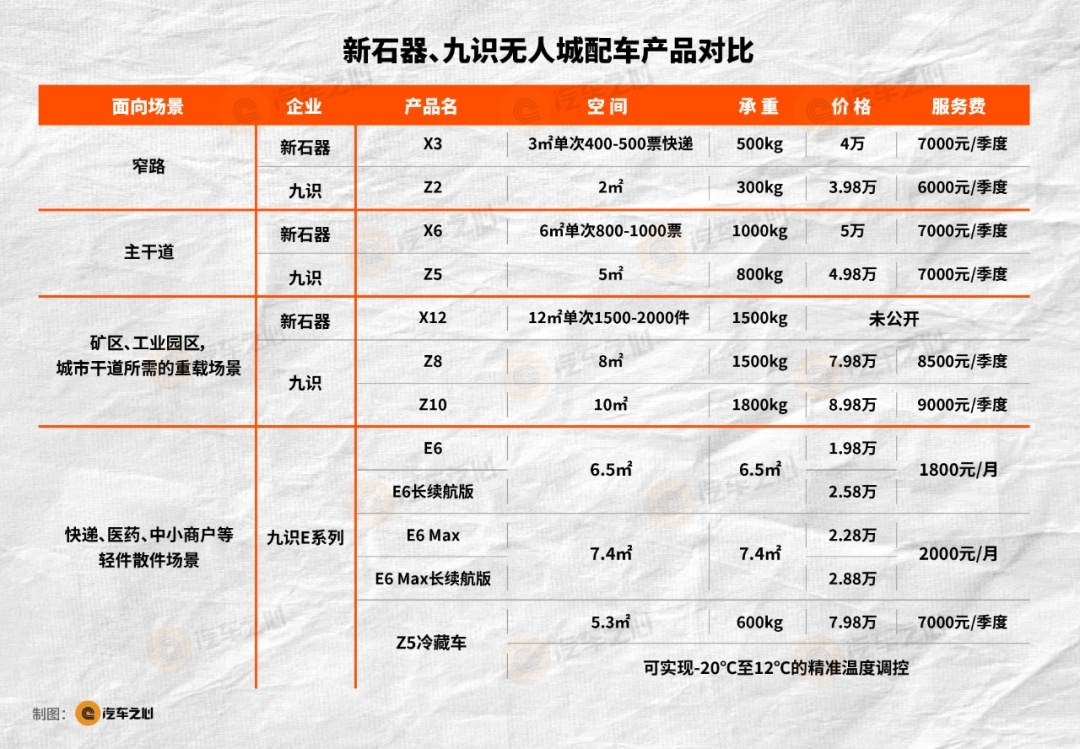
Multiple product lines also adapt to diverse road scenarios, securing road access in over 200 cities.
However, their expansion strategies differ: Neolix focuses on platform partnerships, while Jushi targets SMEs and niche markets.
Neolix collaborates with major couriers like ZTO, YTO, and JD.com, while Jushi prioritizes SMEs to build trust before attracting large clients.
Beyond these factors, significant funding has been critical. Neolix raised 1 billion yuan in February, and Jushi secured $100 million in April, with both exceeding 2 billion yuan in total funding.
02. Scaling Production: A Comprehensive Test
Why is 10,000 units a milestone?
Yu Enyuan compares it to passenger vehicles: 10,000 units represent 0.5% of China's 20 million urban delivery vehicles, marking the transition from 0 to 1.
Scaling brings three structural changes:
- Cost optimization: Economies of scale reduce marginal costs.
- Data-driven algorithms: More deployments enrich perception and behavior data.
- Scenario expansion: Broader technical validation unlocks new use cases.
Achieving 10,000 units tests cost control, manufacturing, delivery, and operations.
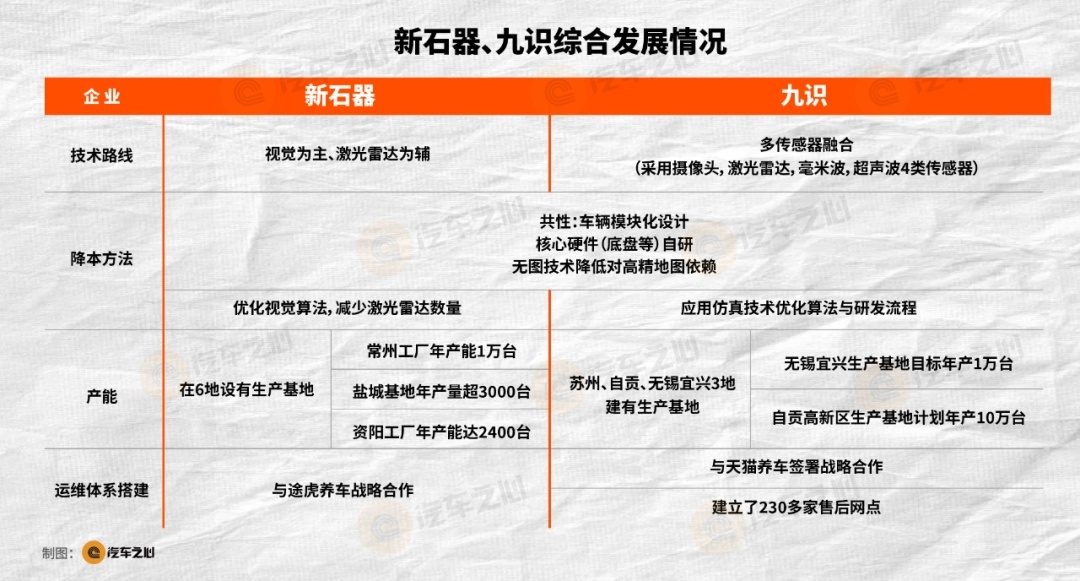
Both companies rely on in-house R&D for cost control.
Neolix uses vision-first, lidar-assisted designs, reducing lidar counts to cut costs. Jushi employs multi-sensor fusion and simulation to accelerate testing.
Neolix operates six factories, with annual capacity exceeding 10,000 units. Jushi's three plants target 10,000+ units annually.
Both partner with suppliers like Hesai for stable component supply.
Post-delivery, after-sales and maintenance determine customer retention. Neolix partners with Tuhu, while Jushi collaborates with Tmall and operates 230 service centers.
As the industry moves beyond cost savings, the race to 10,000 units tests long-term viability.
03. Major Players: Slow to Scale
While startups charge ahead, early adopters like JD.com, Meituan, and Cainiao lag in scaling.
Major players fall into two camps:
- In-house R&D: JD.com, Meituan, Cainiao.
- Partnerships: SF Express, ZTO, STO, YTO.
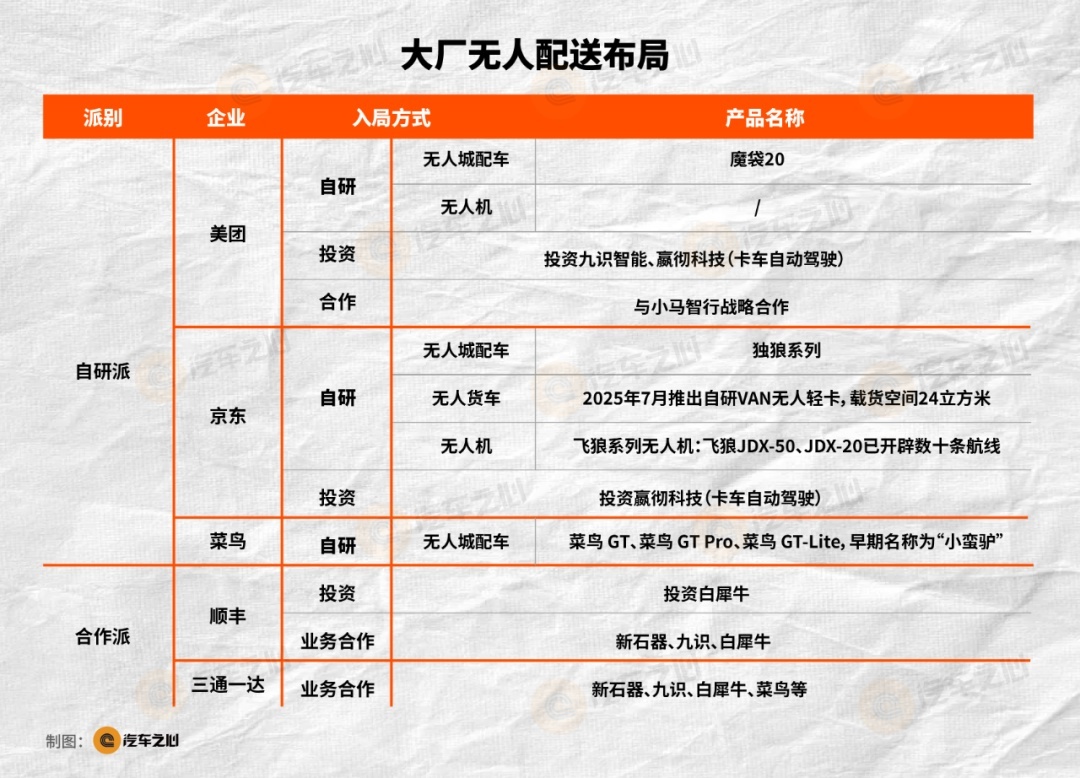
The divide stems from tech DNA: internet-native firms prioritize technology, while logistics firms focus on cost savings.
JD.com last disclosed 700 vehicles in 2022. Meituan reported 500,000 deliveries and 1.3 million km driven by 2024, far behind Neolix and Jushi.
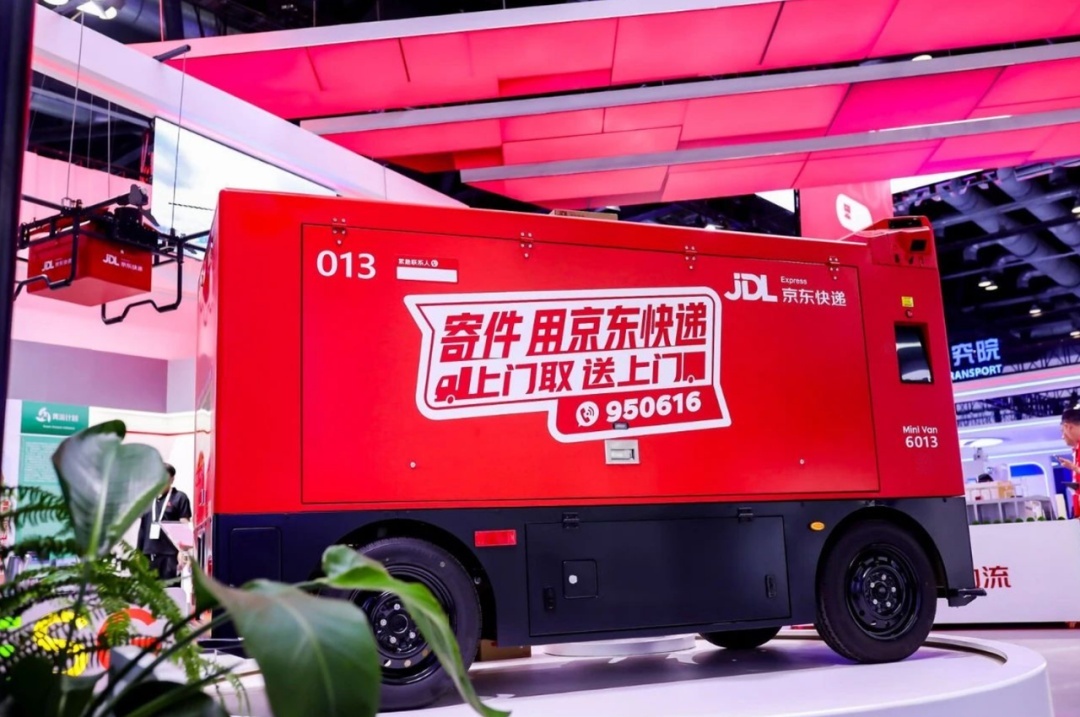
JD Logistics' Wolf 6.0 Delivery Vehicle
Cainiao operates in 200+ cities but has only 4 million deliveries and 500,000 km driven.
Major players treat unmanned delivery as a tool, not a core business, adopting a wait-and-see approach.
Bureaucracy and safety concerns slow Meituan, while JD.com's decentralized 'Big Boss' system prioritizes short-term revenue over innovation.
Leadership changes also disrupted progress. JD.com's X Division weakened after Xiao Jun's 2021 departure, while Cainiao's Chen Junbo left to start a robotics firm.
Startups like Neolix and Jushi thrive on agility and focus, while giants remain cautious. The next milestone? 100,000 annual units, says Jushi's Pan Yuchang.
The industry needs patience, observation, and resilience to outlast the hype.
$JD.com(JD.US) $Meituan(MPNGY.US)
The copyright of this article belongs to the original author/organization.
The views expressed herein are solely those of the author and do not reflect the stance of the platform. The content is intended for investment reference purposes only and shall not be considered as investment advice. Please contact us if you have any questions or suggestions regarding the content services provided by the platform.
