

ANTA, Li Ning, and Xtep collectively hit the 'midlife wall'


Chinese sports brands are collectively losing momentum. Let's look at three sets of data:
1. The penetration rate of sports shoes in China has reached about 50%, which is basically equivalent to that of the United States and Japan. Consequently, the domestic sports footwear market in 2024 is expected to grow by only 5.9% year-on-year to 410 billion yuan, completely bidding farewell to the medium-high double-digit growth of the past decade——>The era of national sports dividends is over.
2. From 2021 to 2023, due to the Xinjiang cotton incident, the market share of domestic brands increased rapidly. Nike and Adidas fell to 16.2% and 8.7% respectively; Anta + Fila + other brands together exceeded 20% and secured the first place, Li Ning at 9.4%, and Xtep at 6.4%, with the overall market share of domestic brands exceeding 50%——>Domestic substitution has entered deep waters.
3. The CR5 of domestic sports brands reached 53%, making China the market with the highest concentration globally. As niche sports rise, leading brands must shift from offense to defense——>The strong are no longer stronger.
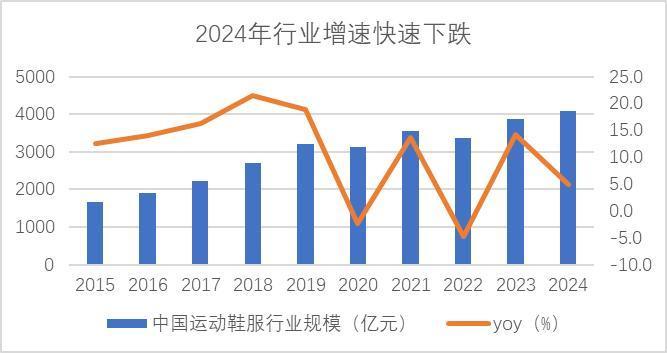
Source: Euromonitor
Three clouds loom over leading Chinese sports brands represented by Anta and Li Ning. How will they overcome the "midlife crisis" test?
01 Midlife Crisis of Leading Sports Brands
As a new consumption that can provide endorphins, facing the "end of the national sports dividend period," "domestic substitution entering deep waters," and "the strong are no longer stronger," the top three domestic sports footwear brands Anta, Li Ning, and Xtep are completely unrelated to this round of new consumption bull market.
Operational data has become the latest verification of the above logic: Anta's brands Anta and FILA have only achieved single-digit growth for six consecutive quarters, with the company's overall growth relying on other outdoor brands; this is not an isolated case, Li Ning recently announced that the entire first half of the year recorded low single-digit growth, and Xtep is also moving from mid-single-digit growth towards low single-digit growth.
In the latest semi-annual communication meeting, Anta was candid about the weakness in the first half of the year: increased industry discount rates, rising return rates, and consumers becoming more price-sensitive; the annual growth guidance for Anta and FILA brands has been reduced to single digits, and the previous goal of Anta's main brand surpassing Nike's market share in three years is being re-evaluated.
2024 is the industry's turning point, and Euromonitor predicts that the growth rate will only maintain at 5.8% over the next five years. In the next cycle, leading brands will not only face industry deceleration but also the impact of declining market share.
From a fatalistic perspective, Anta was founded in 1991 by Ding Shizhong and his brothers, Li Ning brand was established by the gymnastics prince in 1990, and Xtep was founded in 1987 by Ding Shuibo from the same village as Ding Shizhong.
Anta is 33 years old, Li Ning is 35 years old, and Xtep is 38 years old——these national brands that rose with the Olympic dividends have collectively hit the "midlife wall."
02 Discourse Power Cannot Be Bought
1. Manufacturing Heights and Brand Woes
It must be admitted that brand operation is very difficult. Although the textile and apparel production capacity has undergone four global shifts, brands are still mainly in Europe and the United States, with Japan and South Korea having a small market share.
However, as a global manufacturing highland, we have achieved considerable success in brand building in consumer electronics, and the previously criticized automotive industry has also seen a batch of brands rapidly gaining market share globally with the rise of new energy (BYD, Geely, Chery, and XPeng), and three independent strong players in large-displacement motorcycles have entered the European and American markets.
But in the field of sports footwear, our domestic brands have quickly surpassed Nike and Adidas in sales by relying on cost-effectiveness, channel construction, and social events domestically, but in reality, brand power has always been seriously lacking.
The fashion field focuses on fashion trends, with a higher proportion of fashion elements, and overseas, especially European and American brands, always occupy the discourse power of defining beauty, especially the binding of leading designers is understandable. However, in the sports field, functionality and technological elements are the main cards, which is actually our advantage, but domestic brands have not transformed the competitiveness of the manufacturing link into discourse power on the brand side.
This is also the core reason why this industry is so passive in the trade war. At the bottom of the smile curve, if overseas brands only need to pass on part of the tariffs to upstream manufacturing, the OEM link will instantly become unprofitable.
Tariffs reflect the brand woes of domestic sports footwear: why can we clearly make the world's most cost-effective products, but do not have world-class brands?
2. Resorting to Multiple Brand Strategies, but the Dividend Period Will Also End
Early domestic imitation and various fake foreign brands have gradually withdrawn from the historical stage, leaving behind some products with national identity, but these domestic enterprises have also eaten up the first wave of brand operation dividends:
●Anta relies on a combination of domestic sports stars + CCTV + Olympics, but the weakening of the main brand Anta has proven that this step is no longer effective;
●Li Ning's gymnastics, which started the brand, is still a niche sport and can no longer establish a sports mindset, and the slogan "Everything is Possible" is gradually losing its influence. More regrettably, China Li Ning once went viral as a national trendy brand, but due to untimely pricing and distribution, the brand momentum is even weaker than Anta.
●Xtep has established a foothold in marathon running shoes, but the problem is that it has not established a brand image in the minds of mainstream consumers in first- and second-tier cities.
The first approach taken by national brands is to imitate overseas leading brands and impact global mainstream events to operate the main brand.
Consumers are very concerned about what brand top athletes use, although in reality, the performance differences of different products are not significant, and many are even OEMed by the same company. However, global leading sports events, including basketball, football, rugby, golf, and tennis, are basically monopolized by overseas brands like Nike and Adidas.
Domestic brands' several offensives have been difficult to succeed, such as Li Ning, Anta, and Peak's layout for NBA stars, which did not lead to the brand going viral. China is a manufacturing powerhouse but indeed a sports weak country, making it difficult for sports brands to break out through events, and the monopoly of top event resources constitutes the deepest moat for overseas sports brands.
If the main brand cannot be operated, then choose to buy. The second brand choice of operation is to save the country through a curve, by stacking the operation of niche "foreign brands," which has proven to be successful.
Anta, with its first-rate management efficiency, has become the biggest winner. In 2009, the company acquired 85% of FILA China's equity from Belle International for 400 million yuan, and its current valuation has reached tens of billions. Anta has thus summarized a mature approach: deeply explore brand genes, increase volume through celebrity endorsements and other activities, establish image through differentiated stores, and later replicate FILA's success with Descente and Kolon, and in April this year, acquired Germany's Jack Wolfskin for the fourth time to expand its table.
Other brands also follow suit. For example, Xtep contacted the niche running shoe leader Saucony in 2019 and fully acquired Saucony China's operating rights in 2024, later inviting Eddie Peng as an endorser and building large stores in high-line cities, growing into a big brand with 1 billion yuan in revenue that year, which is a comprehensive imitation of the same village Anta's thinking.
Through multi-brand operation, Anta has established itself as the largest local sports footwear leader, with its 70 billion yuan revenue slightly larger than the sum of Li Ning + Xtep + 361 Degrees. But its main brand's 33.5 billion yuan has not opened a gap with Li Ning. Moreover, both the main brand and FILA have begun to fall into low single-digit growth, and the strategic goals set in 2023 need to be fully revised, which is no different from the predicament faced by other domestic brands.
The longer-term problem is that Anta has completed full coverage of low, medium, and high brands, and as the outdoor dividend fades, the growth magic constructed by multi-brands will also fail in the foreseeable future. Overseas brands have proven that different brands' rejection reactions are more common.
At its peak in 2008, Uniqlo was also obsessed with low, medium, and high multi-brands, with the revenue contribution of acquired brands accounting for 16%, and ultimately, the acquired brands continued to be unprofitable; including Adidas, which acquired Reebok for $3.8 billion in 2006, and finally sold this hot potato for $2.5 billion in 2021.
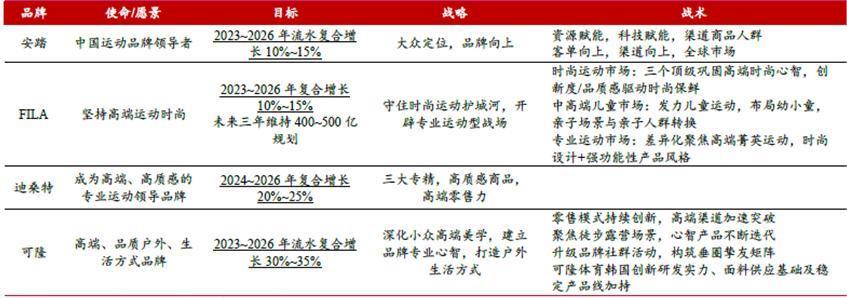
Figure: Anta Brand 2024-2026 Development Strategy Source: Anta Sports Investor Conference, Guolian Securities
3. Not Limited to Learning from the Leading, Niche Brands Are Actually More Worthy of Reference
But brand building and operation are life-and-death issues in the apparel industry. Not everyone knows that Nike, founded in 1964, initially did business in the United States by selling Japanese running shoe brand Onitsuka Tiger, with no shoemaking experience, but through NBA operations, deepened basketball enthusiasts' recognition of its product quality and sports spirit, later expanding to all categories.
Not only Nike, but even including old brands like Adidas, everyone initially was either a tailor shop, a sales company, or retired athletes modifying products, and no overseas brand's origin is nobler than domestic ones. The success of overseas brands is at least half attributed to brand operation capabilities.
On the one hand, domestic leading brands are still imitating Nike and Adidas's brand operation methods, setting up flagship stores in first- and second-tier cities to deepen brand image. For example, Anta launched champion stores and Winter Olympics-themed brand experience stores; Li Ning implemented an efficient large store strategy, and Xtep launched the ninth-generation store, all aiming to strengthen brand image in consumers' minds.
Learning from industry-leading benchmarks is not a big problem in itself, but at the same time, we observe that what should be learned more is other niche brands. The rise of niche verticals has led to a decline in leading brand shares, and a global common trend is that brands established later have a post-advantage due to better understanding of consumers in segmented categories:
●In 1996, rugby star Kevin founded Under Armour, going viral with non-cotton sweat-wicking sportswear;
●Lululemon was founded in 1998, originating from Canada, which is not considered a major apparel brand country, occupying the yoga pants market with product strength and community marketing;
●Crocs, founded in 2002, was created by water sports enthusiasts using special closed-cell resin materials with anti-slip, antibacterial, and deodorizing functions for water shoes;
●Nike is difficult to cope with HOKA (founded in 2009 by two French runners) and ON (founded in 2010 by a professional triathlete and two running enthusiasts) in the running field, which are marked by technological specialization.
In China, the demand for outdoor sports is also booming, becoming a way of expressing social culture. Global leading events are inherently our weak areas, but the rise of niche demands such as marathons, mountaineering, and camping instead gives domestic companies the opportunity to re-establish brand power.
In today's more long-tail sports, being late is not necessarily a disadvantage but rather an advantage, and the rise of self-media further enhances the dissemination efficiency of niche quality products, breaking the monopoly of leading brands, which is also the core reason for Nike and Adidas's weak stock performance in recent years.
However, in this trend, domestic brands choose to embrace the way of acquiring overseas niche brands and then promoting them, rather than actively exploring new trends. But successful cases are also worth our attention, such as Xtep becoming the first domestic brand in marathon runners' minds with its flagship 160X series, and 361 Degrees producing high-value, high-cost-performance clogs that have become popular.
03 "Quality-Price Ratio" Wheels Will Equally Roll Over Every Brand
1. Paying for the Division of Lords, Ultimately Should Fully Tilt Towards Service
In the era of supply shortage, leveraging the dealer network with a light asset model can quickly cover vast low-line markets. Even Nike relies on distributors like Tobe and Baosheng to achieve high coverage comparable to Chinese local brands, and domestic brands rely on dealers for wild expansion.
The inventory crisis that occurred in 2011 has long proven that the sports footwear market has shifted from supply shortage to oversupply. Although many brands were eliminated in this inventory crisis, Anta, Li Ning, and Xtep gradually emerged from the predicament in recent years.
However, the domestic substitution dividend from 2019 to 2023 allowed domestic brands to once again enjoy industry dividends and forget to get closer to consumers. Anta (including FILA), Li Ning, Xtep, and 361 Degrees all have about 10,000 stores, especially the latter, with store efficiency having a very large gap compared to the fully direct-operated overseas Uniqlo.
Moreover, the brand entity or its core executives have a large amount of interests tied to major dealers, resulting in dealers becoming lords, with tails too big to wag. Among the domestic top three, only Anta's Ding has completed the direct operation reform through an iron fist to eliminate relationship households, entering the channel 2.0 era.
Undoubtedly, with the complete end of the shortage and domestic substitution dividends, domestic brands directly face a stock competition market where not advancing means retreating. Moreover, as apparel is the category with the highest online rate, coupled with the rise of new media, the brand's information advantage is no longer sufficient to support a markup rate of more than 4 times, and suppressing the discourse power of operators is imperative.
Not only brand operators, but also in channel construction, they must understand their consumers. The first principle of channels should not be to complete distribution and harvest consumers, nor should it be superficially learning high-end DTC and SPA terms from overseas brands; it should be more efficiently reaching consumers.
2. Reaching Consumers, Benefiting Consumers
Current domestic brands are somewhat obsessed with DTC.
From a chain perspective, DTC is undoubtedly the solution in the post-dealer era. But we understand that DTC is not only about improving channel efficiency, but also about better understanding your consumers.
The DTC ratio of niche brand ON exceeds 70%, and Lululemon exceeds 90%, which is evidence; more extreme is Uniqlo, which insists on 100% direct sales in China, relying on large store efficiency to achieve steady growth, and its advantage is evident in the downturn.
Although direct operation is more asset-heavy and costly, and the space for adjusting listed company reports is greatly reduced, it allows brands to directly connect with end consumers, which is a more correct long-term approach.
Direct operation can create a more efficient omni-channel retail ecosystem, not only overseas niche brands, but also domestic consumer electronics and automotive channel chains are very short, allowing consumers to get good value for money, while white goods still have many brands relying on channels, with online and offline not being a single inventory, and the current channel reform is still the Achilles' heel.
Currently, the domestic sports brand leading the way is still Anta, known for its management, which started channel DTC reform in 2020, with some stores, especially high-end stores, directly operated by the company, and some franchisees operating according to company standards, dividing stores into five levels, with direct operation + e-commerce exceeding 80%.
Another determined one is Xtep, which raised HK$1 billion through placement and convertible bonds in February this year to promote the DTC development of the main brand and Saucony, and we expect the company's future capital expenditure to double.
Domestic sports brands have been simultaneously adjusting stores and channel DTC reforms in recent years, all to make up for historical debts. As for whether domestic sports brands should also open large stores and close small stores in low-line cities, and overall reduce the number of stores, it is worth further discussion. Bosideng is doing this, and it seems to be working well.
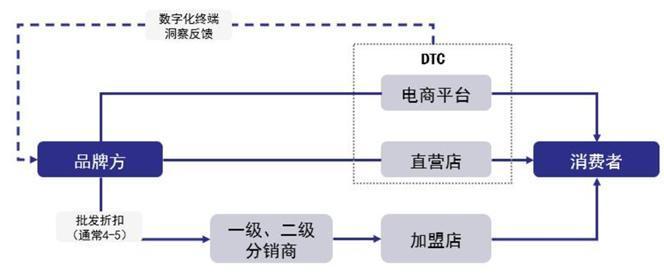
Figure: Apparel Industry DTC Channel Model Source: Guoxin Securities
In addition to better understanding consumers, improving channel efficiency, we believe the second meaning is to reduce markup rates, rather than blindly increasing tag prices and acquiring higher-end brands to achieve ASP growth.
Due to the apparel industry's markup rate second only to cosmetics, most people cannot resist the temptation of paying an intelligence tax. Overseas brand merchants (such as Nike, ON) are best at storytelling, and domestic brand merchants basically imitate this path, but in the difficult period of recent years, the "price increase logic" seems to be contrary.
Domestic brands' gross profit margins remain at a high level, even steadily rising, but the accompanying decline in turnover rate means that price wars are only a matter of time.
Uniqlo's counter-success experience is more enlightening, relying on the core strategy of "quality-price ratio." Uniqlo achieves a markup rate of less than 3 times domestically through efficient channels, still beating domestic companies and overseas competitors. By efficiently transferring profits to consumers, rather than making price highs and lows a label of brand high-end or not.
In the foreseeable future, consumers' demand for quality-price ratio will equally roll over every brand.
As the national trend and acquisition dividends fade, sports brands in increasingly difficult business environments can only bid farewell to grand narratives and return to the most simple essence of business: the consumer is king. Re-examining brand positioning and channel layout, perhaps Uniqlo's history is more worth revisiting.
This article is based on public information and is for information exchange only, not constituting any investment advice.
$ANTA SPORTS(02020.HK) $LI NING(02331.HK)
The copyright of this article belongs to the original author/organization.
The views expressed herein are solely those of the author and do not reflect the stance of the platform. The content is intended for investment reference purposes only and shall not be considered as investment advice. Please contact us if you have any questions or suggestions regarding the content services provided by the platform.
