

Public funds are trying to make a comeback with WeChat.

Disintermediation has always been the vision of the public offering industry, and fund companies have been trying to reduce their reliance on banks, third-party sales platforms, and other channels through direct sales models, thereby reducing sales costs, enhancing customer stickiness, and mastering user data.
But the reality is that while disintermediation is progressing slowly, the direct sales APP, which fund companies have high hopes for, has become a drag.
In recent years, the trend is that many small funds have gradually taken down or stopped maintaining their own direct sales APPs, while choosing to transfer direct sales business to WeChat. Small fund companies are already somewhat overwhelmed, and it is not wise to operate an APP that is costly and yields negligible output.
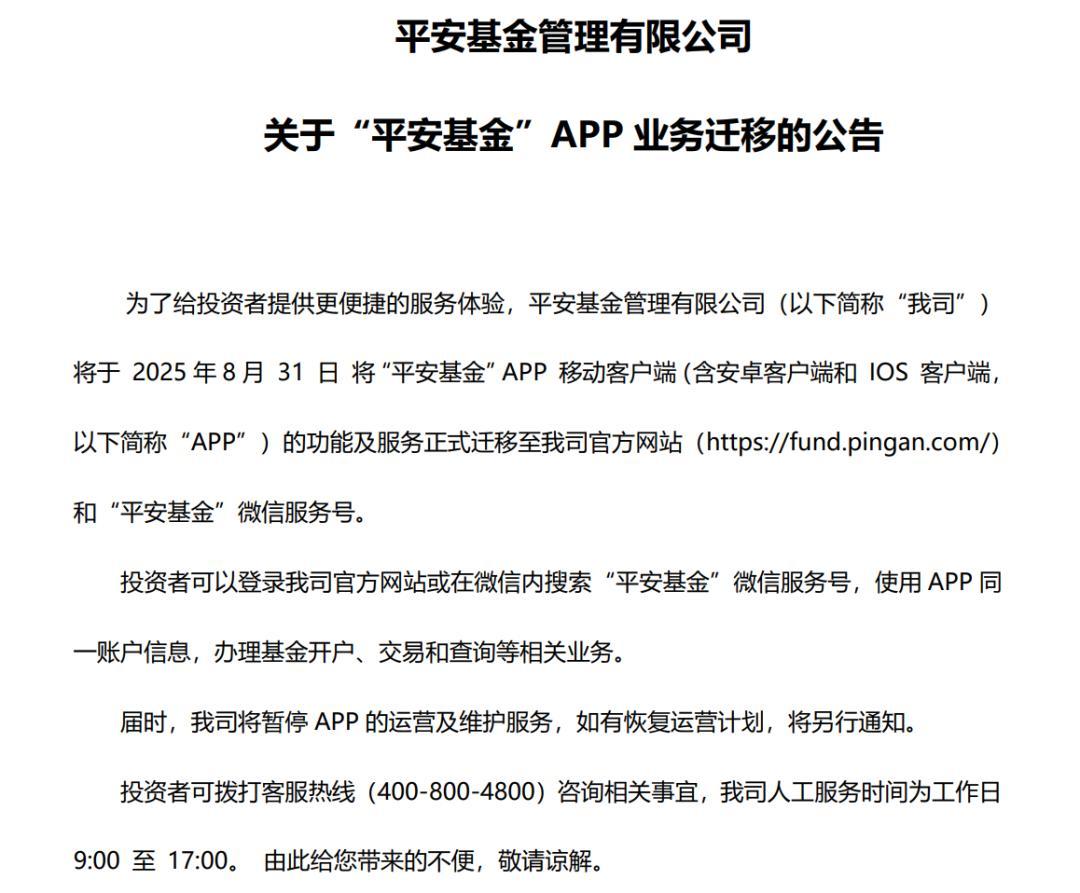
Recently, the wave of shutdowns has spread from small and medium-sized funds to fund companies with over 600 billion in scale. At the end of last month, Ping An Fund, with a management scale of over 640 billion yuan, announced that it would suspend the operation of its own APP. This means that more fund companies of the same scale or larger are reviewing and evaluating their APP operations.
Market opinions suggest that more public fund companies will choose to shut down direct sales APPs in the future. After migrating business from APPs to WeChat, fund companies can rely on WeChat's own users, reach a large number of potential users, and greatly reduce the threshold for acquiring customers without relying on users to actively download APPs.
In fact, even some leading fund companies that have not yet abandoned the APP channel have already launched WeChat mini-programs. It can be said that WeChat carries the dual functions of upgrading fund companies' direct sales channels and user operations. After deepening the WeChat ecosystem, fund companies also have certain opportunities to regain some channel discourse power from distribution agencies.
01 Public Fund Transition to WeChat
Recently, Ping An Fund announced that it would suspend the operation and maintenance services of its APP at the end of August. If there is a plan to resume operations, it will be notified separately, and the functions and services on the APP will be migrated to the official website and the "Ping An Fund" WeChat public account.
Ping An Fund's suspension of APP operation is not an isolated case. Since the beginning of this year, many public funds such as Guoshou Anbao Fund, Qianhai Kaiyuan Fund, and Morgan Stanley Fund have successively shut down. Looking at the long term, 20 fund and asset management institutions, including Caitong Fund, Everbright Prudential Fund, Changxin Fund, Zhonghai Fund, Debang Fund, and Hongta Hongtu Fund, have successively suspended/closed APPs.
In February last year, the Securities Times pointed out that according to Daole Technology statistics, among the fund companies in operation, only about 50 APPs (excluding fund wealth subsidiary APPs and other asset management institutions with public offering licenses) are in operation, accounting for about 40%.
Obviously, the shutdown of public fund APPs is not new, but the factor that has attracted industry attention this time is that Ping An Fund, as a medium-sized fund company with a management scale of over 640 billion yuan and a non-money management scale of over 2300 billion yuan, has a certain wind direction effect.
This also means that more medium-sized and even large fund companies may abandon their own APP territories in the future.
After announcing relevant information, these fund companies have unanimously migrated their business to their own official websites/WeChat public accounts/WeChat mini-programs. At present, there may not be many fund investors buying products through the official website PC end, and WeChat public accounts/mini-programs may become the main battlefield for fund companies' direct sales.
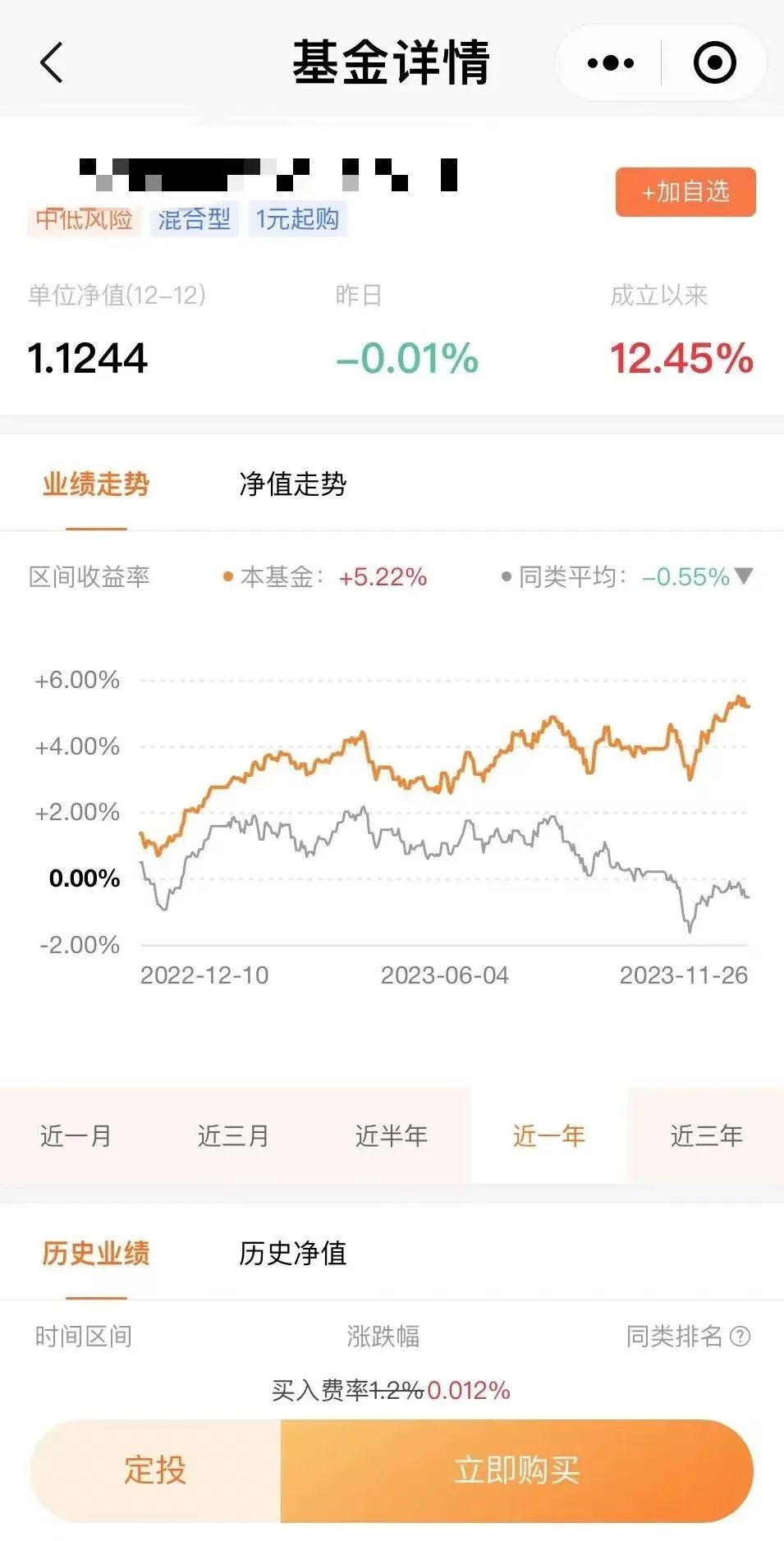
Shutting down APPs and migrating business to the WeChat platform is a re-recognition of the traffic logic by public funds and a strategic shift in the industry from self-built platforms and self-operated traffic to embedding in the WeChat ecosystem and leveraging platform traffic for direct sales. It can also be seen as a typical evolution of channel lightweighting by public funds.
Behind the choice of "parasitizing" the WeChat ecosystem in direct sales channels, on the one hand, fund companies, even if they work hard to operate their own APPs, have little effect in terms of customer acquisition numbers. Looking at the entire industry, in the first half of 2025, only the APPs of five fund companies, including E Fund, Huaxia, Harvest, Jianxin, and China Merchants, achieved positive growth in monthly active users.
Most APPs are caught in the dilemma of user loss. According to Yiguan data, even the Tianhong Fund APP, which relies on Alipay, had only 40,800 monthly active users as of June this year. At the end of 2022, this number was 122,500.
On the other hand, while customer acquisition is difficult, the pressure of operation is high. A public fund person previously stated that operating a direct sales APP requires fund companies to invest at least millions or even tens of millions of yuan in costs each year, including platform development, operation and maintenance, iterative updates, and other aspects.
For small fund companies with a scale of less than 100 billion yuan, operating an APP becomes a luxury under the premise of being stretched.
In fact, even for fund companies with a scale of over 100 billion yuan, operating their own APP is increasingly becoming a "loss-making business."
Looking at the fund companies that have shut down/suspended APPs, those with a management scale of over 100 billion yuan include Qianhai Kaiyuan Fund, Ping An Fund, and Guoshou Anbao Fund. These fund companies generally have the characteristics of debt funds and money funds supporting half of their scale. The fee rates of these two products are lower than other products. The typical feature reflected at the income level is "thin profit and high sales," and growth potential is limited by product types.
Therefore, in the context of no harvest, direct sales APPs have fallen from "strategic strongholds" to "cost black holes."
02 Threefold Logic of Path Migration
As the main battlefield of direct sales, the shutdown of APPs is not only due to the imbalance of input-output ratio but also due to the squeeze from distribution channels.
From the perspective of distribution channels, they are mainly divided into banks, securities firms, and third-party independent platforms, with third parties including Ant Fund, Tiantian Fund, and other institutions. Direct sales include WeChat public accounts/mini-programs, official websites, and APPs.
Due to the high profit margin of direct sales, it has always been a long point for fund companies to exert their efforts. Therefore, the scale of direct sales has always been at a high level, but later the distribution channels contributed most of the sales revenue by leveraging traffic advantages.
Distribution platforms gather products from multiple fund companies, and investors can purchase products from different fund companies in one stop without switching multiple platforms, meeting diversified investment needs. Obviously, the shelf attributes of distribution platforms are indeed more in line with habits, especially for novice users. In comparison, direct sales APPs with single-brand shelf characteristics seem to have no competitiveness.
The article "Five New Trends in the Development of China's Public Fund Industry in 2023" pointed out that the proportion of fund companies' direct sales scale has declined for five consecutive years, from 84% in 2016 to 26.42% in 2021.
After that, the share of direct sales was further eroded by distribution. According to the China Foundation Association's release of the public fund sales retention scale of fund sales institutions in the second half of 2024, as of the end of the fourth quarter of 2024, among the top 100 fund distribution institutions, there are 23 banks, 56 securities firms, 16 third-party distribution institutions, 3 fund sales subsidiaries, and 2 insurance companies. Among them, the non-money fund retention scale of bank channels is 4.22 trillion yuan, the third-party distribution platform is 3.24 trillion yuan, and securities firms are 1.91 trillion yuan. Xu Kang, chief analyst of non-bank at Huachuang Securities, pointed out that the domestic public fund sales model is driven by distribution institutions, with distribution scale accounting for 70%-80%, occupying a dominant position.
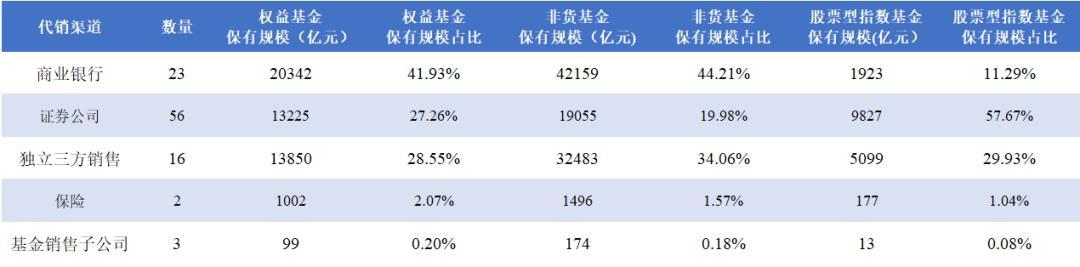
It can be said that the current distribution institutions are not just "selling funds," but are platforms that simultaneously have customer source entrances, data assets, and user mindsets. Fund companies' direct sales APPs, especially small fund companies, are squeezed to only have the functions of "brand display" and "compliance filing," and the real sales closed loop is no longer in their hands.
Therefore, choosing to move the business on direct sales APPs to WeChat/WeChat programs is not a simple "move," but a choice under the triple pressure of high costs, channel squeeze, and user habit migration.
From the regulatory level, in May this year, the China Securities Regulatory Commission issued a high-quality development plan for public funds, encouraging the industry to reduce operating costs, prompting fund companies to optimize resource allocation and reduce inefficient investment.
It is worth mentioning that although direct sales APPs are gradually becoming abandoned, the direct sales channel is still regarded as an indispensable track by the industry. Securities China previously interviewed industry insiders who pointed out that for fund companies, direct sales can grasp core customer groups and save commission fees shared with distribution institutions.
Therefore, fund companies may use lower costs, lower rates, and higher stickiness to "dig" customers back from large distribution platforms to their own bowls. From industry cases, at the end of last year, Huaxia Fund's mini-program Red Rocket was launched, and from the number of users, as of the end of June this year, it has exceeded 10 million.
03 Final Route Map of Channel Division
In fact, besides Huaxia Fund, many index factories have successively launched WeChat mini-programs.
For example, China Europe Fund's "Fund Investment Assistant," Fortune Fund's "E Together Fortune," Harvest Fund's "Super Jia Bei," Guotai Fund's "Guotai ETF Toolbox," Bosera Fund's "ETF Zhi Hui Jia," and GF Fund's "Index Investment Thermometer," and for example, Huabao Fund, which has both "Huabao Good Base Exchange" focusing on active equity and "ETF All Know" laying out ETFs.
It is worth mentioning that among the current mini-programs, Huaxia Fund's Red Rocket attempts to break the situation of product islands by introducing ETFs from the entire market, while China Europe Fund's mini-program features the sale of funds from the entire market.
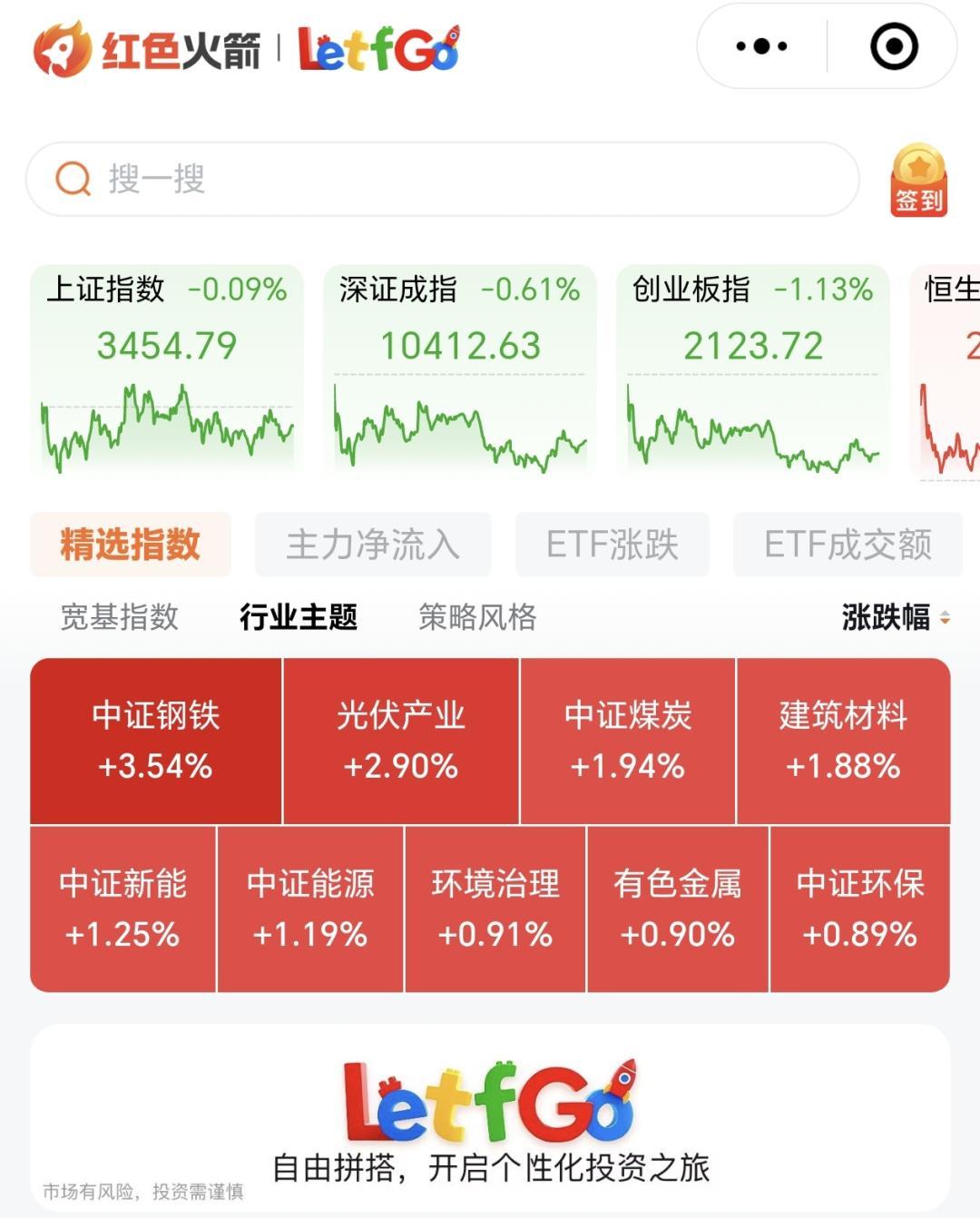
However, at present, not all mini-programs can directly trade, only Qianhai Kaiyuan Fund, Chuangjin Hexin Fund, and Pengyang Fund are allowed to open trading functions and can directly purchase funds. Some fund companies' mini-programs need to jump to WeChat Wealth Management to purchase funds.
From the regulatory requirements in 2017 to suspend the trading, redemption, and regular investment functions of funds in mini-programs to the current pilot opening, it means that the attitude of regulatory authorities has significantly relaxed, and the possibility of gradually expanding the pilot scope from point to surface and finally achieving full opening is relatively high.
Quoting the content of the interview with industry insiders by Caijing Lian, "Although Wealth Management tends to be more inclined to fixed-income products in strategy, the advantages of customer groups, scene advantages, and attributes such as community combination brought by the WeChat ecosystem have never dispelled the marketing of fund companies in the WeChat ecosystem."
For some large public fund companies, while focusing on the WeChat ecosystem, they also show a completely different attitude towards direct sales APPs compared to small and medium-sized public funds, choosing to increase investment in direct sales APPs.
For example, Southern Fund, Wanjia Fund, Yinhu Fund, and Bosera Fund have all upgraded their direct sales APPs, gradually shifting their functional attributes to investment advisory.
Tianxiang Investment Advisory previously pointed out that from the current industry development, serving investors and enhancing investors' sense of gain has gradually become the business goal of fund sales channels.
Heavy investment also has obvious effects. E Fund e Wallet's active users in June increased by 30.35% month-on-month, Huaxia Fund Manager's active users in June increased by 76% month-on-month, and the active users of Huatai Cash Treasure, Harvest Financial Jia, and Southern Fund APP in June all showed positive growth month-on-month.
In other words, the industry is transitioning from seller sales to buyer investment advisory, and for some fund companies that still value APPs, APPs are no longer just transaction entrances but "main battlefields" that accompany customers. The investment in direct sales APPs will eventually form a "three-stage cycle"—turning traffic into retention, then turning retention into productivity, and finally feeding back into direct sales itself.
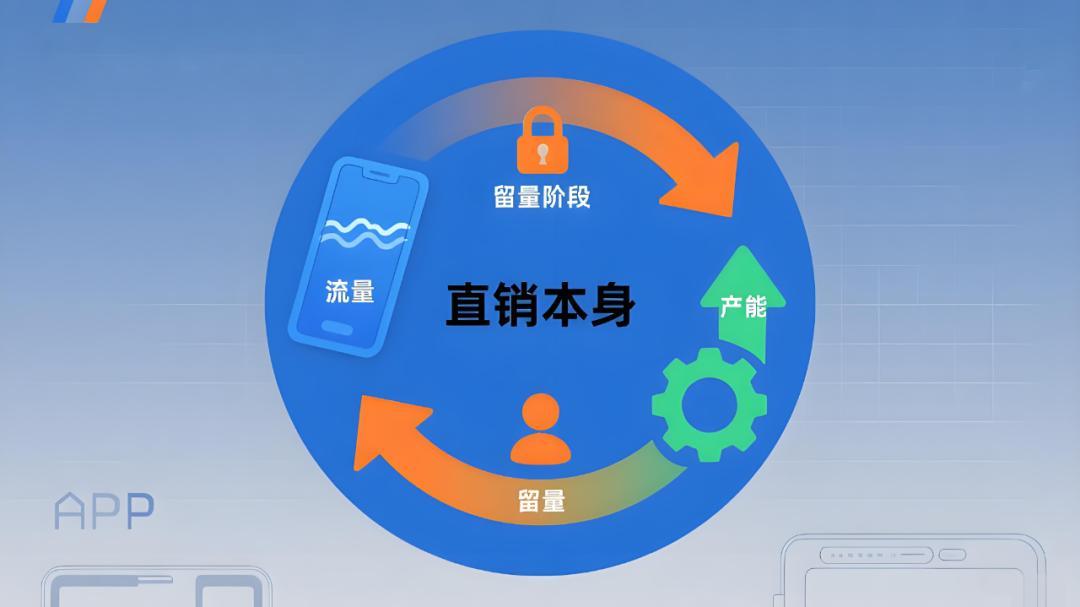
Obviously, APPs will not completely disappear. While some large fund companies increase investment in APP operations, they also pay attention to operations on WeChat; medium-sized main battlefields may combine public accounts and enterprise WeChat for private domains.
It is foreseeable that whoever first runs through the "WeChat direct sales/investment advisory" will be able to sediment high-stickiness customers in their service accounts/mini-programs, forming a "private domain direct sales pool" and gaining more discourse power in the channel battle.
However, public funds still face some challenges in running through the direct sales model on WeChat. Caijing Lian pointed out that on the one hand, there is no timetable for the regulatory opening of public mini-program direct sales, and fund companies in sandbox testing have not yet explored better paths; on the other hand, there are still significant disputes between WeChat internally and fund companies regarding the admission boundaries and charging models of mini-program entities.
Reference Materials:
Securities Times Network, "More Fund Direct Sales APPs May Go Offline in the Future"
21st Century Business Herald, "Multiple Thousand Billion Public Funds Shut Down APPs"
Beijing News, "More than 20 Funds Have Stopped APPs in 5 Years, Public Direct Sales 'Cut Off' App Plot"
Caijing Lian, "Public Mini-Program Era Coming? Sales Function Reopened, Selling Funds Still Has Three Major Pain Points"
Sina Fund, "Small and Medium-sized Public APPs Accelerate Exit: Tianhong, Penghua, Bosera Fall into Shutdown Countdown, Inefficient Clearing Becomes Industry Consensus"
The copyright of this article belongs to the original author/organization.
The views expressed herein are solely those of the author and do not reflect the stance of the platform. The content is intended for investment reference purposes only and shall not be considered as investment advice. Please contact us if you have any questions or suggestions regarding the content services provided by the platform.
