

Didi Food Delivery's 'Three Arrows' Shot at 'Our Own People'


The "involution" skills of Chinese tech giants are becoming increasingly international.
While the domestic "food delivery war" shows signs of cooling down, little known is the fierce battle between Didi and Meituan in the Brazilian market, 18,000 kilometers away.
Brazil is the largest economy in Latin America, with a population of over 210 million and a food delivery market size of 12 billion USD, growing at an annual rate of about 20%, making it the fifth largest food delivery market in the world. This market has long been monopolized by the local platform "iFood," which occupies about 80% of the market share.
On May 12 this year, Meituan's overseas food delivery brand "Keeta" announced its entry into Brazil. Less than a month later, on June 9, Didi announced the relaunch of its Brazilian food delivery business "99Food."
What was supposed to be a battle between two Chinese dragons and the Brazilian local giant turned into an involution struggle right from the start.
"To secure the outside, one must first stabilize the inside," even after 100 years, this metaphor still holds significant value.
01 Didi Food Delivery's "Three Arrows"
From public media information in Brazil and domestically, it is known that within just two months of business relaunch, Didi has launched three arrows in the Brazilian food delivery market, directly targeting its old rival Meituan.
1. Signing restrictive agreements with merchants
According to media reports, in late June this year, Brazilian local self-media first revealed that Didi's 99Food had contacted some well-known local chain merchants, offering cash incentives (advance payments) worth millions to individual merchants, and signing restrictive contracts against Meituan Keeta. Some contract contents show that merchants are prohibited from cooperating with Meituan Keeta but can continue to cooperate with Brazil's own iFood delivery platform.
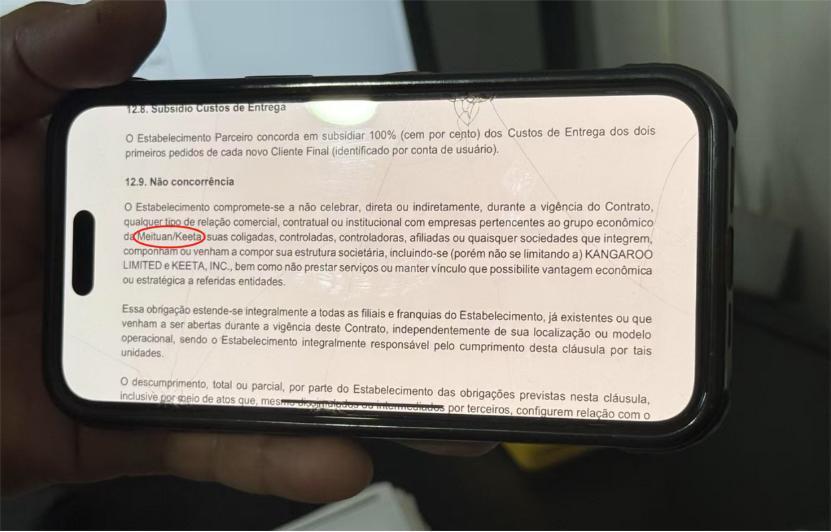
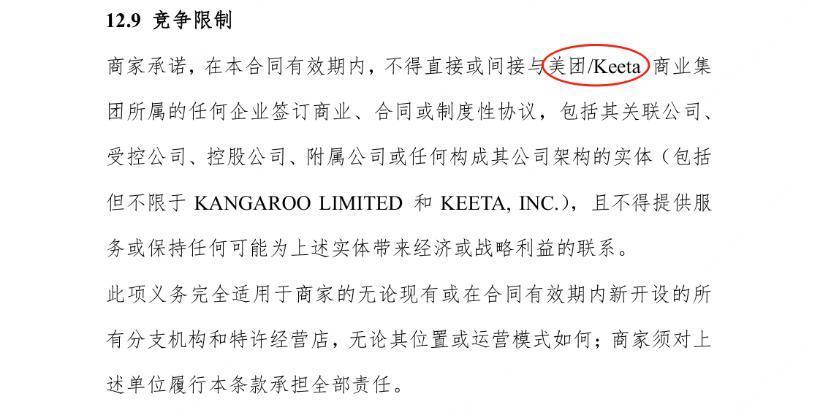
Image: Part of the restrictive agreement signed by 99Food with some merchants (with translation); Source: Aurora News
In early July, Brazilian media "O Globo" followed up with reports, confirming the behavior and revealing more details.
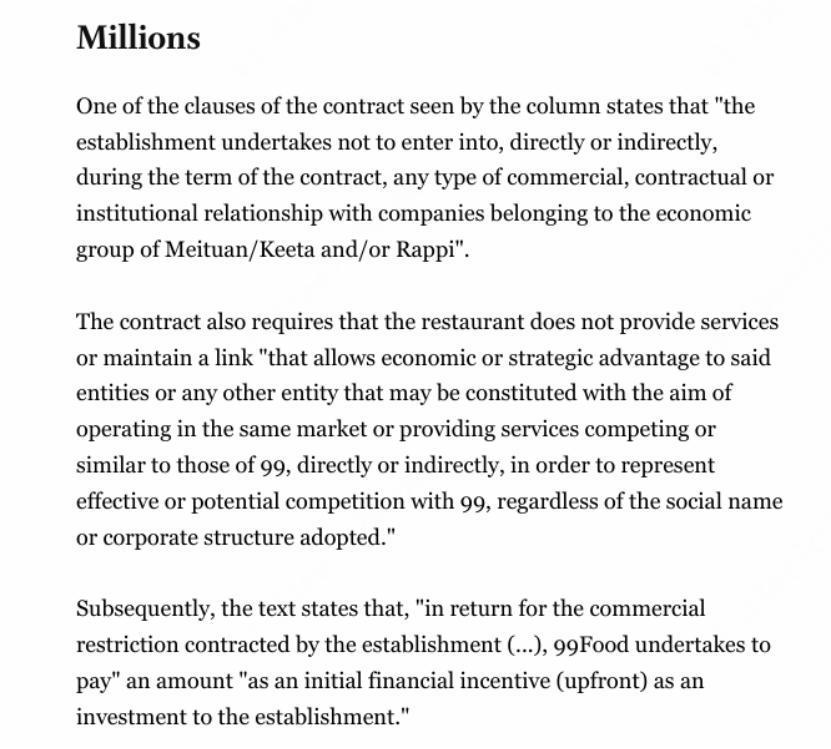
Image: Related report from "Globo"; Source: "Globo" official website
Subsequently, in response to media inquiries, Didi 99Food admitted to signing similar restrictive clauses with some merchants, stating that this move is a strategic behavior aimed at core merchants.
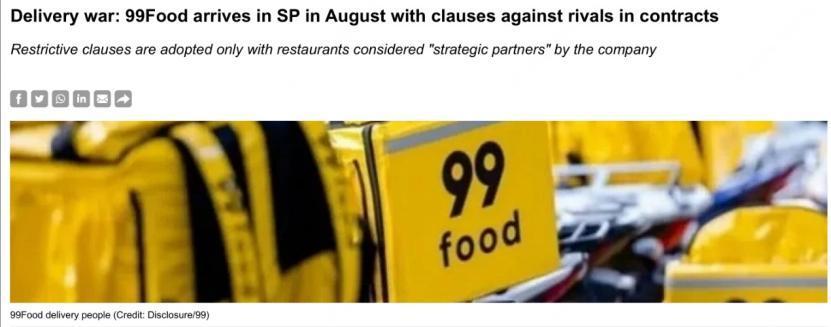

Image: News report on Didi 99Food's response. Source: IstoeDinheiro official website
For those slightly familiar with the history of the Brazilian food delivery market, Didi 99Food's "strategic behavior" is indeed intriguing—actually, it itself has suffered from restrictive clauses in the Brazilian market.
As a Chinese food delivery brand established in 2019 and rooted in the Brazilian market, 99Food was challenged by Brazil's local food delivery giant iFood with restrictive clauses in 2021, requiring merchants to choose sides.
Ultimately, Didi 99Food, with a market share of about 5%, chose to suspend the business in 2023 under the monopolistic unfair competition pressure from iFood, which holds an 80% market share. Subsequently, prompted by this event, Brazil's national antitrust organization CADE introduced new regulations to restrict iFood's unfair behavior.
It is said that Meituan Keeta has filed a lawsuit against Didi 99Food for this behavior, and the local court has already filed the case. According to reports from the São Paulo Page, 99Food has contacted over 100 leading restaurant chains locally, offering a total of 900 million reais (about 1.2 billion RMB) in cash advance incentives to sign restrictive clauses against Meituan but not iFood.
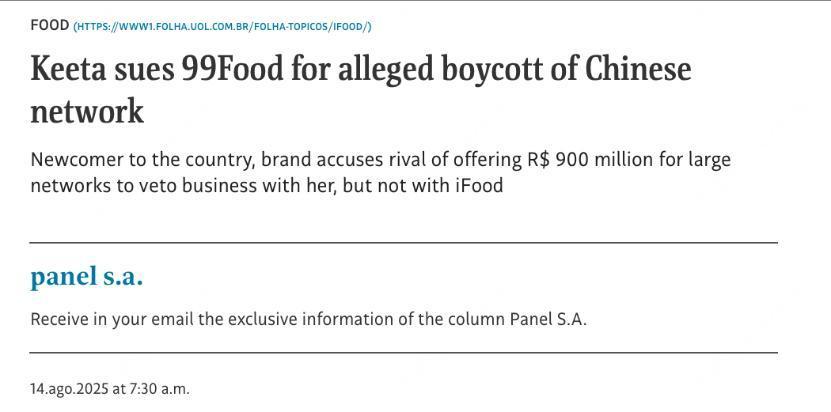
Image: Report from "São Paulo Page"
2. Bidding for the keyword "Keeta" in search engines
"Troops move before provisions," has always been a military strategy iron rule. In the mobile internet era, search engines, as core traffic entrances, play the important role of ancient "provision routes."
Therefore, in the past 20-plus years of internet campaigns, bidding for well-known brand names and commercial logos as search engine keywords has been a tried-and-true "tactical shortcut."
In the domestic market, from the early "Dazhong Moving Factory" to the recent "Pop Mart," similar typical cases have emerged one after another. According to judicial precedents, such behavior is usually judged as unfair competition by hijacking competitors' traffic.
This controversial tactic has also appeared in the overseas public opinion.
According to media reports, previously, Didi's 99Food bid for the "Keeta" keyword on Google, causing users to see 99Food's ads first when searching for "Keeta." Meituan Keeta then filed a lawsuit against 99Food for this behavior in the local Brazilian court.
On August 11 local time, the São Paulo court issued an injunction, ordering 99Food to stop the involved behavior within three days, with a daily fine of 20,000 reais (26,000 RMB) for overdue.
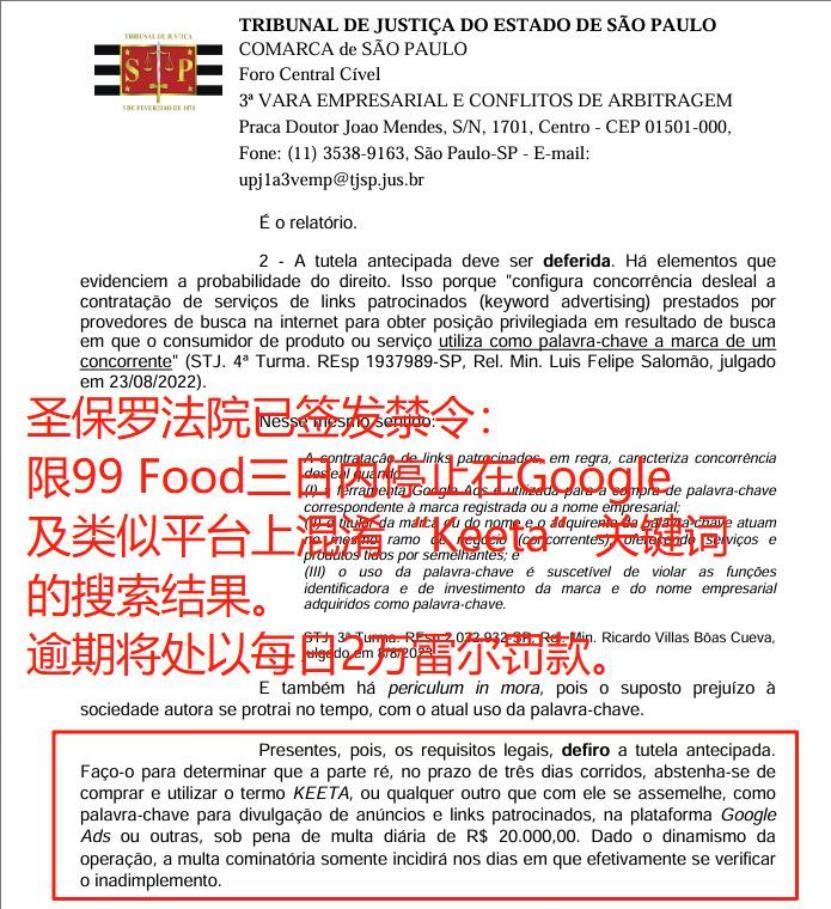
Image: Content of the injunction. Source: Aurora News
3. Suing Keeta for trademark infringement
The third arrow Didi 99Food shot at Meituan Keeta is a trademark infringement lawsuit.
According to media reports, the lawsuit documents show that 99Food accuses Keeta of deliberately imitating 99Food in color, graphics, and fonts, causing consumer confusion, and requests the court to order Keeta to immediately change its logo.
Interestingly, what is known to the Chinese public is that Didi's primary color is "orange," and Meituan's primary color is "yellow." However, in the Brazilian market, the main color tone of both food delivery brands is "yellow."
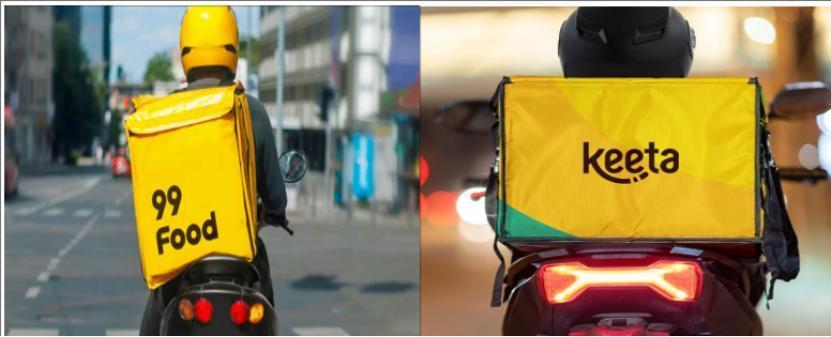
Image: Didi 99Food brand logo VS Meituan Keeta brand logo. Source: Internet
According to Brazilian local media reports, 99Food stated in the lawsuit that through a rearview mirror, "Keeta's 'ee' is '99,'" thus constituting similar confusion with its 99Food logo, suspected of trademark infringement.
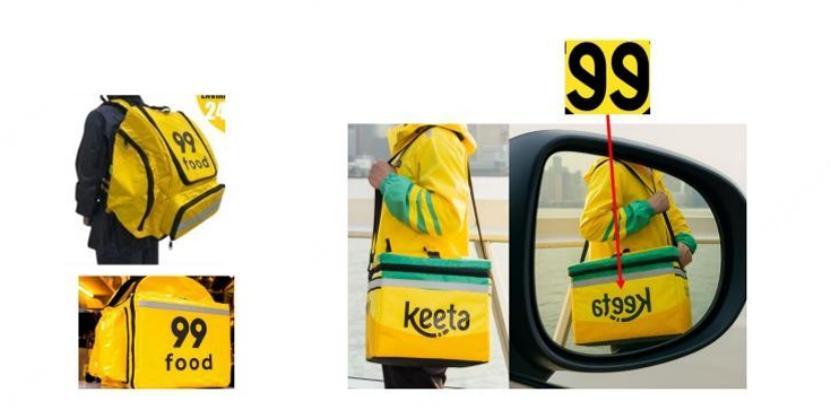
According to local media reports, Keeta responded to the legal dispute, stating that its logo and color scheme have been associated with the Meituan brand for over 14 years and with the Keeta brand itself for three years. In fact, Meituan's international brand Keeta was launched in Hong Kong in May 2023, followed by its landing in the Saudi Arabian market, with the brand color scheme continuing Meituan's yellow.
Whether "ee" is "99," this amusing trademark dispute ultimately needs to be decided by the court.
02 Obvious Insights
Since entering 2025, from the real industry to the capital market, the most important keyword is "anti-involution." Whether in the photovoltaic industry or the lithium battery industry, they all provide profound footnotes to this era's will: "Involution" ultimately leaves no survivors.
This can be seen from the "waterfall kill" style K-line chart of the market value of related industry listed companies.
Indeed, business competition is always cruel, like drinking water, knowing the warmth and coldness oneself. We should not speculate on the motives behind every business strategy of tech giants. But regarding its rationality and economy, there are many obvious insights worth alerting:
1. Strategic Fog: Involution is useless, alliance breaks the situation
As mentioned earlier, the Brazilian food delivery market has long been dominated by the local giant iFood, with a market share of over 80%. The Chinese 99Food and Keeta, wanting to share a piece of the pie, will inevitably face iFood head-on, sooner or later.
However, spending huge sums to sign restrictive contracts with core merchants, restricting their cooperation with Meituan, not only deviates from business logic but also seems like "the clam and the snipe fight, the fisherman benefits," puzzling and making outsiders laugh.
As "Strategies of the Warring States: Qi Strategy" states, "Divided, the force is weak; united, the power is strong." Having already experienced iFood's "bullying," 99Food should be more familiar with this taste. From 2019 to 2023, 99Food's highest market share in the Brazilian food delivery market was only 5%. Now trying to use "money diplomacy" to gain market advantage, restricting potential ally Meituan, not only weakens the joint force against iFood but also places itself in a predicament of fighting alone after one move.
For enterprises going abroad, strategic choices are particularly crucial. Restrictive contracts seem to temporarily curb latecomers, but in the long run, they neither help challenge iFood nor benefit their own market expansion. On the contrary, if they can form an "alliance" with Meituan to jointly fight iFood, they can disperse its firepower and break the "long-suffered" market monopoly in a foreign country.
Thus, the collaborative combat between the two new entrants is the best strategy to break iFood's barriers.
2. Externalization of Involution: Enterprises going abroad, self-binding dilemma
Chinese enterprises going abroad originally intended to explore incremental space in the international market, but unfortunately fell into the "externalization of involution" trap. This "shooting arrows at one's own people" competition logic not only weakens the enterprise's own profitability but also damages the overall image of Chinese brands in the international market.
The competition in the Brazilian food delivery market reflects this dilemma.
If Didi and Meituan continue to consume internally, iFood will inevitably reap the benefits. The result of internal fighting can only be "mutual destruction," making iFood's dominant position more stable.
"The Book of Songs: Minor Odes: Tang Di" says, "Brothers quarrel within the wall, but unite against external insults." Whether Didi or Meituan, they urgently need to have a deep sense of this ancient lesson and stop the low-level disputes in the foreign battlefield as soon as possible.
This is just as Michael Porter said in "Competitive Strategy": "Successful competitors do not defeat all opponents, but find differentiated positioning." If Didi and Meituan can each showcase their strengths, segment the market, and compete with differentiation, they can stand firm in the Brazilian market for the long term.
Above all, "involution" has no winners. This survival path cannot be ignored.
This article is based on public information and is for information exchange only, not constituting any investment advice.
The copyright of this article belongs to the original author/organization.
The views expressed herein are solely those of the author and do not reflect the stance of the platform. The content is intended for investment reference purposes only and shall not be considered as investment advice. Please contact us if you have any questions or suggestions regarding the content services provided by the platform.
