

Daily New Option Class Lesson 2: Put Options

The last lesson covered call options, and this lesson will discuss put options (Put).
First, the definition: a put option is the right to sell the underlying asset at a strike price.
Let's start with an example:
Suppose you think AAPL is currently priced at $100, which is too expensive, and you believe it will fall in the future. You can then buy a put option with a strike price of $90, expiring in one month, paying a premium of $5.
If, after one month, AAPL drops to $80 as you predicted, you can buy AAPL at $80 from the market and sell it to your put option counterparty at $90, earning $10. Of course, to calculate the net profit, you need to deduct the $5 premium you paid for the option, so your net profit is $5.
Let's look at the profit chart for a put option.
If you are the buyer (long put), and at expiration, the stock price does not fall below the strike price of your option, the option will not be exercised (because exercising would result in a loss), and you lose the entire premium.
When the stock price falls below the strike price, you exercise the option.
Profit = (Strike Price - Stock Price - Premium) * 100 * Number of Contracts
From the company and the chart, it's clear that when the stock price equals the strike price minus the premium, you break even.
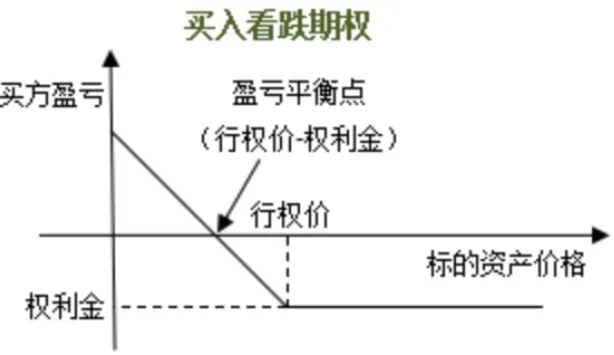
If the stock price continues to fall, congratulations—you start making money. The more the stock price drops, the more you earn. Unlike the theoretically unlimited profit potential of call options, the maximum profit for a long put is theoretically capped when the stock price hits zero (delisting).
Now, for the seller (short put), the seller's position is the mirror image of the buyer's, symmetric along the X-axis. When the stock price is above the strike price, the seller keeps the premium as profit. When the stock price falls below the strike price, the seller starts losing money, with the maximum loss occurring if the stock price hits zero (delisting).
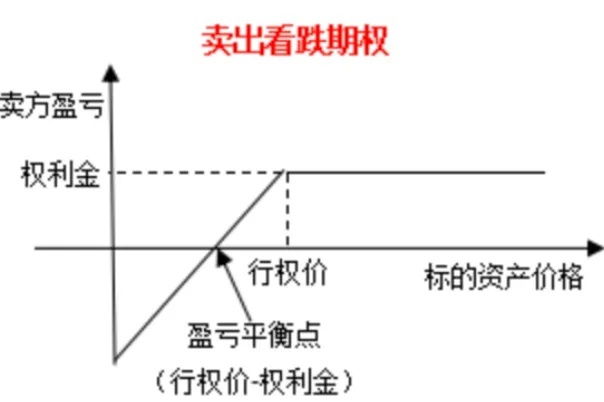
That covers puts. Since the call option was explained in detail earlier, some common concepts won't be repeated here. Feel free to ask questions in the comments.
Next, let's focus on some aspects that are harder for beginners to understand.
After these two lessons, it should be clear that buying a call is equivalent to going long, and buying a put is equivalent to going short (if this isn't clear, you're penalized to review the lesson). If you were trading stocks directly, people would think you're crazy for simultaneously going long and short—buying and then immediately selling, just to pay brokerage fees?
But options are different. Simultaneously going long and short—buying calls and puts—isn't irrational; it's a strategy.
Simply put, buying a call is buying the opportunity to profit big if the stock surges, and buying a put is buying the opportunity to profit big if the stock crashes. Buying both calls and puts means you can profit big whether the stock surges or crashes. Essentially, you'd do this because you believe the stock will move significantly, not trade sideways, as sideways movement would result in losing the premiums paid (neither option is exercised, or the profit from one side doesn't cover the cost).
This strategy of buying both calls and puts is a common options strategy called a straddle (same strike price) or strangle (different strike prices).
Fundamentally, an option is a right. Ignoring the premium, from the stock's perspective, an option is a financial product with one-sided profit potential. For example, with a long call, you don't lose if the stock falls, but you profit if it rises.
Stocks, whether you go long or short, are assets. As assets, they are subject to bilateral price movements—you can profit or lose based on price changes. (Of course, options themselves are also assets, with premiums as their prices, traded in secondary markets. This will be covered in practical courses.)
So, if someone randomly goes long and short on stocks (ignoring market trends), with frequency on the vertical axis and profit on the horizontal axis, their profit distribution would likely resemble a normal distribution, with similar probabilities of profit and loss.
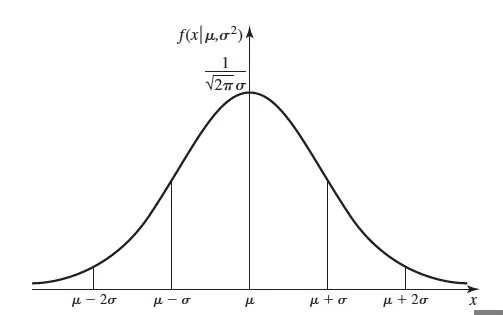
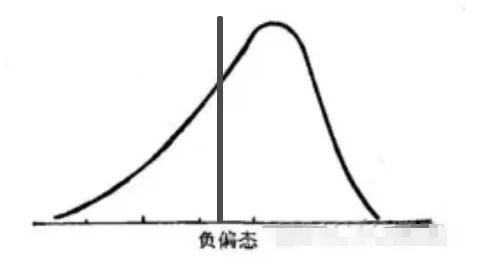
If they randomly buy calls or puts, the distribution would be right-skewed—small losses (premiums) are more likely, while big gains are less likely. This is why many option gamblers buy naked options to chase this small probability.
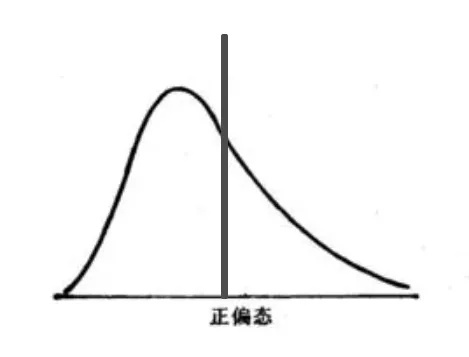
Selling options is the opposite—small gains are more likely, while big losses are less likely. Sellers of naked options, especially out-of-the-money ones, focus on high-probability events, aiming for steady returns rather than overnight riches.
Okay, the basic concepts of options are covered. But honestly, focusing on stocks to trade options is a beginner's mindset. Treating options themselves as tradable assets is what experts do.
This involves advanced topics like the Greeks and option combination strategies, which we'll cover in future lessons. Stay tuned.
$SPDR S&P 500(SPY.US) $Invesco QQQ Trust(QQQ.US) $NASDAQ Composite Index(.IXIC.US)
The copyright of this article belongs to the original author/organization.
The views expressed herein are solely those of the author and do not reflect the stance of the platform. The content is intended for investment reference purposes only and shall not be considered as investment advice. Please contact us if you have any questions or suggestions regarding the content services provided by the platform.
