

Commercialization and R&D are in full swing, Dizal Pharmaceutical ushers in the "singularity moment"


Hawking once proposed that at some point in the future, AI will surpass humans and become an incredible existence. This moment is referred to as the "Singularity," which will trigger a qualitative change in the world.
Hawking's prediction of the "Technological Singularity" depicts a future where AI surpasses human cognition. In the field of biomedicine, Dizal Pharmaceutical's "Singularity Moment" has quietly arrived in the first half of the year. With the simultaneous volume growth of its two core products, Sunvozertinib and Golvatinib, Dizal achieved total revenue of 355 million yuan in the first half of the year, a year-on-year increase of 74.4%. While its self-sustaining capability continues to strengthen, it has achieved its first profit at the commercialization level.
Beyond the volume growth in performance, Dizal Pharmaceutical has also demonstrated its ability to independently incubate pipelines and enter the U.S. market through Sunvozertinib. This fully unleashes Dizal's long-term focus on pioneering innovation in R&D, with the potential to independently replicate more pipelines in the U.S. market, thereby achieving a perfect closed-loop across the entire value chain.
01 The Domestic Market is the Foundation
The foundation for the internationalization of pharmaceutical companies lies in establishing a sufficiently deep moat in the domestic market.
Looking at global multinational corporations (MNCs), their success is invariably built on a solid foundation in their domestic markets. Even though the U.S. market is vast, European pharmaceutical companies like AstraZeneca, Novartis, and Novo Nordisk still place great importance on their European markets, with revenue contributions exceeding 20%.
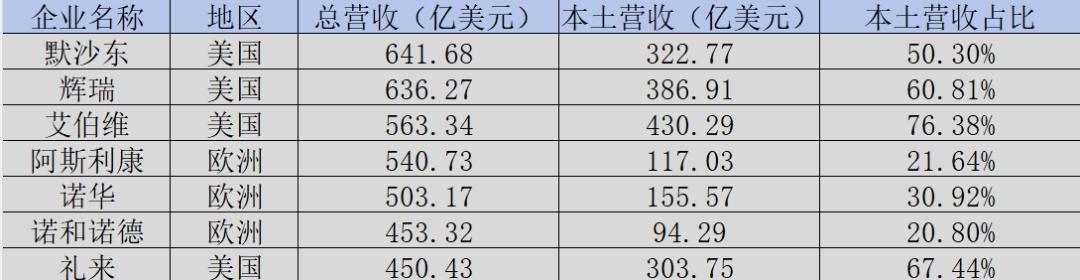
Figure: Global MNC Revenue Overview for 2024
However, over the past three years, China's innovative drug industry has been caught in an unprecedented "capital winter," leaving most biotech companies unable to focus on the domestic market. Startups struggle to launch IPOs, and listed companies face financing difficulties. To survive, many biotech firms have begun trading overseas rights for upfront cash flow.
Dizal has already provided a perfect answer to the question of survival, maintaining ample cash flow even during the "capital winter."
First, Dizal has established a differentiated pipeline matrix with two commercialized products, continuously generating cash flow. While the domestic market may seem limited compared to the "vast" European and American markets, it remains the foundation for China's innovative drugs.
Unlike unfamiliar overseas markets, the domestic market is the soil for pharmaceutical incubation. Whether in terms of industry policies, market demand, or operational efficiency, the domestic market is where companies can most easily establish advantages. Chinese pharmaceutical companies aiming to compete globally must first solidify their domestic foundation.
In this regard, Dizal's strategy is visionary. Both Sunvozertinib and Golvatinib were prepared for commercialization before approval and were included in the national medical insurance catalog in their first year post-approval, leading to significant volume growth in the first half of the year. Despite the expansion of the commercialization team, the sales expense ratio dropped from 99.9% last year to 75.5% in the first half of this year, demonstrating the strength and efficiency of Dizal's commercialization. Given that both products are still in the early stages of commercialization, there is substantial room for improvement, and full profitability driven by commercialization is within reach.
Second, Dizal is one of the few innovative pharmaceutical companies with independent financing capabilities during the "capital winter." Dizal proposed a private placement plan during this period, securing approval for 1.796 billion yuan in funding in February this year. This marks the first time since June 2024 that an unprofitable company on the Shanghai Stock Exchange has completed a refinancing registration.
The increasingly mature product matrix and strong commercialization prospects underpin Dizal's financing capabilities. The interim report shows that Dizal's cash and tradable financial assets totaled 2.251 billion yuan, an increase of 1.423 billion yuan year-on-year. Thanks to its deep roots in the domestic market, Dizal is confidently pursuing a global strategy to maximize value.
02 Dizal's Path of "One Success After Another"
The "homogenization" leading to "internal competition" is another underestimated issue in China's pharmaceutical industry. Unlike the "speed-first" mindset prevalent in traditional domestic competition, Dizal focuses on building technological barriers.
The traditional logic of innovative pharmaceutical R&D is "what can we do," while Dizal's logic is "what can we excel at." The difference lies in the former's reliance on luck for success, whereas Dizal has a clear vision from the outset.
Leveraging solid translational science, Dizal mitigates most risks early in the process, ensuring each clinical pipeline is a rigorously designed "standout." This R&D approach, akin to a systematic "engineering" model, maximizes "capital efficiency" and achieves "one success after another."
Based on this, Dizal is extremely cautious in initiating clinical trials, with all pipelines pursuing technological barriers. Whether it's the already commercialized Sunvozertinib and Golvatinib or subsequent pipelines, all are "pioneering innovations" with novel molecular structures/mechanisms.
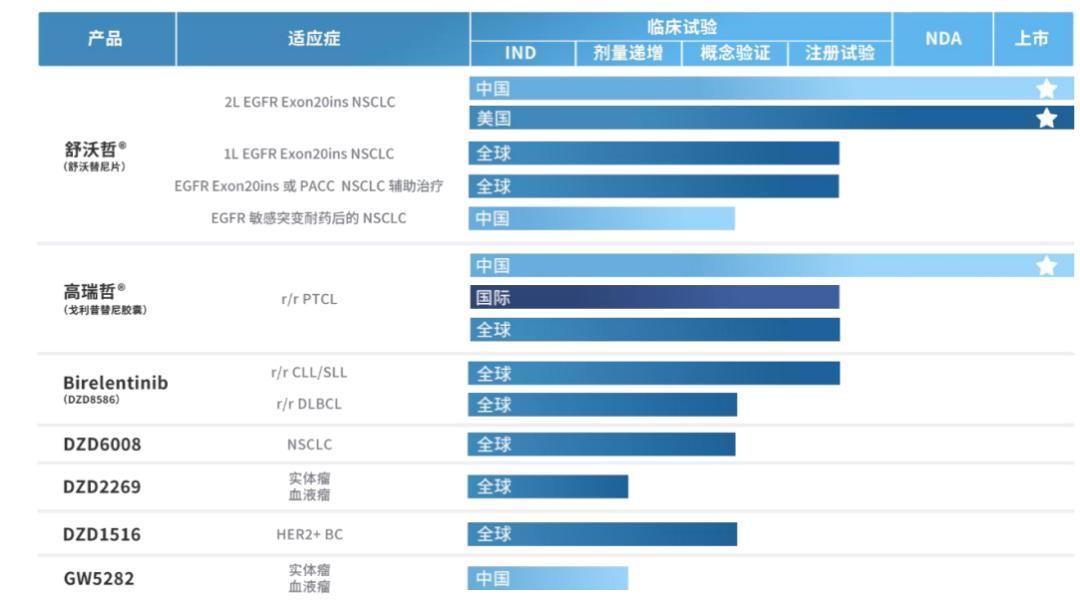
Figure: Dizal Pharmaceutical's Pipeline
On July 2 this year, Sunvozertinib was approved in the U.S. through priority review and quickly became the only small-molecule targeted drug for EGFR Ex20ins NSCLC included in the globally authoritative NCCN guidelines for lung cancer.
This is just the first step for Sunvozertinib. Its international multicenter Phase III confirmatory trial (WU-KONG28) for first-line treatment of EGFR Ex20ins NSCLC has completed patient enrollment. Once its best-in-class (BIC) potential is validated, Sunvozertinib will solidify its global leadership in this treatment area.
Meanwhile, Dizal is targeting the significant unmet needs in the lung cancer field. The global population of patients resistant to third-generation EGFR TKIs continues to grow, and with the widespread use of Osimertinib as first-line treatment, resistance demand is increasing exponentially. Dizal's future pipeline includes the blockbuster product DZD6008, which has already demonstrated potent inhibition against EGFR TKI-resistant triple mutations (C797X, T790M, and L858R/del19) in early clinical studies, potentially replicating Osimertinib's $6 billion peak revenue trajectory.
Beyond this, Dizal's second commercialized product, Golvatinib, aims to push "innovation" to the limit. As a highly selective JAK1 inhibitor, Golvatinib leverages its unique mechanism to break through treatment bottlenecks in peripheral T-cell lymphoma (PTCL). It is also being actively explored in combination with PD-1 inhibitors for advanced NSCLC.
In fact, Dizal is continuously advancing its pipelines in lung cancer and hematologic malignancies, with each pipeline forming a well-structured layout of indications.
One of Dizal's "hidden gems" in hematologic malignancies, Birelentinib (DZD8586), recently achieved promising progress. Its study on heavily pretreated (after BTK/BCL2/BTK degrader failure) chronic lymphocytic leukemia/small lymphocytic lymphoma (CLL/SLL) patients was presented as an oral report at this year's ASCO and ICML international conferences. In August, it received FDA "Fast Track Designation," which will accelerate its Phase III clinical trial.
As the world's first LYN/BTK dual-target inhibitor, Birelentinib's breakthrough lies in addressing the two main resistance mechanisms of BTK inhibitors, potentially solving an industry pain point that has persisted for over a decade. The global BTK inhibitor market exceeds $10 billion, and the growing population of resistant patients could unlock a new blue ocean worth billions.
From a macro perspective, these self-developed pipelines are both independent "special forces" and strategic "chess pieces" in an overall layout, weaving a comprehensive network covering the full disease cycle. This not only builds an irreplicable technological moat but also outlines an exponential growth trajectory in the capital market.
03 The "Singularity Moment"
After a comprehensive review of Dizal Pharmaceutical, it is clear that the company is entering a "Singularity Moment" driven by both commercialization and R&D.
How can the flywheel of innovation-driven growth start spinning? The core lies in when it can incubate a product matrix capable of generating sustained cash flow. From this perspective, Dizal, with its full-scale commercialization breakthrough, is undoubtedly close to success. Its two commercialized products still have significant growth potential, and subsequent pipelines exhibit strong commercialization prospects. As revenue scales up, Dizal's operational efficiency will continue to improve, ushering in an era of full profitability.
On the R&D front, Sunvozertinib's independent entry into the U.S. market is the "finishing touch" that activates the entire closed-loop ecosystem. Designed with "engineering" precision, each of Dizal's pipelines is capable of competing globally. Sunvozertinib's success proves that Dizal can independently incubate innovative pipelines for the global market—a capability that can be replicated across other pipelines, bringing more pioneering innovations to the U.S. market.
In the past, investors only considered the domestic market's partial value; in the future, they will evaluate the full value of the global market. From this perspective, investors need to ascend to a new "dimension" to truly understand Dizal's value.
Now, the hurdles are behind, and Dizal is fully entering its next phase of development. From a biotech tackling difficult targets to an innovative leader with limitless potential, Dizal is quietly undergoing a "dimensional upgrade" in value.
This article is based on publicly available information and is intended for informational purposes only, not as investment advice. $Dizal Pharmaceutical(688192.SH)
The copyright of this article belongs to the original author/organization.
The views expressed herein are solely those of the author and do not reflect the stance of the platform. The content is intended for investment reference purposes only and shall not be considered as investment advice. Please contact us if you have any questions or suggestions regarding the content services provided by the platform.
