

We underestimated the agricultural value of Pinduoduo

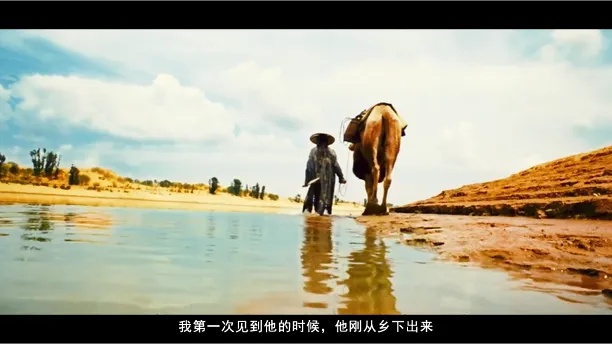
The greatest seclusion is in the marketplace.
As is well known, Pinduoduo is an agricultural company.
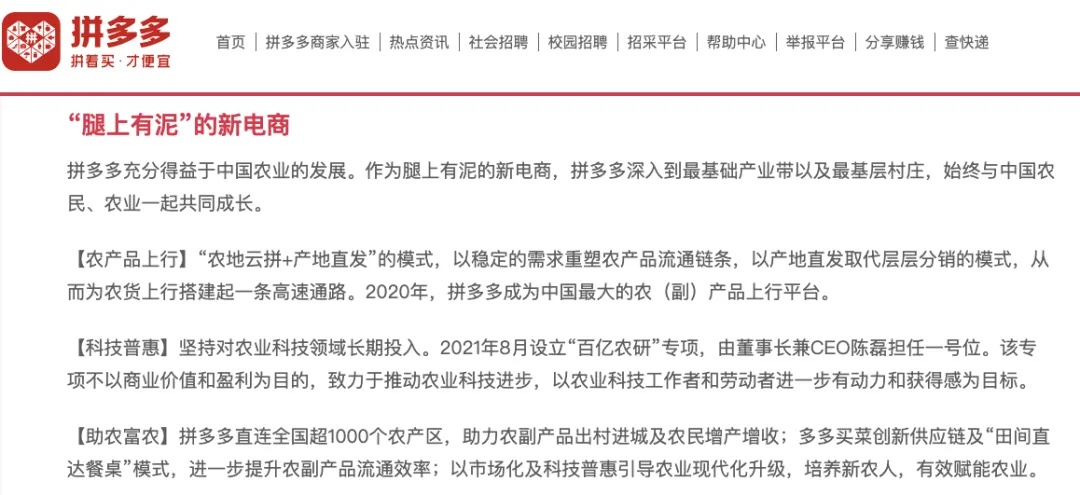
Unlike other e-commerce platforms, Pinduoduo's brand promotion has always focused on agricultural support projects such as Duoduo Farm, Cloud Farming, and Duoduo Specialty Products. The company's official website also repeatedly emphasizes:
We are deeply rooted in agriculture and are the world's largest online retail platform for agricultural and sideline products.
At Pinduoduo's quarterly earnings calls, investors are concerned about AI deployment, user needs, business strategies, financial outlooks... But no matter what you ask, the management's answers always circle back to supporting agriculture.
When agriculture is repeatedly mentioned, it has become a smokescreen for everyone's eyes: a shield to refuse to communicate company information, a PR topic to showcase the company's value, and a safe harbor where nothing can go wrong. No one seriously considers the true value of agriculture.
But in reality, Pinduoduo may be conducting a large-scale social experiment—agricultural transformation.
The value of this is vastly underestimated.
1、
The 500 million-strong farming community is the "ballast stone" of China's socio-economy, the direct producers of basic agricultural products such as grain, vegetables, meat, eggs, and dairy, supporting the food needs of 1.4 billion people. In 2023, China's agricultural wholesale market transaction volume reached 6.53 trillion yuan.
However, agriculture remains the industry most severely constrained by circulation, with land, labor, and even products holding low value in the industrial chain. The constraints of circulation can be broken down into two parts: supply-demand matching and logistics losses.
Take fruits as an example. Every time a fruit is picked from the tree and handled, there is loss, and the loss increases further during transportation. The average loss rate in the fruit industry is about 15%-30%, and for perishable items like strawberries and lychees, it can exceed 50%.
Even more challenging is the harvest period limitation. The typical fruit picking period is 10-15 days. Beyond this time, the fruit either spoils or cannot be sold. The question is, how can you accurately match demand and sell everything within these two weeks? Not to mention the uncertainty of weather, where sudden rain often leads to unharvested agricultural products and wasted losses.
The root of the difficulties in supply-demand matching and logistics damage lies in China's small-scale farming economy, which makes agricultural products a fragmented, non-standardized business. Farmers do not directly interact with consumers, nor do they have the ability to analyze demand, while the circulation process relies on a large number of scattered, inefficient social organizations. In the end, farmers only capture the very end of the product's value.
The smart among you will surely think of a solution: What if demand could be accurately matched, and then the produce could be picked directly from the field and shipped to consumers?
2、
This is exactly what Pinduoduo is doing.
It is driving a complete transformation of the agricultural industry: matching supply and demand, optimizing the supply chain, reshaping production relations, and enabling farmers to integrate production, sales, and labor.
- First is supply-demand matching. The platform has data on the ripening cycles and logistics conditions of agricultural products from over 2,000 counties nationwide. Through low-price group buying, it unifies and scales demand to achieve precise matching.
- Next is supply chain shortening. It simplifies the traditional multi-layered agricultural product circulation process—"farmer - broker - wholesaler - retailer - consumer"—into a three-tier chain: "farmer - platform - consumer," significantly reducing losses.
- Finally, it achieves production based on sales. The ultimate goal of this system is to shift from the traditional "produce what you can sell" to "grow what is needed," accurately matching market demand and achieving seamless integration from production to consumption, reshaping production relations.
The core of this is orders and data.
With order demand, farmers are willing to sell, which is the premise. The online model of e-commerce is naturally conducive to data collection. With real-time data from the entire process, the efficiency of the industrial chain can be continuously optimized. Thus, direct sourcing from production areas, cold chain construction, technology promotion, variety improvement, farmer training, and brand incubation... can be implemented. Going further, it can accelerate the iterative upgrading of agriculture from the breeding stage, such as the new varieties mentioned by the company, like Yanshu 25, Xida Konjac, and Jingu 21 millet, which are supported in collaboration with research teams.
This work has a long cycle and slow results, as it is transforming an industry that has existed for thousands of years. Pinduoduo does not need to handle every specific step; the key is to provide a commercialized system that drives the integration of social resources, including farmers, merchants, warehouses, transportation, and university agricultural research institutes.
A successful commercialized closed-loop is an important way to drive industrial upgrading.
Can other e-commerce platforms do this?—No, because they can't even achieve the first step of aggregating demand.
For example, if a farmer has 10,000 jin of fruit, selling at 10 yuan per jin, and it's about to rain, requiring early harvesting and selling. On Pinduoduo, lowering the price to 9 yuan can immediately sell out, but on other platforms, it can't. If it can't be sold, the loss is more than 10,000 yuan. Conversely, if it can be quickly sold on Pinduoduo, reducing losses by 10%, then the price can be 10% cheaper than other platforms.
This is also what Huang Zheng emphasized in his early speeches: reverse customization—concentrating massive demand into limited products, then reverse-customizing after achieving scale to reduce costs. In essence, it's the same as what Costco does. But in China's unique context, this model has even greater value in agriculture. Pinduoduo goes further than Costco, transforming the supply chain and production end from the source.
In this logic, low prices are the result, not the cause, because low prices are the most effective way to aggregate demand.
3、
The next question is, how to consider the value of this?
If calculated in terms of revenue and profit, agriculture contributes little to Pinduoduo's platform. From 2018 to 2021, Pinduoduo's agricultural product GMV was 653, 1363, 2700, and 4200 billion yuan, respectively. It hasn't been disclosed since, but now agricultural product GMV is about 1 trillion, accounting for 20% of the platform. However, agricultural products are exempt from transaction commissions. Although we don't know the advertising costs, the overall revenue share should not exceed 10%, and considering the investment in the agricultural industrial chain, the profit share is even smaller.
If you delve into Pinduoduo's e-commerce system, the value of agriculture begins to emerge.
- First is the traffic value. Fresh agricultural products are high-frequency consumer categories, playing an important role in platform traffic.
- Second is the system value. The front-end agricultural products + back-end distribution channels + nationwide layout form a deeply entrenched business. Now you understand why other platforms have abandoned the unprofitable community group buying, while Pinduoduo still insists on "Duoduo Grocery"?
- Third is the long-term value. The resources and time invested in the early transformation of agriculture are substantial, with no significant economic returns in the short term. But agriculture is an industry with deep industrial chains. After completing the modernization transformation, the commercial space that can be explored later can be huge.
But more importantly, it's the value beyond profit.
Let us emphasize again: the 500 million-strong farming community is the "ballast stone" of China's socio-economy. Imagine, if a company can use technological means to optimize supply-demand matching, upgrade production relations, and transform agriculture on a large scale, directly improving farmers' lives, what kind of value is this?
Providing a trading platform, producing a car, manufacturing a phone, selling a set of clothes, making a game—these can all be very successful commercially. But establishing a systematic solution for the future of 500 million farmers is clearly more challenging.
What lies beyond profit often brings value that surpasses profit.
If we look at Pinduoduo's endgame, the value of transforming agriculture is vastly underestimated.
The copyright of this article belongs to the original author/organization.
The views expressed herein are solely those of the author and do not reflect the stance of the platform. The content is intended for investment reference purposes only and shall not be considered as investment advice. Please contact us if you have any questions or suggestions regarding the content services provided by the platform.
