

From 'Energy Guzzler' to 'Energy Efficiency Leader': How New Generation Industrial Furnace Technology Helps High-Carbon Industries Like Metallurgy and Building Materials Achieve Deep Decarbonization?

Global Info Research recently released the "Global Industrial Furnace Market Size, Key Players, Major Regions, Product and Application Segmentation Research Report 2026", which provides a systematic and comprehensive analysis of the global industrial furnace industry. The report covers the overall market size of global industrial furnaces, key regional market trends, operational performance and competitive share of major manufacturers, product segmentation types, and downstream application areas. It not only deeply analyzes the competitive landscape, revenue, and market share of major industrial furnace companies worldwide but also highlights the product features, technical specifications, gross margin, and latest developments of various manufacturers (brands). The report's historical data covers 2021 to 2025 and provides authoritative forecasts for future market trends from 2026 to 2032, offering valuable insights and decision-making references for industry participants.
Product Definition and Statistical Scope
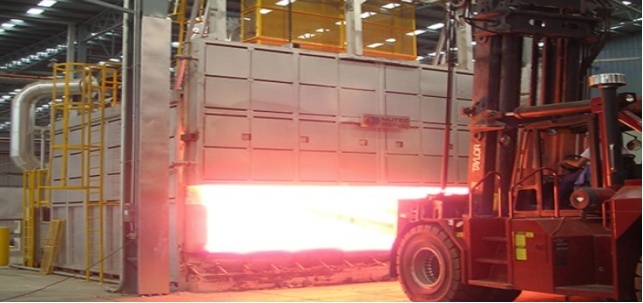
An industrial furnace is a thermal equipment used in industrial production to heat materials or workpieces by utilizing the heat generated from fuel combustion or electrical energy conversion. Broadly speaking, boilers are also a type of industrial furnace, but they are not conventionally included in the scope of industrial furnaces.
Figure 1: Industrial Furnace Product Image
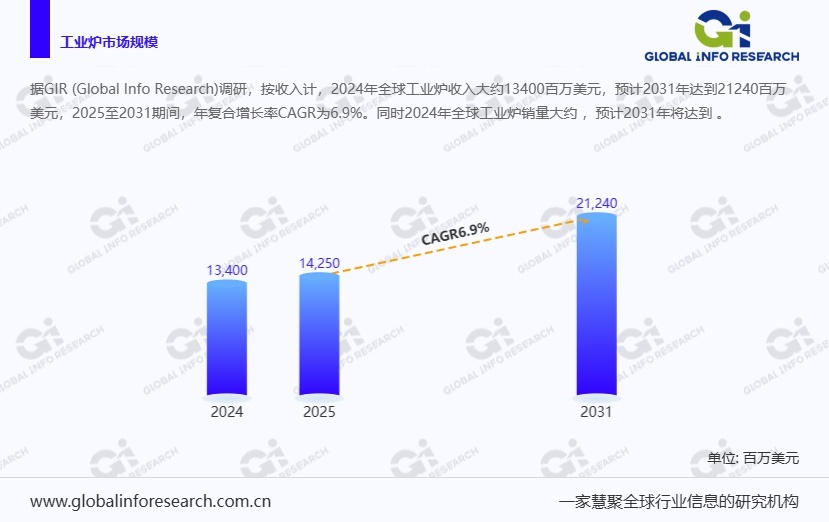
According to GIR (Global Info Research) research, in terms of revenue, the global industrial furnace revenue in 2024 is approximately $13.4 billion, and it is expected to reach $21.24 billion by 2031, with a compound annual growth rate (CAGR) of 6.9% from 2025 to 2031.
Major manufacturers include:
Andritz
Danieli
Tenova
Aichelin Group
Chugai Ro
ALD
Inductotherm Corp
SECO/WARWICK
Ipsen
Beijing Jingcheng Fenghuang Industrial Furnace Engineering Technology Co., Ltd.
PVA TePla
Despatch
Nachi-Fujikoshi
Gasbarre Furnace
Mersen
ECM Group
Surface Combustion
CEC
Nutec Group
Sistem Teknik
AVS
Wisconsin Oven
TAV Vacuum
Zhongye Nanfang Thermal Engineering
By product type, the market is segmented into:
Combustion Type
Electric Heating Type
By application, the market is segmented into:
Steel Metallurgy
Industrial Processing Heating
Machinery and Metal Materials
Surface Coating
Others
Key regions of focus include:
North America
Europe
China
Japan
Industrial Furnace Market Factors and Industry Chain Analysis
1. Market Drivers for Industrial Furnaces
First, green and low-carbon policies continue to empower the industry. Under the dual-carbon goals, the government has introduced multiple environmental policies to strictly control industrial emissions, requiring the transformation or elimination of traditional high-energy-consumption and high-pollution industrial furnaces while promoting the adoption of energy-efficient and clean-energy industrial furnaces. These policies are forcing the industry to upgrade, creating a broad market space for industrial furnace products that meet environmental standards and accelerating the adoption of green industrial furnaces.
Second, rigid demand growth in downstream high-end manufacturing. Rapid development in high-end manufacturing sectors such as lithium battery cathode materials, electronic ceramics, automotive components, and aerospace components has raised higher requirements for the temperature control accuracy, process stability, and energy efficiency of industrial furnaces. Capacity expansion in related industries directly drives demand for specialized industrial furnaces and high-end heat treatment furnaces, becoming a core driver of market growth. The CAGR of China's industrial furnace market size from 2019 to 2023 reached 16.94%, reflecting the pull of downstream demand.
Third, technological innovation enhances product competitiveness. The integrated application of technologies such as high-efficiency combustion systems, waste heat recovery devices, and intelligent control systems has significantly improved the energy utilization efficiency of industrial furnaces and reduced exhaust emissions. The use of new materials such as high-temperature-resistant ceramics and insulation materials has extended equipment lifespan and reduced maintenance costs. Technological iterations make industrial furnaces more adaptable to high-end manufacturing needs, driving product upgrades into high-value-added areas.
Fourth, the release of demand for the replacement of existing equipment. Early industrial furnaces in use generally suffer from low energy efficiency, non-compliant emissions, and poor stability, making them unable to meet current production and environmental requirements. Industrial enterprises are continuously releasing demand for the replacement of existing equipment to ensure production compliance and improve efficiency, becoming an important incremental driver of industrial furnace market growth.
Fifth, expanding export opportunities in international markets. China's industrial furnace manufacturing capabilities continue to improve, with some products approaching international advanced levels and offering significant cost-performance advantages. The development and industrial upgrading needs in regions such as Europe, the U.S., and Southeast Asia provide a vast export market for domestic industrial furnaces. Domestic companies are increasingly capturing international market share through technology exports and overseas channel expansion.
2. Future Development Factors for Industrial Furnaces
First, deepening green transformation. Future industrial furnaces will further promote the replacement of clean energy, widely adopting hydrogen and electricity to replace traditional fossil fuels, reducing greenhouse gas emissions. At the same time, combustion processes will be optimized to improve waste heat recovery and utilization, driving low-carbon practices throughout the product lifecycle, aligning with industrial development directions under the dual-carbon goals.
Second, digital and intelligent upgrades. The deep integration of Industry 4.0 technologies, such as IoT, big data analytics, and AI, will achieve real-time monitoring, precise parameter adjustment, and fault prediction for industrial furnace operations. Remote maintenance services will gradually become widespread, improving equipment operational efficiency and maintenance convenience, driving the transformation of industrial furnaces from traditional equipment to smart devices.
Third, modular and customized development. Modular design will become mainstream, with standardized module combinations adapting to different production needs, shortening delivery cycles, and reducing operational costs. At the same time, customized industrial furnace solutions will be provided for the personalized process requirements of downstream segments, improving the adaptability of products to application scenarios and expanding high-end market space.
Fourth, strengthened industry chain collaboration and integration. Upstream efforts will focus on domestic breakthroughs in core materials and components such as refractory materials and precision control components to enhance supply chain stability. Midstream companies will promote intelligent production upgrades to improve product quality consistency. Downstream, collaborative R&D with manufacturing enterprises will deepen, forming a "demand-R&D-production" linkage mechanism to build a competitive advantage across the entire industry chain.
Fifth, diversified expansion of application scenarios. While consolidating applications in traditional metallurgy and chemical sectors, industrial furnaces will extend into high-end segments such as new energy (e.g., lithium battery material sintering), new materials (e.g., electronic ceramic firing), and aerospace (e.g., component heat treatment). Innovative applications in environmental scenarios such as solid waste treatment and resource recycling will further broaden market boundaries.
3. Development Barriers for Industrial Furnaces
First, high barriers in core high-end technologies. Core technologies such as precision control components, high-efficiency combustion systems, and special refractory materials for high-end industrial furnaces are still monopolized by some international companies. Domestic companies lag in R&D capabilities and the efficiency of technology commercialization. For example, the core components of bell-type furnaces were long dependent on imports, and domestic production faced issues such as short lifespan and deformation, slowing the process of domestic substitution.
Second, high initial investment and operational costs. The R&D and production of high-end industrial furnaces require significant capital investment, leading to high initial equipment prices. At the same time, the operation and maintenance of intelligent and green equipment require professional technical support, further increasing operational costs for enterprises and creating purchase and usage barriers for small and medium-sized manufacturers.
Third, incomplete industry standards and certification systems. The industrial furnace industry has numerous segments, with varying requirements for equipment parameters and performance across different application scenarios, lacking unified high-end product evaluation standards and quality control specifications. Entering international markets requires stringent overseas certifications, which are complex, time-consuming, and costly, increasing market entry difficulties for companies.
Fourth, shortages of professional technical talent. The R&D, design, installation, debugging, and operation of industrial furnaces require multidisciplinary knowledge in materials science, thermal engineering, and automation control. Currently, there is a significant gap in relevant professional talent in the industry, limiting companies' technological innovation capabilities and affecting the full performance and market promotion of high-end equipment.
Fifth, significant risks from raw material price fluctuations. Core raw materials for industrial furnace production include steel, refractory materials, and electromechanical components, whose prices are highly volatile due to factors such as international commodity markets, geopolitical issues, and environmental policies. Raw material costs account for a high proportion, and price increases directly squeeze profit margins and increase uncertainty in production planning, with small and medium-sized enterprises having weaker risk resistance.
4. Industrial Furnace Industry Chain Analysis
The industrial furnace industry chain encompasses four collaborative segments: upstream raw materials and core component supply, midstream manufacturing and processing, downstream application markets, and supporting services. The upstream core segments include basic raw materials (steel, refractory materials, insulation materials, etc.) and core components (combustion systems, control systems, heat exchangers, electromechanical components, etc.), as well as production equipment (precision machining tools, testing instruments). Among these, high-end control components and special refractory materials were once import-dependent, but domestic companies such as Jiugang Xibu Heavy Industry are now driving the localization of core components through technological breakthroughs. The prices of basic raw materials are significantly influenced by commodity markets, directly impacting upstream costs. Midstream manufacturing and processing form the core of the industry chain, divided into two camps: brand manufacturers and OEMs, responsible for the design and R&D of industrial furnaces, core component integration, final assembly, and quality inspection. The market exhibits a competitive landscape where "leading brands dominate the high-end segment, while small and medium-sized manufacturers focus on the mid-to-low end." Leading companies leverage their technological advantages to dominate in specialized industrial furnaces and high-end heat treatment furnaces, while SMEs primarily produce standardized products. The downstream application market is extensive, covering industries such as metallurgy, chemicals, lithium battery cathode materials, electronic ceramics, automotive components, and aerospace, with demand growth in high-end manufacturing becoming the primary industry increment. The sales model is primarily B2B engineering customization, requiring deep collaboration with downstream enterprises to match specific production process needs. Supporting services include installation and debugging, operation and maintenance, and testing and certification, where the professionalism of installation and debugging directly affects equipment performance, international certifications are key barriers to entering overseas markets, and the shortage of professional operation and maintenance talent is a common industry challenge. Overall, the industry chain is characterized by "upstream material cost sensitivity, midstream core technology barriers, and downstream diversified and fragmented demand." The localization of core technologies, digital transformation, and industry chain collaboration and integration are the core drivers of industry upgrades, with high-end and green development becoming key directions for future industry competition.
The copyright of this article belongs to the original author/organization.
The views expressed herein are solely those of the author and do not reflect the stance of the platform. The content is intended for investment reference purposes only and shall not be considered as investment advice. Please contact us if you have any questions or suggestions regarding the content services provided by the platform.
