

Tianrun Cloud (02167.HK) Analysis: How to use OpenClaw to rapidly integrate a phone bar plugin

$TI CLOUD(02167.HK) In the customer service system, phone calls remain one of the most core capabilities.
Whether it's customer inquiries, after-sales handling, complaint escalation, or complex issue collaboration, many key service actions ultimately need to be completed via phone calls.
For agents, this is the most core operational entry point in the workbench; for enterprises, whether phone capabilities are stable, user-friendly, and can truly be embedded into business processes directly impacts service efficiency and customer experience.
Therefore, many enterprises hope to embed the phone bar into their own business systems, integrating phone capabilities with customer data, work order flow, and service processes to build a unified workbench and improve overall work efficiency.
But this is not an easy task. The phone bar plugin itself involves complex capabilities such as API calls, real-time event push, softphone, exception handling, and reconnection mechanisms.
Traditionally, from understanding the documentation to completing development and launch, it often takes a week or even longer.
Now, with OpenClaw, this work can be completed in just 1 hour, and you don't even need to do it yourself.
1. How to Use OpenClaw to Compress Phone Bar Development from 1 Week to 1 Hour
The value of OpenClaw lies in making originally complex and time-consuming tasks simpler and easier to implement.
In traditional development mode, integrating a phone bar is often a long "marathon."
Developers first need to understand the plugin documentation, sort out the API structure, event model, and parameter logic, and also handle multiple core modules such as login, state management, softphone control, transfer, and monitoring.
The real trouble isn't just writing the functionality, but also making event linkage, exception handling, reconnection mechanisms, and interface states run smoothly together. Often, the most time-consuming part isn't the development itself, but the initial understanding and intermediate debugging.
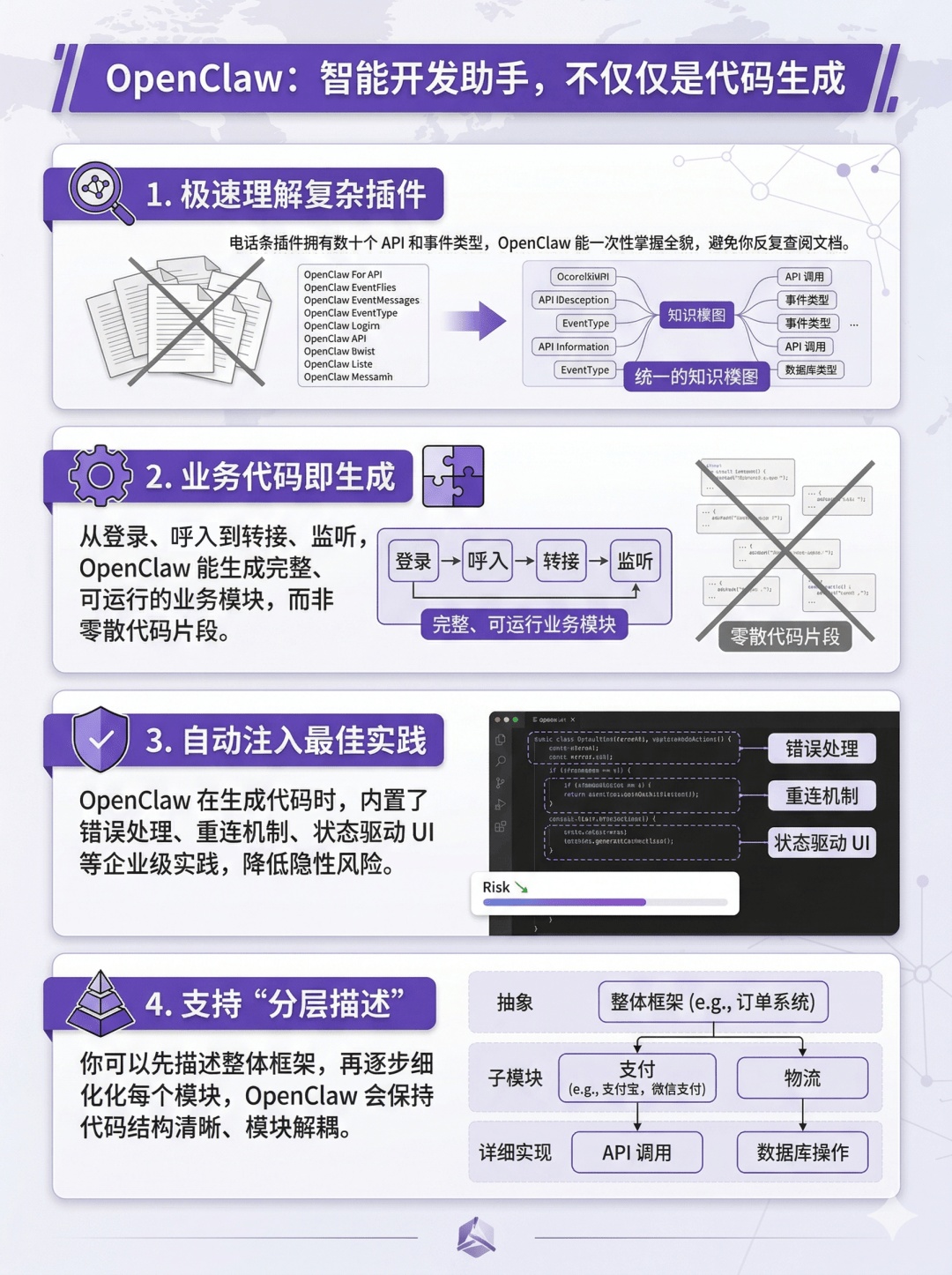
The change brought by OpenClaw is first reflected in the "understanding" step.
In the past, the prerequisite for developing a phone bar was to first understand the documentation bit by bit;
Now, developers only need to provide the relevant documentation of the phone bar plugin to OpenClaw, and it can automatically parse the document content, understanding the plugin's API structure, event model, parameter meanings, and usage methods.

Click to add image description (up to 60 characters) Edit
A large amount of information that originally required developers to digest themselves is now pre-processed by AI, allowing development to enter the actual implementation phase faster.
More importantly, OpenClaw doesn't just help read documentation; it can also directly convert requirements into code.
When developers clearly describe business requirements, such as what kind of agent workbench is needed, which functional modules it includes, how the interface is organized, and how interactions are presented, OpenClaw can directly generate relatively complete HTML and JS code.

Click to add image description (up to 60 characters) Edit
Please implement an agent workbench page:
This includes not only plugin initialization, login and state management, call control, but also event listening, UI linkage, and basic exception handling and reconnection mechanisms. Work that originally needed to be broken down into multiple steps can be significantly compressed.
More importantly, this development method is not a one-time output, but can be continuously iterated.
With the assistance of OpenClaw, development is no longer a linear process of "write first, modify later," but a gradual refinement through dialogue:
· Add functionality: "Please add a satisfaction rating button, and display the customer's ringing status during incoming calls."
· Fix issues: "After the customer hangs up, the call panel is not hidden, please fix."
· Adjust styles: "Please change to a dark theme and make the call button round."
· Correct terminology: "Please change '置忙' to '示忙' and '强插' to '拦截'."
For each round of modifications, OpenClaw can accurately locate and adjust the code without you manually searching through dozens of lines of logic.
2. The Real Advantage: Not "Writing Code," but "Building Systems"
What OpenClaw truly changes is not just "writing code faster."
Its greater value lies in transforming the task of enterprise phone bar development from an engineering task that is highly dependent on experience, has a lengthy process, and is costly, into a process that is easier to advance and continuously optimize.
Especially for enterprises that want to deeply embed phone capabilities into their business systems and build a unified workbench, this change is not just an improvement in technical efficiency, but also means that business requirements can be responded to faster, and the system can be closer to real usage scenarios.
Click to add image description (up to 60 characters) Edit
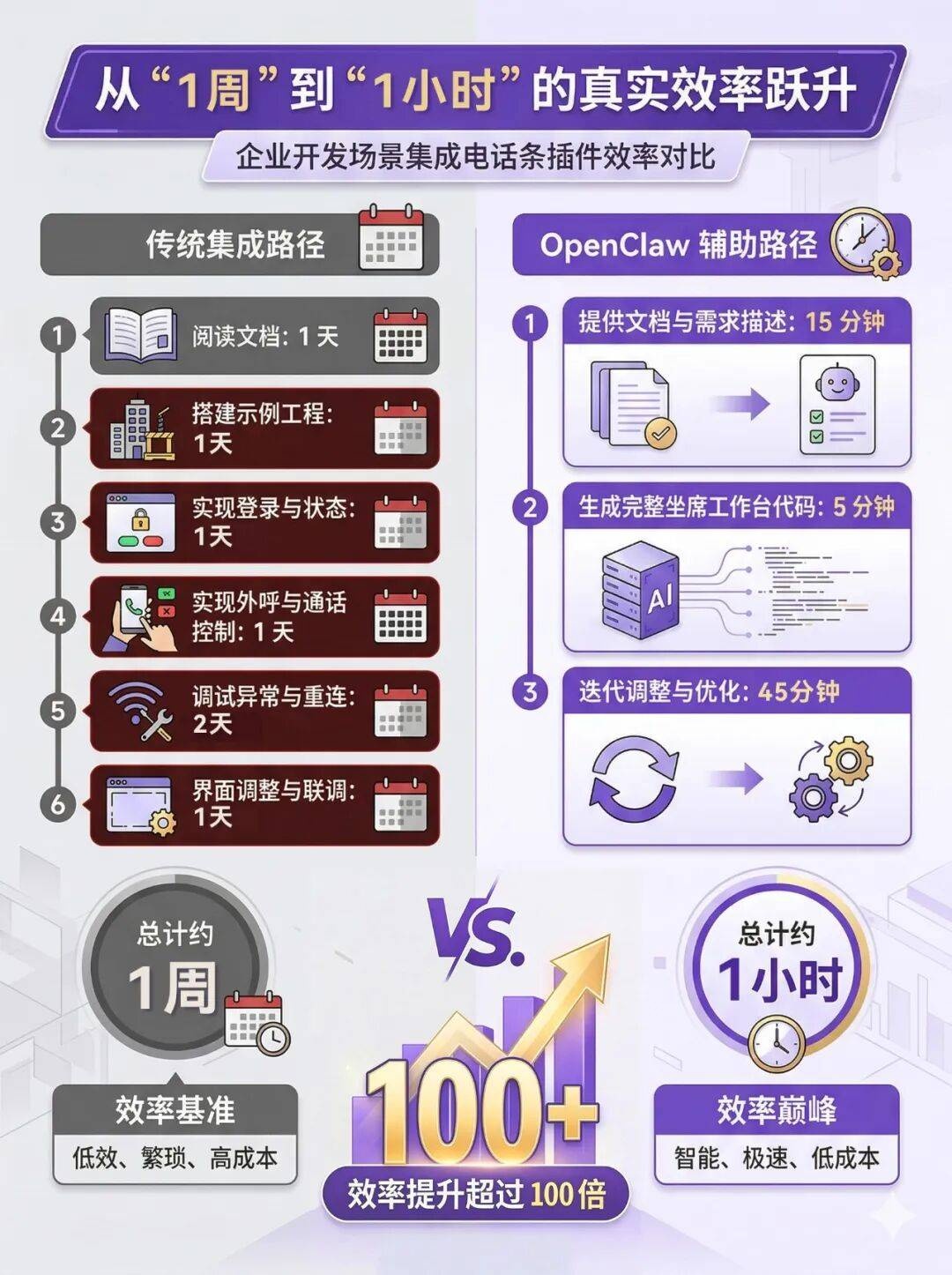
From the results, this efficiency improvement is very intuitive.
Using traditional working methods, reading documentation, building example projects, implementing login and state, completing call control, debugging exceptions and reconnections, and then interface adjustments and joint debugging, the whole process usually takes about a week;
With the assistance of OpenClaw, providing documentation and requirement descriptions takes only over ten minutes, generating complete code takes only a few minutes, and after tens of minutes of iterative optimization, the whole process can be compressed to about 1 hour, with efficiency improved by over 100 times.
Click to add image description (up to 60 characters) Edit
3. Let AI Handle the "Complex," Let People Focus on "Creation"
The significance behind this is not just saving a few days of development time.
More importantly, enterprises can integrate phone capabilities into their business systems faster, complete the construction of a unified workbench faster, and also get frontline teams to use tools that truly fit their business processes faster.
Things that were previously stuck due to "documentation being too complex, development being too slow, joint debugging being too heavy" now have the opportunity to be significantly shortened. For enterprises that need to continuously optimize service processes and frontline efficiency, this acceleration itself is valuable.
Ultimately, the combination of OpenClaw and the phone bar plugin is not just about speeding up the integration of a component, but also about redefining how enterprises develop such complex capabilities.
It frees developers from the tedious understanding of documentation and basic debugging, allowing them to focus more on business logic, experience optimization, and system innovation; it also gives enterprises higher development efficiency and stronger implementation capabilities in this core matter of phone capabilities.
$TI CLOUD(02167.HK)
The copyright of this article belongs to the original author/organization.
The views expressed herein are solely those of the author and do not reflect the stance of the platform. The content is intended for investment reference purposes only and shall not be considered as investment advice. Please contact us if you have any questions or suggestions regarding the content services provided by the platform.
