

OKLO vs VRT: Two Approaches on One Chain

I need to state a signal upfront—recently, many people saw the OKLO and VRT collaboration announcement and went to allocate a 50/50 position evenly across these two stocks, with the reasoning that "nuclear energy + data centers are on the same industry chain." This intuition is completely wrong. It's true that OKLO is upstream and VRT is downstream, but the risk structures of these two stocks differ by three orders of magnitude. Using the same approach will likely result in any profits being given back to the market.
I've put these two stocks together for a horizontal breakdown, focusing on "the real difference in odds behind the same market cap increase."
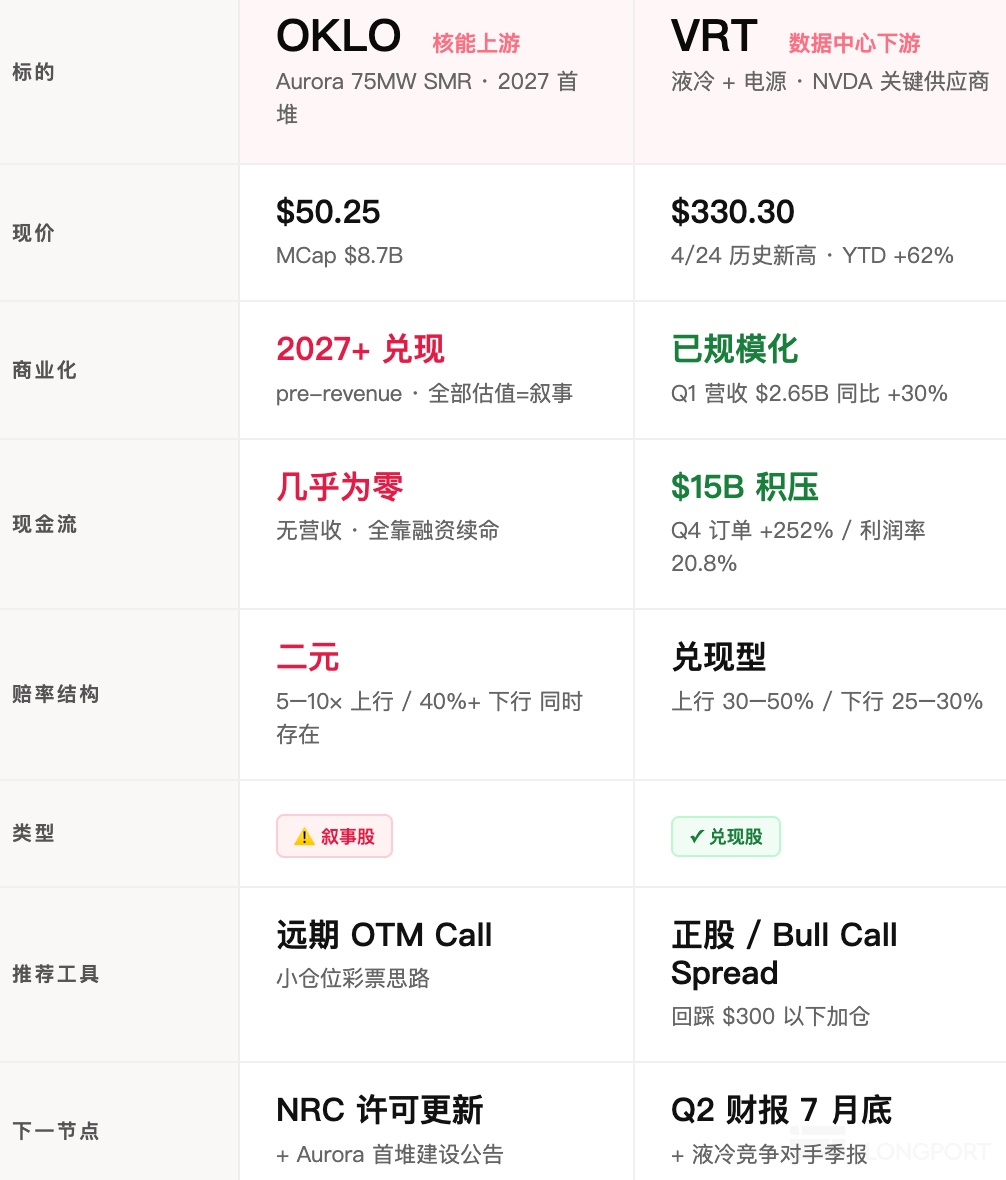
【$Oklo(OKLO.US) :A pure narrative stock, only playable with small option positions】
Current price $50.25, market cap ~$8.7B. Commercialization progress: First 75MW Aurora modular reactor delivery in 2027—meaning this company currently has virtually no commercial revenue; its entire valuation is built on the narrative that "AI computing power will force demand for nuclear energy." Recent catalysts—collaboration with $NVIDIA(NVDA.US) + Los Alamos National Laboratory pushed the stock up +58%, and the VRT collaboration added another wave of hype.
Why is the risk structure special? The real odds for a pre-revenue narrative stock like OKLO are binary: either the first reactor is successfully delivered in 2027–2028 + SMR economics are recognized by the market → stock price multiplies 5–10x; or any narrative is questioned during that period (NRC regulatory delays, first reactor delay, AI capex growth falling short of expectations) → stock drops over 40% within 30 days.
Failed squeeze scenario: First reactor delivery delayed from 2027 to 2028 (delays are the historical norm for nuclear projects, as NuScale experienced), NRC construction permit process slower than expected, SMR economics questioned by independent bodies. Any of these triggers would instantly send OKLO back to square one—this is the most vulnerable part of a narrative stock.
【$Vertiv(VRT.US) :An execution stock, suitable for either shares or Bull Call Spreads】
Current price $330.30 (4/24 all-time high), YTD +62%, market cap >$100B level. Commercialization progress: Q1 2026 revenue $2.65B up +30% YoY, operating margin 20.8%, full-year guidance $13.25–$13.75B revenue, EPS $5.97–$6.07, $15B backlog, Q4 orders surged +252% YoY. This company isn't telling stories; it's already generating cash flow—liquid cooling + power management are critical infrastructure for this generation of AI servers like $NVIDIA(NVDA.US)'s GB300, unavoidable.
Why is the risk structure completely different? VRT is a clear "execution over the next 18 months" play, with most expectations already priced in by the market. Upside isn't like OKLO's multiples, but downside risk is also much smaller—unless the entire AI capex cycle reverses (a macro risk, not a company-specific risk), a standalone VRT pullback is unlikely to exceed 25–30%.
Failed squeeze scenario: 1) AI server capex weakens in 2027 (biggest macro risk); 2) Liquid cooling competitors (Schneider, Modine, CoolIT) compress gross margins; 3) High customer concentration risk ($NVIDIA(NVDA.US), Microsoft too large). These risks are at the level of "revenue growth slowing from +30% to +10%," not "stock price halving."
So why can't you use the same approach?
Many people see "OKLO and VRT collaboration" and think these two stocks will rise in the same direction and magnitude. In reality, this B2B collaboration has a negligible impact on VRT (OKLO is at most a case study on VRT's client list, not a revenue pillar), but a huge impact on OKLO (because OKLO has no commercial revenue yet, any collaboration announcement is a narrative boost). The same piece of news elicits completely unequal reactions from the two stocks—that's why you can't use the same logic.
If you want to allocate to the "Nuclear AI" track, the correct approach isn't 50/50, but rather:
Position structure: 90% VRT shares (capture certain growth) + 10% OKLO far OTM Calls (capture the narrative lottery)
Risk control rules: VRT down 20% hold (allowable trend correction); OKLO down 40% cut immediately (narrative break threshold)
🕙Timing nodes:
· Next node for VRT: Q2 earnings (expected end of July 2026) + liquid cooling competitor quarterly reports, catalysts clear
· Next node for OKLO: NRC construction permit quarterly updates + Aurora first reactor construction milestone announcements, timing irregular but each is important
If not yet entered, wait for OKLO to pull back below $40 and VRT below $300 before considering entry respectively. These observation levels are based on "narrative intact + trend intact."
The most crucial sentence: Heavy position in OKLO shares is gambling (odds don't match the position size), heavy position in VRT shares is possible but comes with the cost of extremely high beta. The worst thing to do is "I'm bullish on this industry chain so I'll go heavy on both"—using the wrong tools in a good track will still lose money.
The copyright of this article belongs to the original author/organization.
The views expressed herein are solely those of the author and do not reflect the stance of the platform. The content is intended for investment reference purposes only and shall not be considered as investment advice. Please contact us if you have any questions or suggestions regarding the content services provided by the platform.
