

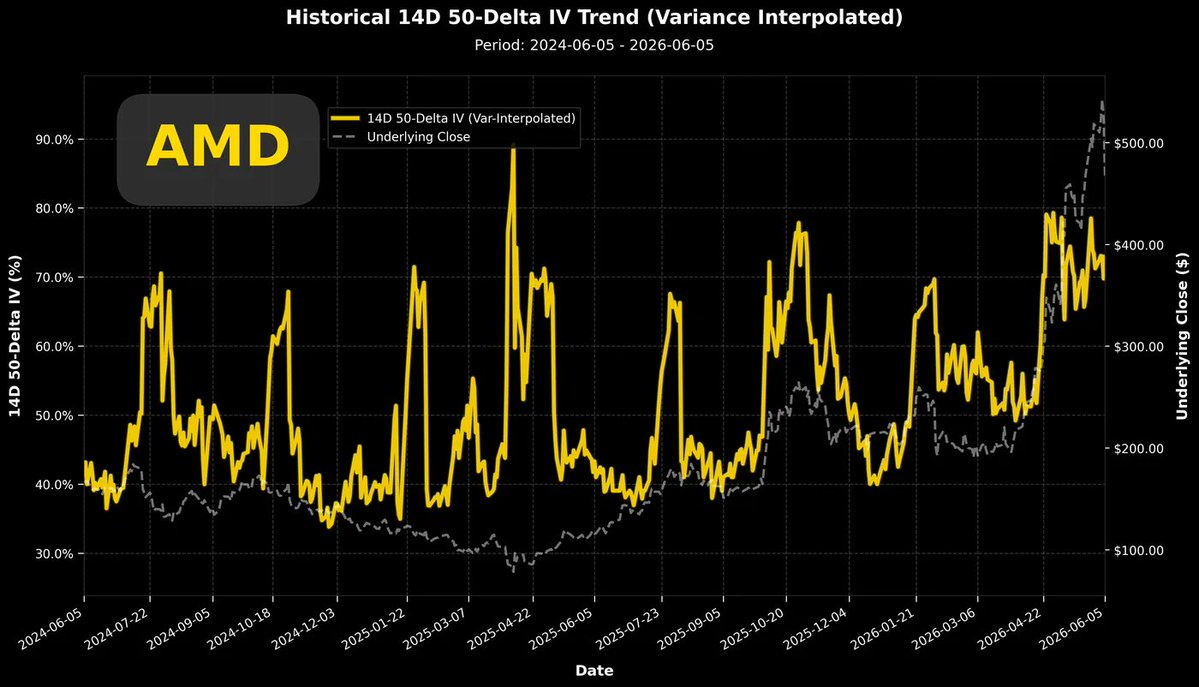
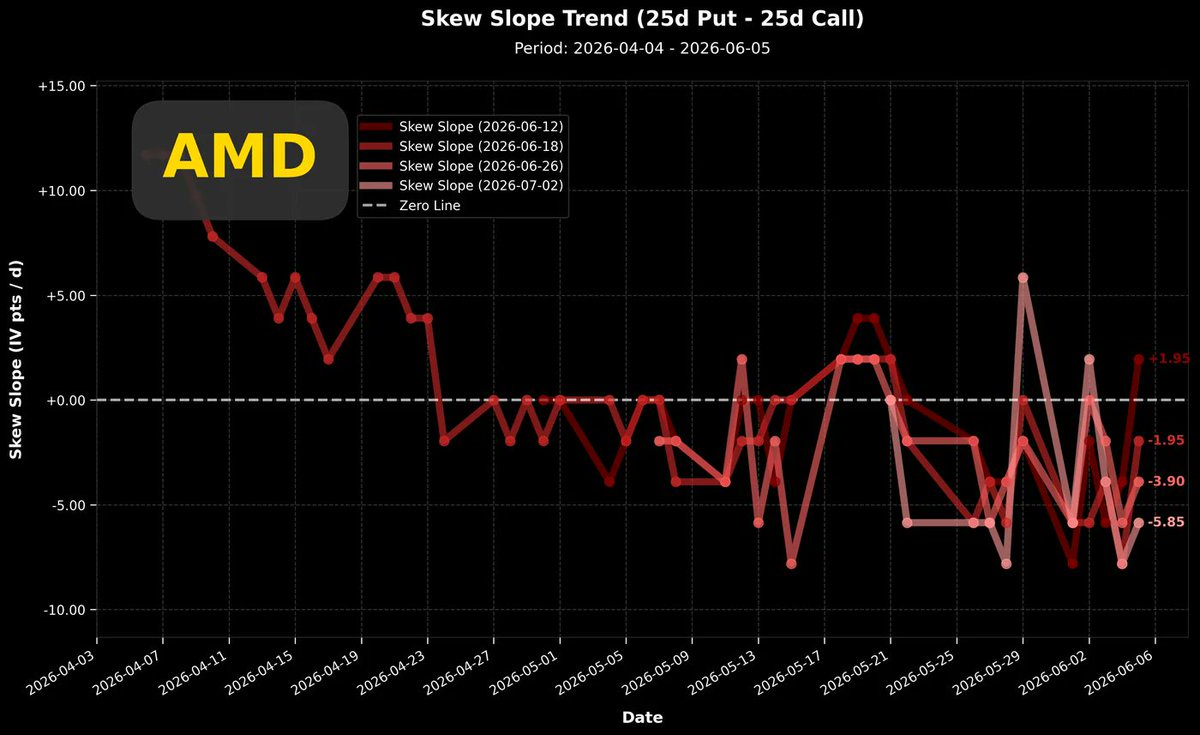
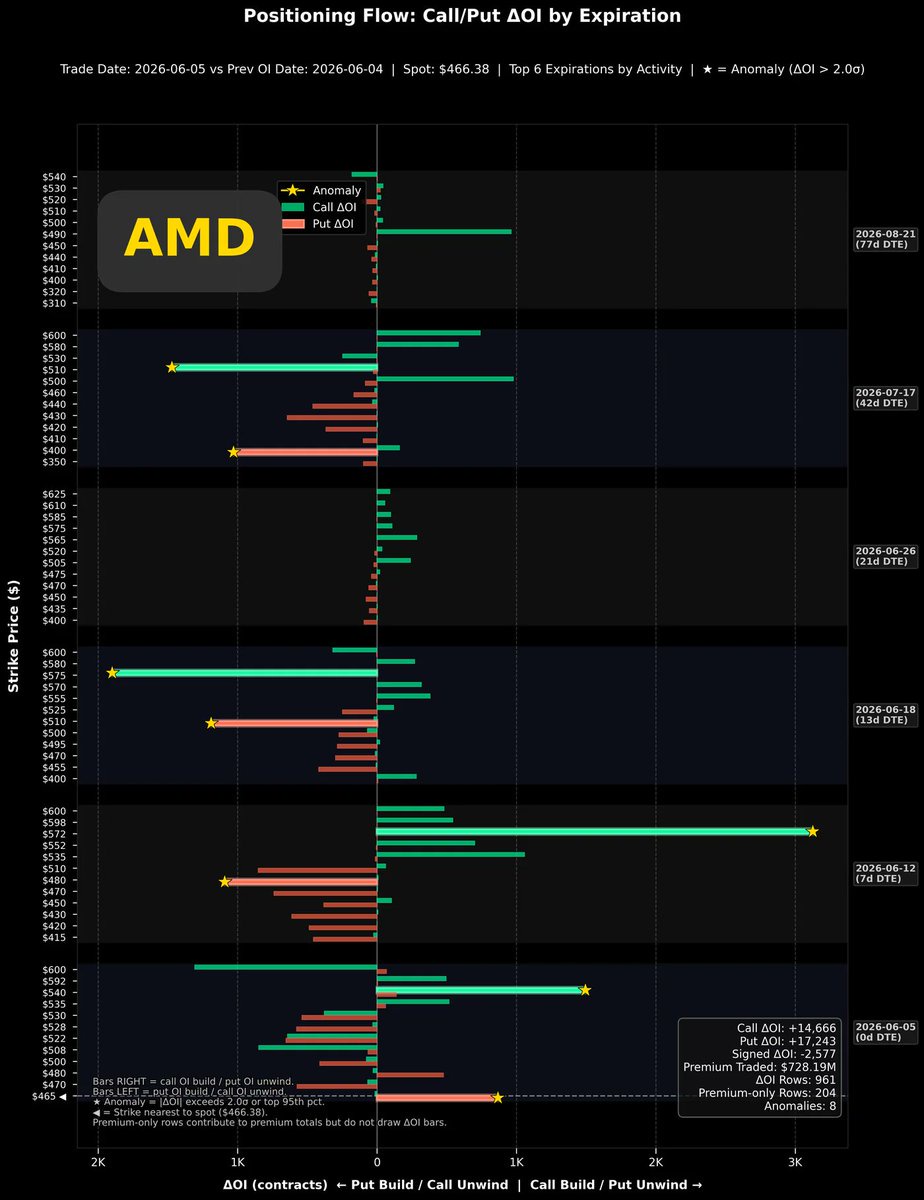
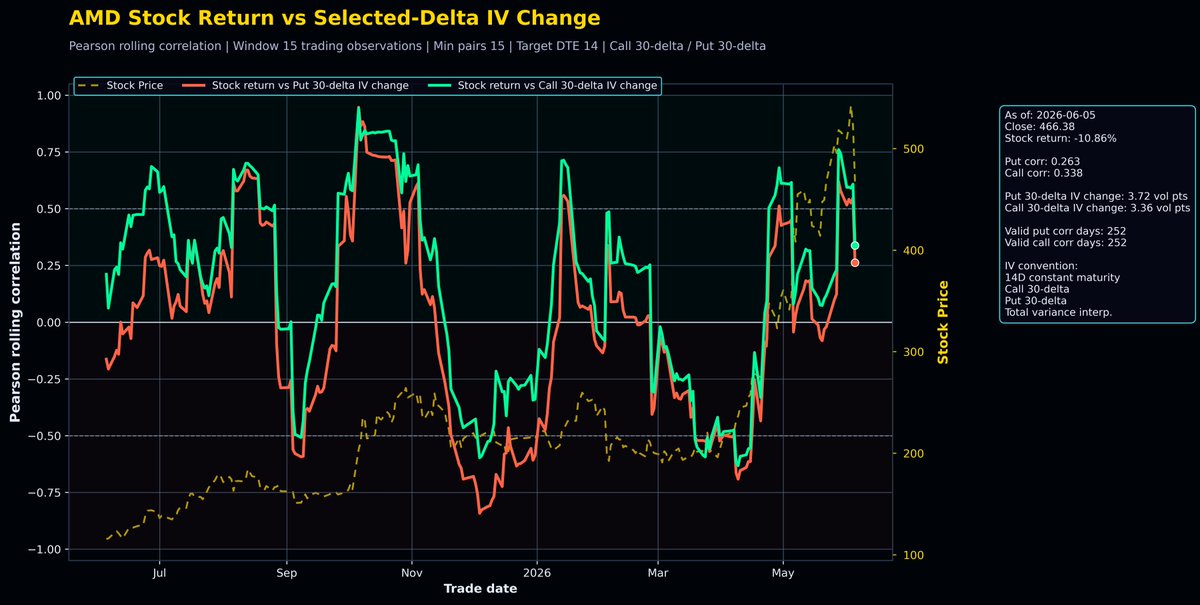
$AMD(AMD.US) (Advanced Micro Devices) suddenly dropped 10.86% last Friday. Did such a sharp single-day decline produce any special patterns in the options trading data? I'll state my conclusion first: the existing structure remains unchanged. The top-left chart shows the two-year overall implied volatility. This chart reveals that after the last earnings report, the benchmark level of implied volatility was raised a notch, and volatility did not fall back to the pre-earnings benchmark. After the earnings, the trading atmosphere entered a new mood (or narrative). After last Friday's sharp decline, the current volatility level is still within the fluctuation range of the new benchmark. The top-right chart shows the recent Put/Call volatility spread. After last Friday's sharp decline, the volatility spread jumped upwards, but the magnitude of the jump is not large, still within the normal fluctuation range. After Friday's sharp decline, neither volatility nor the volatility spread has shown a new pattern. It seems that the current stock price volatility is still considered by market participants as a normal release of energy for $AMD(AMD.US). The bottom-left chart is the single-day position change chart. It shows some long positions closing out, but more significantly, put options being opened across a fairly wide range of strike prices. These trades can't be clearly attributed to who is exiting or entering, as under these general position changes, the volatility spread didn't change much, only shifting slightly towards puts, with no clear directional bias observed. The bottom-right chart shows the correlation coefficient between stock price returns and volatility. Last Friday's decline also caused the correlation coefficient to plummet from above 0.5 (positive correlation). If it could touch zero, it would be more reassuring, because after May, there was a local stock price low point, which was accompanied by the correlation coefficient briefly touching zero. If it doesn't even touch zero, it doesn't look like a complete stock price pullback pattern. Summary: While $AMD(AMD.US)'s stock price is pulling back, volatility hasn't changed much. Position changes show increased buying interest in Puts and some call options closing out, but these are minor. The structure presented by the options trading data is the same as before the sharp stock price decline. According to correlation analysis, we are indeed in the consolidation phase of a stock price pullback. If the subsequent correlation coefficient can drop to negative or at least touch zero, then we can start watching for the emergence of a local bottom in the stock price.
The copyright of this article belongs to the original author/organization.
The views expressed herein are solely those of the author and do not reflect the stance of the platform. The content is intended for investment reference purposes only and shall not be considered as investment advice. Please contact us if you have any questions or suggestions regarding the content services provided by the platform.
