D
Jul 22 at 10:03 PM
TSLA (2Q26 Trans): Optimus V4 capacity target: 10 mn units/yr
Dolphin Research has compiled$Tesla(TSLA.US) FY26 Q2 earnings call highlights. For our take on the print, see 'Tesla: Holding auto GP, can the AI masterplan wait?'.
I. Key takeaways
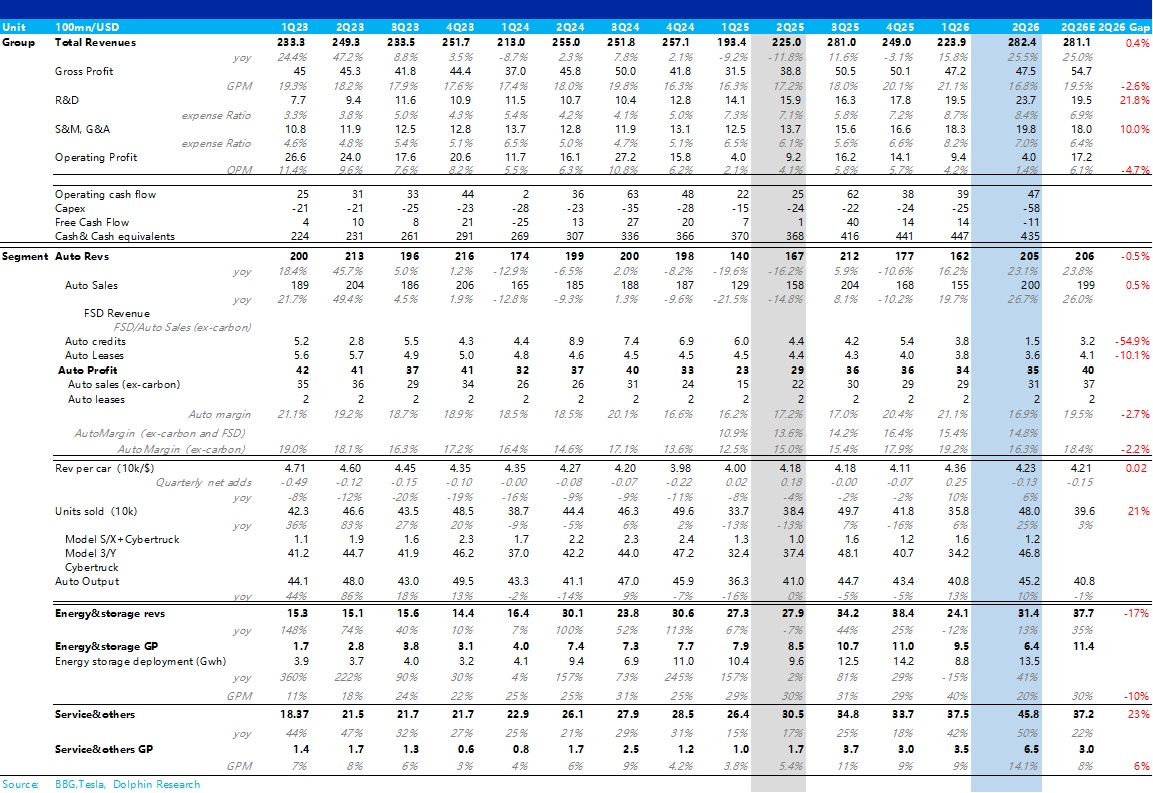
1. Guide and CapEx: Full-year CapEx remains guided at $25bn+, stepping up further in 2H (CapEx more than doubled QoQ this quarter, flipping FCF negative). Management expects CapEx to keep rising over the next 2–3 years for the Robotaxi fleet, Optimus capacity, a semiconductor fab, solar manufacturing, and AI compute; Opex (mainly R&D) will continue to climb through 2026 and beyond. Energy GPM is expected to normalize in the low-to-mid 20% range over the long term.
2. Key operating and profit metrics (QoQ):
- Global deliveries hit a Q2 record, with Americas +60%, APAC +27%, and EMEA +12% (records in the Netherlands, Australia, and New Zealand). Quarter-end backlog was the highest since 2023. - Auto GPM ex-regulatory credits fell from 19.2% to 16.3%. Adjusted for a $230mn one-off tailwind in Q1 (voluntary reversal and tariff relief not repeated in Q2), margins were roughly flat; higher rates lifted subvention costs recognized upfront as a contra-revenue, weighing on auto GPM. - Energy deployments were 13.5 GWh (+53% QoQ; second-highest quarter ever). But energy GPM dropped from 39.5% to 20.4%, driven by a ~$240mn voluntary reversal tied to legacy projects' supplier cell issues, non-repeat of >$200mn tariff benefit from Q1, and lower industrial storage ASP amid competition. - Services & other GPM improved from 9.2% to 14.1%, a record high, on volume leverage and better cost control across the fleet businesses (used cars, Supercharging, service centers, insurance, etc.). - FSD: In North America, ~55% of deliveries had an active FSD subscription at delivery. Global paying FSD users are near 1.5mn (55% one-time purchase, 45% subscription). With buy-out removed in most markets, future FSD monetization will be subscription-led.
3. Below-the-line impacts: Net income was boosted by a +$1.0bn FV gain on SpaceX holdings, partly offset by ~$300mn FX losses and ~-$100mn Bitcoin losses.
4. Capital structure: The company is opportunistically securing debt capacity and can borrow up to $30bn to accelerate investments. Management reiterated a commitment to capital-efficient deployment.
II. Call details
2.1 Management remarks
1. Autos and demand
a. Q2 deliveries set a record, and Model Y has become the world's best-selling model (all body types), with momentum still building. b. FSD is the core demand driver: in markets where FSD is approved, take rates are high; many US customers visit stores primarily for FSD and then choose a car. As more countries approve FSD, management expects a similar demand uplift. c. Capacity is the main constraint, with supply chain limits beyond batteries into electronics. The team is signing strategic agreements with suppliers to remove bottlenecks.
2. Robotaxi and autonomy
a. Safety record is 'impeccable': over 380k miles of unsupervised Robotaxi driving across 2 states and 6 cities, with zero major accidents (only incidents were others hitting a stationary vehicle). Management says this validates the pure-vision stack — no LiDAR, radar, or HD maps, just cameras — as safe, comfortable, and affordable. b. Expansion cadence: unsupervised miles have been compounding at double digits WoW (>10%/week) YTD, with full-year pace expected to hold. The service now spans 7 US markets (incl. Florida, Texas, and the Bay Area), and time-to-launch per city is trending toward zero, with an end goal to operate by 'state' rather than city. c. The multi-city rollout, rather than maxing a single city, is to prove stack generality and work through software and ops issues with small, controlled fleets. As Robotaxi vehicles run near around-the-clock, a small fleet can generate large miles, so management tracks 'unsupervised miles' over vehicle count.
d. Software: the active Robotaxi fleet runs early V15 FSD. V15 has ~7 major improvement tracks in parallel, with ~40% already merged into the fleet build; internal signals suggest bets are paying off and can support sustained acceleration. e. Cybercab: manufacturing targets are aligned with the projected ramp in unsupervised miles. The same V15 models that power Model Y and other platforms will also power Cybercab; as Cybercab uses an all-new chassis, Tesla is first collecting chassis-specific driving data with retrofitted cars adding a wheel and pedals, before scaling vehicles and cities materially. f. Robotaxi will remain fully vertically integrated. Demand should not be an issue, with very attractive unit economics; the constraint is the 'March of 9s' in reliability. The strategy is to move as fast as possible without harming anyone, as any incident would draw headlines and tighter oversight.
3. Optimus (humanoid)
a. Elon reiterated Optimus will be the 'biggest product ever', but also Tesla's hardest to mass-produce. Nearly all parts are net-new with no off-the-shelf supply, requiring in-house production or building supply chains from scratch. b. Lines: the former Fremont Model S/X space is being converted for Optimus lines. Given new components, the early ramp will have a prolonged flat phase before the normal S-curve. c. Target: achieve human-level and beyond hand dexterity. Gen 3 aims to match human form and human-grade function and dexterity. d. Data flywheel: the humanoid form enables learning from human behavior — daily factory work, small high-quality demonstrations from data-collection teams, and large volumes of task demos from the internet. Then 'Optimus Academy' will let many bots practice tasks, using RL to learn from successes and failures toward superhuman performance, with an end-to-end approach (signals in, control out) by the same team behind FSD V12–V15.
4. AI chips, Terafab and compute infra
a. Terafab: billed as one of the most ambitious advanced manufacturing/semiconductor programs ever, with a separate reveal planned. A development line has been ordered in Austin, integrating litho/masks, logic, memory, packaging, and test in one building for rapid iteration; Terafab is critical to scaling Optimus to avoid chip bottlenecks and is being advanced with SpaceX. b. AI chips: Elon is very bullish on Tesla's in-house AI chips, calling them the 'best edge compute chip globally'. The upgrade path includes moving camera-based vehicles to stronger AI boards (HW4/next-gen); AI5 is a moderate step up vs. AI4 and should enter volume next year, with the following gen targeted to start around mid next year and first used in Optimus; thanks to TSMC, Samsung, and Micron for support. c. Digital Optimus: porting Tesla's autonomy tech to 'computer use', controlling screens via real-time video rather than screenshots. This is essential for the physical Optimus operating touchscreens/computers; the effort is in collaboration with SpaceX, with large models like Grok acting as the 'manager' to break down and assign tasks. d. Distributed compute: Tesla is building a Megapack-like compute module ('megapod') combining large amounts of AI4 and x86 compute in a containerized unit. It can be deployed globally, including at Superchargers, which have ~7 GW power today and growing, leveraging aggregated distributed power for AI compute.
5. Energy
a. Storage is growing very fast and is seen as key to powering AI data center expansion. Backlog is healthy, and capacity is being added to meet current demand and future needs from data centers and broader electrification. b. Megapack 3 is about to enter production.
6. Capacity and manufacturing expansion (big CapEx year)
a. Multiple lines are entering production/ramp this year: Cybercab (in production), Optimus (ramping), Tesla Semi (in production), Megapack 3 (imminent), a lithium refinery (in production), cathode refining, cell expansions, and end-to-end solar manufacturing from silicon purification to cells and modules. b. Elon views this as the largest US industrial expansion since WWII, laying the groundwork for the next era.
2.2 Q&A
Q: On the Optimus supply chain — as you internalize and build capacity, do you see suppliers co-investing and onshoring in the US to scale faster and more capital-efficiently?
A: Suppliers have been very supportive and have invested heavily to back Optimus and Robotaxi. Notably, Samsung and TSMC are building fabs — TSMC in Arizona and Samsung in Texas — putting tens of billions into AI compute for Optimus and Robotaxi; Panasonic is investing billions to expand cell capacity. Karn: Samsung's fab will be heavily dedicated to future programs and is a multi-billion-dollar commitment. We see comparable investments in memory and new processes like MIM parts and flexible PCBs — non-linear tech better suited for robots than traditional auto supply. Where we cannot find the right partner, we build in-house, supported by strong manufacturing engineering and design teams. Elon: thanks also to Micron — with memory prices high, they made key multi-year capacity allocation decisions for Tesla on reasonable terms.
Q: Sensor rules for Robotaxi are evolving across states. What would be a reasonable approach from regulators to avoid under- or over-regulation?
A: We have made good progress in the US. The federal FMVSS process is moving toward acceptance of purpose-built AVs, and we appreciate the support; at the state level, cases like New Jersey are disappointing. As Ashok noted, we focus on vehicle performance — that is what ultimately convinces regulators and the public. The best regulation sets targets and lets innovators find solutions; prescribing 'solutions' before defining problems is not helpful. Tesla will continue to let real-world performance speak, and that is the basis for our expansion.
Q: What milestones would trigger faster Robotaxi fleet or market deployment — safety metrics like miles-per-incident, or others? And would you consider third-party distribution (e.g., ride-hailing platforms) to lift utilization, or stay fully integrated?
A: We expect Robotaxi to remain vertically integrated. Demand should exceed our service capacity given compelling economics, so the constraint is the reliability 'March of 9s' — how many nines you need before scale, ultimately pushing to 99.99999%. This is essentially the sole factor limiting Robotaxi growth.
Q: There is chatter about some form of SpaceX–Tesla combination. Do you see merger synergies, and is that reasonable from your standpoint?
A: As you can see, we already collaborate extensively with SpaceX, with growing overlap, especially on Terafab. We obviously cannot discuss any 'combined company' ideas now; if anything were to happen, it would follow proper process. Brandon (Legal): We continue to benefit from the relationship with SpaceX, with many mutually beneficial transactions. Earlier this year, we signed an investment and framework agreement to deepen collaboration on Terafab, digital Optimus, and more. Elon: There are additional synergies — Grok in the car powering digital Optimus; Starlink is being integrated into Cybercab and across models in available markets. Robotaxi needs connectivity everywhere — even Silicon Valley has cellular dead zones — and Starlink's ubiquitous coverage helps avoid service stalls and enables low-cost, high-bandwidth in-car experiences like 4K live sports. Management: As Ashok said about the Cybercab experience, once you are not driving, time opens up for calls, movies, and more — hence the big screen. We have started pilot rides inside the Austin factory, and connectivity proves crucial.
Q: Cities are being added, but in-flight vehicle count remains in the 'dozens' not 'hundreds'. Why not scale 1–2 cities (e.g., Austin) first before expanding, and what constrains vehicles in the field?
A: We are going multi-city to demonstrate generality and low-cost portability, and that is what we see internally. Growth is actually exponential but early, so it is less obvious externally; and as noted, Robotaxi fleets run near continuously while human owners drive only hours per day, so small fleets can rack up large miles — hence we track 'unsupervised miles' not 'vehicle count'. Ashok: We are solving ops as well as software, so broader placement helps us iron out issues with controlled small fleets before true scale. Elon: Cybercab also needs chassis-specific data before scaling, unlike Model 3/Y's huge installed base; we are calibrating with retrofitted Cybercabs with wheel and pedals, and counts and cities will rise meaningfully. Lars: City and state transport rules vary without a unified federal framework, so we must proceed city by city and will keep doing so.
Q: Following Lars — NHTSA Administrator Jonathan Morrison indicated on CNBC openness to removing pedals and possibly the wheel, which looks like a gating item for Cybercab scale. At the federal level, what else is needed to fully unlock Cybercab capacity?
A: Short answer: 'nothing'. We have a good relationship with Administrator Morrison; they are aligning to public needs and an obvious trend, working to stay ahead and do the right things. We have been transparent on plans and progress for years. We may not be perfectly in lockstep, but we do have a partner, and we are moving forward together.
Q: Semi autonomy — given the large TAM, when do you expect autonomy on the Semi?
A: Driver shortages are acute, trucking is critical, and autonomous Semis can ease shortages and improve safety and comfort. But Semi volumes remain small and will be a tiny share of our fleet even by year-end, so it is more rational to focus autonomy on high-volume models (Model 3/Y) and Cybercab and nail unsupervised autonomy there. We expect Semi autonomy to start around year-end or early next year, but we do not want it to distract from the Cybercab 'March of 9s'. So for ~6 months it will sit behind; next year it becomes a focus as Semi ramps.
Q: With Starlink integrated into Cybercab, beyond in-car streaming, could Cybercabs become mobile hotspots for Starlink Mobile?
A: There is an interesting angle: Tesla vehicles' Starlink terminals could act as a kind of 'base station' or relay to provide ground connectivity for phones or any WiFi user. That is another topic, and a fixed Starlink terminal also does the job.
Q: For Optimus semis (microprocessors, MCUs, actuators, etc.), will you use off-the-shelf, custom designs at third-party fabs, or fully in-house?
A: Optimus uses many highly specialized power electronics, designed by Tesla and manufactured by suppliers. By Optimus 4 (to be produced in Austin), the stack will be more vertically integrated with many stages brought in-house. The goal is an order-of-magnitude capacity increase — ideally ~10mn units per year for Optimus 4 vs. ~1mn for Optimus 3 — subject to overcoming extremely hard mass-production challenges.
Q: Timing for Optimus 4, and the plan to upgrade HW3 to HW4 to run FSD V15 and beyond — still intact?
A: Upgrading camera-based cars (below HW4) is reasonable and will be financially sensible at some point; otherwise other changes are needed. We actually prefer upgrading to the next-gen AI board: AI5 is a moderate step up from AI4 and likely in volume next year, and the following chip should start volume around mid next year and debut in Optimus. The AI chip team is moving fast; I am excited about Tesla's edge chip and think it will be the best in the world — if anyone has better, happy to meet and shake hands. Progress is solid, and thanks again to TSMC, Samsung, and Micron.
Q: CapEx pacing — to what extent are you 'capped' by diminishing efficiency, and to what extent is CapEx the key to removing supply constraints?
A: I ask the team to spend CapEx as fast as possible without too much waste. We are not optimizing for peak capital efficiency if it slows us down — it is a balance between efficiency and time; faster can deliver higher NPV even at slightly lower efficiency. I am happy with progress — the scale of parallel buildouts across so many areas is unprecedented, perhaps comparable only to Ford's Model T era — arguably the largest US industrial expansion since WWII. Vaibhav: All CapEx goes into productive assets — expansions for Optimus, Cybercab, the LFP plant, the Semi plant, even a semiconductor fab, and a major solar buildout in the US. (Elon: this is significantly underappreciated.) We aim to 10x US solar manufacturing; these are greenfield builds, and we are effectively acting as GC for nearly all sites given the scale. As Elon said, we are moving fast on many fronts and must make it work in the real world. Elon: CapEx efficiency scales well with size overall.
Q: On storage, will supply remain constrained for the foreseeable future? And how does current demand split between 'data centers' vs. 'utility peak shaving', given your comments on smoothing extreme power swings during AI training?
A: It is broader than peak shaving — it is grid balancing. Batteries are ideal to balance intermittent wind/solar; solar + batteries will power most of the world, just like every Starlink satellite runs on solar + batteries — the sun dwarfs other sources. The real constraint is AI: even hyperscalers struggle to 'power on' AI and find enough electricity while smoothing extreme, short-duration power swings during training — loads can drop ~70% in a very short time, requiring fast power electronics. That is why SpaceX is buying many Megapacks for data centers — mainly to smooth training loads — and it helps 'pull more' from the grid by assuring utilities you do not need power in the worst hours/days because batteries can carry you. In fact, batteries may be the best way to expand usable US electricity: the US has ~1.2–1.3 TW of generation but averages ~0.5 TW load, so capacity is ~2.5x average. Batteries alone could potentially double usable energy. We therefore expect Megapack demand to be extremely strong.
<End of transcript>
Risk disclosure and disclaimer:Dolphin Research disclaimer and general disclosure
Login to unlock17,958characters for free
This content is only available to signed-in users. Sign in to your Longbridge account to read the full post.