

Yesterday, $Bilibili(BILI.US) and $TENCENT(00700.HK) announced major moves — BILI issued a convertible bond and launched…
Yesterday, $Bilibili(BILI.US) and $TENCENT(00700.HK) announced major moves — BILI issued a convertible bond and launched a buyback, while Tencent fully exited its equity stake and subscribed to part of the CB. Dolphin Research walks through the mechanics first, then the impact.
1) Execution: viewed from BILI and Tencent
(1) BILI: net raise of $400mn
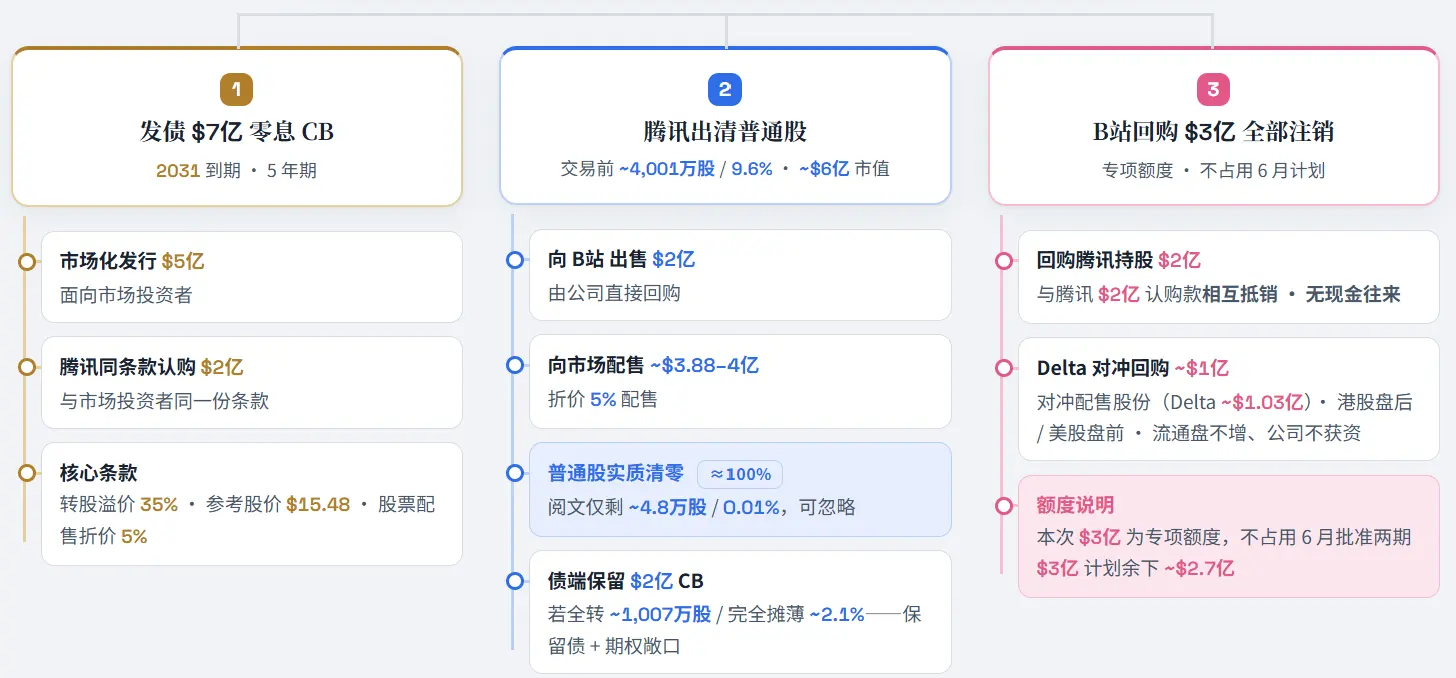
BILI is issuing $700mn of CBs in total, with Tencent taking $200mn and the remaining $500mn placed in the market. Concurrently, it conducted an equity placement of ~7mn shares worth $100mn, and will offset the placement via a matching $100mn repurchase and cancellation.
In addition, for the 40mn shares Tencent is selling (~$600mn), BILI will purchase $200mn worth.
Net-net, BILI raises $700mn and spends $100mn (placement hedge) plus $200mn (buying part of Tencent’s block), resulting in a net financing of $400mn.
(2) Tencent: fully exits equity, retains debt plus option-like upside via potential conversion
Before the deal, Tencent held 40.01mn BILI shares, a 9.6% stake (our earlier read on a 6% cut in May was incorrect). Post-transaction, Tencent exits its entire equity position, accepting a ~5% placement discount as the cost.
By subscribing to $200mn of CBs, it effectively keeps a debt position equal to roughly one-third of its prior equity value, with upside optionality via potential conversion.
2) Impact on BILI: near-term choppy, long-term constructive as the Tencent overhang is removed
(1) Tencent’s sale plus concurrent placement will still cause near-term volatility despite the buyback hedge
BILI’s CB carries a zero coupon and a 35% conversion premium vs. the reference price. In today’s high-rate environment, that does not appeal to traditional long-only investors. Hence the concurrent equity placement to help CB buyers establish initial short positions (delta placement).The logic is as follows: typical buyers are arbitrage funds, who go long the CB and short the underlying to hedge single-direction risk. They are not taking a directional view; they seek to monetize volatility.
Borrowable float in BILI is limited and borrow costs are high (China ADR short demand is elevated and dual listings fragment the borrow pool). If multiple CB buyers source borrow simultaneously in the open market, it would push borrow costs even higher.Therefore, the underwriters aggregate borrow supply via a delta placement to lower the borrow cost for CB buyers.
To mitigate the initial short interest’s impact on price moves, BILI executed a matching $100mn repurchase. While this helps offset shorting pressure in aggregate, the process can still introduce near-term swings.Meanwhile, of the Tencent block, BILI is taking $200mn, but another ~$388–400mn (~5%) still needs to be placed by the banks.
(2) Longer term: low-cost funding and removal of non-fundamental pressure
BILI is raising $700mn, and the $300mn of buybacks do not consume the existing authorization. Overall, net proceeds are $400mn.
The CB is zero-coupon with a high conversion premium (US ADS reference around $20, HK at HK$155), more than 40% above yesterday’s close. Near to mid term, equity dilution from the CB alone should be limited.
All in, funding cost is low, and the USD proceeds can be deployed into AI investment or further buybacks.
In the Q2 update, we highlighted the valuation overhang from Tencent’s potential selldown. We had expected Tencent to wait for some recovery before trimming.
In practice, Tencent moved fast (to raise USD for compute and buybacks), choosing to sell at a low price and accept a 5% discount rather than wait for a valuation rebound.
To preserve the strategic relationship (BILI is an effective channel for Tencent’s games and AI applications), Tencent still subscribed to $200mn of CBs. For Tencent, that effectively means receiving ~$400mn of cash.
For BILI, the selldown overhang is removed. Versus Tencent drip-selling or dumping in the open market, this structure is more conducive to share price stability.
3) BILI valuation: back to fundamentals; inflection tied to the new game cycle starting in Q4
Friday’s close implies a $6.37bn mkt cap. On adj. net profit of 3bn/4bn in 2026/27, that is ~14x/11x PE; with a mid-cycle multiple and matched growth, there is room for multiple repair, implying $8bn+ on 18x this year or 15x next year.
Near-term catalysts hinge on Q4 timing for 'Three Kingdoms: Kingship Under Heaven'. 'Shining Lumi' goes live in mid-Sep, but as a lighter casual title its contribution to the new cycle may be limited.
The copyright of this article belongs to the original author/organization.
The views expressed herein are solely those of the author and do not reflect the stance of the platform. The content is intended for investment reference purposes only and shall not be considered as investment advice. Please contact us if you have any questions or suggestions regarding the content services provided by the platform.