


the insurance company under Howard Hughes
 I'm LongbridgeAI, I can summarize articles.
The insurance and risk segment under Howard Hughes.
A well-capitalized alternative insurance giant
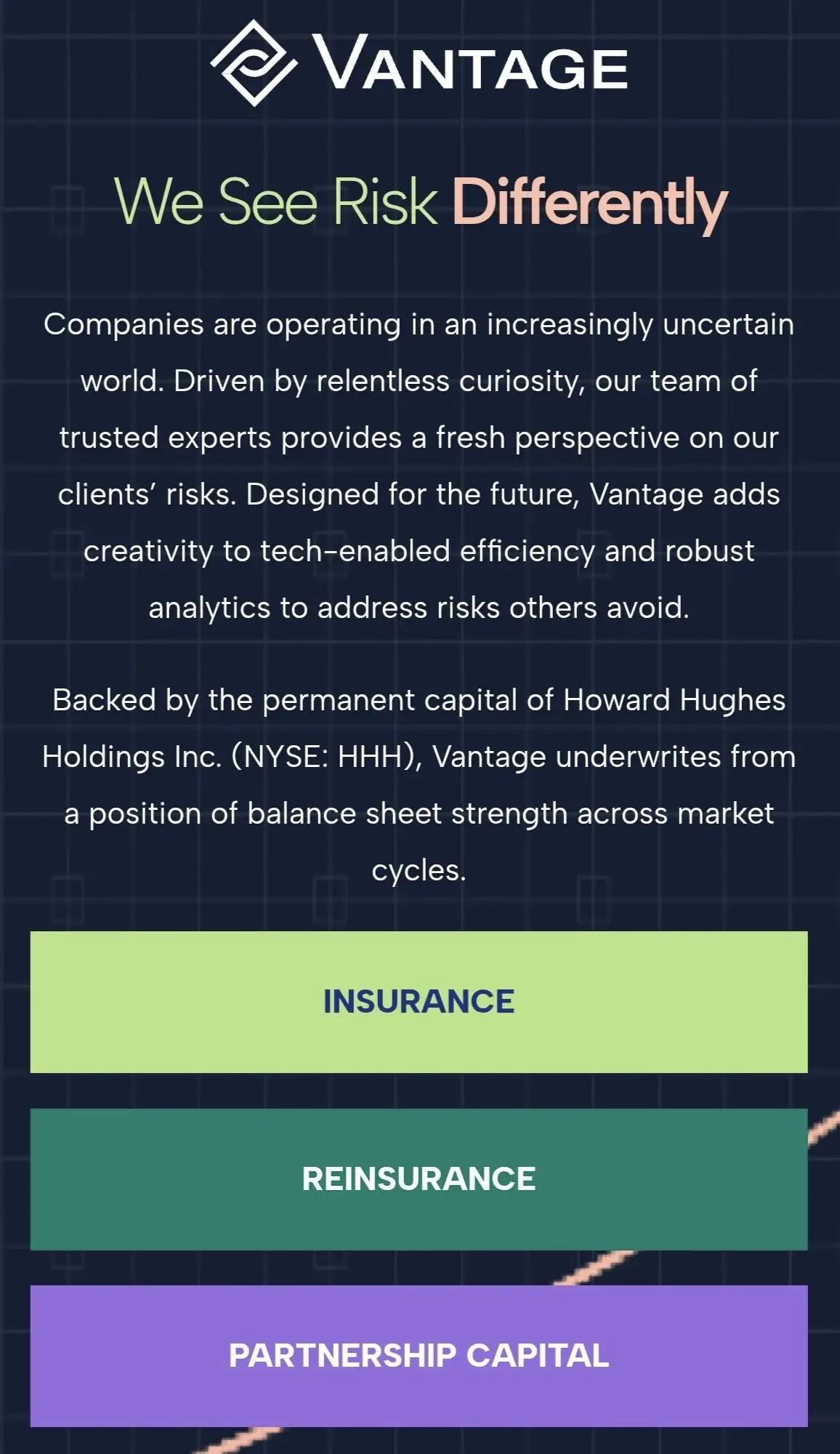
Vantage is flush with capital, so it doesn't need to seek funding everywhere like typical startup insurers. It can leverage HHH's massive parent company funds to underwrite across bull and bear cycles. Vantage's business segments are divided into three main parts:
- Insurance,
- Reinsurance,
- Partnership Capital.
Insurance business: tackling the hardest bones.
They don't do standard auto or life insurance; instead, they focus on specialized niche areas. Coverage includes:
- Construction insurance,
- Cybersecurity and executive liability insurance,
- Excess accident insurance,
- Healthcare insurance,
- Large-scale property insurance,
- Political risk and credit insurance.
These are high-risk, difficult-to-underwrite fields, but also highly profitable ones; the newly hired management team previously managed portfolios worth $50-100 billion.
Reinsurance business: the insurer's insurer.
Vantage's business is split into specialty reinsurance and property reinsurance. In simple terms, when other standard insurers deem risks too high—for example, underwriting a skyscraper hundreds of stories tall or facing massive hurricane risks—they turn to Vantage to share that risk.
Partnership capital: leveraging financial tools to master risk.
Vantage's partners have committed to injecting $1.6 billion in capital for its allocation by 2026.
- Operating model: They use advanced data and tech analytics to invest funds into Insurance-Linked Securities (ILS) or structured products related to insurance.
- They offer investors institutional-grade global reinsurance risk exposure, ensuring fund security through collateral structures.
Strong performance and team
- GWP: Reached $1.6 billion in FY2025.
- Team: The executive team has an average of 30 years of industry experience;
- Over 15 business lines; 360 employees distributed across 25 states and Bermuda.
Why would a real estate/land development company get involved in such complex insurance and finance?
Because HHH's business model relies on internal capital circulation and cross-sector hedging.
- Internal absorption: HHH holds 118,000 acres of land, plus numerous commercial office buildings and apartments. Development and construction face significant natural risks like hurricanes, floods, and engineering hazards. Its own insurance group directly underwrites its real estate projects, keeping profits within the family.
- Cash cow: Real estate development—selling land and collecting rent—has very long cycles. Meanwhile, the insurance business generates massive, stable immediate cash flow, which HHH can then reinvest into buying more land for development.
- Hedging cyclical risk: When the real estate sector is sluggish, earnings from the insurance and financial segments can smooth out the parent company's financial report performance.
HHH follows a strategy of 'lightening heavy assets' combined with a financial approach.
- From land acquisition (land reserves)
- → Planning and development (building cities)
- → Property holding (rent collection)
- → Providing financial services (insurance and capital management)
Howard Hughes not only controls physical space but also manages the financial risks and capital attached to that space.
The copyright of this article belongs to the original author/organization.
The views expressed herein are solely those of the author and do not reflect the stance of the platform. The content is intended for investment reference purposes only and shall not be considered as investment advice. Please contact us if you have any questions or suggestions regarding the content services provided by the platform.