
The pain of financial markets is essentially the intense friction between human evolutionary underlying code (pursuit of…
The pain of financial markets is essentially the intense friction between human evolutionary underlying code (pursuit of certainty, loss aversion, craving for instant feedback) and the market itself (randomness, uncertainty, anti-human nature).
As long as you are in the market, the following five types of pain are inevitable and unavoidable:
I. The Five Inevitable Pains
1. The Pain of Shattered Expectations (Unattainable Desires)
You buy expecting it to rise, but it falls. Psychologically, the pain of losing $10k is more than twice the joy of gaining $10k (loss aversion).
This pain directly stings the nerves.
2. The Pain of Self-Denial (Selling Too Early & Missing Out)
You sell a stock just before it moons, or cut your losses right before it hits the daily limit. This pain isn't about losing money; it's the extreme self-blame of 'Why am I so stupid?'—seeing clearly yet acting wrongly. It attacks your self-esteem directly.
3. The Fear of Losing Control (Anxiety)
Facing tomorrow's unknowns, sudden geopolitical crises, or a plunge in US Treasuries, you realize you can control nothing. The sleepless nights while holding positions are essentially a deep fear of 'losing control'.
4. The Torment of Comparison (Jealousy & Greed)
Seeing others make 10x on AI while your stock stays flat triggers jealousy. You can't resist chasing highs, eventually becoming the bagholder. Always comparing, always feeling inadequate.
5. The Agony of Loneliness
Trading is an extremely lonely practice. Your P&L, your discipline, your regrets cannot be shared with others. It's like driving alone to a small county town, bearing all the pressure, swallowing it all by yourself.
II. How to Reduce Pain from the Root?
Since pain stems from the conflict between code and laws, the antidote cannot be 'comfort', but rather reshaping your cognition and system. Categorized by essence:
1. Lower Expectations: Accept 'Pain' as the Physical Cost of Trading
Treat losses, selling too early, and missing out as the 'utility bills' and 'cost of goods' necessary for doing business. When entering a trade, mentally treat the stop-loss amount as money already spent. When you allow pain to happen, its impact on you is halved.
2. Separation of Tasks: Decouple 'Trading Results' from 'Personal Value'
The core concept of Adlerian psychology. A loss is merely the manifestation of market probability, not a character flaw. Detach the 'self'; trading is just executing a system. Losing money means the system is on the unfavorable side of probability, not that you are a failure.
3. Hedge 'Uncertain Markets' with 'Certain Rules'
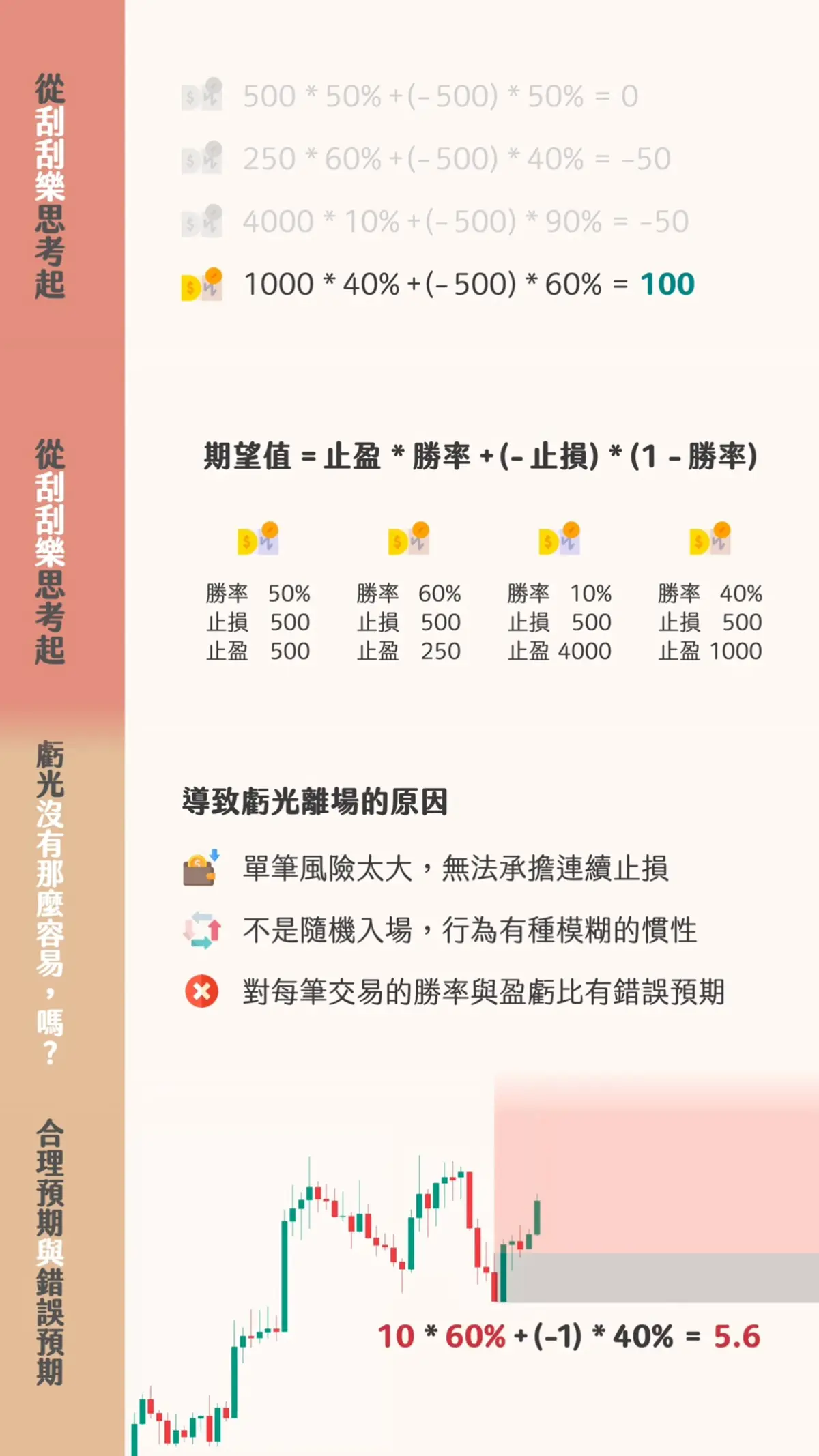
You can't change market uncertainty, but you can set absolutely rigid rules for yourself (e.g., single-trade loss limits, position caps). When your account floor is locked down tight, the fear of losing control drops significantly. You no longer fear how the market moves because you've already calculated the worst-case exit.
4. Abandon 'Comparison' and 'Omniscience'
Stop trying to catch every hot trend; stop envying others' doubling myths. Admit you are an ordinary person, only earning money within your cognitive scope and belonging to your system. Giving up the desire to earn every penny reduces pain by 80%.
 Long image
The copyright of this article belongs to the original author/organization.
The views expressed herein are solely those of the author and do not reflect the stance of the platform. The content is intended for investment reference purposes only and shall not be considered as investment advice. Please contact us if you have any questions or suggestions regarding the content services provided by the platform.