

A Medical AI Case Study Amid Cross-Market Divergence: Forbes Decodes Desai Tech's "Microsoft Office of Healthcare" Platform Strategy
 I'm LongbridgeAI, I can summarize articles.
The same underlying technology narrative is experiencing vastly different pricing dynamics across capital markets on both sides of the Pacific.$DIAGENS-B(02526.HK)
Over the past 52 weeks, US medical AI leader Tempus AI (TEM) saw its stock price fluctuate significantly between $40.77 and $89.09, gaining approximately 21% YTD as of November 13. Legacy giant GE HealthCare (GEHC) rose about 35% over the last six months but remained essentially flat for the year (Data source: Public quotes, as of close on Nov 13, 2026); in contrast, influenced by historical burdens from early "1.0 era" commercialization missing expectations and market liquidity structures, the entire medical AI sector in the Hong Kong market continues to see divergent pricing.
Is China's medical AI falling behind technologically, or is it undergoing a divergence in cross-market pricing logic?
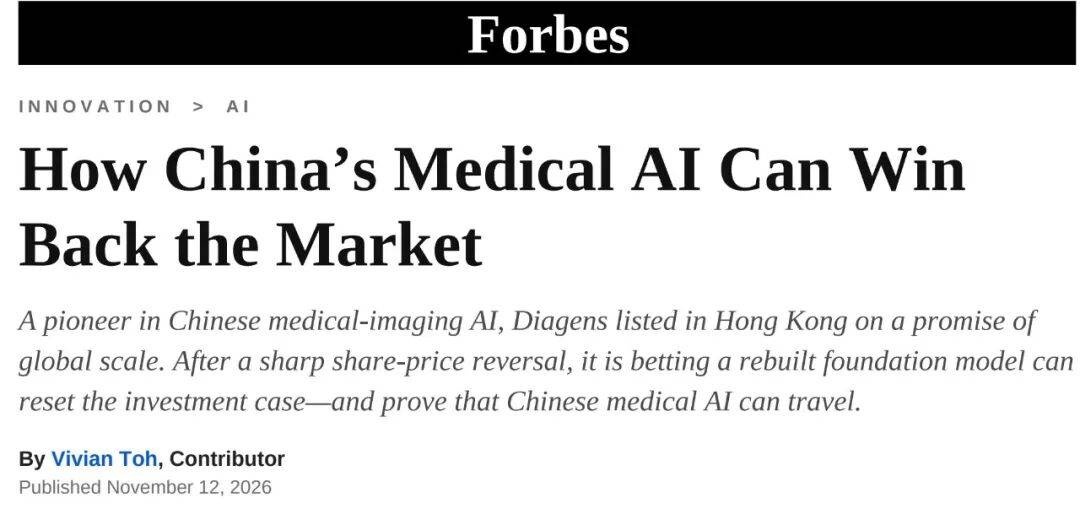
On November 12, authoritative international business media Forbes published an in-depth special report titled 'How China’s Medical AI Can Win Back the Market'. In this feature focusing on the valuation reshaping of Chinese medical AI, Forbes used Deshi Technology (02526.HK), the 'first global medical imaging large model stock' that listed on the HKEX Main Board in March this year, as the sole deeply analyzed industry benchmark case, stating directly that this trans-oceanic divergence is 'less a technological verdict on Chinese medical AI, and more a Pricing Anomaly'.
Coincidentally on the same day, Deshi Technology announced major upgrades to its sixth-generation medical imaging foundation model, iMedImage® 6.0 (abbreviated as iMed-6.0). A single post on its official overseas X platform garnered over 853K views globally within just 18 hours.
As discussion heat from the overseas tech circle and commercial scrutiny from international media converged simultaneously on this Hangzhou hard-tech enterprise, a core industry issue emerged: What gives new-generation platform players like Deshi Technology the leverage to rewrite the traditional commercial ledger of medical AI?
Beyond the 千亿-parameter arms race: Underlying reconstruction supports a 'Generalist Foundation'
Previously, the bottleneck preventing medical AI companies from achieving economies of scale lay in siloed development approaches like 'one plugin per disease' or 'one model per disease'—one system for lung nodules, another for retinal scans or fractures. High hospital procurement costs and cumbersome clinical switching left vendors trapped in endless customization, with high marginal R&D costs.
Breaking through this ceiling requires possessing a universal foundation capable of native cross-modal and cross-organ understanding.
As early as 2025, Deshi Technology's fifth-generation foundation model stood at the pinnacle of global medical imaging parameter scale with 104 billion parameters. However, this time, Chairman and CEO Dr. Song Ning actively poured cold water on the industry's 'parameter worship' during an interview with Forbes:
'Everything is new; our underlying architecture has undergone substantive reconstruction. The standard for measuring next-generation models lies in architecture and application, not parameter scale.'
Shifting away from brute-force compute stacking toward underlying cross-modal architectural reshaping, iMed-6.0's test results directly validate that 'smarter architecture beats brute compute':
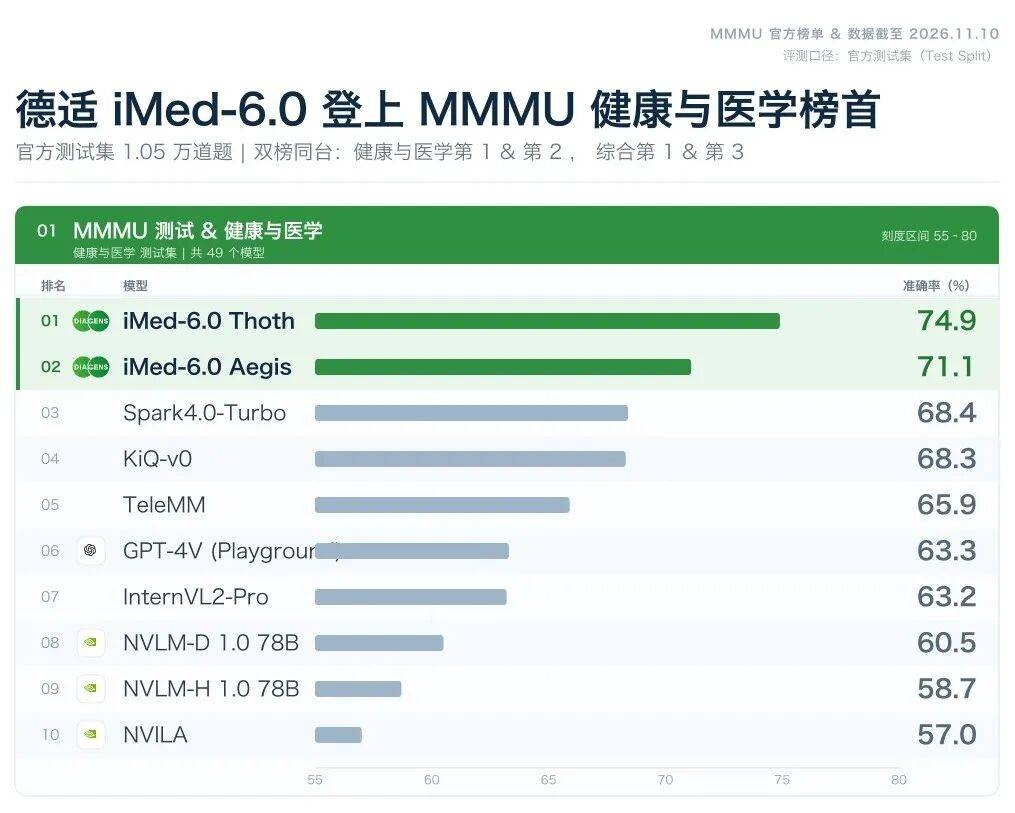
- Capturing top spots on dual authoritative domestic and international benchmarks: In the internationally recognized multi-disciplinary multi-modal benchmark MMMU (Test), flagship version iMed-6.0 Thoth achieved 66.2%, ranking first globally in the overall leaderboard, and jointly took the top two global spots in the core 'Health & Medicine' category alongside lightweight version Aegis (74.9%/71.1%). In the authoritative medical large model evaluation MedBench VLM, Thoth and Aegis not only secured the top two positions on the comprehensive leaderboard with scores of 64.4 and 61.7 respectively, but also demonstrated a 断层 performance in the core item 'Medical Visual Perception and Text Extraction', scoring 88.8 and 84.9 points, surpassing GPT-5.5 (48.2 points) by over 40 points, comprehensively outperforming mainstream general large models like Gemini-3.5-Flash and Claude Opus4.7 both domestically and internationally.

- A single lightweight foundation covers 509 thoracic and abdominal signs: More clinically penetrating is the general CT vertical model developed based on the lightweight version Aegis, which for the first time 打通 s chest (263 items) and abdomen (391 items) examinations on a single model. After deduplication, it synchronously covers 509 diseases and imaging signs across 8 major anatomical regions, directly addressing industry blind spots prone to missed diagnoses at the junction of traditional chest and abdominal CTs (such as the liver dome and lower lung base). In zero-shot technical validation (without fine-tuning on target sets) on nearly 40,000 pairs of real-world CT image reports from multiple hospitals, its macro-average AUC for 249 key clinical tasks reached a high of 0.930.
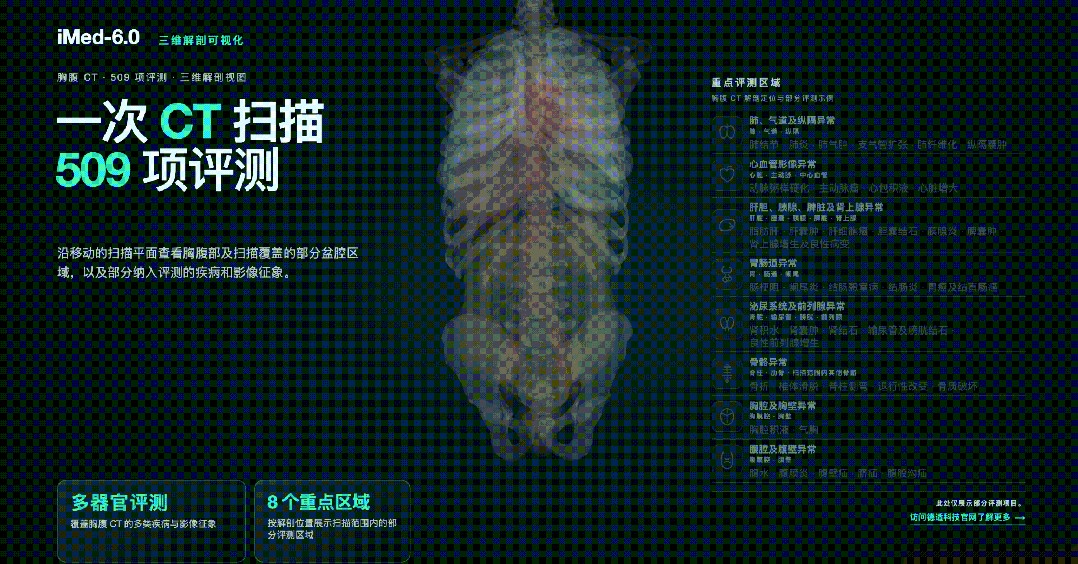
From an industrial evolution perspective, the true value of these data points lies in R&D economics: When a lightweight foundation can natively understand over 500 types of thoracic and abdominal abnormalities, support 19 medical imaging modalities, and cover over 90% of clinical scenarios without fine-tuning, downstream incubation of new disease models no longer requires tens of thousands of samples and long cycles of two to three years—this is precisely the technological singularity where medical AI transitions from 'heavy-asset artisan workshops' to 'industrialized software platforms'.
'The Microsoft Office of Medical Imaging': From Single Project-Based to Scalable Platform Economy
Forbes pointedly noted in its report that the capital market's scrutiny standards for medical AI have undergone a hard switch: 'Investors who previously paid for growth now demand empirical evidence of operating leverage.'
Many medical AI companies are still 'selling projects' rather than 'selling platforms,' leading to margin pressure due to customized delivery and a lack of recurring revenue.
The core 筹码打动 international observers about Deshi Technology lies in its iMedLoop™ full-process platform, which completely returns productivity tools to hospitals.

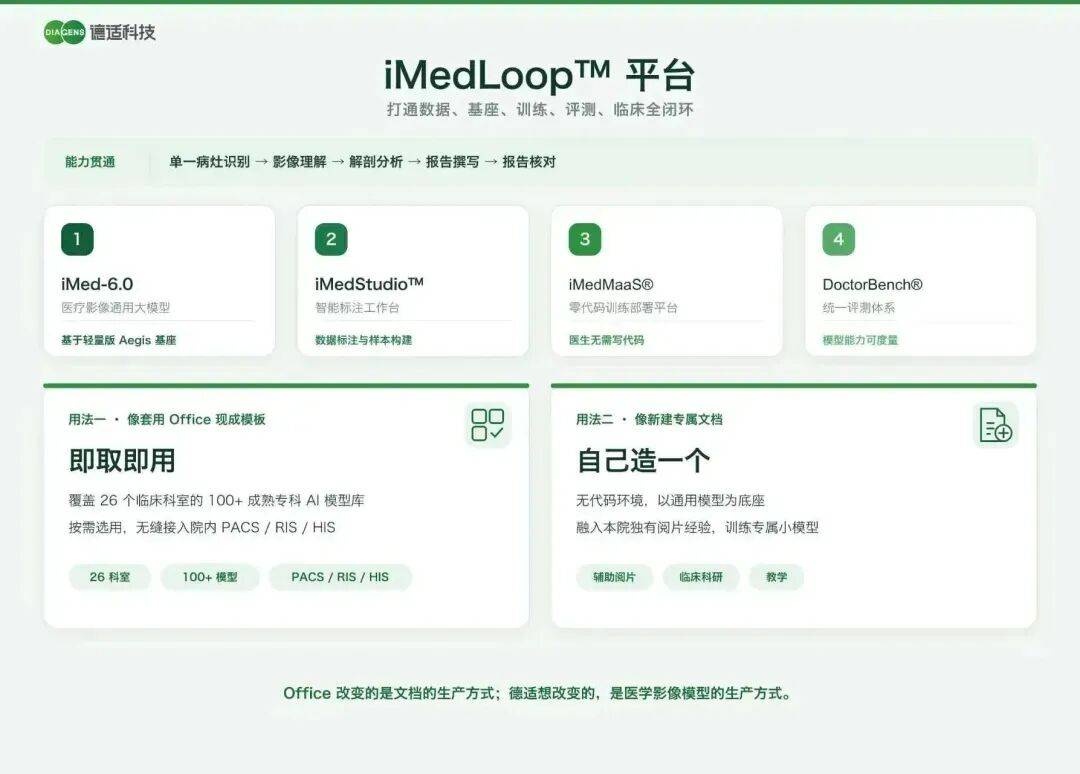
In the interview, Dr. Song Ning analogized the closed-loop tech stack consisting of the intelligent annotation workstation (iMedStudio™), the universal foundation (iMedImage® 6.0), and the training deployment middle platform (iMedMaaS™) as 'the Microsoft Office of the medical imaging world': Before Office was born, printing documents had to be sent to external professional print shops; after Office became popular, anyone could independently complete layout production right at their desk.
Similarly, leveraging the zero-code environment of iMedLoop™, clinical doctors who best understand complex cases do not need programming basics. Using only around 200 compliant samples accumulated by the department, they can autonomously train specialized AI copilots adapted to their hospital's disease spectrum within 2 to 3 months, compressing annotation workload to 1/200th of traditional levels and reducing comprehensive R&D costs to 1/10th.
This 'industrial mother machine' logic is already reflected in Deshi Technology's financial report structure:
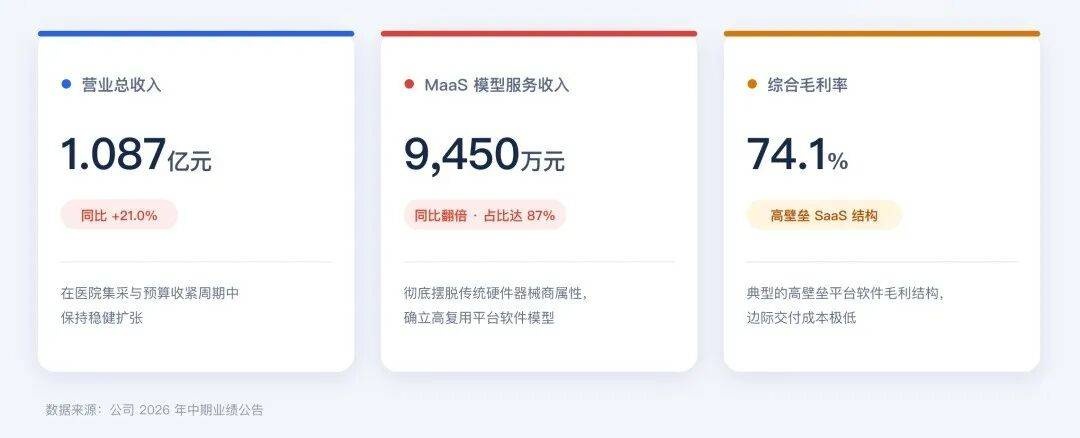
Huatai Securities predicted in a research report released in October 2026 that Deshi's model service revenue is expected to grow from approximately 242 million yuan in 2026 to about 1.111 billion yuan in 2028.
From a business model perspective, Deshi's growth logic is built on a cycle of 'foundation model — doctor co-creation — clinical charging': The stronger the foundation model's capabilities, the less time and cost required to develop new specialty models; doctor zero-code co-creation brings more clinical needs and professional experience, enabling the platform to develop more practically useful models; and as regional cloud models like 'examination at grassroots, identification in the cloud, review at provincial level' advance, more models are expected to enter hospital and regional cloud scenarios for continuous use, bringing recurring charges, as well as authorized data and feedback to feed back into the foundation capabilities. If this cycle can continue to operate, revenue growth is possible to outpace the growth of development and delivery costs—of course, each link in the cycle, including model capability, hospital participation, and willingness to pay, still needs to be verified one by one in practice.
Furthermore, the company's charging model has further upgraded. In September this year, Deshi Technology reached a strategic cooperation with 'Anzhen'er', the Zhejiang operational entity of the National Artificial Intelligence Application Pilot Base (Medical), exploring a hierarchical diagnosis and treatment closed loop relying on the provincial medical cloud ecosystem ('examination at grassroots, identification in the cloud, review at provincial level'), and entering the inference service model charged by case/token call volume. Once volume-based billing runs smoothly at scale in regional health clouds, the bottleneck of single hospital procurement budgets that has plagued the industry for years will be transformed into sustainable cash flow.
Regarding short-term book losses (net loss of 55.9 million yuan in the first half) concerned by some market voices, Forbes also objectively pointed out that in a cycle where the industry is generally contracting and defending, Deshi Technology is a typical 'counter-cyclical strategic investor'—high-intensity investment in compute and architectural reconstruction is essentially building extremely high entry barriers for the next stage of global scale expansion.
Facing Forbes' Ultimate Three Questions: Anchoring Global Revaluation with the Stability of 'Qi Zong'
Of course, as a rigorous international business analysis, Forbes did not shy away from the thresholds Chinese medical AI must cross to reach global maturity, and threw out the 'three major tests' determining the long-term valuation cap at the end of the article: The first overseas hospital to pay, the first independent clinical trial verification, and the first year of truly scaled recurring revenue.
Looking closely at Deshi Technology's moves over the past half-year, its moat around these three exam questions is clearly visible:
- High-barrier regulatory access first: The company's core product, AI AutoVision® Chromosome Karyotype Auxiliary Diagnosis System, obtained the Class III Medical Device Registration Certificate from the National Medical Products Administration (NMPA) in May this year (the world's first Class III certificate approved based on a large model), while holding EU CE certification, and reached deep cooperation with international genomics leader Bionano Genomics. The US FDA Class II review is proceeding as planned (expected to land in Q1 2027).
- Dual positioning in industry-academia-research and going global: The company recently not only partnered with The Hong Kong Polytechnic University (PolyU) to co-build the 'Joint Laboratory for General Artificial Intelligence and Medical Applications' to strengthen international academic evidence, but also reached a three-year strategic cooperation with Guangxi Yongjiang Laboratory, using ASEAN as a springboard to accelerate the overseas commercial replication of the 'in-hospital self-training platform'.
- Institutional side of capital markets: Since August this year, Deshi Technology has successively been included in 23 authoritative indices such as the Hang Seng Composite Index and the Hang Seng Stock Connect AI Theme Index, officially entering the pool of eligible stocks for Stock Connect, and has recently continued to receive net inflows from southbound funds for increased holdings.
Facing short-term market volatility, Dr. Song Ning defined Deshi Technology as the 'Qi Zong' (Internal Style) in Chinese martial arts, which first spends time building solid internal foundations, and firmly stated: 'Stock prices will fluctuate in the short term; what truly matters is whether investors can understand the business and believe in the long-term strategy—that is the most precious value investment.'
Penetrating the pricing temperature difference across markets, the second half of medical AI ultimately must return to the hardcore test of clinical real value and commercial sustainability. Tempus has verified that medical data and AI can form large-scale commercial volume, and public research reports provide Deshi Technology with a growth path that can be tested year by year. If Deshi Technology can achieve revenue scale as scheduled along this path and gradually run through continuous service charging and operating leverage, the commercial ledger of Chinese platform-type medical AI will also welcome a brand-new benchmark for scrutiny.
The copyright of this article belongs to the original author/organization.
The views expressed herein are solely those of the author and do not reflect the stance of the platform. The content is intended for investment reference purposes only and shall not be considered as investment advice. Please contact us if you have any questions or suggestions regarding the content services provided by the platform.