
Global market size reaches $855 million in 2025! Analysis of 2-in-1 solar street lights with a 6.3% CAGR from 2026 to 2032
 I'm LongbridgeAI, I can summarize articles.
1. Executive Summary
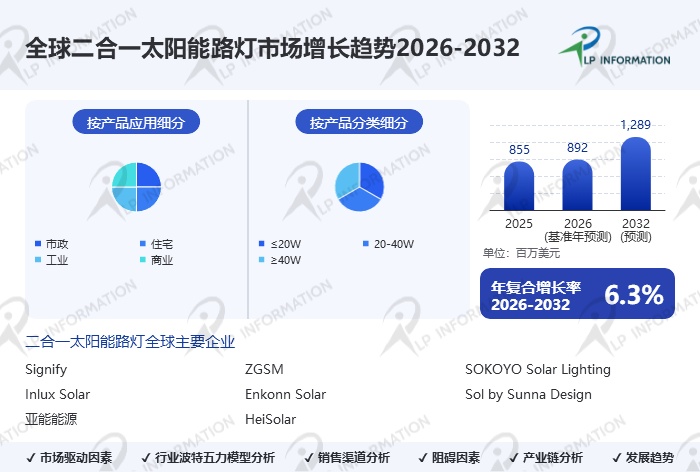
The two-in-one solar street light, featuring a design with independent photovoltaic (PV) panels and integrated luminaires, offers significant advantages in charging efficiency and reduced wiring costs. According to LP Information data, the global market size was approximately $855 million in 2025 and is projected to reach $1.289 billion by 2032, representing a CAGR of 6.3% from 2026 to 2032. Despite challenges such as tariff policy shifts, leading companies with high-efficiency designs and resilient supply chains (e.g., Signify) are poised to dominate the market driven by global municipal and off-grid lighting demand. The industry is evolving towards higher photoelectric conversion efficiency and cost-effectiveness.
2. Industry Overview
A two-in-one solar street light is an outdoor lighting system that integrates LED fixtures, batteries, controllers, sensors, and lighting modules into the luminaire body, while the solar panels are installed separately. This design allows for optimal sun angle exposure, enhancing power generation efficiency. Compared to traditional grid-tied and all-in-one street lights, it offers lower wiring costs, flexible installation, and higher generation efficiency. In terms of market size, the global market was valued at approximately $855 million in 2025 and $892 million in 2026, expected to reach $1.289 billion by 2032, with a CAGR of 6.3% from 2026 to 2032. Global production reached 2.13 million units in 2025, with an average selling price of $410/unit and a gross margin of approximately 20%-40%. The industry is significantly influenced by policies and supply chain dynamics, maintaining steady growth overall.
3. Product Classification
By power output, two-in-one solar street lights are mainly categorized into ≤20W, 20-40W, and ≥40W, suitable for rural paths, community roads, and main arteries, respectively. By installation height, they are divided into 3-4m, 4-6m, and others, with height selection directly linked to illumination area and power requirements. The core of the product lies in the separation of the PV panel and the luminaire, facilitating angle adjustment to maximize sunlight absorption. With technological advancements, mid-to-high power products integrating higher-capacity lithium batteries and smart charge/discharge controllers are gaining share, ensuring battery life during consecutive cloudy days while meeting illumination requirements for various scenarios.
4. Application Scenarios
Applications are primarily segmented into municipal, residential, industrial, and commercial sectors. Municipal roads and rural off-grid areas represent the largest application scenarios, mainly aimed at reducing wiring costs and addressing insufficient grid coverage. Residential communities, commercial parks, and school parks focus more on aesthetics and intelligent control features (e.g., motion sensors, light control). Industrial zones and parking lots prioritize high brightness and long battery life. Additionally, these products play a crucial role in remote areas lacking stable power supply and in landscape squares.
5. Competitive Landscape
The global two-in-one solar street light market exhibits high concentration. Key players include Signify, Inlux Solar, Yaneng Energy, ZGSM, Enkonn Solar, HeiSolar, and SOKOYO Solar Lighting, with the top three global manufacturers holding a significant market share in 2025.
Industry Dynamics: Signify leverages its position as a global lighting giant to continuously integrate high-efficiency PV components with IoT control systems. Domestic firms like Yaneng Energy and ZGSM are expanding rapidly in Asia-Pacific and emerging markets, relying on mature optical designs and cost control. Enkonn Solar and HeiSolar demonstrate strong competitiveness in off-grid and customized commercial solutions. Meanwhile, facing trade barriers such as US tariffs, some leading companies are accelerating regional supply chain layouts and overseas factory construction to maintain pricing and delivery advantages.
6. Global Regional Market Analysis
Global market regional differentiation is pronounced. The Americas (US, Canada, Mexico, Brazil) demand is driven by municipal and off-grid projects, with competitive environments fluctuating due to tariff policies. Europe (Germany, France, UK, etc.) imposes strict standards on product design and energy efficiency, with Germany being a core market. The Asia-Pacific region (China, Japan, South Korea, India, Southeast Asia) is the fastest-growing area due to infrastructure construction and rural lighting projects, where Chinese manufacturers hold strong competitiveness. The Middle East and Africa (Egypt, South Africa, Gulf states, etc.) have huge potential for off-grid lighting demand, driven by weak grid infrastructure and abundant sunlight resources.
7. Supply Chain Analysis
Upstream Raw Materials: Includes solar panels, LED chips, lithium batteries, charge controllers, sensors, aluminum alloy housings, and PCBs. Core components (e.g., high-efficiency PV panels and long-life lithium batteries) account for a high cost proportion, with their technical parameters directly determining end-product performance.
Midstream Manufacturing: Covers luminaire structural integration, battery management, optical design, waterproof testing, assembly, and aging tests. Midstream processes must address the matching between independent PV panels and luminaires, ensuring product durability and waterproof ratings; certification and quality control are key barriers.
Downstream Applications: Encompasses municipal, rural roads, residential, and industrial/commercial parks. Related services extend to lighting solution design, installation guidance, project commissioning, and after-sales battery replacement and spare parts supply. The completeness of the service network directly impacts customer stickiness.
8. Drivers, Restraints, and Future Trends
Drivers: 1. Surging infrastructure demand in off-grid and weak-grid regions globally; 2. Policy subsidies and promotion for energy-saving and green energy lighting by various countries; 3. Declining costs of solar components and lithium batteries, improving overall product cost-effectiveness.
Restraints: 1. Lifespan and degradation issues of core components (e.g., high-energy-density lithium batteries) under extreme weather; 2. Increased cross-border expansion costs for multinational enterprises due to trade friction and tariff policies; 3. Insufficient understanding of product quality standards in some emerging markets, leading to low-price, low-quality products disrupting the competitive landscape.
Future Trends: 1. Upgrading towards higher power and intelligence (e.g., IoT connectivity, adaptive dimming); 2. Accelerated regionalization and localization of the supply chain to mitigate tariff risks and enhance resilience; 3. Further optimization of PV panel and luminaire structural design to pursue higher photoelectric conversion efficiency and integrated aesthetics.
9. Conclusion
The global two-in-one solar street light market is in a period of steady growth, with a projected CAGR of 6.3% from 2025 to 2032. The independent PV panel design provides unique advantages in generation efficiency and installation flexibility, aligning with global low-carbon and off-grid lighting needs. Facing intense market competition and trade policy changes, companies need to build moats in high-efficiency R&D, localized supply chain layout, and comprehensive service capabilities to seize the broad opportunities brought by municipal and industrial/commercial lighting upgrades.
10. FAQ
Q1: What is the market size and growth rate of two-in-one solar street lights?
A: According to LP Information data, the global market size was approximately $855 million in 2025 and is expected to reach $1.289 billion by 2032, with a CAGR of 6.3% from 2026 to 2032.
Q2: What are the main classifications of two-in-one solar street lights?
A: Classified by power into ≤20W, 20-40W, and ≥40W; by installation height into 3-4m, 4-6m, and others; applications cover municipal, residential, industrial, and commercial categories.
Q3: Who are the major global manufacturers of two-in-one solar street lights?
A: Mainly including Signify, Inlux Solar, Yaneng Energy, ZGSM, Enkonn Solar, HeiSolar, SOKOYO Solar Lighting, etc., with the top three global manufacturers holding a high market share in 2025.
Q4: What are the main advantages and supply chain structure of this product?
A: The advantage lies in the adjustable angle of the independent PV panel for better sunlight capture, reducing wiring costs and suitability for off-grid areas. The upstream consists of battery panels, LED chips, and lithium batteries; midstream involves structural integration and assembly testing; downstream applications include municipal roads and park scenarios.
11. Sources
Data and information in this article are excerpted from LP Information's "Global Two-in-One Solar Street Light Market Growth Trend 2026-2032", as well as public materials from company websites (e.g., Signify, ZGSM), official industry associations, and news media. Core data such as market size, production volume, prices, and company shares are sourced from LP Information research reports; analysis regarding US tariff policies and supply chain resilience references publicly available macroeconomic and trade information. Any other cited public data has been noted in the text.
The copyright of this article belongs to the original author/organization.
The views expressed herein are solely those of the author and do not reflect the stance of the platform. The content is intended for investment reference purposes only and shall not be considered as investment advice. Please contact us if you have any questions or suggestions regarding the content services provided by the platform.