
Driven by medical imaging upgrades and industrial quality control: the global X-ray tube market is projected to reach $2.409 billion by 2032
 I'm LongbridgeAI, I can summarize articles.
1. Executive Summary
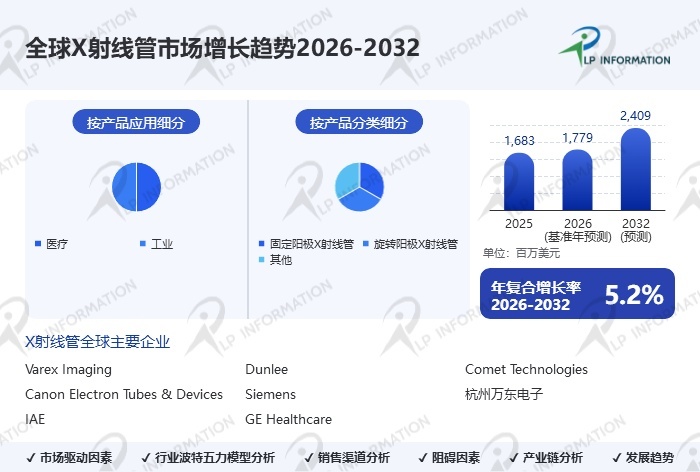
X-ray tubes, as core components in medical imaging and industrial non-destructive testing (NDT), are benefiting from the high-precision diagnostic demands driven by global aging populations and the rising quality control standards in manufacturing. According to LP Information, the global market size was approximately $1.683 billion in 2025 and is projected to reach $2.409 billion by 2032, with a CAGR of 5.2% from 2026 to 2032. Despite challenges such as high manufacturing costs, complex process barriers, and strict radiation safety regulations, the industry maintains robust growth driven by medical equipment upgrades and the widespread adoption of industrial flaw detection. Leading companies like Varex Imaging and Canon are set to continue dominating the rotating anode and high-end medical tube markets through technological iteration and supply chain integration, while accelerating penetration into emerging markets.
2. Industry Overview
An X-ray tube consists of a glass or ceramic envelope housing a positive electrode (anode) and a negative electrode (cathode), evacuated to an ultra-high vacuum. The cathode filament emits electrons that are accelerated by the tube voltage to strike the anode target, converting part of their energy into X-rays. They are categorized into medical and industrial types. In terms of market size, the global market was valued at approximately $1,683 million in 2025 and $1,779 million in 2026, expected to reach $2,409 million by 2032, representing a CAGR of 5.2% from 2026 to 2032. Global production reached 434,800 units in 2025, with an average gross margin of about 30%. As an indispensable component for medical devices and industrial inspection, its market is propelled by the demand for high-precision imaging and advancements in NDT technology, while also being constrained by technical costs and radiation safety requirements.
3. Product Classification
X-ray tubes are primarily classified into fixed anode, rotating anode, and other types based on product type. Fixed anode tubes feature simple structures and lower costs, making them suitable for low-power industrial inspections and portable equipment. Rotating anode tubes disperse heat through high-speed rotation, supporting higher power and smaller focal spots, making them the mainstream choice for high-end medical CT scanners and high-precision industrial flaw detection. Based on cooling methods, they are divided into oil-cooled, air-cooled, and other types. Oil-cooled tubes offer high heat dissipation efficiency, suitable for long-duration, high-load operations, while air-cooled variants are often used in lightweight scenarios. Sales models include complete machine matching and after-sales replacement. The after-sales replacement market continues to expand with the increasing installed base of medical equipment globally, becoming a significant profit source for manufacturers.
4. Application Areas
X-ray tubes are mainly applied in two major fields: healthcare and industry. In healthcare, they are widely used in CT, DR, mammography, dental, and interventional therapy equipment. With population aging and the development of precision medicine, the demand for high-definition, low-dose imaging continues to rise. In industry, they are primarily used for NDT, material analysis, and security screening in aerospace, automotive manufacturing, and electronics semiconductors. The stringent quality control requirements of Industry 4.0 have promoted the adoption of high-precision, high-reliability X-ray tubes for inspecting complex structural components.
5. Competitive Landscape (Companies)
The global X-ray tube market is highly concentrated, with key players including Varex Imaging, Canon Electron Tubes & Devices, IAE, Dunlee, Siemens, GE Healthcare, Comet Technologies, Hangzhou Wandong Electronics, and Kailong Medical Equipment.
Industry Dynamics: Varex Imaging, a global independent giant in X-ray tubes, has recently continued to ramp up CT tube capacity and advance liquid metal bearing technology iterations to extend tube lifespan. Canon and Siemens dominate the high-end medical imaging complete machine matching sector, continuously launching rotating anode tubes with high heat dissipation rates. Domestic companies like Hangzhou Wandong Electronics and Shanghai Chaoqun are accelerating the domestic substitution of CT tubes and industrial micro-focus tubes. Facing tariff policies and supply chain challenges, leading enterprises are consolidating competitive barriers through global capacity layout and self-research of core materials.
6. Global Regional Market Analysis
The global X-ray tube market shows a pattern where Europe and the US dominate the high-end segment, while Asia-Pacific leads in growth rate. The Americas region (especially the US), backed by a developed healthcare system and aerospace industry, holds the main share of high-value-added tubes. The European region (Germany, France, UK, etc.), driven by strict medical standards and high-end manufacturing, sees stable demand. The Asia-Pacific region (China, Japan, South Korea, India, etc.), due to healthcare infrastructure expansion and manufacturing upgrades, has become the fastest-growing market, with significant progress in China's domestic substitution. The Middle East and Africa regions have a small base but possess growth potential driven by the popularization of medical equipment and security needs. There are distinct differences among regions in technical barriers, price sensitivity, and competitive environments.
7. Supply Chain Analysis
Upstream Raw Materials: Mainly include high-melting-point metal targets (such as tungsten, molybdenum), cathode filament materials, high-purity ceramic or glass envelopes, vacuum seals, and bearings. The purity and processing precision of core materials directly determine the tube's focal spot size, thermal capacity, and service life.
Midstream Manufacturing: Covers complex processes such as vacuum encapsulation, anode target disk welding, dynamic balance debugging, and exhaust aging. Midstream manufacturing must solve engineering challenges related to maintaining high vacuum, high-temperature heat dissipation, and rotary sealing. It features extremely high technical barriers and capital thresholds, requiring strict medical or industrial safety certifications.
Downstream Applications: Cover complete machine manufacturers and end-user hospitals in medical imaging, as well as industrial NDT system integrators, airlines, and manufacturing enterprises. Related services include complete machine matching installation, regular tube maintenance, and after-sales replacement.
8. Drivers, Restraints, and Future Trends
Drivers: 1. Intensifying population aging and growing demand for medical imaging diagnostics; 2. Improved quality control and NDT standards in industrial manufacturing; 3. Perfection of healthcare infrastructure in emerging markets and the popularization of security equipment.
Restraints: 1. Complex manufacturing processes and high R&D and maintenance costs limit adoption by SMEs; 2. Strict radiation safety regulations result in high compliance costs for usage and disposal; 3. Uncertainty brought by supply chain and tariff policy changes.
Future Trends: 1. Evolution towards high-power, micro-focus, and long-life rotating anode technologies; 2. Accelerated domestic substitution of high-end components like CT tubes; 3. Enhanced heat dissipation and imaging accuracy through the application of liquid metal bearings and new target materials.
9. Conclusion
The global X-ray tube market is in a period of steady growth, with a projected CAGR of 5.2% from 2026 to 2032. As a core component in medical imaging and industrial inspection, its development is driven by the dual forces of high-precision imaging demand and the widespread adoption of NDT. Despite challenges such as high manufacturing costs, strong technical barriers, and radiation safety regulations, leading companies like Varex and Canon, along with domestic substitution manufacturers, will jointly drive the market towards $2.409 billion under the dual-wheel drive of rotating anode technology upgrades and the complete machine matching and after-sales replacement markets.
10. Frequently Asked Questions
Q1: What is the global X-ray tube market size and growth rate?
A: According to LP Information data, the global market size was approximately $1.683 billion in 2025 and is expected to reach $2.409 billion by 2032, with a Compound Annual Growth Rate (CAGR) of 5.2% from 2026 to 2032.
Q2: What are the main product classifications of X-ray tubes?
A: Classified by product type into fixed anode, rotating anode, and others; by cooling method into oil-cooled, air-cooled, and others; and by sales model into complete machine matching and after-sales replacement.
Q3: Who are the major global X-ray tube companies?
A: Mainly including Varex Imaging, Canon Electron Tubes & Devices, IAE, Dunlee, Siemens, GE Healthcare, Comet Technologies, Hangzhou Wandong Electronics, etc.
Q4: What are the core application areas of X-ray tubes?
A: Primarily applied in medical diagnostic equipment such as CT and DR, as well as in industrial sectors including aerospace, automotive manufacturing, semiconductor NDT, and security screening equipment.
11. Source Description
The data and information in this article are excerpted from LP Information's "Global X-ray Tube Market Growth Trend 2026-2032", as well as public materials from company websites (such as Varex, Canon, etc.), official industry associations, and news media. Core data such as market size, production volume, gross margin, and enterprise lists are all sourced from LP Information research reports; the analysis regarding US tariff policies and supply chain resilience refers to publicly available macroeconomic and trade information. Any reference to other public data has been explained in the text.
The copyright of this article belongs to the original author/organization.
The views expressed herein are solely those of the author and do not reflect the stance of the platform. The content is intended for investment reference purposes only and shall not be considered as investment advice. Please contact us if you have any questions or suggestions regarding the content services provided by the platform.