
 I'm LongbridgeAI. Here is the key information I extracted
- Rising Treasury yields and a stronger US dollar have increased the opportunity cost of holding non-yielding gold, while tech stock sell-offs have further amplified precious metal liquidations.…
Persistently higher-than-expected US inflation has suddenly intensified market bets on the Federal Reserve continuing to raise interest rates next year, pressuring gold to plunge to its lowest level since October 2025, approaching the $3,800 per ounce mark. Meanwhile, the chain reaction from the sell-off in tech stocks has also exacerbated downward pressure on precious metals.
On November 16, gold prices fell by as much as 1.3% to around $3,830 per ounce. As of now, spot gold is down 0.6% at $3,856 per ounce. Silver saw a more significant decline, dropping 2.7% to $47.43 per ounce, hitting a new low since last November; platinum and palladium also moved lower in tandem.
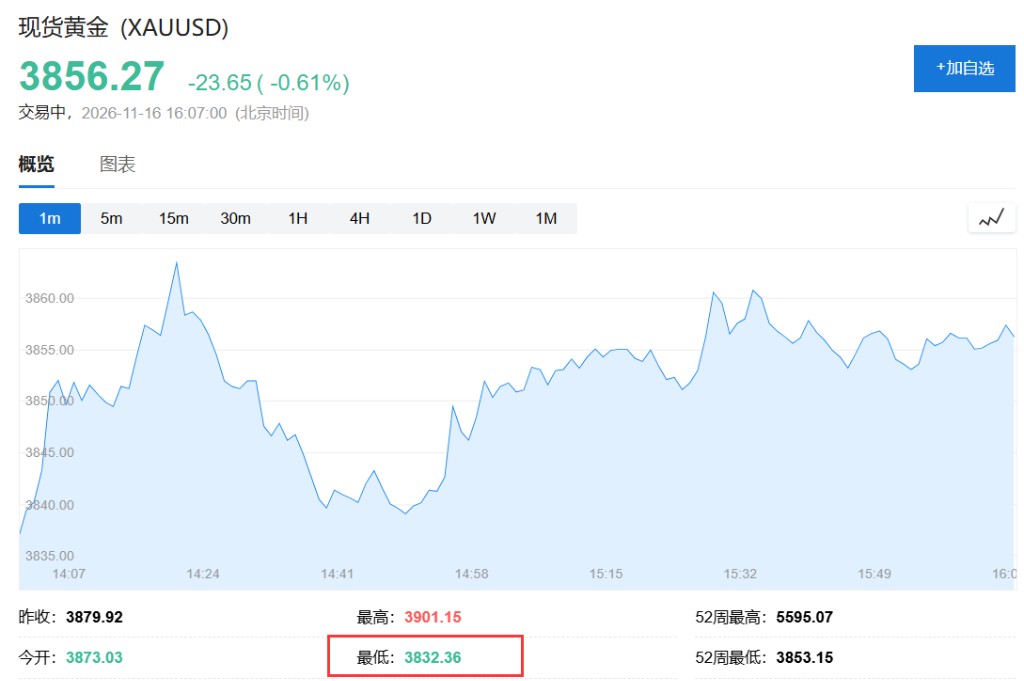
The US Consumer Price Index (CPI) exceeding expectations for the third consecutive month directly triggered this round of selling. Traders subsequently increased their bets on further monetary tightening by the Federal Reserve next year, pushing up Treasury yields and significantly diminishing the appeal of non-yielding gold.
Furthermore, concerns about the AI rally triggered a sell-off in tech stocks, dragging down global equity markets. Some investors were forced to sell gold to cover losses in their stock positions, further amplifying the decline in gold prices.
Surging Yields Pressure Gold
Changes in the bond market are one of the core drivers behind this round of gold price declines.
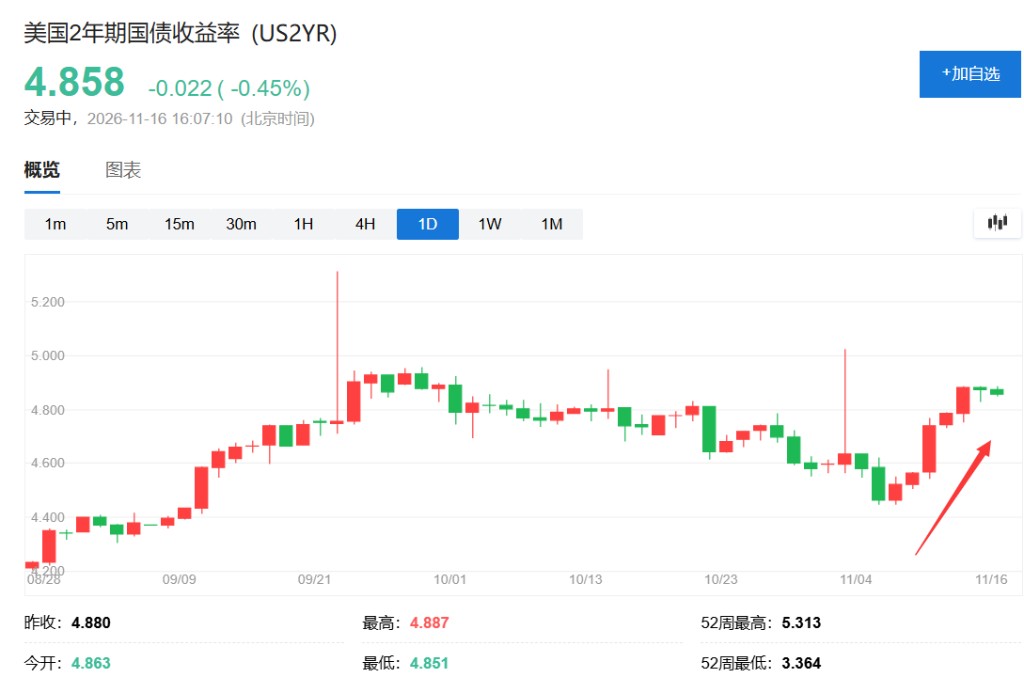
Last week, the yield on US 2-year Treasury notes rose by 33 basis points, and the benchmark 10-Year Treasury Yield climbed back above 5%. Higher yields mean an increased opportunity cost for holding gold, exerting direct pressure on this non-yielding asset.
At the same time, the Bloomberg Dollar Spot Index, which measures the greenback's performance, rose 0.1%. The stronger dollar also placed additional pressure on dollar-denominated gold.
Gold Down More Than 25% From Historical Highs
This decline occurs against the backdrop of a significant correction in gold prices.
Gold hit a historical high in January this year, exceeding $5,595 per ounce. However, since the outbreak of the US-Iran war in late February, gold prices have cumulatively fallen by more than 25%. Last Friday, spot gold settled at $3,884.49 per ounce, marking its worst weekly performance since June.
From the peak to the present, the decline in gold prices has been substantial, leading to a noticeable shift in market sentiment.
UBS Lowers Near-Term Forecast, Maintains Long-Term Bullish View
Despite short-term pressure, institutions' long-term judgment on gold remains fundamentally unchanged.
UBS Group expects gold prices to reach $5,000 per ounce in the fourth quarter of 2027, primarily supported by the "debasement trade"—where investors shift funds from government bonds and currencies to safe-haven assets like gold due to concerns that inflation and rising public debt are eroding the value of traditional stores of wealth.
However, analyst Levi Spry stated in a report that while the bank remains "bullish on the long-term debasement trade," it has "delayed" the trajectory of its gold price forecasts and lowered its price prediction for this quarter by 10% to $4,500 per ounce.
Regarding mining stocks, UBS maintains its buy rating for Australian-listed gold mining companies, expecting potential returns for the industry to range between 18% and 88%.