
 I'm LongbridgeAI. Here is the key information I extracted
- Although third-quarter revenue is projected to reach approximately 109 billion US dollars with strong fundamentals, market sentiment remains pressured by uncertainties surrounding future guidance, leadership succession, and export controls.…
NVIDIA is scheduled to release its quarterly earnings report on Tuesday local time (early Wednesday Beijing time), but this time, the numbers themselves have taken a back seat. Jensen Huang's sudden departure has pushed what would have been a routine earnings announcement into one of the most watched moments on Wall Street in decades—what the market truly wants to know is whether NVIDIA, without him, can continue the grand narrative about AI.
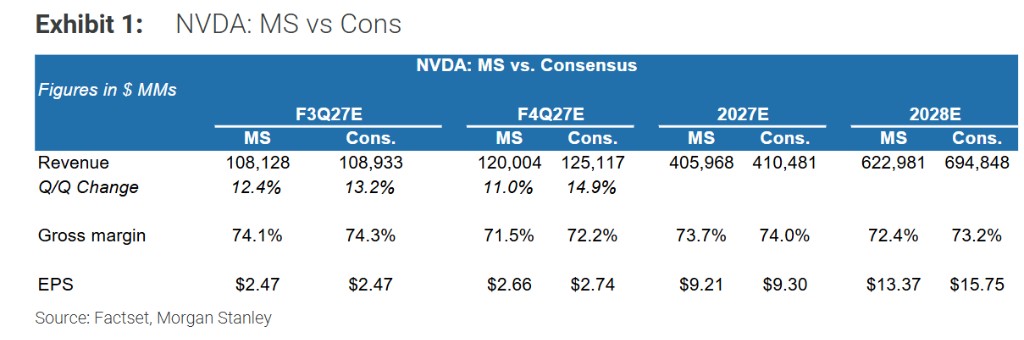
The market expects NVIDIA's third-quarter revenue to reach $109 billion, with earnings growing by 90%.
Jensen Huang resigned as President, CEO, and board member of NVIDIA on November 12, following an investigation by the company's board into an extramarital affair, which was followed by reports of two other extramarital affairs involving NVIDIA employees. The company subsequently appointed Chief Financial Officer Colette Kress as interim CEO, but a permanent successor remains undecided.
Since the news broke, NVIDIA's stock price has fallen approximately 22% cumulatively since October 29, and about 25% over the past month, with its valuation dropping to a 15-year low, trading at only about 11 times forward earnings.
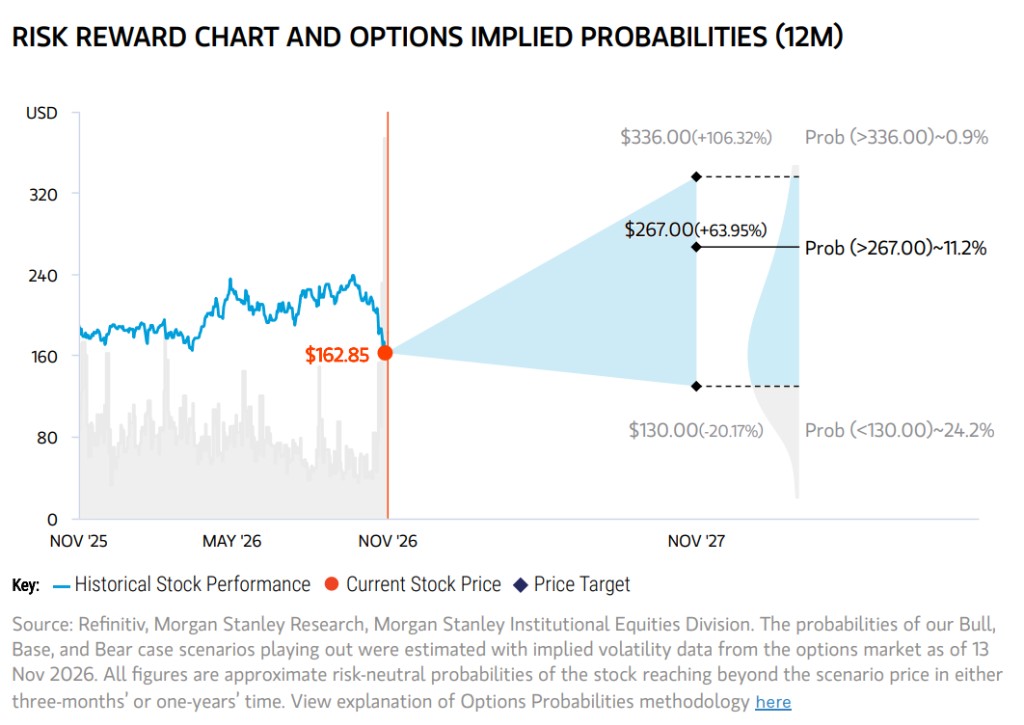
Against this backdrop, HSBC downgraded NVIDIA's rating from "Buy" to "Hold," slashing the Price Target from $365 to $170; Morgan Stanley maintained its "Overweight" rating with a Price Target of $267, but admitted uncertainty about whether the company will provide guidance for the next fiscal year in this earnings report.
Morningstar analyst Brian Colello stated bluntly, "We would be shocked if NVIDIA misses expectations or provides weak guidance," but he also pointed out that the fundamentals for this quarter are "somewhat secondary."
Strong Performance Expected, but Guidance Remains Uncertain
From a purely financial perspective, there is no suspense regarding NVIDIA's fundamentals for this quarter.
HSBC expects NVIDIA's third-quarter revenue (for the period ending October 2026) to be $113 billion, exceeding the midpoint of management's guidance of $108 billion and market expectations. Non-GAAP earnings per share are projected at $2.55, approximately 3% higher than the consensus estimate.
Morgan Stanley also indicated that its channel checks show business remains strong, with supply still unable to meet demand even though some projects in Southeast Asia have slowed down.
However, the market is more concerned with whether the company can reiterate the medium-to-long-term targets previously released under Jensen Huang's leadership—including the FY2028 revenue growth guidance of approximately 70%, and the forecast of nearly 100% year-over-year growth in customer demand.
Morgan Stanley noted that its current forecast for FY2028 revenue growth is 52%, lower than the company's 70% guidance. It believes this figure already fully reflects downside risks, but given the appointment of an interim CEO and other uncertainties, it remains unclear whether the company will provide guidance for the next fiscal year in this earnings report. D.A. Davidson analyst Gil Luria stated that management is likely to remain cautious and restrained when responding to questions related to Jensen Huang.
Succession Issue Dominates Market Sentiment, Valuation Reset Not Yet Over
Jensen Huang's departure holds significance for NVIDIA far beyond a typical CEO change.
Over the past thirty years, he transformed NVIDIA from a startup concept in a California restaurant into a core AI infrastructure enterprise with a market capitalization exceeding $4 trillion. His foresight on technology trends and flat management style shaped the company's unique competitive advantages—according to an HSBC report, Jensen Huang directly managed over 60 direct reports, with many decisions made personally by him.
After Colette Kress took over as interim CEO, the long-term succession plan remains unclear, and NVIDIA's board has initiated a search for both internal and external candidates.
HSBC believes that there is limited room for stock price revaluation until a permanent successor is identified and demonstrates the ability to execute the existing product roadmap. The bank significantly lowered its target P/E ratio from 25x to 11x (aligning with the current valuation trough) and explicitly stated that the formal CEO transition and related organizational structure adjustments are not expected to have a substantial impact on the company's product development or competitive position before 2028.
Siebert Financial Chief Investment Officer Mark Malek stated, "'Interim' means the real decision has not yet arrived, the investigation is ongoing, and thus Tuesday's earnings call has become the most important in the company's history."
Three Core Issues: Demand, Supply, and Export Controls
In addition to the succession issue, analysts and investors will focus on three aspects.
AI Demand and Financing Prospects: Morgan Stanley pointed out that after the midterm elections, the Democratic Party achieved victories on several anti-data center platforms, leading to a significant rise in concerns about land, power, and infrastructure bottlenecks. SoftBank (a partner in NVIDIA's PORTS-Pike project) has already recorded a $3.7 billion impairment on power equipment. Furthermore, emerging cloud computing companies such as CoreWeave, Nebius, and IREN have collectively guided for approximately $100 billion in capital expenditures for 2027, but their combined market capitalization has shrunk by about $38 billion in the past month. The tightening financing environment poses potential risks to NVIDIA's long-tail customer base.
Rubin Platform Mass Production Progress: This quarter marks the first large-scale shipment of products based on NVIDIA's Rubin architecture, previously expected to account for about 20% of data center revenue (approximately $20 billion). Morgan Stanley noted that key testing partner KYEC has lowered its performance guidance for two consecutive quarters, partly due to Rubin's ramp-up being slower than expected, but analysts believe this will not significantly impact NVIDIA's revenue recognition for this quarter.
Export Control Risks: HSBC conducted a sensitivity analysis on this. Based on regional revenue distribution over the past six quarters, the US accounted for approximately 69%, while other countries and regions accounted for about 31%. If a comprehensive export ban were implemented on other regions (resulting in a loss of about 11% of revenue), HSBC estimates that FY2028 earnings per share would drop by approximately 13% compared to the baseline scenario. In a bear case scenario, earnings per share would be $13.57, about 14% lower than the current market consensus.
Cautious Wording in the Conference Call, Unlikely to See "Sparks"
Several analysts expect this conference call to be the most watched in NVIDIA's history, but the actual amount of information may be disappointing.
StoneX analyst Cody Acree stated, "Attention will obviously be higher, but I don't think there will be more substantive content to discuss; they will not respond to specific details regarding Jensen Huang's resignation." Interactive Brokers Chief Strategist Steve Sosnick warned, "There are countless uncomfortable questions that could be thrown at NVIDIA, and wrong answers will be punished."
It is worth noting that Jensen Huang did not typically give an opening statement on earnings calls, but he actively participated in the Q&A session and was known for his signature macro narrative on the transformative impact of AI. Morgan Stanley pointed out that under the new management structure, such broad expressions of AI enthusiasm may marginally converge.
Gabelli Funds Portfolio Manager Hendi Susanto held a relatively optimistic stance, believing that NVIDIA no longer relies solely on one executive. "The culture of rapid innovation he created has been integrated into NVIDIA's engineers and product roadmap. At least for the next two years, we do not see a major impact on NVIDIA's roadmap."