
 I'm LongbridgeAI. Here is the key information I extracted
- The court found that plaintiffs plausibly stated claims under the Sherman Act, pointing to synchronized production cuts, simultaneous exits from DDR4, and identical customer review questionnaires.…
A federal judge ruled that a class action lawsuit accusing the three major memory chip manufacturers of conspiring to restrict supply can proceed. This decision will force Samsung, SK Hynix, and Micron to disclose internal documents, providing a new legal footnote to ongoing market concerns about the abnormal surge in memory prices.
On November 14, Noël Wise, a judge in the US District Court for the Northern District of California, denied the joint motion to dismiss filed by the three defendants, ruling that the plaintiffs' complaint sufficiently stated claims of conspiracy in violation of Section 1 of the Sherman Act. The three companies must file their answers by December 7, after which the case will enter the discovery phase. This marks the most significant procedural victory for the plaintiffs to date.
The macroeconomic significance of this case far exceeds that of typical antitrust litigation.
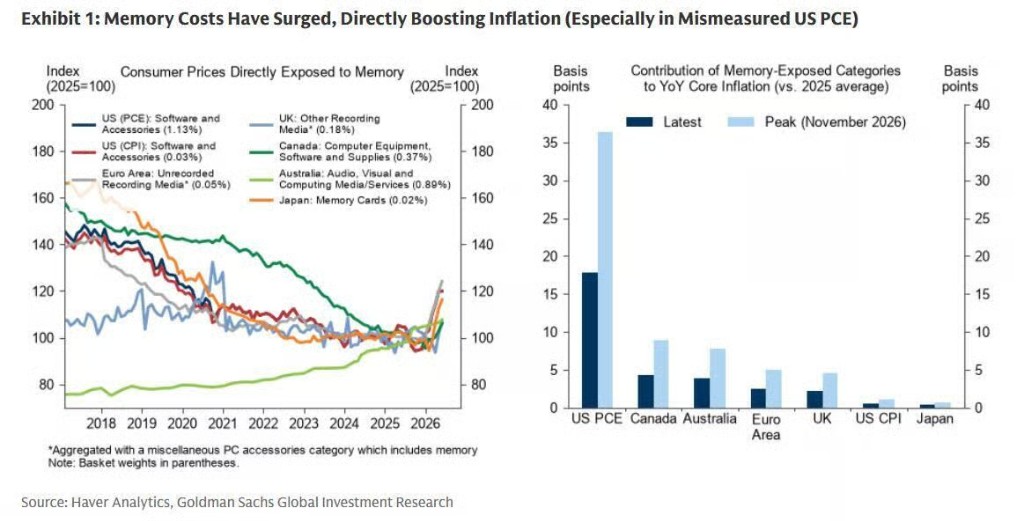
According to calculations by Goldman Sachs economist Megan Peters, AI-driven increases in memory, software, and electricity prices have added more than 0.2 percentage points to core PCE, and are expected to contribute a cumulative 0.5 percentage points by year-end. Meanwhile, standard DRAM prices have cumulatively risen 697% over 18 months, with the three defendants collectively accounting for over 91% of global DRAM revenue.
Judge Identifies "Eagle Formation Flying," Rejects "Repeat Litigation" Defense
This case was filed on June 25, 2025, by 17 plaintiffs under the name Garciaguirre v. Samsung Electronics. The plaintiffs include 14 consumers and three small PC manufacturers, representing all indirect purchasers who bought devices containing commercial DRAM. Their claims include class certification, injunctive relief, and treble damages.
The core defense strategy of the three defendants relied on citing precedent.
A similar lawsuit regarding the price surge from 2016 to 2018 was dismissed in 2020, a decision upheld by the Ninth Circuit Court of Appeals in March 2022. The court reasoned that simultaneous production cuts by three competitors constituted normal parallel conduct in an oligopolistic market and did not constitute evidence of conspiracy. During hearings in September, the defendants argued that the new complaint was merely the same conspiracy theory dressed in AI clothing, asserting that each company's decisions to cut production, shift to High Bandwidth Memory (HBM), and exit DDR4 were independent profit-seeking choices.
Judge Wise did not accept this argument. In her ruling, she explicitly pointed out substantial differences between this case and the circumstances involved in the Ninth Circuit's 2022 decision, and refused to dismiss the lawsuit.
During the hearing, the defendants cited the late Judge Richard Posner's assertion that it is normal for competitors in an oligopoly to observe each other. Wise responded that the behavior described by the plaintiffs was "more like eagles flying in formation"—and formation flying is not a natural habit of eagles. The implication of this statement is that while monitoring competitors' moves is legal, synchronized actions and an eightfold price increase over three years require an explanation.
Seven "Plus Factors" and a Highly Similar Customer Review Questionnaire
Since parallel conduct itself is legal, the plaintiffs must prove "plus factors," meaning actions that no rational business would take alone unless it knew competitors would do the same. The key timeline outlined in the complaint is as follows:
The three companies announced production cuts successively between late 2022 and 2023, with SK Hynix and Micron about three weeks apart, followed by Samsung; subsequently, all three shifted capacity to HBM and signed long-term supply contracts; in the second quarter of 2025, all three announced their exit from mainstream DDR4 within the same quarter; in December 2025, Micron announced the closure of its consumer memory brand, Crucial; and in January 2026, the three companies launched customer review questionnaires with highly similar content.
Judge Wise evaluated these factors one by one. She excluded allegations related to DDR3 (as Micron still produces DDR3), gave little weight to comments made on investor conference calls and at industry meetings, and determined that the oligopolistic market structure itself is a neutral factor. She also ruled that simply shifting to HBM was insufficient to prove conspiracy, given HBM's higher profit margins.
What truly concerned the court were the following points: First, despite significant room for price increases, none of the three companies substantially expanded standard DRAM capacity, with Samsung and Micron reportedly delaying or suspending new fab construction; Second, all three signed multi-year HBM contracts with AI customers, while Samsung and SK Hynix reportedly refused to offer long-term contracts to large standard DRAM buyers; Third, the simultaneous exit from DDR4 in the same quarter and Micron's abandonment of the Crucial brand remained insufficiently explained by the defendants; Fourth, the highly similar customer review questionnaires launched in January 2026 were the most concerning aspect for the court, with Wise stating that this allegation "strongly supports a reasonable inference of conspiracy."
The court also rejected the defendants' argument that the 1998–2002 cartel case was too old to be relevant. That case ended with plea agreements, imprisonment for several executives, and total fines of approximately $731 million paid by the three companies, with Micron receiving immunity for reporting its co-conspirators.
Soaring Memory Prices Have Become a Macro Variable; Goldman Sachs Expects New Supply Unlikely Before 2028
The widespread market attention on this case stems from the fact that the abnormal trend in memory prices has permeated the macroeconomic level.
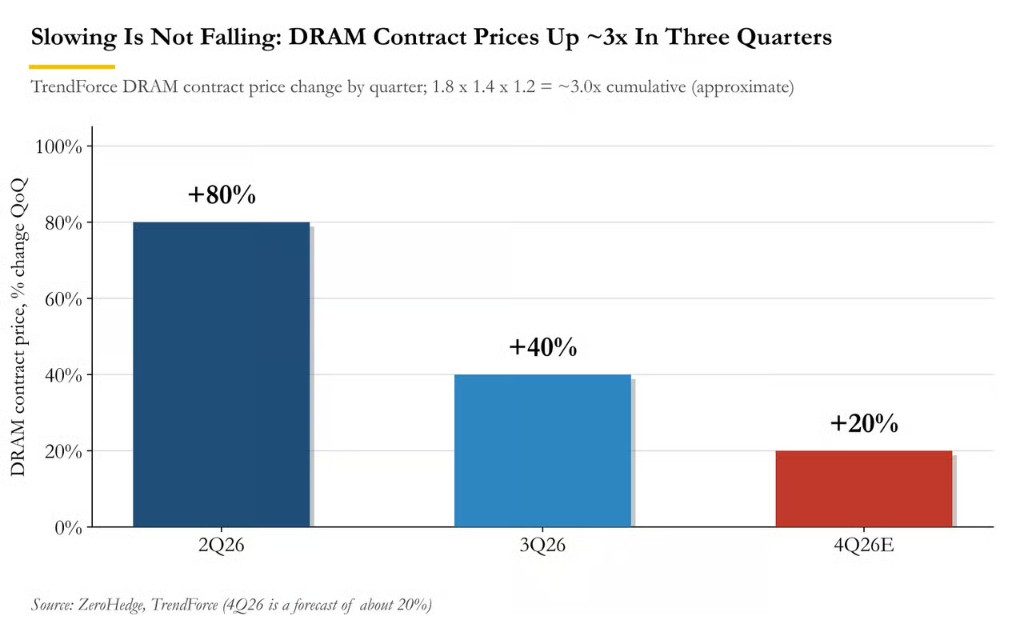
According to data from Goldman Sachs' Korea Technology Team (led by Giuni Lee), South Korea's DRAM exports hit a record high in October, reaching $34 billion, a year-on-year increase of 595%. Total memory exports grew by 359% year-on-year, marking the ninth consecutive month with growth exceeding 200%. TrendForce data shows that contract prices rose by about 80% in the second quarter, 40% in the third quarter, and about 20% in the fourth quarter. The latest forecasts for PC DRAM and server DRAM are +13% to 18% and +10% to 15%, respectively.
After hosting a TrendForce roadshow on October 27, Goldman Sachs maintained its buy ratings for Samsung and SK Hynix, predicting that meaningful capacity increases will be difficult to achieve before 2028. This judgment is relevant to both sides of the lawsuit: the defendants will use it to prove the long cycle of fab construction and limited cleanroom space, while the plaintiffs will question why none of the three companies broke ground in 2024 when prices began to surge first.
Demand-side shocks are also significant. Citi expects PC shipments to decline by 15% and smartphone shipments by 12% this year. According to Goldman Sachs' Korea team, Alibaba, Tencent, and ByteDance have sought to sign 10-year server DRAM contracts with Samsung and SK Hynix—a move that itself reflects a severe imbalance in market supply and demand.
Discovery Phase Begins; Chinese Competitors May Provide Supply-Side Relief Before the Court Does
Regarding subsequent proceedings, the defendants must file their answers by December 7, with the first case management conference scheduled for January 12, 2027. The case will then enter the discovery phase, which the defendants have strived to avoid, involving emails, chat records, and the document trail behind the three customer review questionnaires. In the 2000s case, it was internal documents and Micron's cooperation with the investigation that ultimately laid the foundation for the charges.
However, two points warrant cautious expectations. First, the standard of review at the motion to dismiss stage is merely "plausibility." If this case eventually reaches a verdict, the same Ninth Circuit Court will intervene again for review. Second, even if the plaintiffs win, the antitrust process spans years, offering no immediate relief for current price levels or consumers. In terms of deterrence, the total fines in the 2000s cartel case amounted to $731 million, whereas SK Hynix's operating profit for a single quarter is reported to have reached approximately 77 trillion Korean won.
Substantial relief on the supply side may come from outside the courtroom first. Acer's CEO has stated that supply shortages have eased as Chinese memory manufacturer Changxin Technology ramps up capacity. TSMC is also reportedly exploring entry into the memory sector. Goldman Sachs expects Changxin Technology's DRAM output to reach half of SK Hynix's by 2028.
For memory stocks currently trading at 2 to 4 times forward earnings, a federal judge's finding that collusion is "plausible" provides a new dimension for interpreting market doubts about their excess profitability.
Goldman Sachs TMT expert Peter Callahan pointed out that while memory stock valuations are extremely low, the market is increasingly concerned about their "excessive profitability." Low P/E ratios in cyclical stocks serve as arguments for both bulls and bears. The DRAM spot price index has climbed from less than $5 at the end of 2024 to about $53, while the forward P/E ratios for Micron, Samsung, and SK Hynix have fallen to 3.8x, 2.6x, and 2.2x, respectively.