
 I'm LongbridgeAI. Here is the key information I extracted
- Anthropic prepared for its massive upcoming IPO on the Nasdaq, aiming to raise up to $64.4 billion amid heavy institutional demand.…
NVDA earnings are out – what did we learn?… Huang’s comeback push fizzles… what’s changed in Luke’s overall AI picture… Anthropic’s IPO test arrives on Thursday
Today, Nvidia (NVDA) reports its first earnings since Jensen Huang stepped down.
If you’re reading this around 5 PM ET, the numbers should be out, and the call – led by interim CEO Colette Kress – should be getting underway.
I’m writing ahead of the release, so we’ll dive into the results tomorrow. But the numbers are only part of the story.
Here’s our technology expert, Luke Lango of Innovation Investor, with what else he’s listening for:
The questions that matter most here: Are customers changing order volumes? Are delivery schedules slipping? Is pricing holding?
And what does management see beyond the next few months – especially on the Megaspeed and Singapore revenue questions hanging over the stock?
Beyond these questions, there’s also the one of leadership – who takes over the reins full-time?
Yesterday, the rumor mill was working in overdrive…
Is a Huang comeback a real possibility?
Over the last 48 hours, we’ve seen a growing campaign to bring Huang back.
According to Bloomberg, yesterday, President Donald Trump told reporters, “I would not mind that,” adding, “A lot of people are asking Jensen, they think Jensen should go back. That certainly isn’t a bad idea.”
Meanwhile, a “Stand With Jensen” petition had gathered 175,000 names as of Monday morning, per The Wall Street Journal – though some people say their names appeared without their having signed.
Not everyone agrees. Treasury Secretary Scott Bessent wants an outside CEO and says, “We need answers in the next 10 days.”
For now, it appears the likelihood of a Jensen 2.0 tenure is fading, even though this afternoon Huang said he would return to Nvidia if asked by the board. Yesterday, CNBC reported that Nvidia’s board is not considering such action.
Legendary investor Louis Navellier has watched all of this with a raised eyebrow. Here he is on yesterday’s Prime Portfolio flash alert podcast:
The gossip here with NVIDIA has gone full circle, where now everybody’s calling for Jensen Huang to return to NVIDIA…
There’s just this whole saga. TMZ has invaded the financial news, and it’s really scandalous.
Looking beyond the gossip
While many headlines continue to focus on the scandalous side of the story, Louis has been zeroing in on the business underneath, and what tonight’s numbers will be:
Sales are still going to be up over 91%, earnings are going to be up over 90%. There’s a huge order backlog.
Shifting to the wider AI trade, Louis points to the potential fallout if Kress disappoints Wall Street on Nvidia’s financing of other AI companies:
She knows about all the orders and everything.
The main thing she has to do is be supportive of that circular financing that Jensen was doing – essentially supporting the customers to buy the chips.
And if she didn’t do that, that would be devastating.
Yesterday’s Digest touched on this risk, examining how AI companies that depend on such financing could face headwinds if the narrative shifts.
This is why Louis keeps returning to that same place – strong fundamentals:
Earnings remain ridiculous. P/E ratios are even more ridiculous…
Obviously, the strong sales and earnings growth remains in our AI- and data center-related stocks, as well as the energy stocks.
This emphasis on hard numbers is the idea behind Louis’ brand-new service, Prime Portfolio
Each month, he runs the market through his Stock Grader system, which scores more than 6,000 stocks from A to F, and distills the results into a portfolio of 25 of his highest-conviction picks.
The grades rest on eight fundamental yardsticks – sales growth, operating margin growth, earnings growth, earnings momentum, earnings surprises, analyst earnings revisions, cash flow, and return on equity – as well as how aggressively big institutions are buying.
Louis revisits the portfolio every month with updated buy, hold, and sell calls, so a stock that loses its edge can be swapped for a stronger one. That’s especially important in volatile markets like the one we have now.
If you missed last Thursday’s presentation, the free replay is right here.
What’s changed in Luke’s assessment of the AI sector
Last week, Luke put 65/35 odds on the Huang scandal being self-contained rather than the first crack in something bigger. But he named tripwires that could change his view, including this one:
Any sign of Justice Department or Commerce Department action on export controls changes our verdict fast.
Yesterday, the Commerce Department announced a rule requiring licenses for advanced chip exports to Singapore, Malaysia, Thailand, Indonesia and Brazil, aimed at stopping Chinese companies from renting Nvidia’s computing power through data centers in third countries. That’s a significant warning shot across the bow for Luke.
Meanwhile, yesterday, the research shop SemiAnalysis cut its 2027 AI capex forecasts, pointing to lower AI supply chain earnings.
Here’s Luke on the fallout, and what he expects from here:
The bad news: All the important technical levels are breaking in [yesterday’s] selloff… Things could get worse in the near term.
The good news: All of our work suggests that while things may very well get worse in the near term, this remains an AI Transition, not a breaking point, and the foundation is being built for a very durable, healthy, widespread AI bull market on the other side of it.
We maintain our outlook of short-term pain, long-term gain.
As Luke waits for the dust to settle in the AI sector, he’s eyeing opportunities outside AI, like healthcare, shipping and some software stocks. We’ll bring you more on this in a future Digest.
Remaining with AI, there’s another key event directly ahead that could impact your AI holdings…
All eyes now shift to Anthropic’s debut
The AI lab is set to price its IPO tomorrow and begin trading Thursday on the Nasdaq under the ticker ANT.
The terms are enormous: 825 million shares at $70 to $78, raising as much as $64.4 billion. With a concurrent private placement, Bloomberg says it would be the biggest listing of all time, and early demand is reportedly about six times the shares being offered.
Why does one IPO matter so much?
Because it’s arriving in an unsteady AI market where a single negative headline could trigger a fresh double-digit decline.
A strong debut – shares trading above the offer price – would suggest everyday market buyers will still pay up for AI exposure. A weak one – shares slipping below it – would suggest the demand was concentrated among the institutions and strategic backers who got in at the offer price but wasn’t broad enough to carry the sector.
That makes Thursday’s debut a barometer for AI sentiment – though not the pillar holding it up. That job still belongs to fundamentals, starting with Nvidia’s guidance tonight.
But there’s an interesting related wrinkle here…
Nvidia is expected to buy about $10 billion of Anthropic stock in the concurrent private placement. It’s another case of a supplier investing in a customer, the same kind of circular arrangement Louis flagged earlier.
A word of caution on hot IPOs
If you’re considering investing in Anthropic tomorrow, let’s revisit a caution I raised in a June issue of Investing Insider, the other InvestorPlace newsletter I helm. Historical data suggests you might want to think twice about buying a hot IPO right after its debut.
The research comes from Professor Jay Ritter of the University of Florida, widely regarded as the foremost academic authority on IPOs. His database covers 45 years and more than 9,300 offerings, and it’s the source material behind much of the IPO research produced by Wall Street’s biggest banks. Goldman cites it, JPMorgan cites it, and so does the SEC.
According to the data, the average IPO has closed its first day about 19% above its offer price. But that offer price goes to institutions – the mutual funds, hedge funds, and pension managers that the underwriting banks cultivate as clients.
Everyday investors like you and me typically buy after trading begins, at the market price, which means after that initial pop.
Ritter’s data show that investors who buy on the first day’s close have then trailed the market by roughly 20.5% over the following three years.
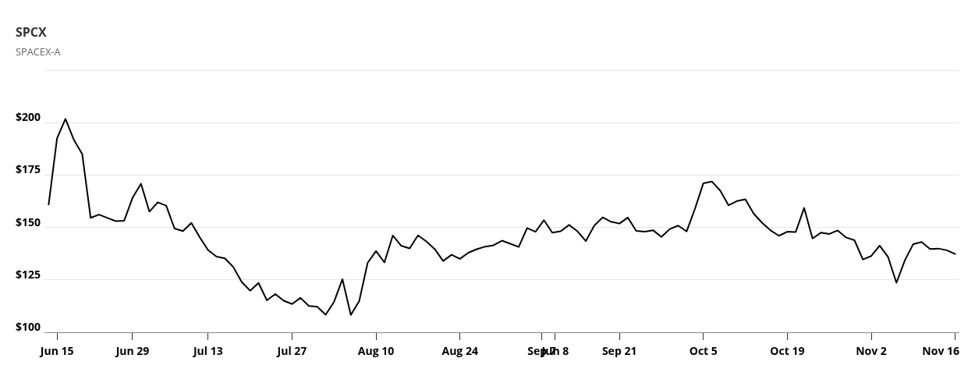
SpaceX offers a recent live example…
It priced at $135 in June and closed its first day at $161. On June 16, it hit a high of about $226.
Then it slid, dipping below its IPO price in mid-July and bottoming near $105 in early August – a drop of more than 50% from the peak.
It has since recovered, but at about $141 as I write on Tuesday, it’s only about 4% above its IPO price. Anyone who bought at that first-day close of $161 is still down about 12%.
To be fair, Ritter’s data also show that unprofitable IPOs overall have trailed the market by about 30.7% over three years, but large, high-revenue unprofitable IPOs have trailed by only about 2.7% – still underperformance, just far less severe. Anthropic, a large-revenue business, falls into that second group.
Overall, this isn’t a call on whether to buy ANT – just a reminder of what the historical data say about IPOs generally.
Before we wrap up, two related trivia questions
First, how many employees could Anthropic’s IPO turn into millionaires?
Got your answer?
About 4,250 of its roughly 5,300 employees – around 80% – according to an analysis by the financial platform Hill, which assumes a $1.5 trillion valuation. Estimates vary, and these are paper gains.
Second, what’s the projected overall average value of the stock that those employees will own?
Ready?
Somewhere around $36.6 million to $40.8 million per employee.
Not bad for a Thursday.
Have a good evening,
Jeff Remsburg